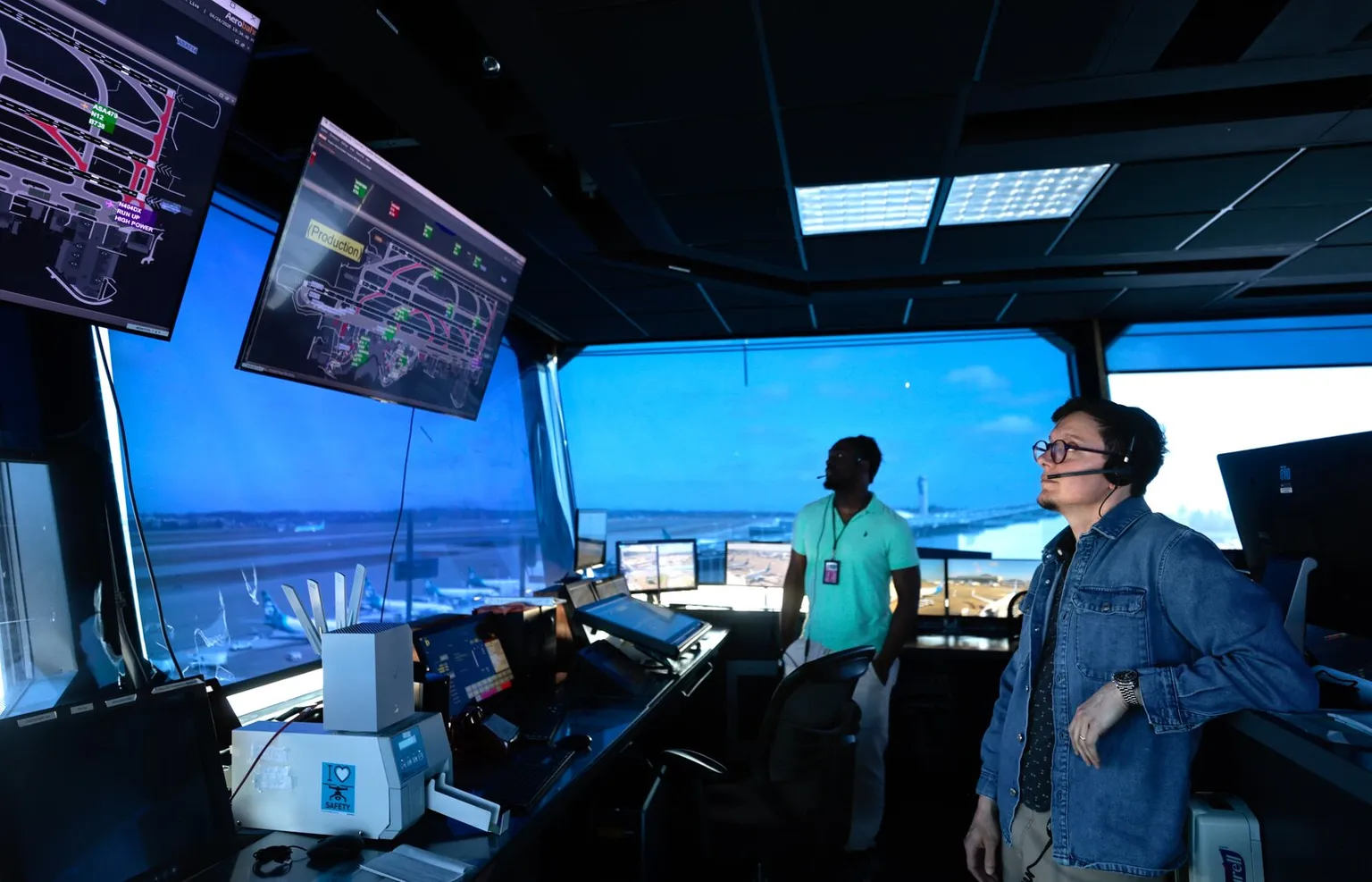
Ramp controllers Jamaal Surrell, center, and Daniel Pakulin monitor the movements of planes and vehicles from Seattle-Tacoma International Airport’s ramp control tower last month. Sea-Tac plans to add transponders and antennas that sync with the FAA’s system, giving air traffic controllers more visibility into vehicle movements. (Karen Ducey/ Seattle Times)Less
Seattle Times business reporter
After a plane collided with a fire truck at LaGuardia Airport in New York City, the head of the transportation safety board urged airports to equip their vehicles with more sophisticated tracking technology.
The fire truck involved in that collision, which killed two pilots, was not equipped with a tracking device, known as a transponder. Without it, air traffic controllers couldn’t pinpoint the location of the firetruck or several nearby vehicles waiting to cross the runway to respond to an emergency on another aircraft.
The controller, and the software system they relied on, couldn’t tell a collision was imminent, the National Transportation Safety Board said in a preliminary report last month.
At Seattle-Tacoma International Airport — a crowded airspace where nearly 1,200 planes take off and land every day — dozens of emergency-response and operations vehicles are already equipped with transponders, according to airport officials. But Sea-Tac is still taking steps to do more.
Those transponders feed data to the airport’s ramp control tower, which is owned and operated by the airport and supplements the work of air traffic controllers. The ramp tower monitors the airport surfaces that don’t fall under the Federal Aviation Administration’s purview.
The two towers use different platforms to collect data about what is happening on the ground, and the FAA’s air traffic controllers can’t tap into all of the information from the transponders already on Sea-Tac’s ground vehicles.
Sea-Tac plans to add transponders and antennas that sync with the FAA’s system, giving air traffic controllers more visibility into vehicle movements. The FAA issued an alert in May 2025 encouraging the use of transponders in all airport vehicles. Sea-Tac is still in the early stages of the process, officials said.
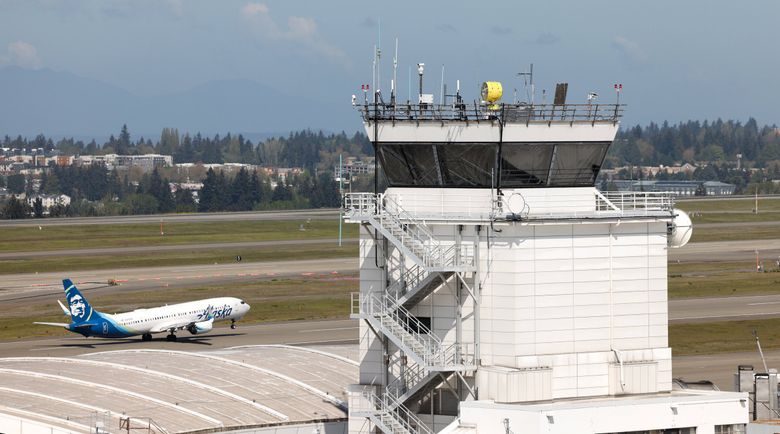
An Alaska Air plane takes off in front of the ramp tower at the Seattle-Tacoma International Airport last month. Nearly 1,200 aircraft take off and land at the airport every day. (Karen Ducey / The Seattle Times)
“It’s really unfortunate to see something that probably was preventable,” Wendy Reiter, Sea-Tac’s new managing director, said in a recent interview. “You always reflect on what if it had happened to us … and what could we do to make sure it doesn’t.”
Reiter and other airport officials emphasized that they could not speculate on the LaGuardia crash.
Though mishaps still happen — two Alaska Airlines planes clipped wingtips last May, and a taxiing plane struck a parked aircraft in February 2025 — Sea-Tac hasn’t seen a severe run-in in at least 25 years, according to FAA data. The February 2025 collision occurred in an area not monitored by the FAA.
The airport has reported “runway incursions,” a catchall term the FAA uses to describe incidents where an aircraft or vehicle is somewhere on a runway where it shouldn’t be. None of those came close to a collision or raised a safety concern, according to the FAA’s classification.
Sea-Tac, which is operated by the Port of Seattle, has an incredibly small footprint for the amount of air traffic it regularly sees. As demand for travel to and from the region grows, the airport can’t physically expand. That means the people orchestrating how planes and vehicles move around the crowded airport have a particularly intense scope of work, said Ed Appleberry, the airport’s ramp tower manager.
“Things happen very fast,” Appleberry said, standing in the shaded ramp control tower as he watched airplanes travel along the taxiway several feet below. “You’ve got to look out a few moves. If you don’t see the conflict until it’s happening, it’s too late.”
Inside the ramp control tower
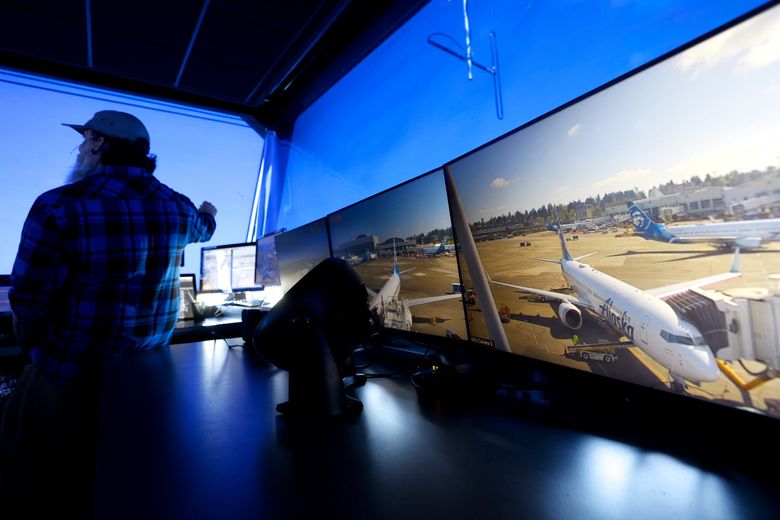
Ramp controller Johnny Hughes tracks the movements of planes parking at gates, sequencing and pushing back from the gates from the ramp tower at Seattle-Tacoma International Airport last month. … (Karen Ducey / The Seattle Times)More
Not every airport has a ramp control tower, while others have several, Appleberry said. Sea-Tac opened its ramp tower in 2006, setting up shop in the former FAA air traffic control tower to help the airport meet demand.
The two towers are in constant communication with one another and pilots operating in Sea-Tac’s airspace. Much of that used to happen through paper printouts and urgent phone calls; now they can communicate digitally, easing some of the workload for the stretched-thin ramp controllers, Appleberry said.
To enable that digital communication, Sea-Tac launched a high-tech Surface Airport Management System, or SAMS, about four years ago. It used a platform from Swedish defense company SAAB, called Aerobahn, and then added its own proprietary layers, including using artificial intelligence to track trends and predict delays.
The SAMS system compiles data from several sources to show ramp controllers what is happening on the ground and in the surrounding airspace. It taps into cameras and sensors at airport gates, flight software on planes in the air and publicly available flight data.
The color-coded system tracks planes as they are a few miles out from the airport and the gates where they are supposed to land. If a gate won’t be ready in time, the system changes the color of a box around the approaching plane, giving the ramp tower time to adjust.
The software platform also records what went on at the gate, so the airport can see what may be causing a bottleneck, from catering to baggage loading.
Inside the tower, ramp controllers monitor several screens displaying the SAMS system and listen to a steady stream of audio from air traffic controllers and pilots. They speak quietly into headsets, giving pilots the go-ahead to push back from the gate or enter the taxiway. They don’t have to stand up to do their job, but the best ones do, Appleberry joked.
There are usually four controllers on shift at a time — two monitoring the airport’s surfaces; one supervising, seated at a desk farther back in the tower; and another taking a break. They rotate positions every hour to stay alert.
From midnight to 6 a.m., when the airport is less busy, the ramp tower is staffed by just one controller.
Because the airport is so fast-paced and physically constrained, the Port requires its ramp controllers to have the same certifications as the FAA’s air traffic controllers. It’s the only airport with that requirement, Appleberry said.
Daniel Pakulin, a ramp controller at Sea-Tac, described the job as a mix of vigilance during slow periods and kicking it “into high gear when traffic picks up.” He’s had to learn how to work with each air traffic controller, and adapt to their personal style, as well as how to bargain with everyone who wants a spot at the crowded airport.
He’d like to work as an air traffic controller but has been in the FAA’s hiring pipeline for about three years. That’s something the federal administration has said it’s working to speed up, as the FAA struggles to hire, train and retain enough qualified air traffic controllers to staff the nation’s busiest airports.
In the meantime, Pakulin said he enjoys working at the ramp tower. It’s “extremely fun trying to adapt to the changes and optimizing the puzzle I am solving,” he said.
New equipment
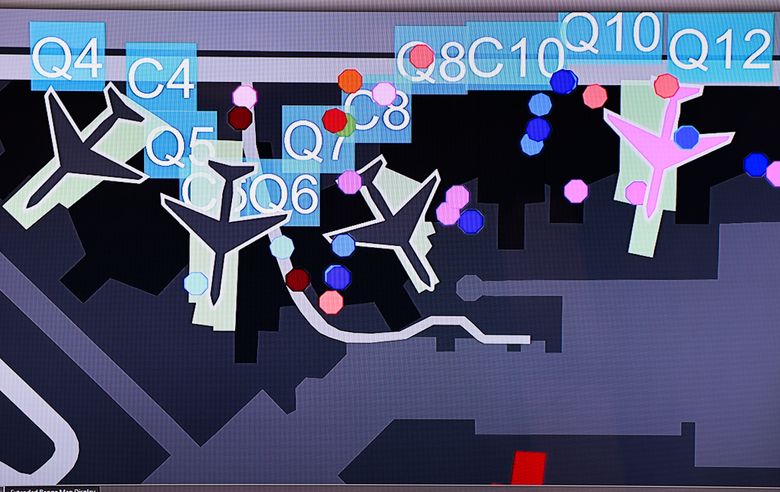
The Surface Airport Management System, seen on the screen, compiles data from several sources to show ramp controllers what is happening on the ground and in the surrounding airspace. (Karen Ducey / The Seattle Times)
In Sea-Tac’s other looming tower, the FAA’s air traffic controllers can see most of the data from the SAMS system, but it doesn’t automatically translate to its own monitoring system, according to Samer Tirhi, the airport’s aviation operations technology manager.
Air traffic controllers at Sea-Tac use their own system — called Airport Surface Detection Equipment, Model X, or ADSE-X — which relies on radar, sensors and satellites to track ground movement. That system is in use at 34 other airports, including LaGuardia, according to the FAA.
In the case of the deadly March collision, the ADSE-X system was unable to track all of the vehicles moving toward the runway; it detected only two radar targets rather than all seven vehicles, according to the NTSB. None of those vehicles had a transponder.
“Without transponder-equipped vehicles, the ADSE-X system could not uniquely identify each of the seven responding vehicles or reliably determine their positions, or tracks,” the NTSB wrote in its preliminary report. “As a result, the system was unable to correlate the track of the airplane with the track of (the fire truck) … and did not predict a potential conflict with the landing airplane.”
Sea-Tac installed transponders on about 60 emergency-response and operations vehicles around 2021, allowing ramp controllers to see exactly where vehicles are and identify them by type, according to Tirhi.
The airport is adding transponders and antennas to those same vehicles so the FAA’s ADSE-X system can use that data to more precisely track vehicles.
The airport is still in the procurement phase and hasn’t yet picked a contractor to provide the equipment, so it’s not clear how much it will cost, according to Port of Seattle spokesperson Perry Cooper. The airport is applying for funding from the FAA for the project, Cooper said.
Separately, Sea-Tac is piloting a new addition to its SAMS system to use cameras to track vehicles that are not equipped with transponders, but the project has been delayed for several years. Tirhi cited COVID-19 disruptions that delayed the installation of necessary hardware.
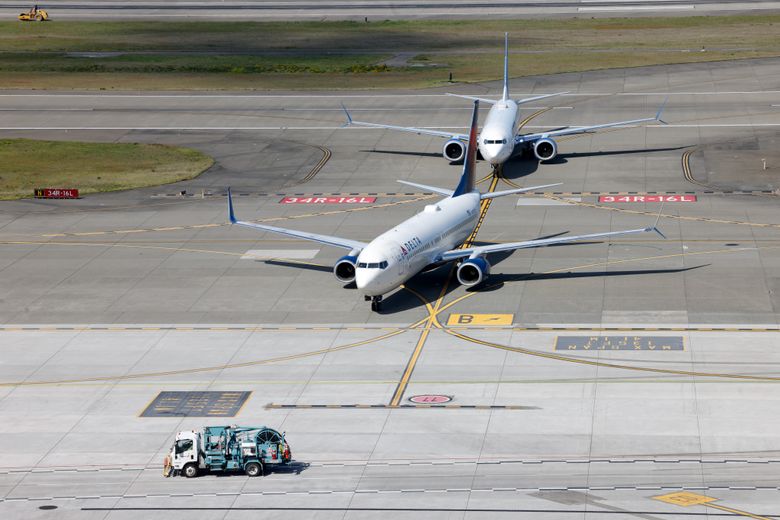
Airplanes taxi out of FAA-controlled airspace toward locally controlled airspace at the Seattle-Tacoma International Airport last month. Sea-Tac is piloting a new addition to its SAMS system to use… (Karen Ducey / The Seattle Times)More
Tirhi said the high-tech SAMS program has been crucial to keeping the airport running smoothly.
Because the airport can’t grow, it has to think about data solutions to give air traffic controllers and ramp controllers as much information as possible to predict and navigate when something unexpected happens. As he put it, “instead of buying pavement, because we can’t, we buy technology.”
Lauren Rosenblatt: 206-464-2927 or lrosenblatt@seattletimes.com. Lauren Rosenblatt is a Seattle Times business reporter covering Boeing and the aerospace industry.