Article Summary:
**Date:** May 19, 2026
**Present:** Vice Chair Brian Davis (presiding), Interim City Manager Bob Larson, Jeff Harbaugh, Luis Troisi, Karen Veloria, Alejandra Cordoba Perez, Emily Inlow-Hood. Mayor Sarah Moore absent at start. Des Moines Aviation Committee Chair Joe Dusenberry joined later.
—
## Pre-meeting
**Davis (0:21):** It’s 6 o’clock. Let’s wait a couple more minutes. We’re basically ready to roll except for the mayor. If she’s not here by 6:02, we’ll go ahead and start. She’ll catch up when she gets here.
**Inlow-Hood (1:16):** Hey Bob, what did you say that public financial review was going to be last night? You mentioned it, but I didn’t make a note of it. I might be curious enough to come.
**Larson:** Meet the team. June 18th.
**Inlow-Hood:** It’s got to be Thursday night, because the 15th is Monday. At the community center?
**Larson:** Yeah. Just to meet the team and talk about the gearing up process for the budget this summer.
—
## Call to order
**Davis (1:53):** 6:02. Let’s go ahead and get going. The mayor will catch up to us, I’m sure. This is the Burien Airport Committee for May 19th, 2026. Mr. Hawthorne, would you please call the roll?
**Hawthorne:** Still waiting on the mayor. Mr. Davis?
**Davis:** Present.
**Hawthorne:** Alejandra?
**Cordoba Perez:** Present.
**Hawthorne:** Jeff?
**Harbaugh:** Present.
**Hawthorne:** Emily?
**Inlow-Hood:** Present.
**Hawthorne:** Luis? Karen?
**Veloria:** Here.
**Davis:** Excellent. We also have Interim City Manager Bob Larson with us. We’ll hear from you in a little bit, but welcome. You’re obviously not a man who shies from a challenge, and your arrival was very well timed as far as our work here. Glad to be working with you.
**Larson:** Glad to be with you.
—
## Minutes of April 21st meeting
**Davis (2:44):** First order of business: minutes of last meeting on April 21st. Anything other than a motion to approve?
**Harbaugh:** Motion to approve.
**Davis:** Motion from Mr. Harbaugh. Looking for a second.
**Veloria:** Second.
**Davis:** Seconded by Karen. All in favor signify by saying aye. Raise your hand—whatever it would be, we’re all in the room. 6–0, the one absence being the mayor. Approved.
—
## SAMP / SEPA process overview
**Davis (3:16):** On to the business agenda. This is the big week when the Port of Seattle releases its proposal for the airport master plan under State Environmental Policy Act rules. That document will be dropped—as near as we can tell—within 30 days, but port staff are indicating more like 45 days. There will be a chance for the public to offer comment, and then the Port will make its determination about what it needs to do.
The bottom line is we do not yet know what that document looks like. We don’t know how it’s broken up or partitioned. We know there will be some basic things—noise, particulate pollution, economic impact, cumulative impact, environmental justice. We just don’t know what it’s going to look like yet. We have to wait until Friday.
**Harbaugh:** We know they’re only going back five years on cumulative.
**Davis:** Yes. Which isn’t long enough, but they may ask me. Once it’s out, cities, individuals, and organizations like ours will have a chance to review, comment, and contest findings should they find that necessary. The Port must respond to all of that input prior to its issuance of the final environmental impact statement.
If the Port issues that EIS and what’s contained is not to the liking of, for instance, the ILA cities that are challenging the FAA’s ruling on the NEPA decision, the cities may challenge that EIS if they consider the Port’s responses to be inadequate. I do not know exactly what that would look like, but my understanding is it would be a hearing examiner sort of process. It wouldn’t be somebody going to file a lawsuit. It’s another administrative process for an appeal.
As I understand it, the ILA cities are getting ahead of this by examining certain things—environmental impacts, sound, particulate, transportation. I understand there’s some runoff from the airport plateau they’re looking into. Also economic impacts—property values, home values, the state of businesses, how many businesses might have been lost over the years since the third runway opened. Based on our conversation with Liz Stead, our community development officer and SEPA compliance officer, the city staffs have got this well in hand. So they seem to be functioning pretty well. But there is stuff we can do, and that’s one of the things we should be discussing tonight.
—
## Dividing the work between the two airport committees
**Harbaugh (6:47):** Jeff, one of the things we talked about prior was: we’ve got two airport committees and we shouldn’t do the same work. This thing drops Friday morning at some point—I hope it’s not another 4,400 pages, but I’m not sure it won’t be. How do we decide who does what with which pieces? We’ve got to divide that up.
**Davis:** That’s one of the things I wanted to ask. There are some fairly obvious breakdowns. Environmental—you could have noise as one group, maybe two or three of us working in subgroups. Particulate pollution, emissions, UFPs would be another. Economic impact would be another. I think because staff will have so much of this covered in an official capacity, what we can do is go through and look at stuff and see how it hits us. Do we like it? Do we not like it? Do we think it’s well supported?
**Harbaugh:** When you say staff will have this well covered, they won’t have seen it before either.
**Davis:** No, no, no. They’re putting the work in ahead of time.
**Harbaugh:** What do you mean by “have it covered?” I don’t understand that.
**Davis:** Staff is looking into these things. Last time, for the NEPA review, people in this room essentially wrote the city’s challenge. But things have really changed. Liz is now on board as our community development director. She’s working with the other people from Des Moines and SeaTac who were involved in the NEPA appeal, and that group is producing—
**Harbaugh:** I see. That’s regarding the NEPA appeal.
**Davis:** But that should flow into the SEPA. Some of that data should flow in.
**Harbaugh:** Is it our expectation then that a lot of the material in the NEPA will be duplicated in the SEPA?
**Davis:** That’s my hunch, but I’ve never been through it before. Does anybody have an insight on that? Bob?
**Larson:** I could offer that we’re anticipating that to be the case. There will definitely be some overlap. We don’t know to what degree, but these staffs are working—and we’re hiring consultants through SeaTac to cover the economic, environmental, the usual stuff. We want to make certain that we’re well covered. We can’t review this document in 30 days. We just put out a letter yesterday for a 90-day on the appeal. We need all of that time. But we’ve got excellent consultants we’re putting together now, and we’re ready to hit the ground running. We’ve already determined several of the likely scenarios—probably eight to nine things we’re using with the mediation. We’re still in that mediation; it’s getting rescheduled as we speak. But we’re ready. Obviously, the NEPA and SEPA both overlap. So we’re pretty confident—excellent staff from all three cities. Liz is doing quite well for us, and we’ve got others from SeaTac and Des Moines, plus the consultants. I’m very confident we’ve got the right people doing these things.
What it will help is for this committee, and the other two cities, to have spokespersons. We’ve got the technical side, but we need mayors, councils, you folks to testify at the appropriate times. That’s what really resonates with the folks who have to listen to us. We can certainly negotiate, but it’s going to be the residents and committee members who make a bigger impact on how this turns out.
—
## Role of this committee
**Inlow-Hood (11:01):** Can I ask a question? Have you all thought about where there’s any role for this committee, other than what you just said? Are you coming back during our regular meetings to give us updates, to talk about findings? Is there a possibility of calling a special meeting because of the short time frame? I’m just curious what the role is for this committee beyond what you’ve said.
**Larson:** Every Monday that techno group gets together. The city managers meet as needed. We expect to join them again next Monday, and the week after, as this thing starts rolling out. To the extent we can share—because we’ve got attorney-client privilege and some of that—we have to be careful about what we say publicly. We don’t want it used against us. But we’ll keep folks informed. We need to, because we need your voice eventually. I’d rather roll you in as you are right now and continue to use you folks to the degree we have to. It’ll help considerably. Hearing from the technical side is one thing—that’s our job. But we also need folks like yourselves who can go speak at meetings and testify.
**Harbaugh:** Bob, if you’re telling me I don’t have to read 300 pages of small print, I’m not all that upset. On the other hand, I would like to find a way to be involved other than standing up and saying what you need us to say. I have some experience on this committee which ought to be useful. And while I appreciate the need for confidentiality given the legal situation, I’d like to find a way to have a voice in how this goes forward.
**Davis:** There will be opportunities to get involved in ways like you’re talking about, Bob. Next Tuesday—the SAMP drops on Friday—the port staff will present this proposal to the port commission at the airport. We’re trying to get some people to just show up and be in the room. If somebody looks at the SAMP and is moved to make a public comment, if you see something glaring you don’t like or do like, there’s nothing to prevent anybody in this room from signing up for public comment next Tuesday and doing that.
Something else we can really help with: during the NEPA process, we actually prepared questions for city council to ask of port personnel at appropriate times. When they made a presentation to city council, we drafted those questions and were part of that. Next week on Wednesday, the Highline Forum is here. The host city always makes a presentation. Are you making the presentation?
**Larson:** Yeah.
**Davis:** Is it on SAMP?
**Larson:** We’re working on it. I don’t know yet. We are going to touch upon the most pressing issues, but we don’t want to dwell on it either. We want to make sure it’s high-level. But I like that—I agree. I’ve been talking to the SeaTac and Des Moines folks at manager level. We need to carve out roles for community members like yourselves. There are some viable options. We just have to balance that with the technical side—making sure staff and our consultants are ripping through the NEPA and SEPA and finding the glaring issues so we can look at impacts and get meaningful engagement with the board. They need to understand: this is where you folks live. You can represent the community members. This is probably your last best shot for a while to get these folks to come to some agreement about these impacts.
**Veloria (15:35):** Can I ask one more? Going into the council meeting where we got the presentation from the Port—having those questions was phenomenal. If we could have questions like that again, it really helped that all of us had them. It felt like we were sending a message: Burien city council, a lot of people with a lot of opinions, all wanting to know these things. That is an ask I would have—some support with that. It’s an opportunity to ask the questions we’d like to hear the answers to, or to push for answers if we don’t have them.
I want to ask—I know it’s a tight time frame and you’re focused on the technical, and we can be spokespeople, but we’re a small slice of the community. Is your comms office going to help amplify what the Port is saying, and help the community know this is happening? I bet a lot of them probably don’t.
I go to the Stack for Justice meetings—the SeaTac airport community coalition. It’s a community-based organization with all the airport cities, and I’m part of it. Linda Wong, who’s basically leading the whole thing, is really on top of it. She’s looking at the SAMP and the SEPA response. We’re planning a town hall for the community—just to give them the basic kind of questions to ask when the Port comes and does their little presentations at the schools. We want to introduce them to our community—the minority community, the people who live under the flight path, the people we can’t get to all this because they’re too busy to go to all the city council meetings. That’s the community we’re trying to reach.
**Inlow-Hood:** Is the town hall already scheduled?
**Veloria:** We’re planning on it. June 17th. Unless something changes, it’ll be at Glacier Middle School.
**Davis:** I met with Linda last week. The goal of that town hall would be to educate people and equip them to walk into these open houses the Port has—which work for the Port. I don’t think they work nearly as well for the residents affected by this stuff. If you’re sitting in an auditorium and somebody answers questions, somebody asks a question that prompts somebody else to go, “Oh yeah, what about that?” It flows that way. But you walk into the gymnasium at Seahurst Elementary like we did for one of these deals a while ago, and it’s daunting. You’ve got stations set up. Nobody knows where to go, what to ask, or how to ask it. So that Stack for Justice open house would be designed to help people walk in and say, “Well, what about this, what about that?” and actually challenge it in some meaningful way. That would also inform their ability to make a comment.
**Veloria:** Also pushing for enough interpreters there, and making sure this information goes out to the community.
**Inlow-Hood:** I’d love to connect and get more information about that.
**Veloria:** Yeah. Karen, could you send out an email to all the members?
**Inlow-Hood:** I don’t know when that is.
**Veloria:** I will. I’d really like to get—
**Inlow-Hood:** Would it make sense for city staff to be there?
**Veloria:** Sure. This is the same group that did the candidate forum—with the Port and the 33rd legislative.
**Inlow-Hood:** I’m just wondering, when I mentioned the communications offices, are there any resources the city has to send out a mailer, or do something in one of our publications that says, “Hey, SAMP’s dropped. There’s this public comment period. Here’s where you can have your voice, here’s where you can learn more”?
**Larson:** I think with the NEPA portion—I don’t think we did a mailer, but there was social media and a website post with a link to both the SAMP information and where you could go to submit your own personal comment. So there was a level of communication.
**Inlow-Hood:** I’d recommend a mailer—something that arrives at people’s mailboxes, if we have the resources, in addition to the work you’re doing. How can we really raise awareness?
**Davis:** There are other things. A couple of us can write letters to the local digital media and get the word out that way. It’s hard to get the community involved because of language and cultural differences—as diverse as our city is, a lot of people are working two jobs to keep the rent paid. We’re a blue-collar town to a great degree. It’s hard for somebody who’s just trying to hold it together and get the kids off to school. As important as this is, it’s hard for people to mobilize for this kind of thing. I’ve considered myself lucky to find just a couple people who would go to Olympia with us during the legislative session. But we should never stop looking for those people, because they can be incredibly impactful when they speak.
**Larson:** Bob, among all the other committees I’ve seen—even the council—this is the group that needs to represent the community. You need to be their spokespersons. Like Brian mentioned, most of these folks are spending most of their day making sure they get day-to-day. To draw their attention to this would be rather difficult. They’re going to rely and trust that the mayor and council and you folks represent them well. They can come to these forums, but a lot of times they don’t know what questions to ask. They’re going to listen to whatever is being presented to them. They’re going to rely on others to see them through this.
—
## Other stakeholders — schools, hospitals, employers
**Inlow-Hood (23:05):** Can I ask one more question? I agree with what Bob said. I’m wondering about other stakeholders in the community—like the school district. Are they a voice in this? The hospital, other big employers, folks that serve vulnerable communities. What can we—
**Larson:** They’re not directly involved but indirectly they’ll be impacted. We just need to keep them informed. If you have those types of forums, get that information to us. We’ll get it out on our different platforms.
**Veloria:** It’s hard. We’re trying to broaden our base. We have the Hawaiian community, the Thai community, Somali community. But like you say, everybody’s working—who has time to come here?
**Cordoba Perez:** One thing I could share: at my school, we’re directly under the flight path. About three weeks ago, our staff complained to our facilities team about our air quality, because UW did a study at our site specifically and found that all of these things are affecting our kids and the people who work there. We started to ask the district to provide us with air purifiers for every single room. We’re trying to push that idea to the district: this is a health issue for our families and our kids. We’re starting to make noise at the district level.
**Davis:** Didn’t we help pay for that study?
**Veloria:** Yeah. Public Health also has done studies on this area. More kids have asthma in this area than—
**Inlow-Hood:** That would be a really clear mitigation, right? And an easy one.
**Larson:** Going to the mayor’s question—get us that information and things you’re hearing about. I’m on the listing through Nate, but get it to us. We’ll make sure staff can try to represent and go to those meetings as much as possible. That way we can gather information and get it back out again.
**Davis (25:31):** One of the hardest things—this is kind of neither here nor there, but I think it’s relevant. One of the hardest things in a process like this is that by its very nature it should be adversarial. The Port has all this stuff it wants to do, but it’s going to have a material impact on our residents and on the municipalities themselves—economic damage I think we have not fully accounted for. They’re adversarial by their nature. That’s a hard thing for most people—to write up a public comment, to go sit down in front of the port commission and say, “You all aren’t doing enough.” But it needs to be done.
Bob, I was glad to hear you say that when we do the Highline Forum next week, that presentation will include some acknowledgment of the difficulties that exist. Because to pretend it doesn’t is a gross disservice to the cities and to their residents. We’ve got to call it for what it is. And we don’t have a lot of time. This is the last chance we’ll have a significant opportunity to make a difference in this whole dynamic for many, many years. Once this process is over with, we’re sailing down the road another 10, 15, 20 years. I don’t particularly like putting up my dukes. But in this role, I’ve got a job to do. So sometimes I put up my dukes, because it’s the right thing to do on behalf of our city and our people.
**Larson:** The Port also has a history—that I’ve experienced—of expecting the START committee, the communities, to just kind of roll over and not say anything. There is an intimidation factor, for whatever reason. That’s starting to change a little bit. So that’s an opportunity.
**Davis:** So where does that leave us? I am going to the port commission meeting. I will take a quick look over the weekend at the SAMP document and see if there’s anything I feel moved to speak about. Maybe the rest of the group might do the same. If it’s within your wheelhouse to get over to the airport on Tuesday at noon—Bob, what time is it?
**Larson:** Noon.
**Davis:** I tend to be there, with maybe a few other councilors. I’ve asked SeaTac and Des Moines council members as well.
—
## Planning the work — proposal for a special meeting
**Davis (28:29):** At this point, friends, what else? What are we missing? I feel like we’re kind of in a little holding pattern, and then in four days’ time it’ll be “here we go.” When is our next meeting?
**Inlow-Hood:** June 16th. That will be within the public comment period. Your thing is on the 17th.
**Veloria:** Right. We’ve already kind of gone into little groups. The group I’m working on are the tree canopy. We’re going to frame it as heat islands—because that’s a little more catchy than just saying it’s too hot out here, or we don’t have enough trees. I’ll be doing research, coming up with: okay, this is what I’m going to be doing in the next bit. Linda’s so great—she gave me all the research material to look at, all the articles and studies. What each group is going to come up with is questions. So when we go to these little meetings, we’ll have something to ask the Port, or give people questions to ask the Port—specific questions for them to answer.
**Davis:** I would hope at a minimum all of us will take some time to look at the SAMP document. Just go through it, and if there’s anything that leaps out at you, make a note and pursue it.
**Harbaugh (30:11):** Mayor—Karen, you said something. The “preparing questions” set something off in my mind. At those hearings, there is a responsibility to answer questions, but not to respond to pleas or statements or anything of that sort. So I think not just asking questions, but asking questions that require an answer.
**Veloria:** One thing we’re using: at that last forum, we had the port commissioners and the 33rd reps, the candidates. They verbally gave us some commitments. We’re going to go by those commitments to say, “Hey, so-and-so told us this. What about that? What’s going to happen?” We’re really trying to be thoughtful about what the questions are.
**Inlow-Hood:** Something I’ve experienced a lot: when people are upset and they get an audience, they go in with the intention of asking questions, then get angry, and it becomes a rhetorical question. Then “ha-ha, you don’t have to answer it.” Preparing ahead, and committing to asking actual answerable questions, is going to be a really valuable addition.
**Davis:** And something we can all think about—you guys who live under the flight path. That’s gold. The single most valuable category of comment, in my experience, particularly with the legislature, is people who live under the flight path. To the extent that you can make yourselves available to participate in that process, that would be wonderful.
**Inlow-Hood (32:14):** First of all, do you want to say your thing? You were trying to say something.
**Cordoba Perez:** Go ahead.
**Inlow-Hood:** What you just said is important not to glide past. That’s why I asked about the school district. Those are children who live in this community, during the day having their learning impacted and breathing in polluted air. I don’t know if the school district has a government relations group. I don’t know how they’re engaging with the Port. But that is a big institution. Could fellow government folks get together? Under that broader umbrella we should be representing—schools especially, because we have a concentration of children. Dr. Duran—do we need to reach out to Dr. Duran?
**Veloria:** I just looked up if he’s invited to the forum and it looks like he’ll be there. He’s a regular attendee.
**Inlow-Hood:** Oh, is he?
**Veloria:** Yes. I don’t mind reaching out to him personally and just sharing information.
**Cordoba Perez:** Our school, on top of being under the flight path, is really old. We’re being bypassed for Hilltop Elementary—bypassed for renovations or a new site. So we’re putting up our dukes for that too.
**Troisi (33:52):** Two points. One—and I’m not trying to double down—but if everyone’s saying this is the most important thing, we should probably just have a study session in two weeks. Come here, meet from 6 to 7. Instead of meeting on the 16th, meet on the 2nd. We can split up the SAMP, delegate it out. People talk about what’s important. We have consistency in focus areas, areas of interest, areas we can relay back to the city manager and say, “Hey, this may not be technically interesting, but we know it’s going to affect the community.” This is our input back to the technical process, and our input into how we communicate. If we’re being asked to be good representatives of the non-elected community, then we should be consistent. That would be my proposal.
The second piece—and again, adding to something I think both Emily and Jeff are aware of. You look at almost any other community-based airport relations and they don’t have this. “Cracking and stacking” is a very popular term these days—the splitting of the Highline Forum as elected representatives and the START committee as a non-elected body is a way of effectively making neither organization effective. You look at what Midway—not Midway—O’Hare does. They cover a much larger body. It’s chaired almost exclusively by non-airport people and they act as technical advisors. They cover things like—we’ve spent all this time debating about black mold. They are fixing it. They’re saying, “Put insulation programs in. Odors and mold are problems to be solved as part of an insulation plan.” It’s also run differently—the chairs are government, and there are a lot of different things done that we don’t do. When we talk about the adversary relationship, I think part of it is: nowhere in Chicago do they need to do this, because they have an effective community-based forum. They don’t have airport committees in San Francisco. They don’t have airport committees in the towns around O’Hare. Coming out of our last meeting about what our bylaws should be as an airport committee—there are very few references, because most airport committees do not have such ineffectual community feedback.
**Davis:** Did I hear a motion in there?
**Troisi:** Sure. I make a motion that we have a study session in two weeks. June the 2nd.
**Inlow-Hood:** I think it has to be a special meeting.
**Troisi:** Special meeting. Sorry, I think I read with your motion.
**Davis:** Usually this is where Garmin would tell me I need to restate it again very specifically as exactly what I want.
**Troisi:** I make a motion for a special meeting on June 2nd at 6 PM to cover the SEPA.
**Harbaugh:** If we’re going to do that, should we invite people from other airport communities who hopefully have also been reading through the document? Maybe that doesn’t make it an airport committee meeting, but we’re going to have other cities looking at the documents.
**Troisi:** Let’s split this into two parts. Should we have a meeting? If we agree, we can invite other neighboring airport committees. But first, let’s agree we’re going to have a meeting, and then amend it.
**Harbaugh:** That’s fine.
**Troisi:** I propose we have a special meeting on June 2nd at 6 PM to cover the SEPA analysis.
**Veloria:** Second.
**Davis:** Motion and second. Any additional discussion? Hearing none. All in favor say aye.
**[Unanimous ayes]**
**Davis:** Yays all around. Unanimous. On the books for June the 2nd, 6 to 7 PM.
**Hawthorne (38:43):** Just a couple notes on special meetings. The rules are a little different. We’ll have to be clear with what’s on the agenda, because you can’t discuss anything that’s not on the agenda in a special meeting. If we want to have neighboring groups come speak to us, we should put it all on the agenda. Make sure it’s on there.
**Davis:** How much notice do we have to give for that?
**Hawthorne:** We need to publish it a minimum of 24 hours before the meeting.
**Inlow-Hood:** I don’t know if a motion is needed for this, but I suggest, Luis, that you attend the agenda-setting conversation for this meeting.
**Troisi:** Yeah. I was going to ask the group since both you two have good relations with our neighboring airport committees—work with you on the agenda.
**Davis:** You can ask Brian. I’m going to send you an agenda. Please provide feedback and I will submit it to Nathan.
**Troisi:** Sounds good. You and Sarah next week to lock that in.
**Davis:** Before we move on—is there a topic of burning interest to anybody in this room? Somebody who says, “I’ve got to have cumulative impacts,” or “I’ve got to have noise.” Anybody so moved to grab that as we move forward as their sub-specialty?
**Harbaugh:** I won’t know that until I see the documents.
**Davis:** I think we’ll have a much better idea. We can use the agenda to provide focus.
**Inlow-Hood:** One other question on that. We’re adding a meeting—are we going to also keep our meeting on the 16th?
**Davis:** I think we should for now.
**Inlow-Hood:** I just wanted to address that. Thank you. Thank you, Bob.
**Larson:** To the extent that staff might be available to attend, I’ll put it on my calendar. I could also ask Liz Stead as a technical adviser to attend.
**Davis:** Terrific. That’d be terrific. Anything else of a burning nature?
**Veloria:** Mayor—if we’re discussing inviting other committees, which I believe is Des Moines, we may expand out of the footprint of this room. I think we should talk about that possibility now instead of waiting.
**Inlow-Hood:** Do we need to make a motion to the other—
**Davis:** You know what, let’s take that offline. We can deal with it in the next couple of days. Are you thinking about maybe moving downstairs to the chambers?
**Veloria:** I’m just thinking about what it would be like to have twice as many people. And they would bring staff as well.
**Davis:** That’s a logistical thing.
**Veloria:** Okay. But the decision needs to understand that logistical piece, so you don’t want to decide the night before.
**Davis:** That involves probably other staff—the clerk’s office being involved. I don’t have any training on how to operate the equipment downstairs to podcast the meeting. And whether it’s even available that night. We can find that out fairly quickly.
—
## Potential START restructuring
**Davis (42:30):** I think we’ve gotten as far with this as we can right now. Unless anybody else has something, we’ll move on to the potential START restructuring. Jeff.
**Harbaugh:** Joe, pull up a chair.
**Davis:** Joe Dusenberry is the chair of the Des Moines Airport Advisory Committee. Welcome.
**Dusenberry:** Thank you. A couple months ago, I got together a group of community reps—six, which is all I got a response from—and said, “Hey, START isn’t really working for us. What do we want to do about it?” Over a couple of meetings, we organized and came up with a draft document for what we’d like to see go on. Did that get distributed to all of you?
**Davis:** Yes.
**Dusenberry:** You should also be aware that the Des Moines committee is taking it forward to their city council, I think on June 11th. Is that right, Joe?
**Harbaugh:** I’d ask to bump that out a week or so, but that’s the plan.
**Dusenberry:** The other thing is that Joe and I are meeting tomorrow afternoon with Marco and Eric from the Port at their initiation. They sent us separate emails asking if we’d like to have them come and talk about it in our airport committees. We said, “Nope, not yet. It’s the community reps you’re going to have to talk to first.” So we’re going to do that and discuss some of the items on here, and see what they’re willing or not willing to do. I don’t have any idea what they’ll come prepared to do or able to do, but the conversation has to start somewhere—because right now, START is largely a waste of time.
Karen was also involved and is one of the reps who showed up. I’ve been disappointed we can’t get more of them involved, but we are where we are. I’ll have a report for you at the next meeting on how this conversation on Thursday goes.
**Davis:** So you’re meeting with them on Thursday?
**Dusenberry:** Thursday. Did I say Wednesday?
**Davis:** Yeah, twice today.
**Dusenberry:** I would have thought it was yesterday or tomorrow. It is Thursday. If there are any questions about this—it’s very much a draft document.
**Veloria:** I have a question. Joe, are you getting any feedback from any of the other community representatives as to why they won’t—
**Dusenberry:** No, not at all.
**Harbaugh:** Jeff’s been the point person, sending out all the emails. We just haven’t had a response. My last email was a copy of this document to the people who had never responded. I said, “Hey, if you’re interested, here it is,” and copied the people, with their agreement, who’d been involved in drafting it. Nothing.
**Dusenberry:** And you even said, “If you don’t want to get involved, tell me so we stop bugging you.”
**Harbaugh:** Yeah.
**Dusenberry:** I think it’ll be pretty difficult if we don’t have at least Des Moines and SeaTac. But we’re really one person away from SeaTac, right?
**Harbaugh:** Yeah. That would be enough to have some impact, because for the most part you just don’t hear from Federal Way that much, or Tukwila frankly. Those are the other members that are part of the organization. Normandy Park too is the sixth.
**Dusenberry (46:35):** Just off what Luis was saying about START—we found out in December that every airport in the country has a roundtable of some kind. They vary quite a bit depending on the type of airport. What we found out was that there’s a national organization of roundtables. We call it a roundtable of roundtables. Right now there are about 8 to 10 airports. I’ve sort of put airports in different buckets. We’re one of what I call high-impact airports on the surrounding communities. The FAA divides airports into tiers, and the top-tier airports—we’re number 14 in terms of passenger volume in the United States.
What we found out when we met with the roundtable of roundtables the very first time: we’re basically a one-off. Most of them are completely different and they don’t have this two-tier layer like we have with the Highline Forum. They represent a much greater area and number of entities. They have representation from state, local, and federal elected officials at their roundtables. My attitude is: hey, everybody else is doing it. Why can’t we?
If we’re going to take a long-term approach—we have an immediate issue in front of us, but the other top-tier airports involved in this conversation may be between big issues. We have a very long-term situation here. The only way we’re going to change things that everybody agrees are wrong—like the 65 DNL—is through Congress. The only way to make progress with that is if we work together with the other airports around the country and come up with a unified message. That’s why we think it’s important. We should look like the other STARTs. We should communicate with the other roundtables and work on state and local issues at this point.
**Davis:** Can’t go any farther with this, can we?
**Harbaugh:** Well, unless people have comments.
**Davis:** No, just in terms of our pursuit of restructuring START right now—there’s nothing to be done right now. We’ll see where they are. They are aware of the noise—
**Troisi:** I have one comment. I think you guys are all hitting the point you should be talking. The thing is, talk to the entities who either are not in the START but perhaps should be. Why do we have a Highline Forum? What is it solving that is the START committee not solving? Why does Chicago include schools and we do not? Those are the kind of questions we want to ask.
**Inlow-Hood (50:24):** Sorry. The “stack and crack”—is that how you said it? When I’m listening to this, I’m thinking that was applied to me. And I apologize for doing this in the past—I’ve said, “Jeff, START doesn’t affect me, I’m an elected official, I’m not allowed to go to START, I’m not part of START. It’s like a wall to keep me out.” Why? This is a really good opportunity to question what that’s all about.
**Veloria:** Questions we’re going to ask.
**Inlow-Hood:** Yeah. So is the end state we want to see something more like the other models? Does that look like a combined forum and START?
**Dusenberry:** The roundtable or START is never going to be a decision-making body. It’s a place where people come to exchange ideas and get information. But we need people at the table who go back to their organizations and actually make decisions—so they hear those conversations. START is just where we go to talk things over and get information. But we need people who can go back to their organizations and actually cast a vote.
**Harbaugh:** If you have never watched a START meeting, you need to do it. Try and stay awake. There’s very little useful information, and when we request things we really want, it doesn’t show up—or it shows up in a form that isn’t useful to us. Partly this happens because there is a process of setting the agenda that I just don’t understand, because the community reps aren’t allowed to be there. And it also has to do with cities having different interests in different areas. Not all are the same as Burien’s and Des Moines’s.
**Davis:** There are opportunities in this to raise awareness. Years ago I worked for a news director in Chicago—I’m thinking of the challenge we have making the other King County communities that are not South King County, but are also port district cities, care about what we’re going through down here. This news director used to say, “Make me care.” We’re still floating around trying to find that button—where we can get people to really engage in what we’re going through. Every time you turn around, there’s another thing you could be dealing with—it’s whack-a-mole. But I see some opportunity in what you guys are working toward.
**Troisi:** It would be to your benefit, as you’re all thinking about this: should this be a Port of Seattle-driven process? Should this be a cities-driven process? Or Seattle Sounds, which would be much closer to Chicago? We’re lucky enough to have three airports—Boeing Field and Renton all within the same area. When we talk about expanding it, is this actually just a problem across everyone south of a regional—
**Dusenberry:** Boeing Field King County Airport has their own START. I better not say they’re not a high-impact airport. If you talk to their neighbors, they think they’re a high-impact airport. But if you take a look at some like mid-century Kansas City—that’s far enough out—their roundtable, or Phoenix Sky Harbor, is more like a mini chamber of commerce. The people around the table are the people actually doing business with the airport, or whose businesses are located on the airport. They don’t have that intense impact on the surrounding communities that Sea-Tac has. That’s one of our limitations: there’s very little we can do to move that impact. We can’t move the impact. It’s here.
**Troisi:** Because it’s an airport in an urban environment.
**Dusenberry:** You look at Chicago O’Hare—they have a scheme to spread that noise around over a period of time. Our situation: we have three parallel runways. We have north wind, south wind, or no wind. We can’t move our noise around.
**Troisi:** Well, Chicago’s got three different sets of runways. So yeah, absolutely.
**Veloria (55:43):** Obviously, Des Moines and Burien have our airport committees where the START members come and sit on the committee or report to committees, and it gets back to council—Jeff or Karen. What happens in Federal Way and SeaTac with the information their community members are getting? Where does that go?
**Dusenberry:** Much like us. But Tukwila, Normandy Park, and Federal Way? I have no idea.
**Harbaugh:** The existence of an airport committee makes it way easier for the community reps to function, because they have a place to bring their information. If you’re in one of the other cities, you get information, and even if it’s you and the other community rep, you’re still trying to figure out how to get to the city council and the city manager. It’s not as easy as it is for us.
**Davis:** We’re going to have to move on, unless anybody else has a burning issue. Thank you, Joe. Really appreciate it. Good to see you.
—
## NEPA update
**Davis (56:41):** Bob, you touched on some of this earlier, but got more to add to your NEPA update?
**Larson:** I stand for questions, but no, I think I covered it. I don’t want to dwell on it too much. You folks know we’re doing this work, and we want to bring this group into it at some point, or carve out that role. We’ve got some good discussion going on that issue. I’ll make certain that Liz, as the technical person on our group, can appear June 2nd as well as June 16th. We know this is the time to do it. We want to tell you what we’re going to do. We want to talk about what we’re doing. And we want to tell you what we did. Hope at the end of the day folks will understand: hey, they’re doing it, they’re getting it done.
I’m very impressed with the other two cities. SeaTac especially picked up the big laboring oar. I know you two were kind of nervous when I first got on board behind the ears, but I live nervous around this stuff.
**Davis:** Are there any questions for Bob, given where we are in that process?
**Troisi:** Just from my understanding—and this might be more for the SEPA. What potential remediations are available? We debate this. They’re not just going to be like, “All right, plow it over.” What changes—what are the possible outcome changes?
**Larson:** Ultimately, what we want to do is have the Port agree there are impacts, and that they’re monetized—meaning this is not just today, not just tomorrow, but going into the future. Whatever it might be: stormwater, pollution, noise, traffic, anything that fits in that category. I can’t tell you in full detail, but we’re supposed to be in mediation with these folks talking about: these are serious impacts. What we’re doing right now is hiring consultants so we can come to them with objective measures, objective analysis—not just anecdotal things. They’ll say, “Well, that’s great, but show us. Show us what the damages are.” Economic damages, all those things. Ultimately we want to say: you’re going to be paying these cities so they can take care of some of these issues over the course of x number of years. Could be the next several decades.
Everybody knows this—they’re a multi-billion-dollar operation. They can afford to do these things, and all of us are paying into those things every time we use the airport facilities one way or another. There are some serious issues going on, and they need to recognize that. The difficult part is they operate at a federal level, but we also have state and local issues. We want to make certain they come to the table. If we don’t do it now, it’ll never happen.
**Harbaugh:** Bob, a really interesting number I’d like to see sometime is how much tax money the City of Burien pays to the Port—and then I might ask how much we get back.
**Larson:** Yes, those are good questions—we ask those questions all the time about county and state, as well as other special districts.
**Harbaugh:** It’s a big number.
**Larson:** Yeah. Thank you.
—
## New business
**Davis (1:00:20):** Public comment for anybody interested coming up. Is there any new business before we get to that?
**Inlow-Hood:** I forgot what I had. Not so important, but I just want to say how nice it is to see everyone. I know sometimes it’s hard to be here in person. I’m trying to do it more, but this is great. It’s like having the whole family over without the dishes at the end.
**Inlow-Hood:** Emily—in our last meeting, we started to talk about NERA. It was on the agenda. Then I think you brought up a good point in terms of scope of this committee. I’m still interested in what role or voice this committee has in that process.
**Troisi:** I can give a bit. The question was: what would our scope be? Taking a look at other example cities and how other places have handled this. Not for the next special meeting, but for our future meeting we can add an agenda item to talk through whether we should or shouldn’t—because I do recognize that in other communities, this would be a planning-exclusive activity. So it’s a question of what we’d like to do and how much time we have to do it well.
**Harbaugh:** I’ll just speak for myself here. Between what’s going on with SAMP and the committee, I’m full up. I’m not going to take on anything new until things normalize a little bit. I know exactly where my focus is here: to find out how we get some compensation in mediation. As long as I think that’s a possibility—and this is the first time in nine years I’ve ever thought it might be—that’s where I’m going to be looking. I’m not going to allow myself to get distracted and drawn in another way, as good an idea as that is. Because my first requirement here is: how do we get the people here who are suffering from some of this some help? That is my absolute priority, and it’s the only one I’ve got.
—
## Public comment
**Davis (1:02:50):** We have several people in our gallery online. Is there anybody who desires to make a public statement or public comment at this time? It’s a two-minute limit. Please raise your hand. We’re going to go first to Kate, who is here. Kate, if you unmute yourself—if you care to activate your camera, it’s an option for you—your two minutes begins right now.
**Kate:** Yeah, thank you. I had no plans of saying anything. I’m happy I got in from the garden. Anyway, glad you’re all talking about this. I applaud having Stack for Justice involved—outstanding group. I would throw out quickly: using Tina Orwall’s proposition on protecting the health of communities. I’m wondering about the status of port packages, and the airport better clean that mess up before they make more mess.
I thought Dave Kaplan might be on and he could clarify—the EIS kind of suggests they were finding problems. Which, you know, they get to call the shots on everything. But I gather he must not be here.
**Davis:** Kate, did you have anything more?
**Kate:** Yeah. How to mediate the damage—that’s the big question. We are a growing urban environment and they are trapped within us. What the heck are they doing getting bigger?
**Davis:** Okay, thank you. On we go to the aforementioned Dave Kaplan. Dave, if you unmute—you are on the clock.
**Kaplan:** Good evening. First I just wanted to correct one thing. The Port doesn’t have billions of dollars. The Port has an approximately $1 billion budget every year, of which there are severe restraints on what the money can be spent for, relative to aviation funds, which have to be plowed back into support for aviation facilities and operations.
In fact, there’ll be an invite coming out in the next day or two to the mayor, city manager, your finance director, and economic development manager, inviting you to a “meet the Port’s Chief Financial Officer,” Chris Webside. It’s going to be held at the Seattle Marriott in SeaTac on Friday, June 12th. Hope you’ll be able to make it.
**Davis:** Anything else? Thank you, Dave.
**Davis (1:06:08):** One other thing to enter into the record: we did receive from Sea-Tac Noise Info a letter that was a compendium of where we’ve been, where we are, and where they’d like to see us go. Sea-Tac Noise Info, as I read the letter, has offered to be a resource. The point Paula Rodriguez, who wrote the letter, made was: as far as they see it, there’s no reason why an outside organization cannot partner with municipalities to do some of this work. Her point is they have a great deal of resources—a tremendous database—all of which is true. So maybe there is some fuel in there for some discussion on an ongoing basis. I wanted to note for the record that we did receive that communication.
**Harbaugh:** Technical point of clarity. The letter actually went to Des Moines and it was in their package for their meeting. They gave us a copy of it. So it didn’t come to us.
**Davis:** Okay. Well, there you go. And there it is.
—
## Adjournment
**Davis (1:07:25):** Do we have anything else? Before we say those magic words: our next meeting will be on June the 2nd, a special meeting of the Airport Committee. Location to be determined, 6 PM. Same as our next regular meeting, which will be on June the 16th. With nothing else to come before us, we stand adjourned.
**[Adjourned]**
This is a machine-generated transcript generated on the fly by Google/Youtube/AI. Accuracy totally not guaranteed. Provided only as a convenience and to help people with disabilities. Caveat lector!
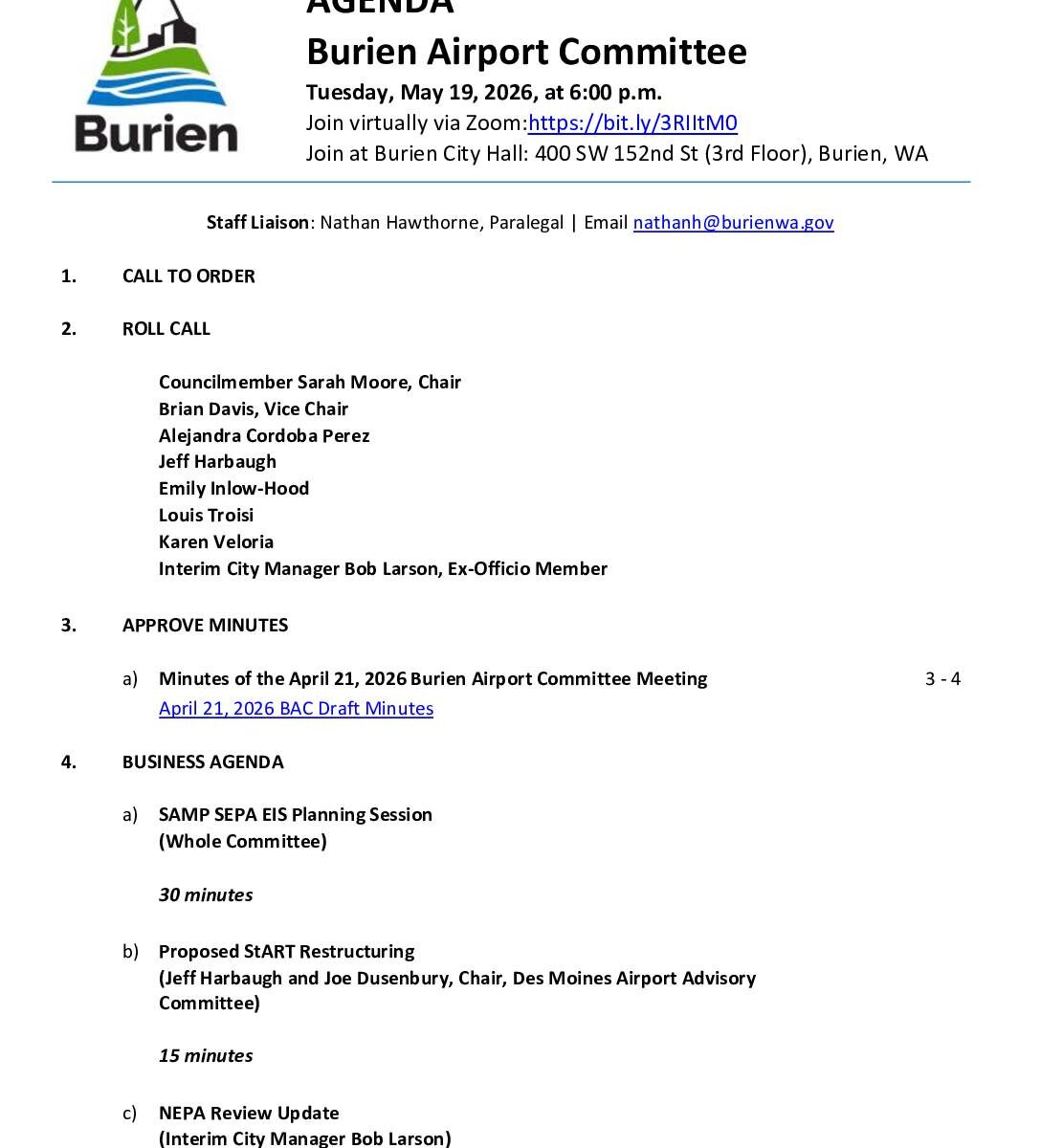
1. CALL TO ORDER
2. ROLL CALL
Councilmember Sarah Moore, Chair
Brian Davis, Vice Chair
Alejandra Cordoba Perez
Jeff Harbaugh
Emily Inlow-Hood
Louis Troisi
Karen Veloria
Interim City Manager Bob Larson, Ex-Officio Member
3. APPROVE MINUTES
Minutes of the April 21, 2026 Burien Airport Committee Meeting
4. BUSINESS AGENDA
a) SAMP SEPA EIS Planning Session
(Whole Committee) – 30 minutes
b) Proposed StART Restructuring
(Jeff Harbaugh and Joe Dusenbury, Chair, Des Moines Airport Advisory Committee) – 15 minutes
c) NEPA Review Update
(Interim City Manager Bob Larson) – 5 minutes
5. NEW BUSINESS
6. PUBLIC COMMENT
Public comment shall be limited to two minutes per speaker.
Email: You may provide a public comment in advance by sending an email to AirportCommittee@burienwa.gov. The Staff Liaison will read your comment aloud during the meeting. Cutoff for emails will be at 4:45 p.m. on the day of the meeting.
In-Person or Zoom: If you are unable to provide public comment via email, and would still like to provide public comment during the meeting, you will need to join the meeting at City Hall, or login to the Zoom meeting, and signup to speak.
7. ADJOURNMENT
1This is a machine-generated transcript generated on the fly by Google/Youtube/AI. Accuracy totally not guaranteed. Provided only as a convenience and to help people with disabilities. Caveat lector!