Smith/Murray provide funding. And so many loopholes.
The House of Representatives has passed its mandated National Defense Authorization Act for Fiscal Year 2026. Near the end of the bill is Section 8801, language previously put forward by Congressman Adam Smith WA-9 to allow the FAA to provide grant funding for updates to existing sound insulation systems (Port Packages) around Sea-Tac Airport.
The bill now goes to the Senate, including matching language from Senator Patty Murray where it is also expected to pass and then be signed by President Trump. From there, the FAA will begin implementation of a new rule to implement the grant. This makes 2027 the earliest possible implementation for eligible homes.
Our take: Be careful what you wish for
In some ways, Section 8801 tracks closely to our original proposal from 2020 and we thank Rep. Smith for finding a way to make this happen. It also meshes perfectly with the original proposal from the Port of Seattle now known as the Sound Insulation Repair Replacement Pilot Program (SIRRPP) 2024-04.
However, it has been almost two years since the SIRRPP was unveiled. But despite allocating $5,000,000 to the program not a single home has been repaired. Clearly the Port has been stalling–avoiding spending even one dollar of their own money to help residents. That time has been spent on surveys–and developing the most conservative interpretation of what homes might be eligible.
Section 8801 will be touted as a major step forward. Until you read what it says within the context of the Port’s SIRRPP.
Section 8801 highlights
- It begins with a very hard limit–only homeowners under the current DNL65 would be eligible for FAA reimbursement and only installs done before 2002. These immediately eliminate over two thirds of homes from eligibility.
- It then adds soft limits which (theoretically) could be addressed by the Port. However, given their current stance on the SIRRPP may not be. Specifically, the law requires proof that the original FAA-funded insulation directly caused structural deterioration—not moisture intrusion, incorrect flashing, or any damage attributable to the contractor. After two years, the Port has been unwilling to say whether or not any homes meet these thresholds.
- Finally, it is worth noting that although all airports may apply, only two airports will be awarded grants. The entire Part 150 program—including this new pilot—is voluntary. So, even if the Port identifies eligible homes, it is under no obligation to apply for this grant or commit to any dollar amount.
While Section 8801 appears to offer a path toward fixing defective insulation, the combination of narrow eligibility, onerous verification requirements, and voluntary implementation, raises real questions as to how much practical relief it will provide.
Call to action
Write your legislators: the Port Commission, your city councils and your state electeds. Tell them you know they can choose to interpret Section 8801 in the broadest possible manner within the current DNL65. Tell them you know that the Port of Seattle can spend its own money to fix bad Port Packages. Tell them to stop making excuses and fix your Port Package, now!
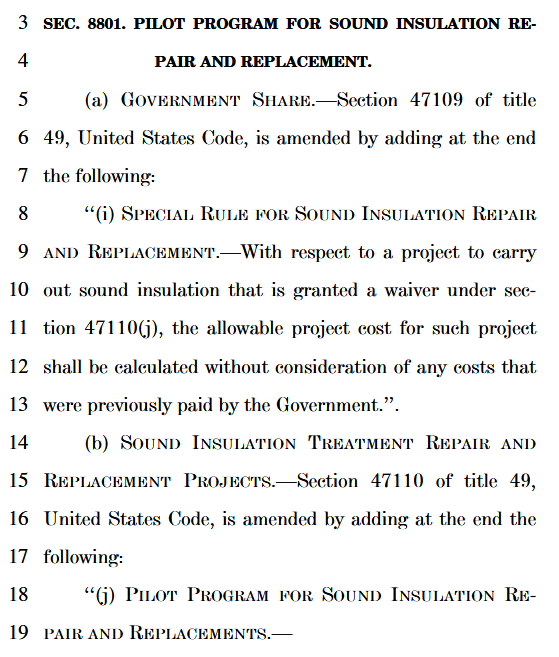
SEC. 8801. PILOT PROGRAM FOR SOUND INSULATION REPAIR AND REPLACEMENT
(a) GOVERNMENT SHARE.—Section 47109 of title 49, United States Code, is amended by adding at the end the following:
“(i) SPECIAL RULE FOR SOUND INSULATION REPAIR AND REPLACEMENT.—With respect to a project to carry out sound insulation that is granted a waiver under section 47110(j), the allowable project cost for such project shall be calculated without consideration of any costs that were previously paid by the Government.”.
(b) SOUND INSULATION TREATMENT REPAIR AND REPLACEMENT PROJECTS.—Section 47110 of title 49, United States Code, is amended by adding at the end the following:
“(j) PILOT PROGRAM FOR SOUND INSULATION REPAIR AND REPLACEMENTS.—
“(1) IN GENERAL.—Not later than 120 days after the date of enactment of this subsection, the Administrator of the Federal Aviation Administration shall establish a pilot program at up to two large hub public-use airports for local airport operators that have established a local program to fund secondary noise insulation using nonaeronautical revenue that provides a one-time waiver of the requirement of subsection (b)(4) for a qualifying airport as applied to projects to carry out repair and replacement of sound insulation for a residential building for which the airport previously received Federal assistance or Federally authorized airport assistance under this subchapter if—
“(A) the Secretary determines that the additional assistance is justified due to the residence containing any sound insulation treatment or other type of sound-proofing material previously installed under this subchapter that is determined to be eligible pursuant to paragraph (2); and
“(B) the residence—
“(i) falls within the Day Night Level (DNL) of 65 to 75 decibel (dB) noise contours, according to the most recent noise exposure map (as such term is defined in section 150.7 of title 14, Code of Federal Regulations) available as of the date of enactment of this subsection; and
“(ii) fell within such noise contours at the time the initial sound insulation treatment was installed.
“(2) ELIGIBILITY DETERMINATION.—To be eligible for waiver under this subsection for repair or replacement of sound insulation treatment projects, an applicant shall—
“(A) ensure that the applicant and the property owner have made a good faith effort to exhaust any amounts available through warranties, insurance coverage, and legal remedies for the sound insulation treatment previously installed on the eligible residence;
“(B) verify the sound insulation treatment for which Federal assistance was previously provided was installed prior to the year 2002; and
“(C) demonstrate that a qualified noise auditor, based on an inspection of the residence, determined that—
“(i) the sound insulation treatment for which Federal assistance was previously provided has resulted in structural deterioration that was not caused by failure of the property owner to repair or adequately maintain the residential building or through the negligence of the applicant or the property owner; and
“(ii) the condition of the sound insulation treatment described in subparagraph (A) is not attributed to actions taken by an owner or occupant of the residence.
“(3) ADDITIONAL AUTHORITY FOR SURVEYS.—Notwithstanding any other provision of law, the Secretary shall consider a cost allowable under this subchapter for an airport to conduct periodic surveys of properties in which repair and replacement of sound insulation treatment was carried out as described in paragraph (1) and for which the airport previously received Federal assistance or Federally authorized airport assistance under this subchapter. The surveys shall be conducted only for those properties for which the airport has identified a property owner who is interested in having a survey be undertaken to assess the current effectiveness of the sound insulation treatment. Such surveys shall be carried out to identify any properties described in the preceding sentence that are eligible for funds under this subsectio.”.
This entire project is a joke. I first complained about my windows being installed incorrectly back in 2016 when I noticed that most of my widow sils were rotting. It’s been nine years of waiting, writing letters, speaking before the port, calling my congressmen and senators. Nine years. I’m about to turn 67 in a couple months and I’ll probably due before anything is fixed. This is outright irresponsible, lack of human decency, and wrong. The port hired these incompetent contractors with no oversight. The bottom line is they screwed up and they need to fix this. Now. Before I die. Nine years! The port should be ashamed. This is another example of how the average person in this country is treated. I have worked my entire life, abbeyed the law, paid my taxes, and volunteered, all for what. To watch our country go to hell. It’s time we get back to taking care of the Americans who are not millionaires or billionaires. Please fix my windows today. There maybe no more tomorrows.