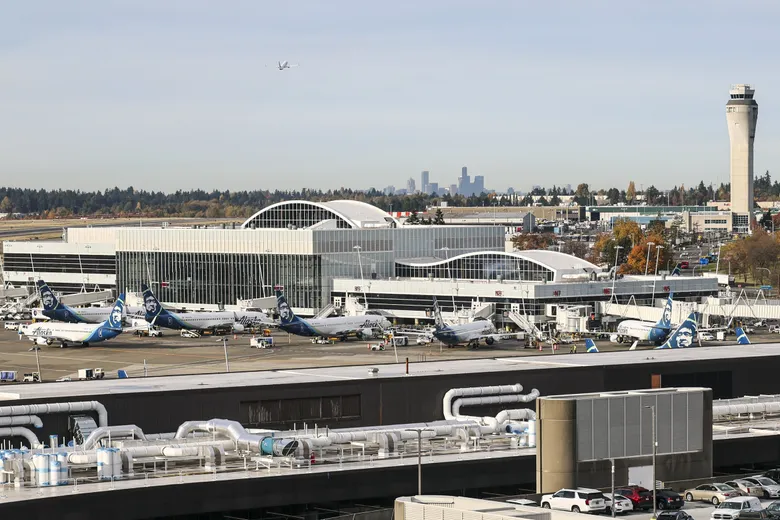
Daily operations at Seattle-Tacoma International Airport in SeaTac. (Kevin Clark / The Seattle Times)
Seattle Times business reporter
The cities of Burien, Des Moines and SeaTac are challenging the Port of Seattle’s long-term vision for Seattle-Tacoma International Airport.
The three cities filed a petition for judicial review of the Federal Aviation Administration’s recent ruling that 31 planned projects, including a second terminal, would not have a significant environmental impact on nearby communities.
The petition, filed in the Ninth Circuit Court of Appeals in November, did not detail the cities’ concerns, but the filing set a new clock for city representatives to file more legal briefings.
It also could delay the Port of Seattle’s march toward launching its new projects. The FAA’s seal of approval was one step forward in the lengthy process to implement the Port’s Sustainable Airport Master Plan, a multiyear endeavor to prepare the airport for an anticipated increase in demand.
The Port carved out 31 projects that it hopes to complete or begin by 2032, including a new cargo warehouse, extended taxiways, a parking lot for employees, and the second terminal, with room for up to 19 new gates.
The Port says the projects will ensure the airport is able to accommodate an expected 56 million annual travelers moving through the airport, an increase from 52 million in 2024.
Sea-Tac’s new terminal
The FAA approved 31 new projects at Sea-Tac, including a new terminal with 19 gates. The projects are part of the Port of Seattle’s master plan to address overcrowding at the busy airport.
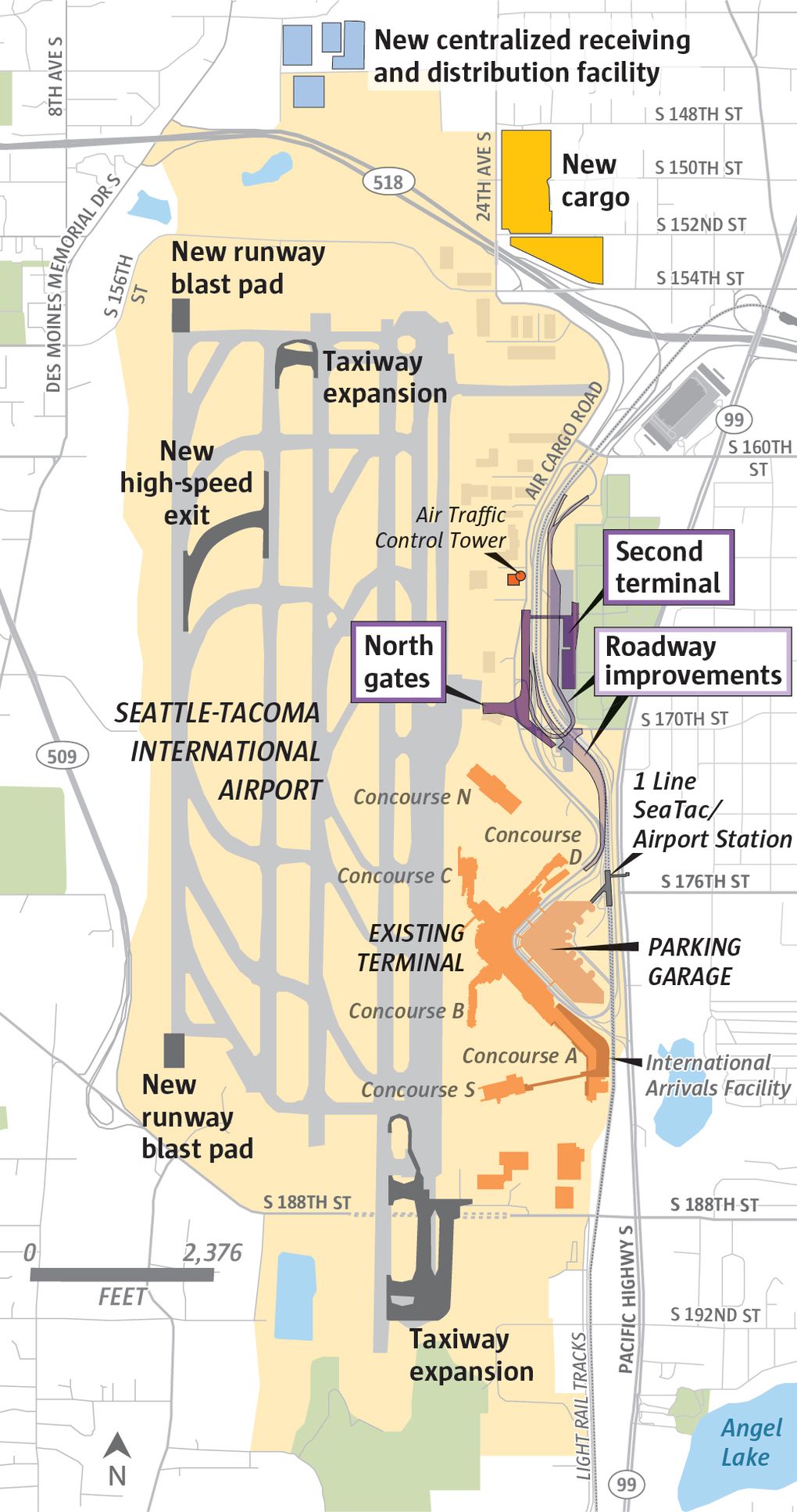
Sources: Esri, Port of Seattle (Reporting by Lauren Rosenblatt, graphic by Mark Nowlin / The Seattle Times)
But the expansion plans tap into enduring concerns that increased traffic at Sea-Tac hurts nearby neighborhoods, with residents alleging the constant noise from planes flying overhead is disruptive and harmful.
With 1,200 planes taking off and landing at Sea-Tac every day, nearby residents on either side of the airport hear up to 600 of those flights, said Brian Davis, vice chair of the Burien Airport Committee, who has been advocating for more mitigation measures from the Port to address noise concerns. “Burien and other airport cities need relief now.”
Vashon Island Fair Skies, a nonprofit that has for years protested an FAA air traffic modernization plan that community members say increased noise and pollution from planes flying over the island, filed a separate petition to review the FAA’s recent findings.
The FAA didn’t consider the cumulative impact of years of changes to the air space, and analyzed a small geographic area that didn’t encompass all the neighborhoods impacted by the Port’s plan while mismeasuring noise levels, the nonprofit argued in its legal filing.
The FAA said Friday it does not comment on pending litigation. The Port of Seattle said it is reviewing the filing. A spokesperson said the 31 projects would “improve the efficiency and safety of SEA, access to SEA and support facilities for the airlines and SEA.”
Meeting the demand
As the Puget Sound region grows, so does demand to fly in and out of Sea-Tac. The airport broke its record for annual passengers nearly every year between 2010 and 2019, according to Port data.
Demand dipped during the COVID-19 pandemic but Sea-Tac resumed its record-breaking growth in 2024 and expects even more demand this year.
To meet increased demand, the Port unveiled its Sustainable Airport Master Plan in 2015 and later identified 31 near-term projects for regulatory approval. In September, the FAA determined those projects would not significantly affect the “quality of the human environment,” according to the regulator’s report.

Arif Ghouse, chief operating officer for Sea-Tac and interim managing director for the Port’s aviation division, said he knew the FAA’s finding would “come as a surprise” to neighboring communities worried about aircraft noise and pollution.
But, he argued in an interview shortly after the FAA’s report was released, increased demand at Sea-Tac means the number of planes will increase no matter what, with or without the Port’s master plan.
Taking that lens, the proposed projects are necessary to make sure the airport is equipped to accommodate more travelers, Ghouse said. Without them, there could be even more detrimental impacts, like increased traffic as cars wait to drop off passengers and more planes circling overhead as they wait for a spot to open to land at the airport.
“We don’t create the demand as the Port, as an airport,” Ghouse said. “We strive to kind of meet that demand that’s coming our way.”
Ghouse added that, under federal law, the Port cannot turn carriers away or tell them to reduce service at Sea-Tac. It’s also constrained by a small footprint that limits physical expansion. The Port considered “dozens” of options, Ghouse said, and landed on the 31 proposed projects.
“All of these things will allow the airport to continue to work when it reaches 56 million passengers,” Ghouse said.
Following the FAA’s review, the Port will start its own environmental review. Then, the Port Commission must individually approve each project.
To gather feedback, the Port said it will conduct outreach to neighbors and regional leaders, with a particular focus on reaching historically underrepresented communities.
Still, Davis from the Burien Airport Committee said the Port hasn’t done enough to include community members. It feels as if they are checking boxes to collect feedback “but behind the scenes, there’s very little action,” Davis said.
Echoing concerns expressed by Vashon Island Fair Skies, Davis said the environmental study had such tight geographic lines that it didn’t include all the communities that had complained of negative impacts from planes flying overhead. And it relied on “archaic science” to determine harmful noise levels, again cutting out groups of people that experience hundreds of planes flying nearby every day, Davis said.
“It’s really important that the airport cities send the Port a message that this is not OK,” Davis said. “It’s not so much the expansion itself, but it’s the way that they’ve gone about the process.”
Burien is in a particularly tough position, Davis continued, because it doesn’t have the economic boost from hotels, parking garages or rental car companies profiting from airport travel. Instead, Burien is “out the airport’s backdoor,” he said. “I really think our people pay a disproportionate price.”
A problem brewing on Vashon
For Vashon residents, the feud goes back more than a decade.
In 2004, the FAA unveiled a new air traffic management system that used automated, satellite-guided software to usher planes into airports around the country, rather than relying solely on air traffic controllers manually directing pilots.
The new program — known as the Next Generation Air Transportation System — would replace the current system that had pilots taking a step-like approach, lowering to a specific altitude and then staying level until they got approval to lower to the next step.
With the NextGen system, planes would follow a razor-thin line and glide to lower altitudes, allowing them to idle their engines in a way they couldn’t before. Boeing and Alaska Airlines were instrumental in developing the new software and performing test flights from Sea-Tac.
But the FAA has struggled to get its NextGen system off the ground.
In a 2024 report, the Government Accountability Office found “weaknesses” in how the FAA managed investments to modernize its air traffic system, including that it had missed some NextGen deadlines by several years.
The FAA declined to answer questions about NextGen. In its 2024 annual report, the agency said the system was “nearly complete.”
In Seattle, the NextGen system would also change how planes approach the airport, allowing them to bypass a long U-turn route that has them fly over several communities north of the city and instead turn over Elliott Bay.
But that part of the system was never implemented, said David Goebel, president of Vashon Island Fair Skies.
Instead, the FAA’s half-implemented plan led to planes flying even lower over the island, increasing noise and pollution concerns.
“They fly low and level, which is the most inefficient form for commercial jet aircraft to fly,” Goebel said. “This change they made causes more low-and-level flying — it was supposed to do the opposite.”
The nonprofit has been waiting years to compel the FAA to study the impacts of Sea-Tac traffic on Vashon Island, Goebel said. Because the FAA delayed implementing its NextGen system for so long, the group ran out of its legal window to file an official complaint, he explained.
Now, it is urging the FAA and the Port to consider the cumulative impact of the NextGen system, the Port’s proposed changes and the opening of a third runway at Sea-Tac in 2008.
The FAA legally didn’t have to consider cumulative effects in its review, following a regulatory change from the Trump administration, but it did include a cumulative analysis in its draft review published last year.
Goebel said that cumulative analysis was inadequate, largely because it used outdated estimates of how the FAA’s NextGen system would have impacted Vashon if it had been fully implemented. It didn’t consider the current reality for residents on the island, Goebel said.
The state’s environmental assessment will include a review of cumulative impacts, following Washington regulations, but Goebel worries the state’s review lacks teeth over a federal decision.
In a rural area like Vashon, without any of the ambient noise of city living, residents hear every plane that flies overhead, Goebel said.
As he sums it up, “it just totally shatters your environment.”
Lauren Rosenblatt: 206-464-2927 or lrosenblatt@seattletimes.com. Lauren Rosenblatt is a Seattle Times business reporter covering Boeing and the aerospace industry.