Funding Port Package updates made simple
There’s always been confusion about Port Packages (sound insulation):
- Who pays for it?
- Who can pay for it?
- Who is eligible?
- Who should be eligible?
There are a bunch of rules governing all of the above. They may seem complicated. Because they are. But the actual solutions are simple. A lot of it depends on trust. Think about any contract you engage in – a bank account, a credit card, a mortgage. The ‘terms and conditions’ may be a mile long. But a truly honest broker – one who is on your side – can always make the possibilities straightforward. Unfortunately, the Port of Seattle has not always been so.
There are solutions – and they are simple. We’ll get there (promise). But we get so many questions, we’ll start by walking you through some of those endless terms and conditions, which seem designed to confuse people and get them to not ask the right questions.
In our Part 150 for Dummies Explainer we’ve already discussed ‘eligibility’ from the FAA’s point of view. In this article we focus on ‘who pays’ in order to provide one simple solution.
Who pays for it
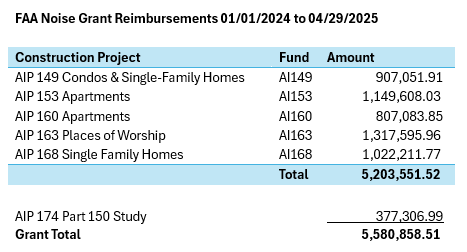
Here is a list of sound insulation projects funded by the Port’s noise program in 2024. Notice that all of them have an AIP code. “AIP” refers to the federal Airport Improvement Program — competitive FAA grants that large airports like Sea-Tac annually receive, often up to $100 million.
As the name implies, AIP grants can fund just about any airport-related improvement — from runways to 1restrooms. They can also be used for one other purpose: sound insulation within the current DNL 65 noise boundary.
That looks like a lot of money! However, almost all those projects, save one, were first eligible back during the Third Runway! And that highlights a crucial point: these grant applications are voluntary. A property may be eligible in 2000, but the Port is under no obligation to apply for money to do the work in any given year. It will always apply for AIP grants every year, but if it needs to fund something else, it can simply put off an eligible sound insulation project – sometimes for decades.
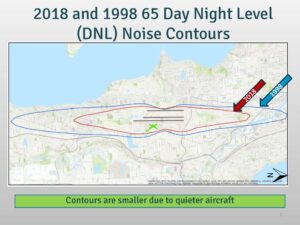
AIP grants can also be used to fund a Part 150 study — that’s the last line. That’s the study that redraws the DNL 65 boundary — often shrinking eligibility because, as the diagram says “quieter aircraft”.
Make passengers pay?
Every so often someone will say that the Port should use airline ticket fees for sound insulation! They always could. They’re called Passenger Facility Charges (PFCs) Since 2001 the Port of Seattle has collected literally billions of dollars of PFCs. So they would be the first in line to support increasing them. However, just like AIP grants, PFCs must be explicitly requested and approved on a per-project basis, and only for currently eligible noise projects.
It’s about reimbursement
 Now, here’s the catch. And it’s a doozy. AIP or PFC don’t really matter. Because with one teeny, tiny exception, the FAA only pays once. That means only homes that never got a Port Package and are still within the current DNL65. It took the Port 30 years, but between the ever-shrinking DNL65, and all the people who gave up or rebuilt their homes, there are almost no first-time projects left to be done within the current noise boundary. So, there is no shortage of federal money for first time Port Packages – because so few people are now eligible!
The teeny tiny exception? The FAA will reimburse the Port for replacements and updates, if the original sound insulation was installed on or before 1993. That condition will only ever apply to a handful of homes near Sea-Tac. The other 9,000+ Port Packages were installed later (during the Third Runway). So, over 99% of homes that received Port Packages are not eligible for federal reimbursement for repair and/or replacement.
Or, you can pay for it yourself
But! The FAA has always made it crystal clear: airport operators are always free to fund their own sound insulation programs — including updates — outside the DNL 65!
In other words: The Port of Seattle can fund sound insulation, new or updates, with its own money. Anywhere. Anytime.
But, there’s another catch. And it’s an even bigger doozy…
The FAA forbids airports from using airport revenue to pay for sound insulation repairs or replacement.
No revenue derived from passengers or airlines. Ouch.
 Diversification to the rescue!
That may sound like a deal-breaker. Until you remember that the Port is a lot more than an airport! It is a highly diversified entity with many other sources of revenue — tourism, marine revenue, real estate, and… the taxes they already collect from every property owner in King County. As far as the FAA is concerned, revenues from any of those are perfectly fine sources of funding for sound insulation.
One solution
 Given the fact that the Port does have so many other sources of revenue, there are many solutions to funding Port Package Updates. To keep it simple, today we’ll only discuss one. We want to stress that this is only one of many possibilities.
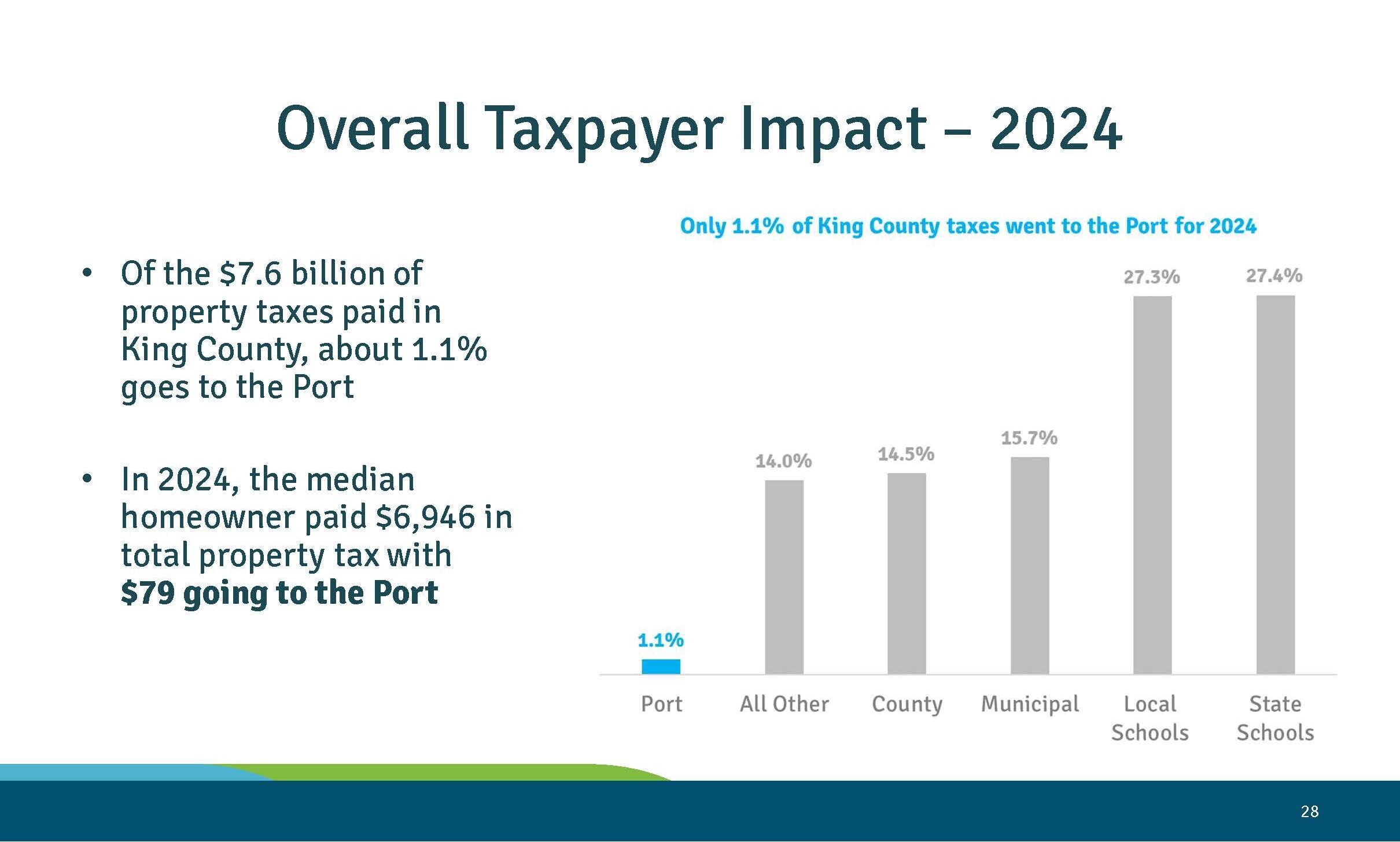
In 2024 the Port collected about $88 million in property taxes. What does that mean to you? It worked out to about $79 per property owner, or to put it another way, every $0.78 in taxes you paid, generated $1,000,000 for the Port.
What do they use that money for? The majority always goes to help the Port pay off debt (read presentation) – like airport projects that send more and more aircraft over our heads every day. But every grant the Port gives to every city and organization in King County comes from that Property Tax Levy. None of it comes from airport revenue, or anywhere else for that matter. All of it comes from you.
So, since all of King County benefits from Sea-Tac Airport’s economic impact – which they are proud to say can be measured in billions of dollars – it’s fair to suggest:
Set aside one dollar per year from every property owner in King County
to support sound insulation improvements in each of the three communities under the original noise boundary.
 Let’s review the numbers:
- One dollar from every property owner in King County generates over $1 million in annual tax revenue for the Port.
- Last year, the Port collected $88 million from King County taxpayers.
- But it returned only 13% of that to communities under the flight path. And most of that went to the City of SeaTac, plus more economic development. Less than $1,000,000 went to address any airport-related negative impacts.
- Most of that $88 million went to fund airport growth — like the SAMP — which only increases the burden on nearby neighborhoods.
- There are currently only three cities that contain 99% of the existing sound insulation systems.
Setting aside one dollar of the Property Tax Levy for each of those cities annually translates to about $3.84 million dollars a year. More than enough money to properly fund a Port Package update program applicable to 99% of homes. Forever.
There’s no need for lawsuits, legislation, or ballot initiatives. The Port already has the money and the authority. All it takes is three Port Commissioners willing to vote for it.
Simple.
Preserving the homes — and the middle-class fabric — of our communities is worth way more than three dollars in exchange for the billions of dollars in economic benefit to the rest of King County. It’s the single most impactful thing the Port could do to offset the damage caused by airport expansion and protect the middle-income housing that is the lifeblood of airport communities.
Prove it!
You may be skeptical. But in 2018, San Francisco International Airport (SFO) set up a sound insulation repair/replacement initiative funded by its own money. Sound familiar? SFO did it first and did it better. No expensive surveys. No delay. Homeowners were told to fill out a form, and a quick inspection determined eligibility. When their name comes to the top of the list, they get an update. Simple. Is the program far too small? Absolutely. But they proved it could work. They just need other airports (like Sea-Tac) to join in and show Congress we know how to do this. That is the way to make reimbursement possible.
Why don’t you know this?
Because the Port doesn’t tell you! It’s easier to offer tiny grants that distract communities from what is really possible. Don’t misunderstand us. Those small grants are real and important to the organizations that use them and they should definitely remain. But they’re a drop in the bucket. Lobbying the FAA for more money? Keep doing it! But either way: stop avoiding the real discussion: airports can already spend their own money to provide important direct mitigations like sound insulation.
Call to Action
It’s not the only solution, it’s one possibility. But it proves that there are fair and realistic solutions that can be implemented now. It only takes leadership from three Port Commissioners.
Now that you know that it’s simple, it’s time for you to speak up.
- Write the Port of Seattle
- Talk to your City and County Councils
“I know the Port always could fund sound insulation repairs and replacement using its own money. I demand that you dedicate at least three million dollars of your own money every year to fund sound insulation repair and replacement, using the SFO model.”
Will the Port push back? Of course. They will nitpick. They will continue to delay. But no matter what they say, there are answers to every objection. We only have to stop taking no for an answer.
Three votes. Three dollars. Simple.
1Since 2019, SEA Airport has received $21 million in FAA grants for terminal restroom renovations. Most recently, SEA was awarded a $10 million grant through the Bipartisan Infrastructure Act (BIL) Airport Terminal Program that will be put towards Phase 5 restroom updates.