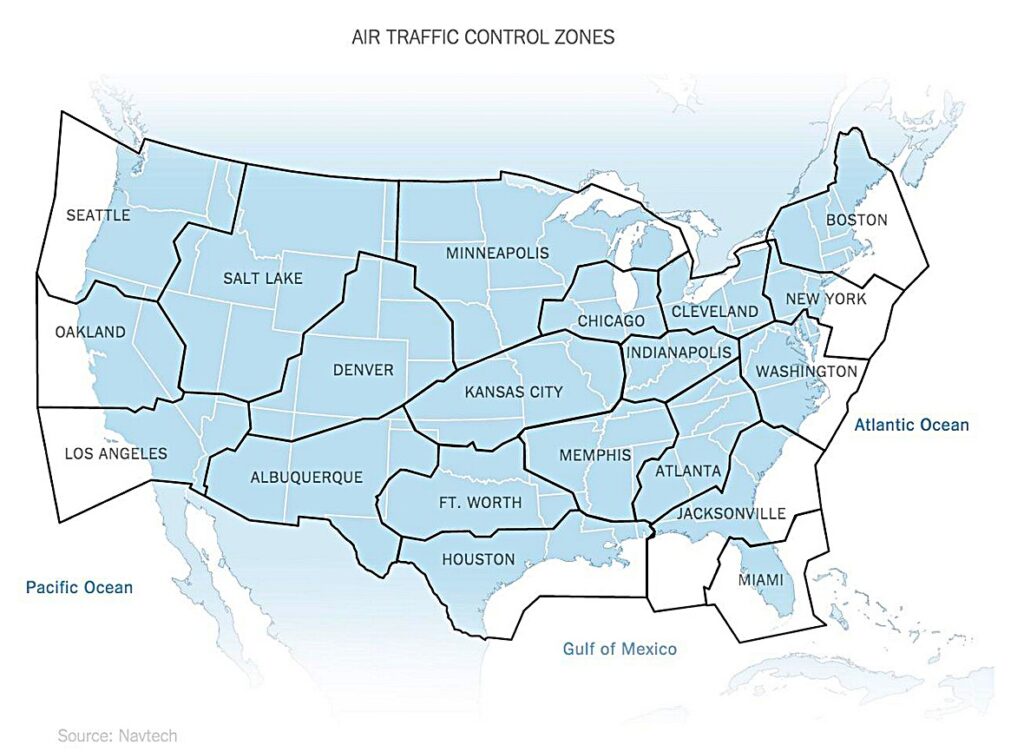
Air Traffic Control Zones United States

A little elaboration for the non-pilots out there. When a flight is on an instrument flight plan, it is under what's called "positive control" from start to finish. Air Traffic Control actually reserves a box of airspace for that flight that moves with the airplane. Positive control means the pilot is always in contact with Air Traffic Control. Here's the sequence of contacts. There are variations, but this is the basic structure. - Ground control: manages the movement of aircraft and all other vehicles while on the ground. The radio call is "ground," as in "Allegheny Ground." - Tower: tracks and manages the movement of aircraft in the air while landing or taking off from the airport. The tower also manages air traffic passing through its control area. The radio call is "tower," as in "Allegheny Tower." - Approach/Departure control: think of it as air traffic control and management for the "metropolitan area." It may have include airports of different sizes and a wide mixture of traffic, from scheduled airline flights to general aviation fun flights. Obviously the approach controllers handle flights inbound to major airports while departure controllers work the flights heading away. The radio call is "approach" or "departure," as in "Pittsburgh Approach." - Center control: this is what the map shows. The continental United States is divided into these 20 zones to manage and control air traffic. Radio call is "center," as in "Cleveland Center."

A Navtech-sourced map displaying the Air Traffic Control Zones across the contiguous United States, dividing the country into named centers including Seattle, Oakland, Los Angeles, Salt Lake, Denver, Albuquerque, Minneapolis, Kansas City, Fort Worth, Houston, Chicago, Indianapolis, Memphis, Atlanta, Jacksonville, Miami, Cleveland, Washington, New York, and Boston. The Seattle ARTCC zone is relevant to Sea-Tac Airport noise policy as it defines the airspace control region covering the Pacific Northwest.
Notes

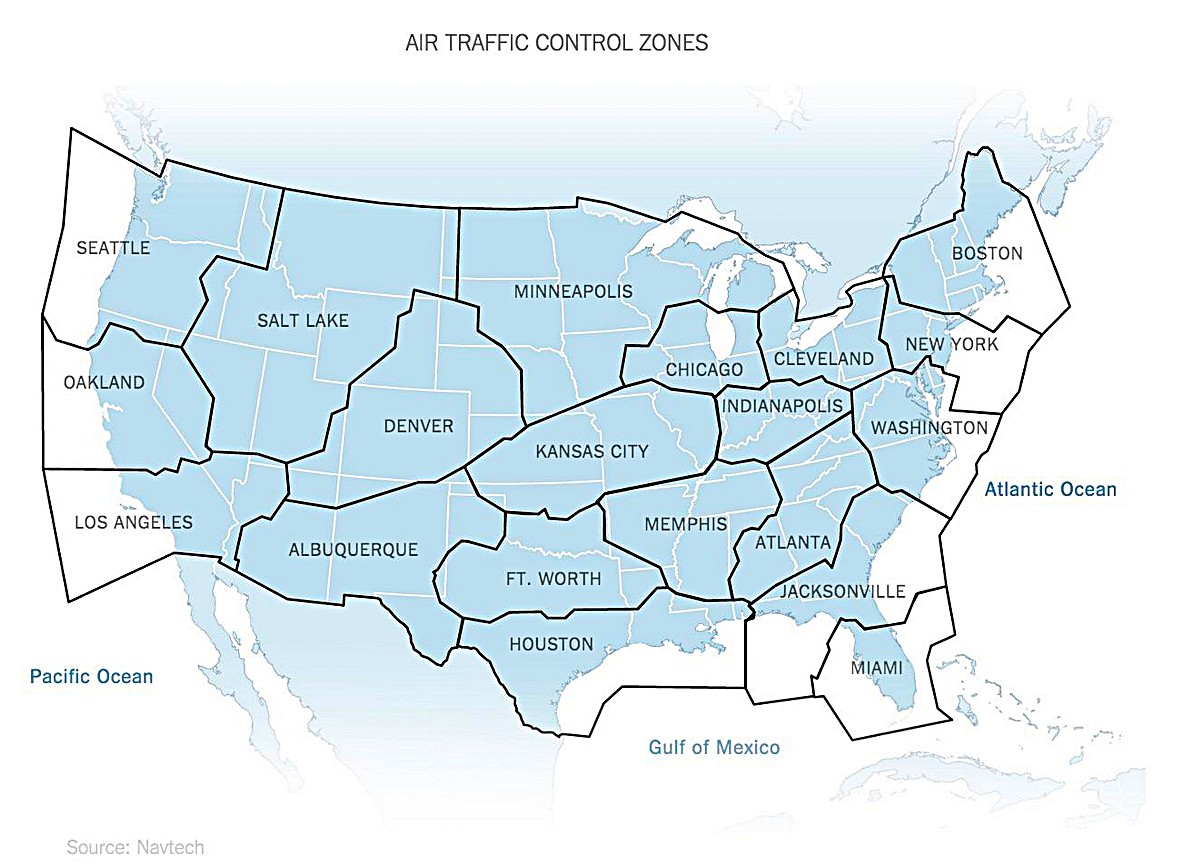
A Navtech-sourced map displaying the Air Traffic Control Zones across the contiguous United States, dividing the country into named centers including Seattle, Oakland, Los Angeles, Salt Lake, Denver, Albuquerque, Minneapolis, Kansas City, Fort Worth, Houston, Chicago, Indianapolis, Memphis, Atlanta, Jacksonville, Miami, Cleveland, Washington, New York, and Boston. The Seattle ARTCC zone is relevant to Sea-Tac Airport noise policy as it defines the airspace control region covering the Pacific Northwest.

V V