TagSea-Tac Communities Plan(236)
-
BAC SP #2 The Purpose Of Nextgen Was To Create Efficiencies In The Nas That Would Do Two Things… 0001
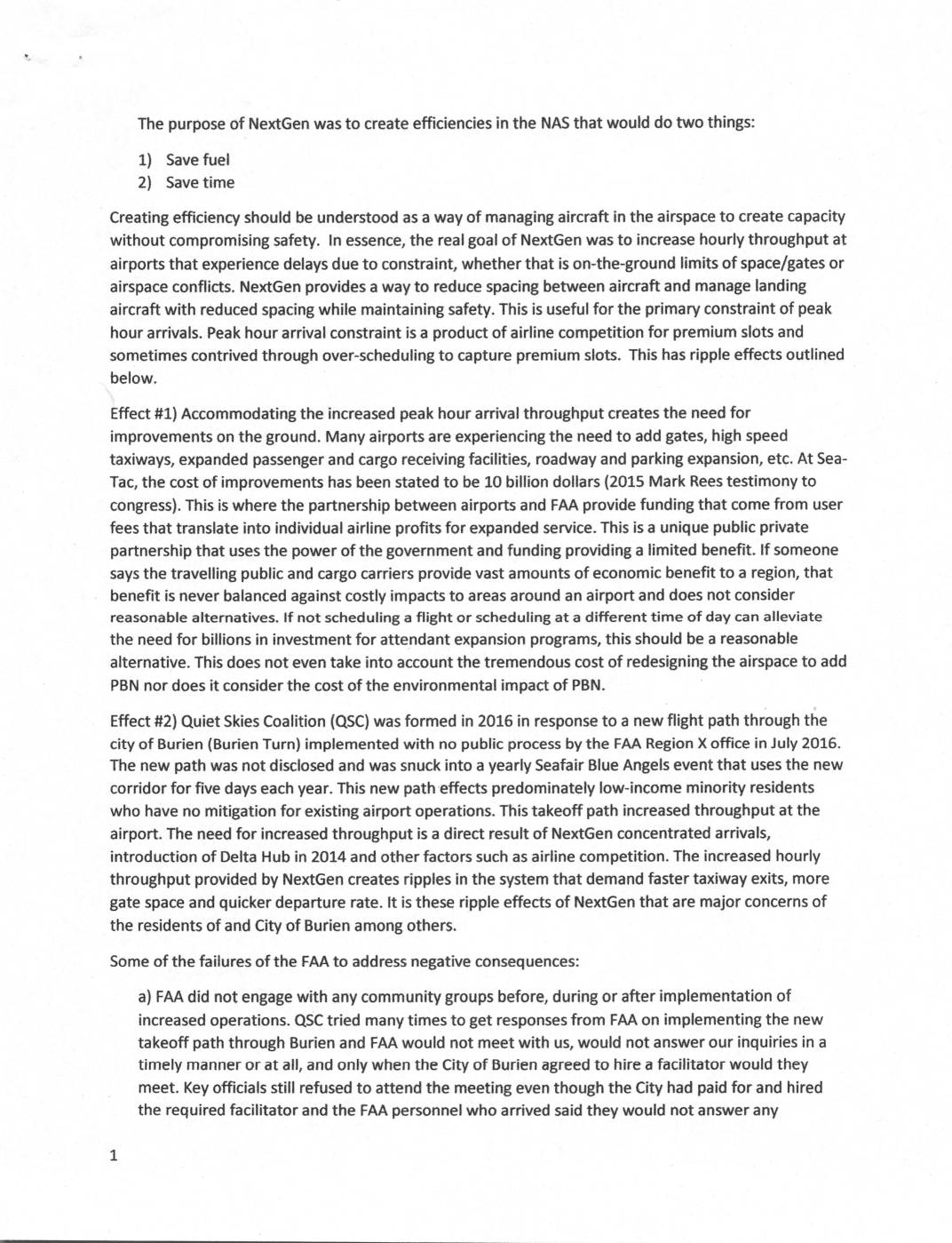
The purpose of NextGen was to create efficiencies in the NAS that would do two things: 1) Save fuel 2) Save time Creating efficiency should be understood as a way of managing aircraft in the airspace to create capacity without compromising safety. In essence, the real goal of NextGen was to increase hourly throughput at airports that experience delays due to constraint, whether that is on-the-ground limits of space/gates or airspace conflicts. NextGen provides a way to reduce spacing between aircraft and manage landing aircraft with reduced spacing while maintaining safety. This is useful for the prinrary constraint of peak hour arrivals. Peak hour arrival constraint is a product of airline competition for premium slOts and sometimes contrived through over-scheduling to capture premium slots. Tbis has ripple effects outlined below Effect #1) Accommodating the increased peak hour arrival throughput creates the need for improvements on the ground. Many airports are experiencing the need to add gates, high speed taxiways, expanded passenger and cargo receiving facilities, roadway and parking expansion, etc. At Sea- Tac, the cost of improvements has been stated to be IO billion dollars (2015 Mark Rees testimony to congress). This is where the partnership between airports and FAA provide funding that come from user fees that translate into individual airline profits for expanded service. This is a unique public private partnership that uses the power of the government and funding providing a limited benefit. If someone says the travelling public and cargo carriers provide vast amounts of economic… -

BAC SP #2 GAO Nextgen Air Transportation System FAA Has Made Some Progress GAO 13 264 April 2013 0001
• Excluded new procedures that would require new design criteria. FAA officials explained that having to wait for new design criteria for promduns could jeopardize the OAPM time frames. Outside of the OAPM initiative, FAA acknowledged that its staff had at times initiated work on a requested PBN procedure only to discover that the design criteria–which ensure the safety of procedures do not yet exist for the desired procedure. FAA officials stated that new design criteria would be needed to more widely deploy PBN procedures, but that effort is being undertaken independently of the OAPM initiative. Excluded sites with ongoing airspace redesign projects. Concerns about potential implementation delays also factored into FAA’s decision about which metroplexes to address in the midterm. Some industry stakeholders have voi md tDncerns that FAA did not include in its current OAPM plans the New York/Philadelphia metroplex, which is the nation’s most congested airspace and contributes to over half of domestic flight delays.37 However, FAA decided to exclude that B metroplex in light of the Record of Decision for the existing environmental reviews for FAA’s ongoing airspa@ redesign work for that area, because the agency did not want to initiate a new , environmental review procesS.38 In addition to the OAPM initiative, FAA has other PBN initiatives that aim to deliver midterrn benefits in less congested areas. For example, FAA’s Greener Shes project, which was initiated by Alaska Airlines, aims to deliver benefits to the Seattle metroplex beginning in 2013, and was shaped by local… -
BAC SP #2 Dear Ms. Hamer Feedback On GAO Study 103933 Community Impacts From Nextgen Noise 20200915 0001
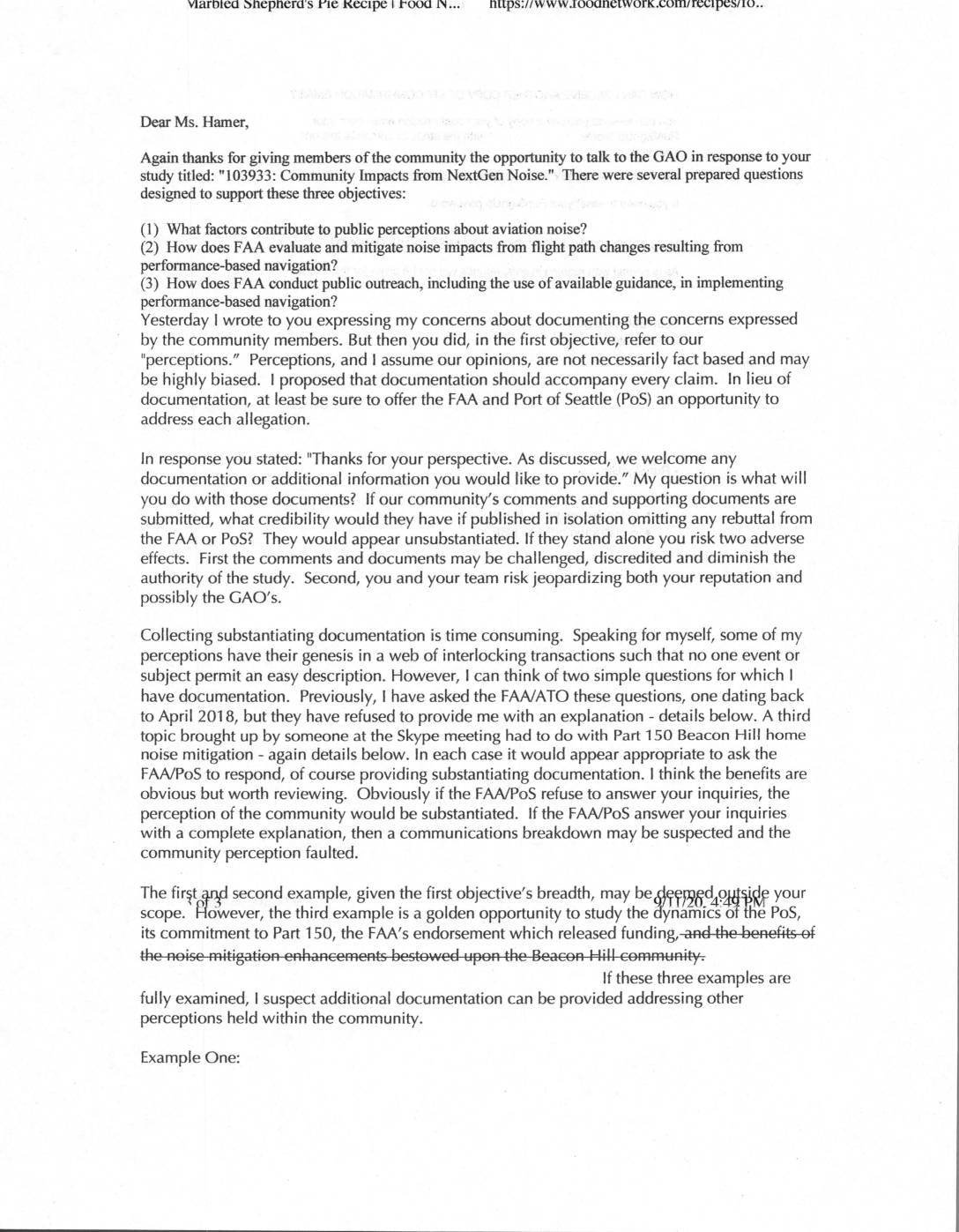
'otea bnel}Hero’s rle ;IDe I roc)a N i mps:// www .iooanetworK.com/ recIpes/10 Dear Ms. Hamer, Again thanks for giving members of the community the opportunity to talk to the GAO in response to Your study titled: " 103933: Community Impacts &om NextGen Noise." There were several prepared questions designed to support these three objectives: (1) What factors contribute to public perceptions about aviation noise? (2) How does FAA evaluate and mitigate noise impacts &om flight path changes resulting from performance-based navigation? (3) How does FAA conduct public outreach, including the use of available guidance, in implementing performance-based navigation? Yesterday I wrote to you expressing my concerns about documenting the concerns expressed by the community members. But then you did, in the first objective, refer to our '’perceptions." Perceptions, and I assume our opinions, are not necessarily fact based and may be highly biased. I proposed that documentation should accompany every claim. In lieu of documentation, at least be sure to offer the FAA and Port of Seattle (PoS) an opportunity to address each allegation. in response you stated: "Thanks for your perspective. As discussed, we welcome any documentation or additional information you would like to prbvide." My question is what will you do with those documents? if our community’s comments and supporting documents are submitted, what credibility would they have if published in isolation omitting any rebuttal from the FAA or PoS? They would appear unsubstantiated. If they stand alone you risk two adverse effects. First the comments and documents… -
BAC SP #2 A I Reform FAA Industry Data Exposes Greener Skies As An Environmental Fraud 20200729 0001
thIS, to start unaerstanclrng tIre 'tir. nttp://alrelorm .corn/reaa-tnls-tustart-una Read this, to Start Understanding the 'Greener Skies’ Fraud Posted on Click to read an interesting article about the 'Greener Skies’ program fraudulently pushed by FAA, Port of Seattle (POS), and industry, and approved by FM in late 201 2. 'Greener Skies’ was pitched, but it actually never of3 7/29/20. 12:28 PM Read thIS, to start unaers tan(IIng tIle 'tir. nttp://alreIorm.com/ 'tnls-t(bstart- una reatly happened. David Suomi (now FAA Regional Administrator) admitted as much when doing his 4/25/2017 $piel for the Port of Seattle Commissioners. Conspicuously, 'Greener Skies’ was focused ONLY on west-side arrivals. Why? Because if FM had tried to create similar concentrated arrival streams over Bellevue, the entire proposal would have been killed by the residents below. 'Greener Skies’ was supposed to bring enormous impact reductions. TIe key design element was to flow more than half of all Sea- Tac arrivals in over Eltiott Bay, miles from horne s, thus with almost no noise impact. Are they doing that, nearly six years later? No, not at all, not even in light traffic, and not even on clear Fall days perfect for flying. Why are the Elliott Bay arrivals so rare? Because the air traffic controllers have to fit all arrivals together, into the final landing flow; i.e., they need to merge both the west flow (especially the HAWKZ arrivals over Vashon Island) and the east flow (the CH INNS downwinds coming up from the southeast entry post near Mt. Rainier,… -
BAC SP #2 Debi Wagner To Nancy Tosta On Draft Council Resolutions 20171018 0001
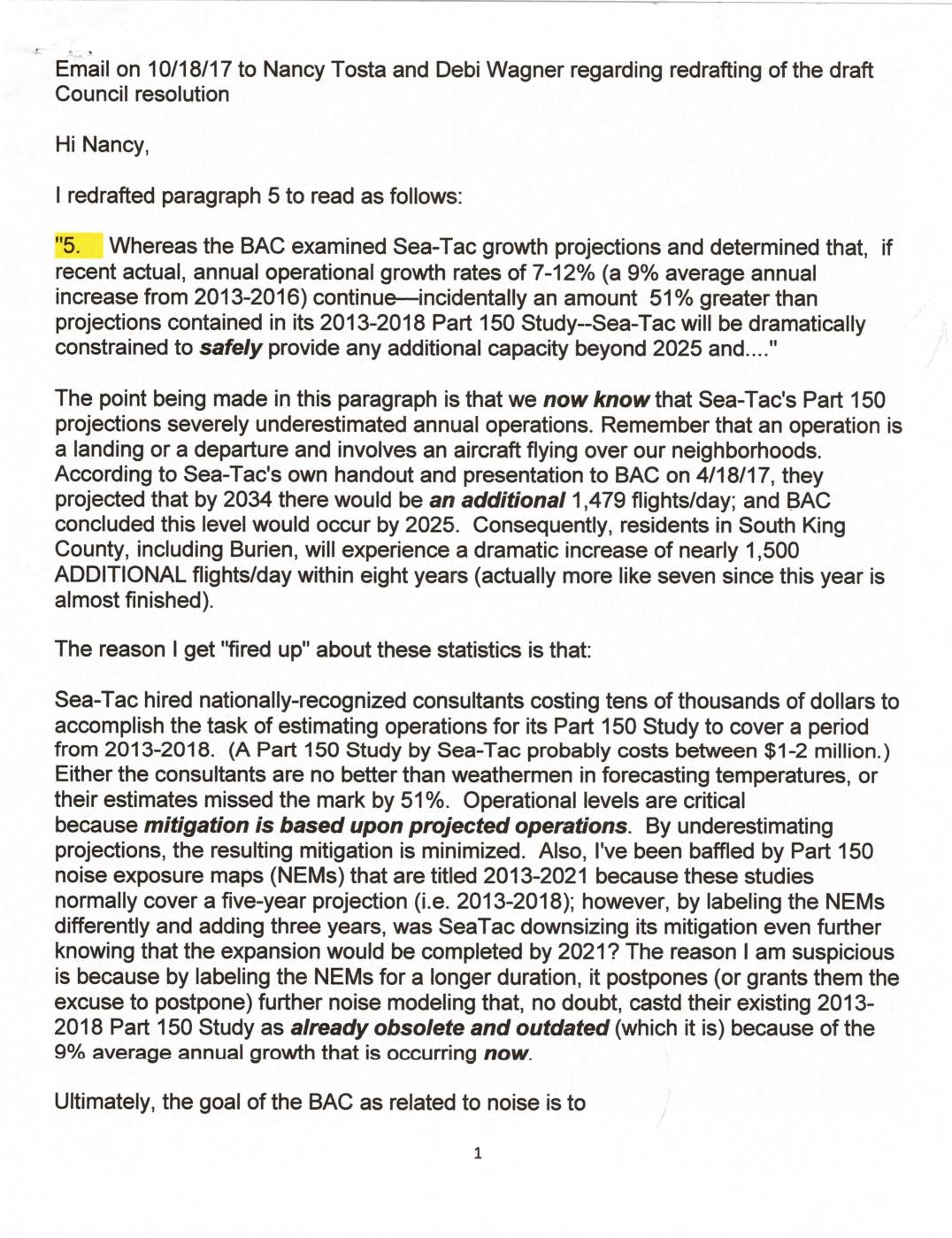
Email on 10/18/17 to Nancy Tosta and Debi Wagner regarding redrafting of the draft Council resolution +_ B Hi Nancy, redrafted paragraph 5 to read as follows: "5. Whereas the BAC examined Sea-Tac growth projections and determined that, recent actual, annual operational growth rates of 7-12% (a 9% average annual increase from 2013-2016) continubincidentally an amount 51% greater than projections contained in its 2013-2018 Part 150 Study–Sea-Tac will be dramatically constrained to safely provide any additional capacity beyond 2025 and...." if The point being made in this paragraph is that we now know that Sea-Tac's Part 150 projections severely underestimated annual operations. Remember that an operation is a landing or a departure and involves an aircraft flying over our neighborhoods. According to Sea-Tac’s own handout and presentation to BAC on 4/18/17, they projected that by 2034 there would be an additional 1 ,479 flights/day; and BAC concluded this level would occur by 2025. Consequently, residents in South King County, including Burien, will experience a dramatic increase of nearly 1,500 ADDITIONAL flights/day within eight years (actually more like seven since this year is almost finished). The reason I get "fired up" at>out these statistics is that: Sea-Tac hired nationally-recognized consultants costing tens of thousands of dollars to accomplish the task of estimating operations for its Part 150 Study to cover a period from 2013-2018. (A Part 150 Study by Sea-Tac probably costs between $1-2 million.) Either the consultants are no better than weathermen in forecasting temperatures, or their estimates missed the… -
BAC SP #2 BAC Resolution Capping Flight Operations And Opposing SAMP 2017 (no Date) 0001
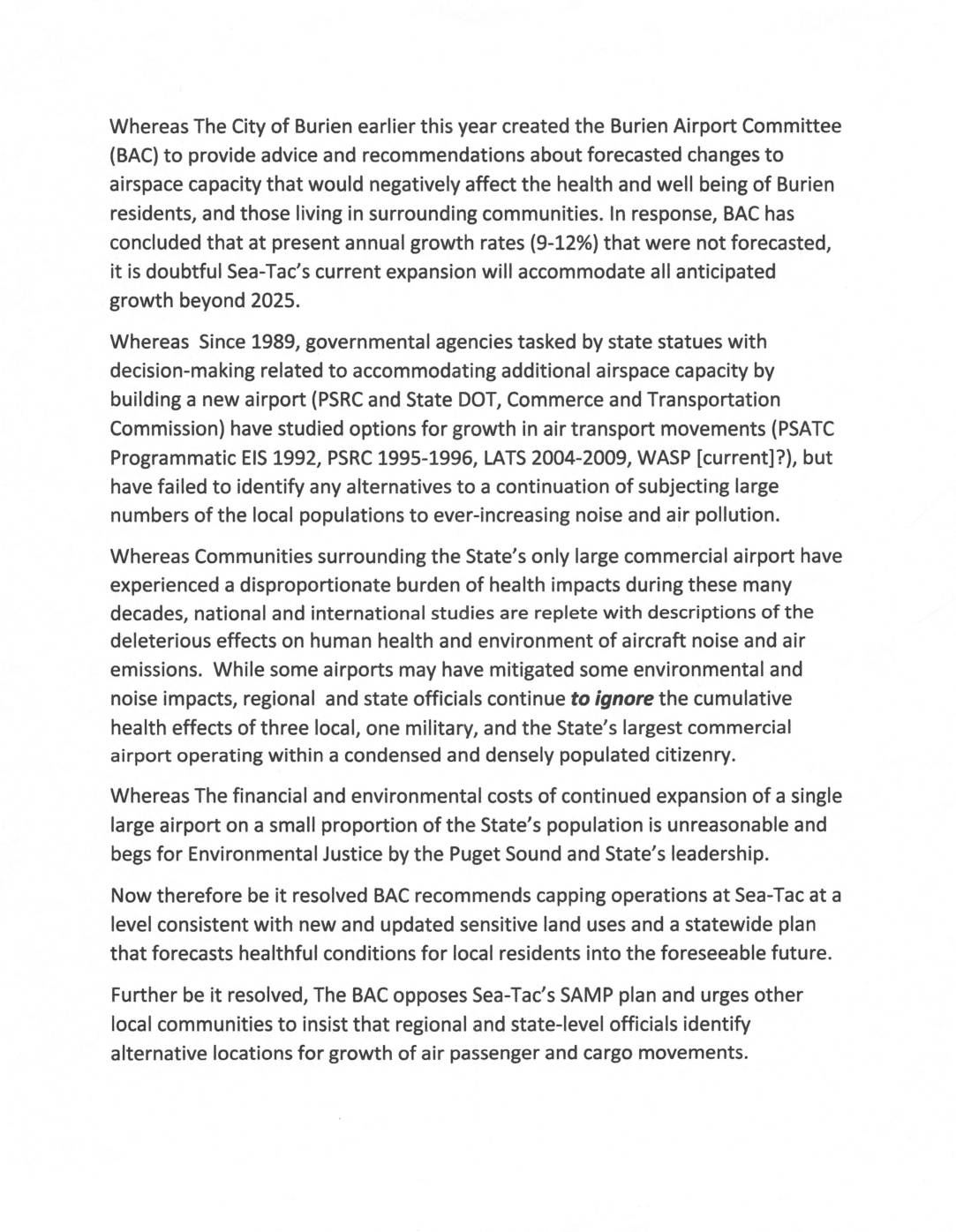
Whereas The City of Burien earlier this year created the Burien Airport Committee (BAC) to provide advice and recommendations about forecasted changes to airspace capacity that would negatively affect the health and well being of Burien residents, and those living in surrounding communities. In response, BAC has concluded that at present annual growth rates (9-12%) that were not forecasted, it is doubtful Sea-Tac’s current expansion will accommodate all anticipated growth beyond 2025. Whereas Since 1989, governmental agencies tasked by state statues with decision-making related to accommodating additional airspace capacity by building a new airport (PSRC and State DOT, Commerce and Transportation Commission) have studied options for growth in air transport movements (PSATC Programmatic EIS 1992, PSRC 1995-1996, LATS 2004-2009, WASP [current]?), but have failed to identify any alternatives to a continuation of subjecting large numbers of the local populations to ever-increasing noise and air pollution. Whereas Communities surrounding the State’s only large commercial airport have experienced a disproportionate burden of health impacts during these many decades, national and international studies are replete with descriptions of the deleterious effects on human health and environment of aircraft noise and air emissions. While some airports may have mitigated some environmental and noise impacts, regional and state officials continue to Ignore the cumulative health effects of three local, one military, and the State’s largest commercial airport operating within a condensed and densely populated citizenry. Whereas The financial and environmental costs of continued expansion of a single large airport on a small proportion of the… -
BAC SP #2 Us Navy ROD Alternative 2a EIS EA 18g Growler Whidbey Island Postcard 0001
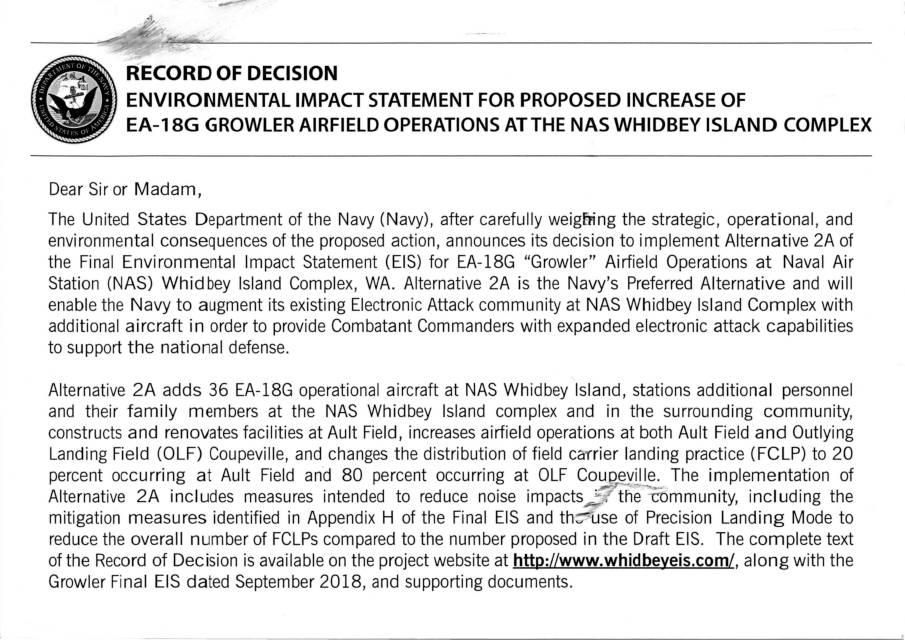
The United States Department of the Navy (Navy), after carefully weigMng the strategic, operational, and environmental consequences of the proposed action, announces its decision to implement Alternative 2A of the Final Environmental Impact Statement (EIS) for EA-18G “Growler” Airfield Operations at Naval Air Station (NAS) Whidbey Island Complex, WA. Alternative 2A is the Navy’s Preferred Alternative and will enable the Navy to augment its existing Electronic Attack community at NAS Whidbey Island Complex with additional aircraft in order to provide Combatant Commanders with expanded electronic attack capabilities to support the national defense. Alternative 2A adds 36 EA-18G operational aircraft at NAS Whidbey Island, stations additional personnel and their family members at the NAS Whidbey Island complex and in the surrounding community, constructs and renovates facilities at Ault Field, increases airfield operations at both Ault Field and Outlying Landing Field (OLF) Coupeville, and changes the distribution of field carrier landing practice (FCLP) to 20 percent occurring at Ault Field and 80 percent occurring at OLF CouQQyille. The implementation of Alternative 2A includes measures intended to reduce noise impactsJ?'th–e fommunity, including the mitigation measures identified in Appendix H of the Final EIS and thrtse of Precision Landing Mode to reduce the overall number of FCLPs compared to the number proposed in the Draft EIS. The complete text of the Record of Decision is available on the project website at http://www.whidbeyeis.com/, along with the Growler Final EIS dated September 2018, and supporting documents. EA-18G EIS Project Manager Naval Facilities Engineering Command FIRST-CLASS MAIL… -
BAC SP #2 Pos Small Matching Grants Program Flyer Spring 2018 0001
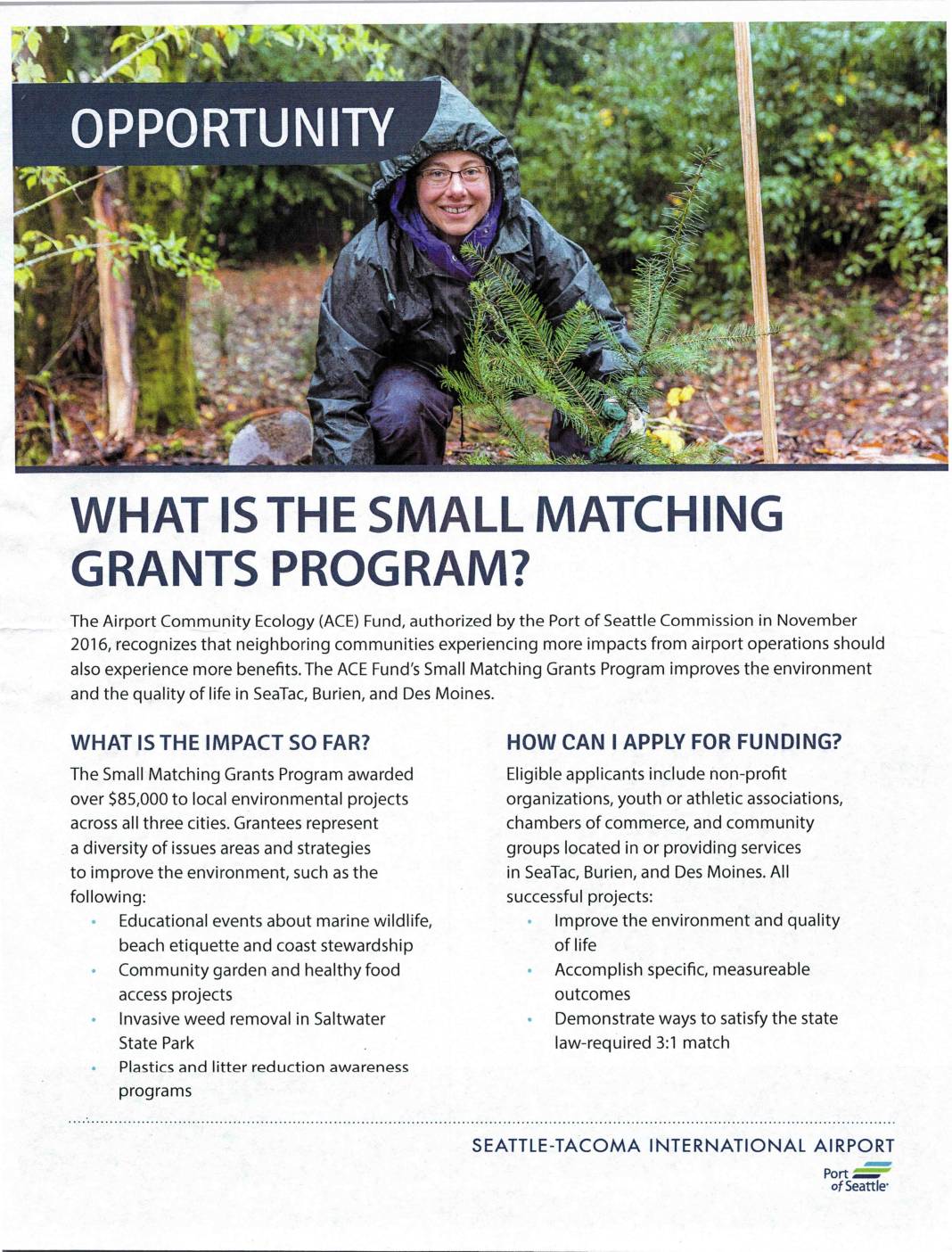
The Airport Community Ecology (ACE) Fund, authorized by the Port of Seattle Commission in November 2016, recognizes that neighboring communities experiencing more impacts from airport operations should also experience more benefits. The ACE Fund’s Small Matching Grants Program improves the environment and the quality of life in SeaTac, Burien, and Des Moines. WHAT IS THE IMPACT SO FAR? HOW CAN I APPLY FOR FUNDING? The Small Matching Grants Program awarded over $85,000 to local environmental projects across all three cities. Grantees represent a diversity of issues areas and strategies to improve the environment, such as the following: Educational events about marine wildlife, beach etiquette and coast stewardship Community garden and healthy food access projects Invasive weed removal in Saltwater State Park Plastics and litter reduction awareness Eligible applicants include non-profit organizations, youth or athletic associations, chambers of commerce, and community groups located in or providing services in SeaTac, Burien, and Des Moines. All successful projects: „ Improve the environment and quality of life „ Accomplish specific, measureable outcomes „ Demonstrate ways to satisfy the state law-required 3:1 match a @ @ ## programs SEATTLE-TACOMA INTERNATIONAL AIRPORT F1)o rHHt //////////rr/1:1 ;H:F : •H ;; / ofSeattle' WHAT IS THE 3:1 MATCH? In accordance with state law, each project must demonstrate a 3 (project) to 1 (Port) match for Port funds awarded. (i.e: For every dollar requested through the grant fund, three dollars of community value must be identi6ed by the applicant.) This match might be a challenge to potential applicants, so… -
BAC SP #2 Pos Sharyn Parker To BAC Re Temporary Noise Monitor 20200717 0001
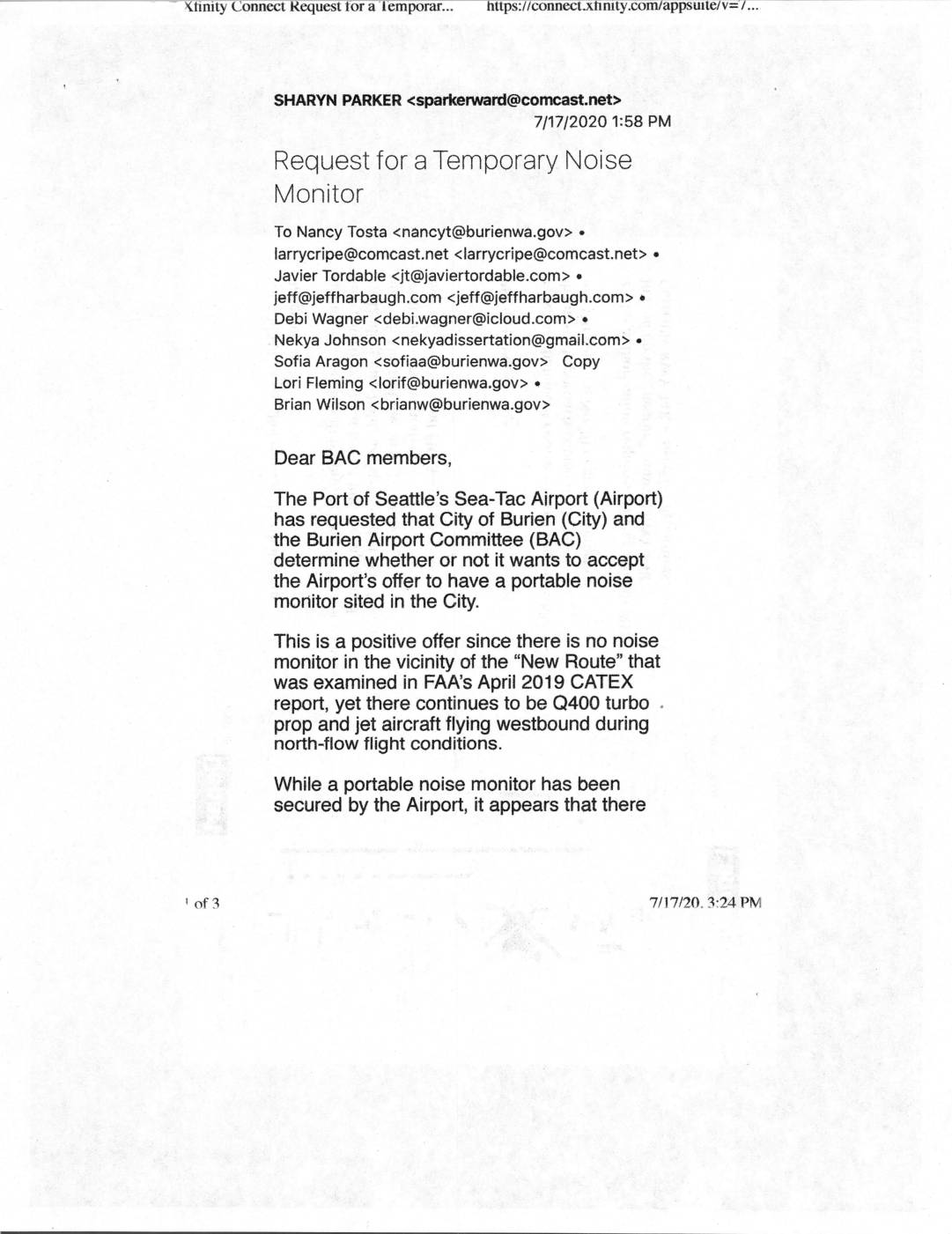
The Port of Seattle’s Sea.Tac Airport (Airport) has requested that City of Burien (City) and the Burien Airport Committee (BAC) determine whether or not it wants to accept the Airport’s offer to have a portable noise monitor sited in the City. This is a positive offer since there is no noise monitor in the vicinity of the “New Route” that was examined in F=AAs April 2019 CATEX report, yet there continues to be Q400 turbo prop and jet aircraft flying westbound during north-flow flight conditions. While a portable noise monitor has been secured by the Airport, it appears that there of3 7/17/20. 3:24 PM iiI: 5-8-5 b. -When parallel runway thresholds are staggered and: 1. The arriving aircraft is approaching the nearer runway: the centerlines are at least 1,000 feet apart and the landing thresholds are staggered at least 500 feet for each 100 feet less than 2,500 the centerlines are separated. (See FIG 5-8-11 and FIG 5-8-42.) '. I' ' ' i, t+ PROBLEMS: ';'{ ’i:+ 1. Noise abatement course is -340 degrees while the missed approach course RWY 34R is -340 degrees. No 30 degrees divergence. 2. This authorization requires arriving aircraft (RED) to land on the “nearer" runway, RWY 34R. Currently RWY 34R is used for departures. 191 IS AIRPORT D ATIS t 180 SEATTLE TOWER t19 9 239 3 (RWVS ! bl, 16C , 34C. 341} gS 239 3 .\WI '1 6R. 3411 CND (ON TII 7 CLNC !XL 128 a CFLllC la (AUT©r+ Pt'ots are… -
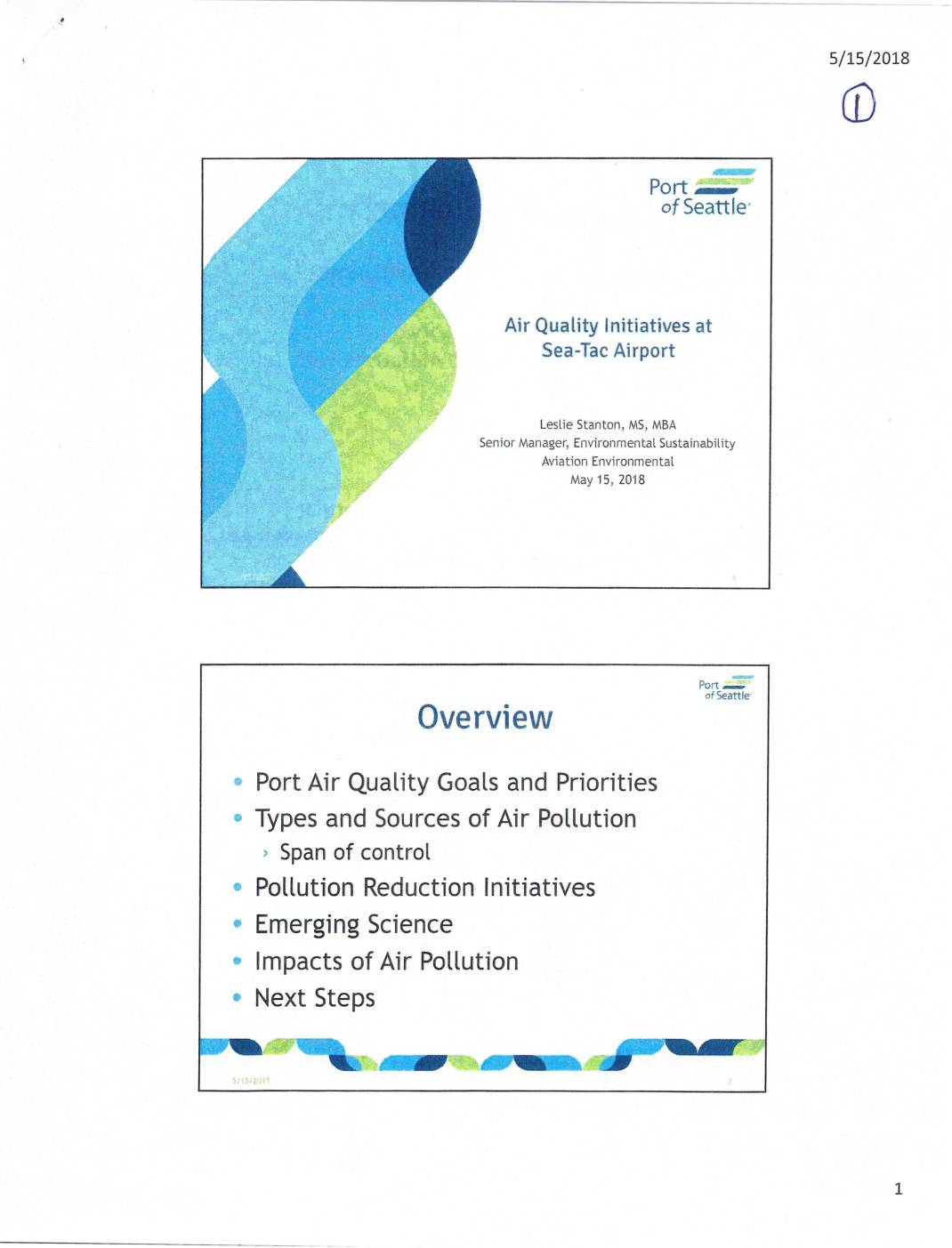
BAC SP #2 Pos Air Quality Initiatives PSCAA Air Quality Presentation Saga Nic 20180505 0001
~ Types and Sources of Air Pollution ; Span of control * Pollution Reduction Initiatives * Emerging Science Impacts of Air Pollution Next Steps ?} // ; 3 /Z:-;•{ c: b 5/15/2018 Port & of Seattle aRe:igJilm Types of Air Pottut: ion Greenhouse gases 'Trap heat in our atmosphere Causes climate change: droughts, flooding, heat waves, loss of snow pack, forest fires, etc. + Regulated Pollutants , NOx, SOx, CO, VOCs Particulate matter (PMI O, PM2 .5) Air toxics > Cause direct adverse health effects in humans :} / ltj ; ?I }] [I Sources of Greenhouse Gases at Sea-'Tac Airport Port ,' „; ' Tf of Seattle as(E(rj 41>W'= )HI»= nb BOaC%} };a +t 2SHaJ Or { ,','„ g u iSON( ; aIEg ; .{ g j- { } 5NE© a Aira8ft- related ( LH::B Passenger Ground TranSport Pat-cv/ned { ! :j ;'L--;"=_ $ 5/15/2018 aWPnW8 Port ___: -::. : of Seattle Promoting Clean Vehicles First US airport to require green taxis First US airport to require green TNCs in 2016 Converting CNG buses to electric @ & It;a Adding more electric charging stations & ) ;' ? :.. / /t.;} ( Passenger Vehicles Port nw,p of Seattle kurtaRL Ground Transportation Access Plan ' Improve access to public transportation , Identify efficient transportation modes , Identify costs and infrastructure changes What’s future of transportation look like? ## s i } =j /2 I; - i '-. 1+ 5/15/2018 Port an....r of SeaRle +#A/£fWE/ Health E Keel:::s of Air Pollution…