TagSea-Tac Communities Plan(236)
-
 2024-05-13 19:04
BAC SP #2 Misc 0004
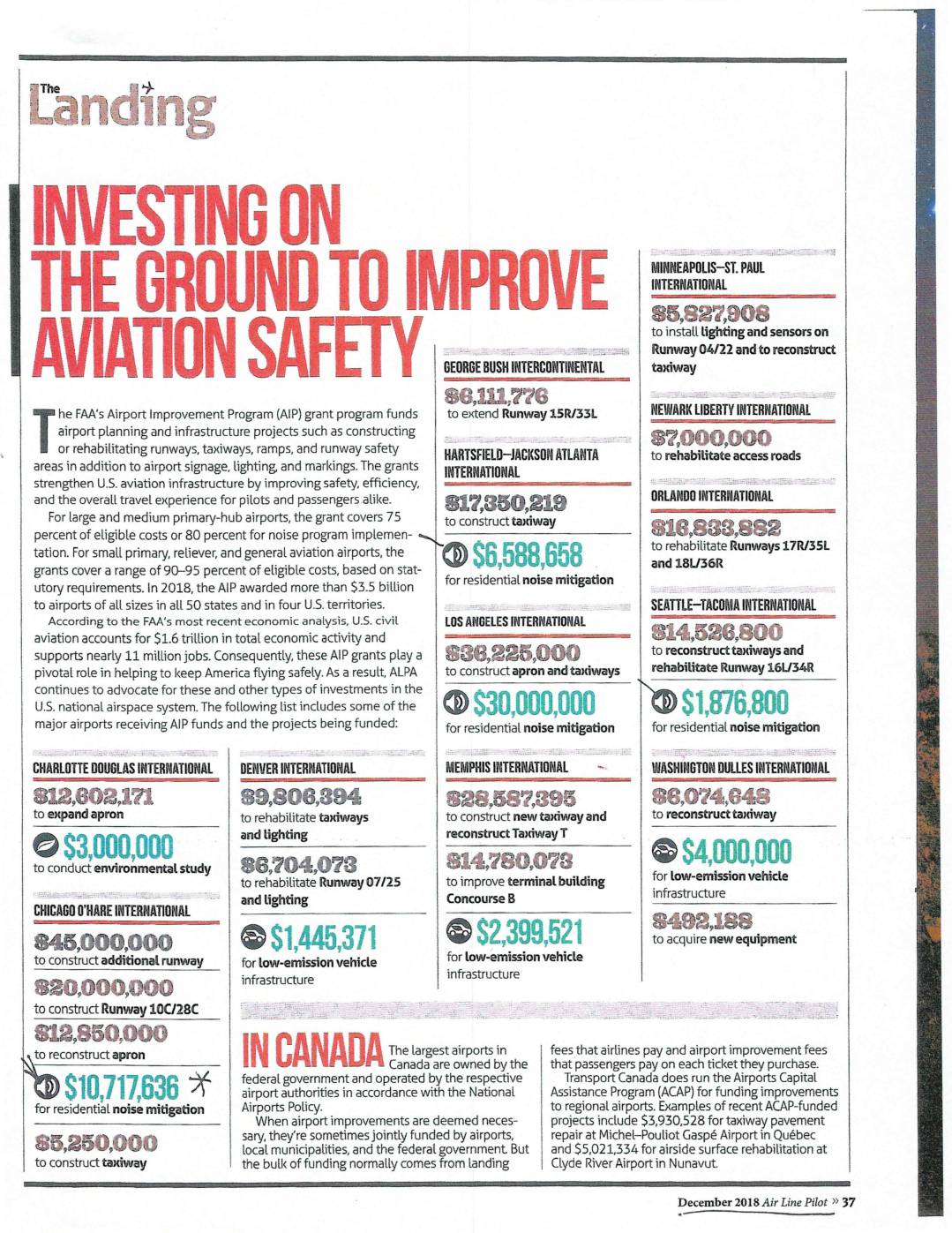
to ii aiR lighting arid sensors on Runway 04/22 and to reconstruct taxiwayGEORGE BUSH INTERCONTiNENTAL NEWARK LIBERTY NTERNATIORALhe FAA’s Airport Improvement Program (AIP) grant program funds airport pLanning and infrastructure projects such as constructing or rehab}htating runways. taxiways. ramps, and runway safety areas in addition to airport signage. lighting, and markings. The grants strengthen U.S. aviation infrastructure by improving safety. effIciency. and the overaLL travel experience for piLots and passengers aLike. For large and medium pdrnary-hub airports, the grant covers 75 percent of eLigible costs or 80 percent for noise program implemen tadon. For smaLI pdmary. rebever. and general aviation airports. the grants cover a range of 9(b95 percent of eligibLe costs, based on stat' utory requirements. in 2018, the AIP awarded more than $3.5 biIbon to airports of aLI sizes in aLL SO states and in four U.S. territories. According to the FAA’s most recent economic analysis, U.S. civil aviation accounts for $1.6 tdtbon in total economic activity and supports nearLy 11 million jobs. ConsequentLy, these AtP grants play a pivotat role in helping to keep America fLying safety. As a result, ALPA continues to advocate for these and other types of investments in the U.S. national airspace system. The following List incLudes some of the major airports receiving AIP funds and the projects being funded: to extend Runway 15R/33L HARTSF tED–JACKSON ATLANTA INTERNATIONAL ©£?,@8©,2X© to construct taxiway to rehabilitate acces roads is& r H:: :BH:+ t): : : i•= JF H : : • : : :}{ 6::… -
 2024-05-13 19:04
BAC SP #2 Misc 0003
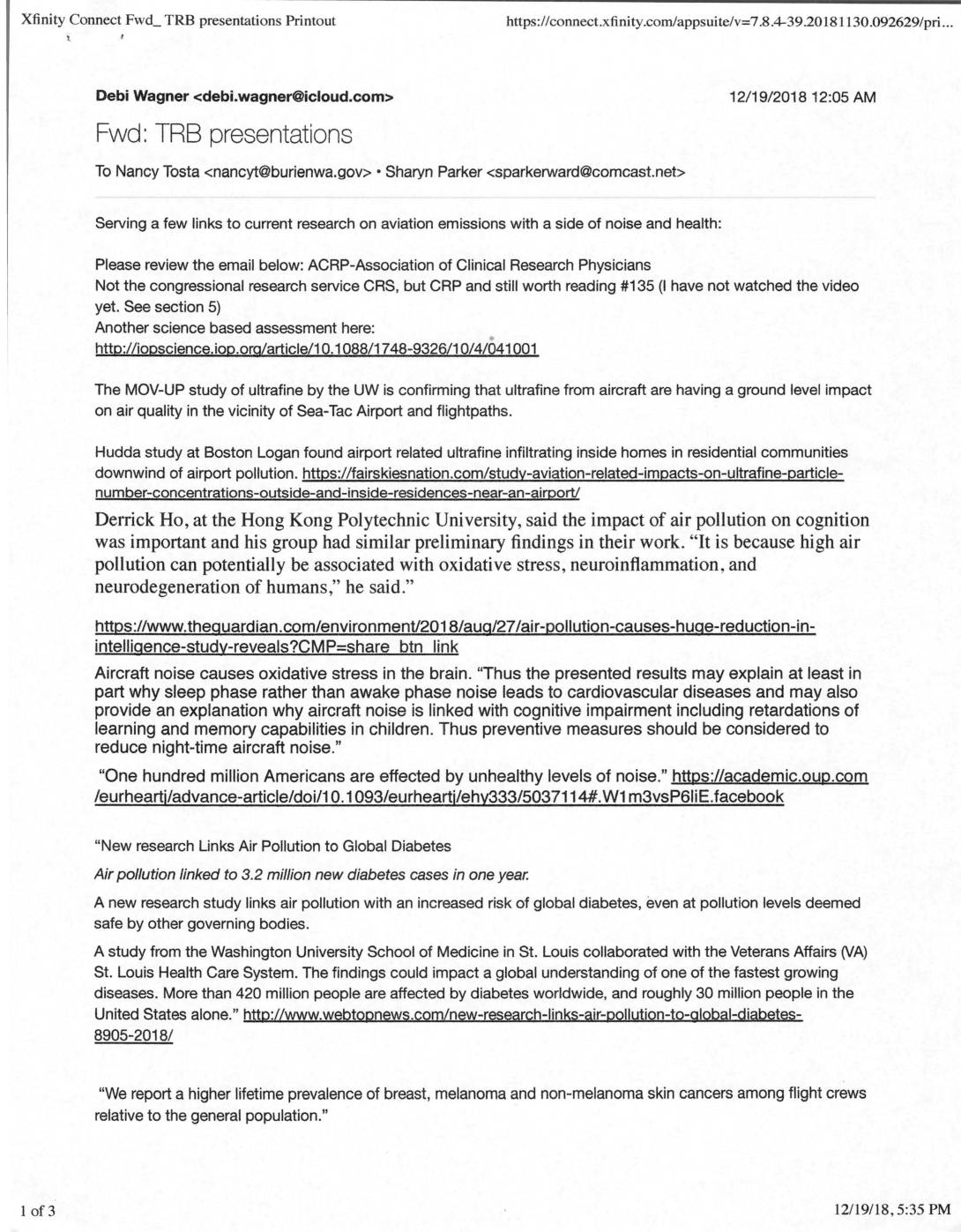
X 6nity Connect Fwd_ TRB presentations Printout Jt https://connect .xfinity.com/appsuite/v=7.8.'k39.20181 130.092629/pri ... Debi Wagner <det>i.wagner@icloud.com> 12/1 9/2018 12:05 AM Fwd: TRB presentations lb Nancy Tosta <nancyt@burienwa.gov> ' Shawn Parker <sparkerward@comcast.net> Serving a few links to current research on aviation emissions with a side of noise and health: Please review the email below: ACRP-Association of Clinical Research Physicians Not the congressional research service CRS, but CRP and still worth reading #135 (1 have not watched the video yet. See section 5) Another science based assessment here: + httD://ioDscience.ioP.ora/article/10.1088/1 748-9326/10/4/041001 The MOV-UP study of ultrafine by the UW is confirming that ultra8ne from aircraft are having a ground level impact on air quality in the vicinity of Sea-'Tac Airport and flightpaths. Hudda study at Boston Logan found airport related ultrafine infiltrating inside homes in residential communities downwind of airport pollution. httPs://fairskiesnation.com/study-aviation-related-imPacts-on-ultrafine-Palticle- number-concentrations-outside-and-inside-residences-near-an-airPort/ Derrick Ho, at the Hong Kong Polytechnic University, said the impact of air pollution on cognition was important and his group had similar preliminary findings in their work. “It is because high air pollution can potentially be associated with oxidative stress, neuroinnammation, and neurodegeneration of humans,” he said.” httPs://www.theguardian.com/environment/201 8/aug/27/air-pollution-causes'huge-reduction-in- intelligence-study-reveals?CMP= share btn link Aircraft noise causes oxidative stress in the brain. “Thus the presented results may explain at least in part why sleep phase rather than awake phase noise leads to cardiovascular diseases and may also provide an explanation why aircraft noise is linked with cognitive impairment including retardations of learning and memory capabilities in children. Thus preventive measures… -
 2024-05-13 19:04
BAC SP #2 Misc 0002
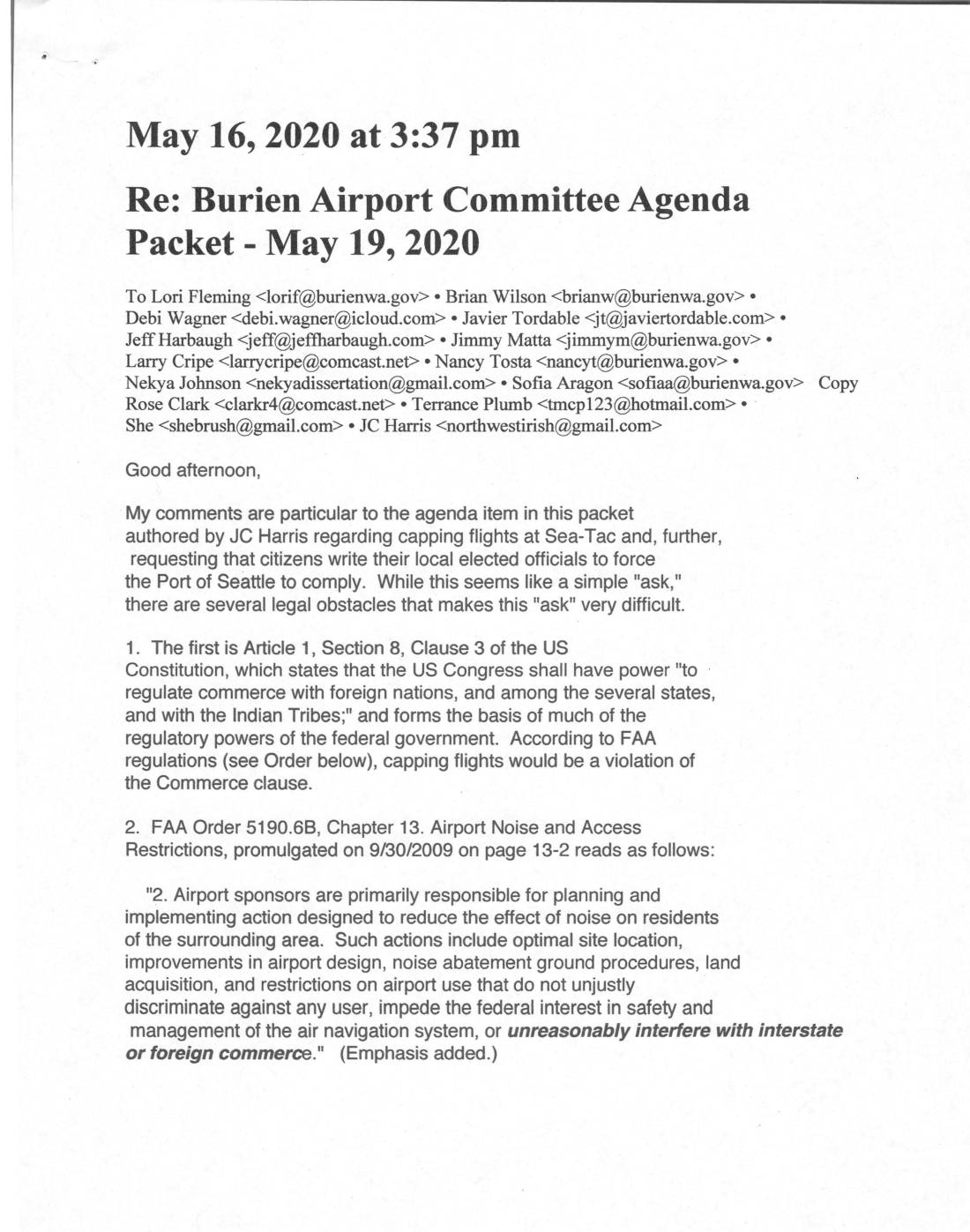
To Lori Fleming <lorif@budenwa.gov> • Brian Wilson <brianw@burienwa.gov> • Debi Wagner <debi.wagner@icloud.com> • Javier Tordable <jt@javiertordable.com> ' Jeff Harbaugh <jeff@jeflharbaugh.com> ' Jimmy Matta <jimmym@bwienwa.gov> ' Larry Cape <lanyuipe@comcast.neP • Nancy Tosta <nancyt@budenwa.gov> ' Nekya Johnson <nekyadissertation@gmail.com> ' Sofia Aragon <so6aa@budenwa.gov> Rose Clark <clarkr:4@comcast.neP ' Terrance Plumb <tmcp123@hotmail.com> • She <shebrush@grnail.com> • JC Harris <northwestidsh@gmail.com> Copy Good afternoon, b My comments are particular to the agenda item in this packet authored by JC Harris regarding capping flights at Sea-Tac and, further, requesting that citizens write their local elected officials to force the Port of Seattle to comply. While this seems like a simple "ask," there are several legal obstacles that makes this '’ask" very difficult. 1. The first is Article 1, Section 8, Clause 3 of the US Constitution, which states that the US Congress shall have power "to regulate commerce with foreign nations, and among the several states, and with the Indian Tribes;" and forms the basis of much of the regulatory powers of the federal government. According to FAA regulations (see Order below), capping flights would be a violation of the Commerce clause. 2. FAA Order 5190.6B, Chapter 13. Airport Noise and Access Restrictions, promulgated on 9/30/2009 on page 13-2 reads as follows: "2. Airport sponsors are primarily responsible for planning and irnplementing action designed to reduce the effect of noise on residents of the surrounding area. Such actions include optimal site location, improvements in airport design, noise abatement ground procedures, land acquisition, and restrictions on airport use that… -
 2024-05-13 19:04
BAC SP #2 Misc 0001
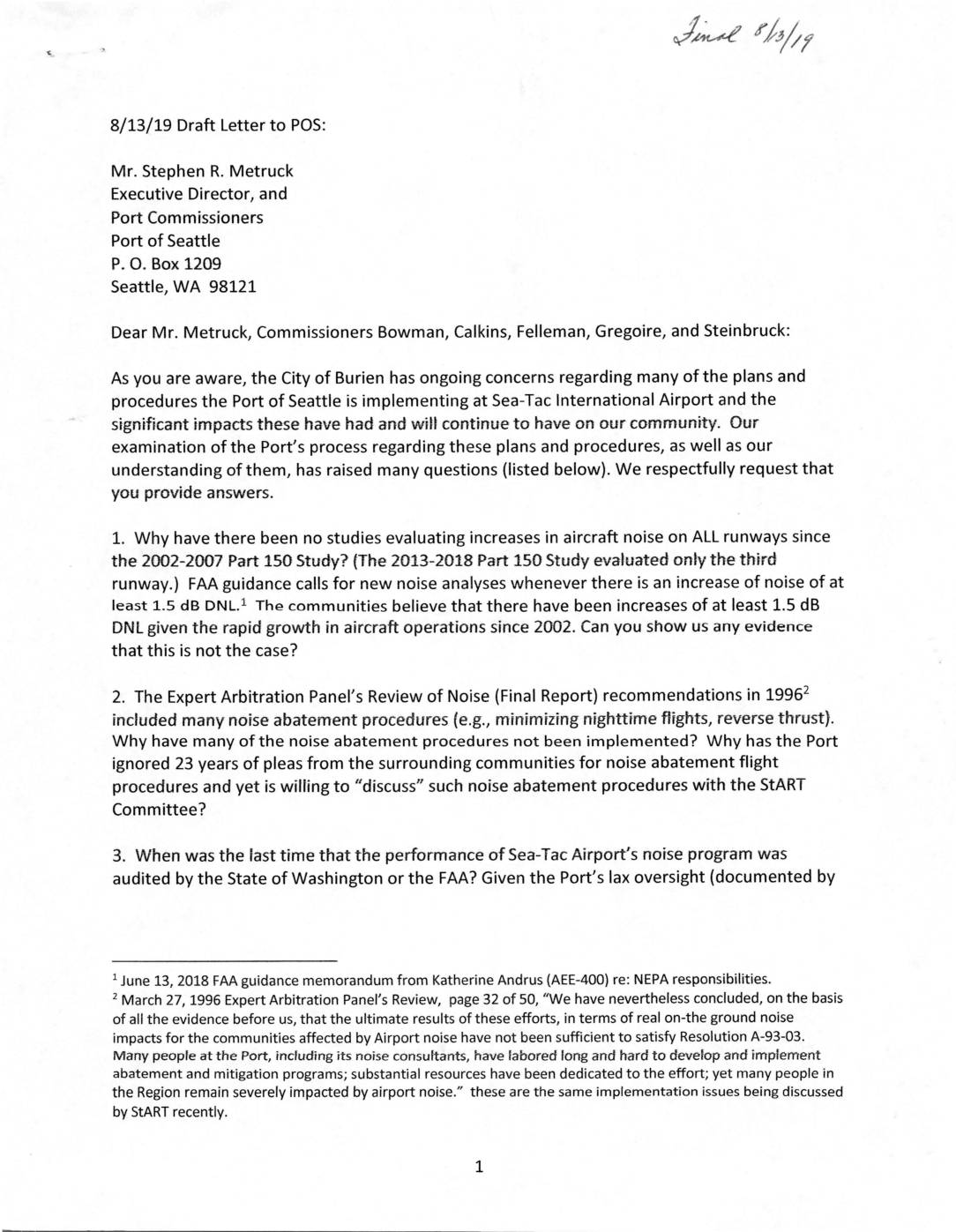
Dear Mr. Metruck, Commissioners Bowman, Calkins, Felleman, Gregoire, and Steinbruck: As you are aware, the City of Burien has ongoing concerns regarding many of the plans and procedures the Port of Seattle is implementing at Sea-Tac International Airport and the significant }rnpacts these have had and will continue to have on our communitY. Our examination of the Port’s process regarding these plans and procedures, as well as our understanding of them, has raised many questions (listed below). We respectfully request that you provide answers. 1. Why have there been no studies evaluating increases in aircraft noise on ALL runways since the 2002-2007 Part ISO Study? (The 2013-2018 Part ISO Study eva}Dated on ty the th}rd runway.) FAA guidance calls for new noise analyses whenever there is an increase of noise of at least 1.5 dB DNL.1 The communities believe that there have been increases of at least 1.5 dB DNL given the rapid growth in aircraft operations since 2002. Can you show us any evidence that this is not the case? 2. The Expert Arbitration Panel’s Review of Noise (Final Report) recommendations in 19962 included many noise abatement procedures (e.g., minimizing nighttime flights, reverse thrust). Why have many of the noise abatement procedures not been implemented? Why has the Port ignored 23 years of pleas from the surrounding communities for noise abatement flight procedures and yet is willing to "discuss" such noise abatement procedures with the StART Committee? 3. When was the last time that the performance of Sea-Tac Airport’s… -
 2024-05-13 19:04
BAC SP #2 Jason Schwartz Linked In Aviation Professionals, SFO Second Chance Initiative Form 0001
Airport Basics I Port of Seattle https://www.portseattle.org/page/airport-basics a SEARCHMENU (/) a Seattle*- Select Language v AAA Horne (/) / Newsroom (/newsroom) of Seattle / Fact Sheets (/newsroom/fact-sheets) / Airport Basics Privacy and Website Tracking (/privacy-policy) Airport Statistics Glossary0 (/page/airport-statistics- glossary) Publicationsa (/page/publications) Explore More Airport Statistics (/page /airport-statistics) Connections e-Newsletter (/page/connections- e-newsletter) Fact Sheets (/newsroom/fact- sheets) Nuts + Bolts (/page/nuts- bolts) Port of Seattle History (/page /port-seattle-history) Seattle-Tacoma International Airport A premier international gateway serving the Puget Sound region and Washington state. Publications (/page /publications) Seaport Statistics (/page /seaport-statistics) Operated by the Port of Seattle, Seattle-Tacoma International Airport (SEA, KSEA) is ranked as the eighth busiest U.S. airport, serving 49.8 million passengers and more than 432,315 metric tons of air cargo in 2018. With a regional economic impact of more than $22.5 billion in business revenue, Sea-Tac generates more than 151,400 jobs (87,300 direct jobs), representing over $3.6 billion in direct earnings and more than $442 million in state and local taxes. Thirty-two passenger airlines (/sea-tac/airlines-destinations) serve 91 non-stop domestic destinations (/page/non-stop-domestic-routes) and 29 international destinations (/page/non-stop-international-routes) including Canada, Winter Operations and Snow Removal at Sea-Tac Airport (/page/winter-operations- and-snow-removal-sea-tac- airport) Other Documents of 6 6/1/19, 2:42 PM (1) Jason Schwartz I LinkedIn https://www .linkedin.com/in/jasonlschwanz/ m Q n eAmeg '0 as Try Premium Freea for 1 Month e Jason SchwartzAviation professional with 25+ yrs of aviation experience including operations, aircraft noise, & community enga... Message More V tOWel De IZ 1 1/ a ABCx2 Communication within Teams Viewers: 63,328 • a… -
 2024-05-13 19:04
BAC SP #2 Final Package Of Remediated Noise Abatement Actions 19900331 Port Mestre Grieve Associates 0001
Tier 1 : Expand Existing Flight Track Monitoring System Tier 2: Develop New Comprehensive Noise Management System Tier 3: Integrate Noise and Flight Track Monitoring Section VIII: Flight Track Management Statement Regarding Flight Tracks Section IX: Section X: Section XI: Section XII: Process Appendix C: T N TENT Noise Budget Nightdme Liaitadon Noise Remedy/Mitigation Program Increase in Annual Rate of Insulation Audit Procedure Enhance Noise Remedy “Cost Shan" Program Alea Mobile Homes Hardship Comnittee Priority Listing Transaction Assistance Public Buildings Impiove Duwamish Industdal/Elliott Bay Corridor Noise Abatement Procedures Duwamish/Elliott Bay Corridor Procedures Microwave Landing System Nighttime Flight Corridors Control of Ground Noise Control Noise From Most Annoying Operations Initiate Noise Abatement Committee Changes in Present Conditions Sea-Tac Noise Abatement Committee f Page 3 Page 4 Page Page Page Page Page Page Page Page Page Page 7 Page 8 Page 8 Page 9 Page 10 Page Page Page Page Page 14 Page 14 Page 15 Page 15 Page 16 Page 16 Page 17 1- According to the technical coyuultalu, this agreenunt l=pnsenB dre most comprehensive noise conaol proW of anY tnajor international airport in the country. Full implementation of all these agreernents could result in an overall noise reduction of apDroxiantely 50% in terms of the Ldn noise levels hI dIe coarmunides surround&lg the airport„ NOTES : Italics indicate c}anges to tta Draft Packl8e resulting from the Mediation Commit' tee Betting on 3131190. I:frI If:638:}?}£i:::::’::::leET=V;:l:::£8£T£=;=£L3::: the Mediator's notes. -2. d SECTION I: NOISE, BUD(,.,ET a& The goal of a noise budget… -
 2024-05-13 19:03
BAC SP #2 FAA Performance Success Stories = Greener Skies Over Seattle 20190205 0001
RCW 36.70A.200: Siting of essential public facilities–Limitation on... https://app.leg.wa.gov/nw/default .aspx?cite=36.70A.200 + , RCW 36.7©A.200 Siting of essential public facilities–Limitation on liability. \ (1) The comprehensive plan of each county and city that is planning under RCVV IiA 36.TQA.<>48 shall include a process for identifying and sUng essential pubFtc facittbes. Essential //// public facilities include those facilities that are typically difficult to site, such as airports, state BIt education facilities and state or regional transportation facilities as defined in RCW 47.06. q 40, regional transit authority facilities as defined in RCW $$ „'tq 2,828, state and local correctional facilities, solid waste handling facilities, and inpatient facilities including substance abuse facilities, mental health facilities, group homes, and secure community transition facilities as defined in RCW Tq ,eg.628 (2) Each county and city planning under RCW 36.70A.040 shall, not later than September 1, 2002, establish a process, or amend its existing process, for identifying and siting essential public facilities and adopt or amend its development regulations as necessary to provide for the siting of secure community transition facilities consistent with statutory requirements applicable to these facilities (3) Any city or county not planning under RCW 36.70A,048 shall, not later than September 1, 2002, establish a process for siting secure community transition facilities and adopt or amend its development regulations as necessary to provide for the siting of such facilities consistent with statutory requirements applicable to these facilities. (4) The ofBce of financial rnanagement shall maintain a list of those essential state pubtk facilities… -
 2024-05-13 19:03
BAC SP #2 FAA Part 150 Study Record Of Approval 2013 (4 Th Part 150 Since 1985) 0001
The Seattle-Tacoma International Airport (Sea-Tac) Noise Compatibility Program (NCP) includes measures to abate aircraft noise, control land development, mitigate the impact of noise on non- compatible land uses, and implement and update the program. Title 14 Code of Federal Regulations (CFR) Part 150 requires that the plan apply to a period of no less than five years into the future, although it may apply to a longer period if the sponsor so desires. The airport sponsor has requested that the program measures be applied to the Future 2018 Noise Exposure Map/Noise Compatibility Program (Exhibit 6-2). The objective of the noise compatibility planning process has been to improve the compatibility between aircraft operations and noise-sensitive land uses in the area, while allowing the airport to continue to serve its role in the community, state, and nation. This NCP is an update to Sea-Tac’s existing program, which the FAA most recently approved in the 2002 Record of Approval (ROA). The recommendations consist of a continuation or modification of some currently approved measures from the 1985, 1994, and 2002 NCP ROAs. It also includes new measures. As outlined in Section 5.1.1 of the NCP, the currently approved Abatement Measures A-2, A-4, A-5, A-6, and A-9 have been completed and are therefore not carried forward in this NCP. Abatement Measures A-7, A-8, A-13, A-14 and A-17 have been withdrawn. Section 5.2.1 provides a review of the currently approved mitigation measures that were included in the 2002 ROA. Mitigation Measures M-1 and M-13 have been… -
 2024-05-13 19:03
BAC SP #2 FAA Airport Community Noise Roundtables And FAA Support Presentation 0001
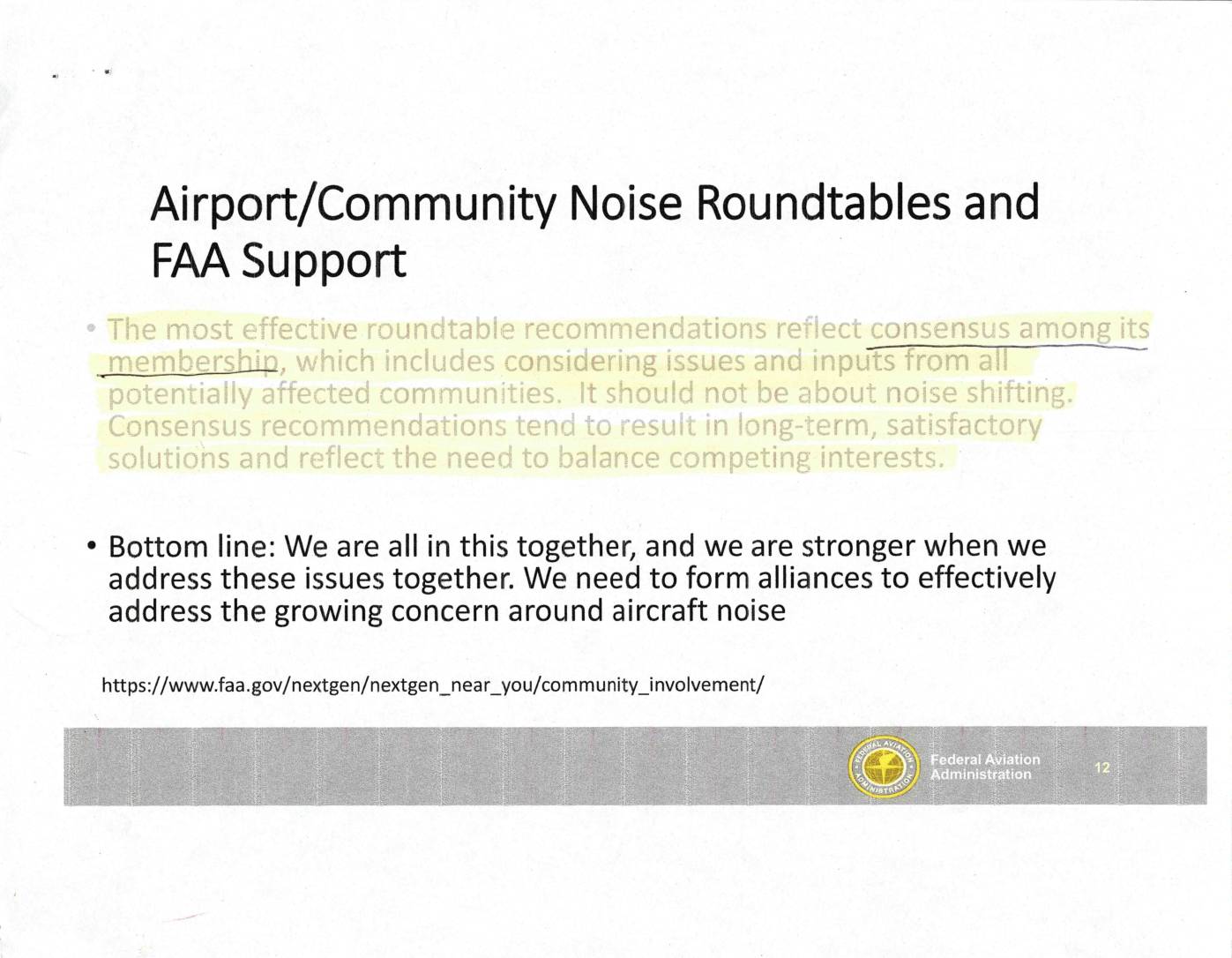
which § fic! tides .<:on$§derg fig §$$ucsg:e f :S. address these issues together. We need to form alliances to effectively address the growing concern around aircraft noise https ://www.faa .gov/nextgen/nextgen_near_you/community_involvement/ hi iiI:iii#!!:i}g #}}if$;}i: + + e Recommen Ins *({jr}MenigV {}’39jr{e are f%Lig*qd- f~eg:list)f f {) {] g"'] <=it a }) g {i) $ , • The ATO WSC must analyze, determine technical feasibility, and respond to each recommendation. This takes considerable resources to complete (months to respond) {"{e &: {”} g:::) ' Ifg f3 ' ;{''<:) [}{? ;}} • The recommendation backlog is considerable. The same ATO specialists work feasibility determinations as well as actionable processes. It’s a resource issue (human, financial) ; { } +’b',ii fi # de i&B k.'&„T/ FF:}} a H p q : ::j t&•a•r:r• F f • • •r I • : :•H r hIb f:it:: g:{#!! P U e Olse es a g: iwg*,*'§r<:>§*§ Fi*$ (? i*%{::;3:,-$;;3i§P$:V along the way # ;] g~"gp%=§zg ft g{§V §#a B{::IIZ% (bo$1] [t: gb It mean There are four feasibility measures: bio: Actionable processes: * E)w$igi’'3*/Dev©gopm)cri{ * ii:ftv§r8f3rv*gen{ai Revge@///$$ess{Bef}{/${(jd v * S;BYe{V RIs;i< Ma ii aHern on{ * g{*a§f} if 3g * §f'g'Q-f):ei}le§"%{i){§of3 t} See notes section for definitions liE; it i:Ii; U B Olse es a ;•} f--’if:: FAA (through the RA’s Office) will assign the appropriate Subject Matter projects, depending on need ;I$ Fii{{ rt/ C Olse a es a the Regional Administrator’s (RA) Office. If technical expertise is needed, the RA will arrange for the… -
 2024-05-13 19:03
BAC SP #2 BAC Draft Letter To Pos Stephen Me Truck On SAMP 20190817 0001
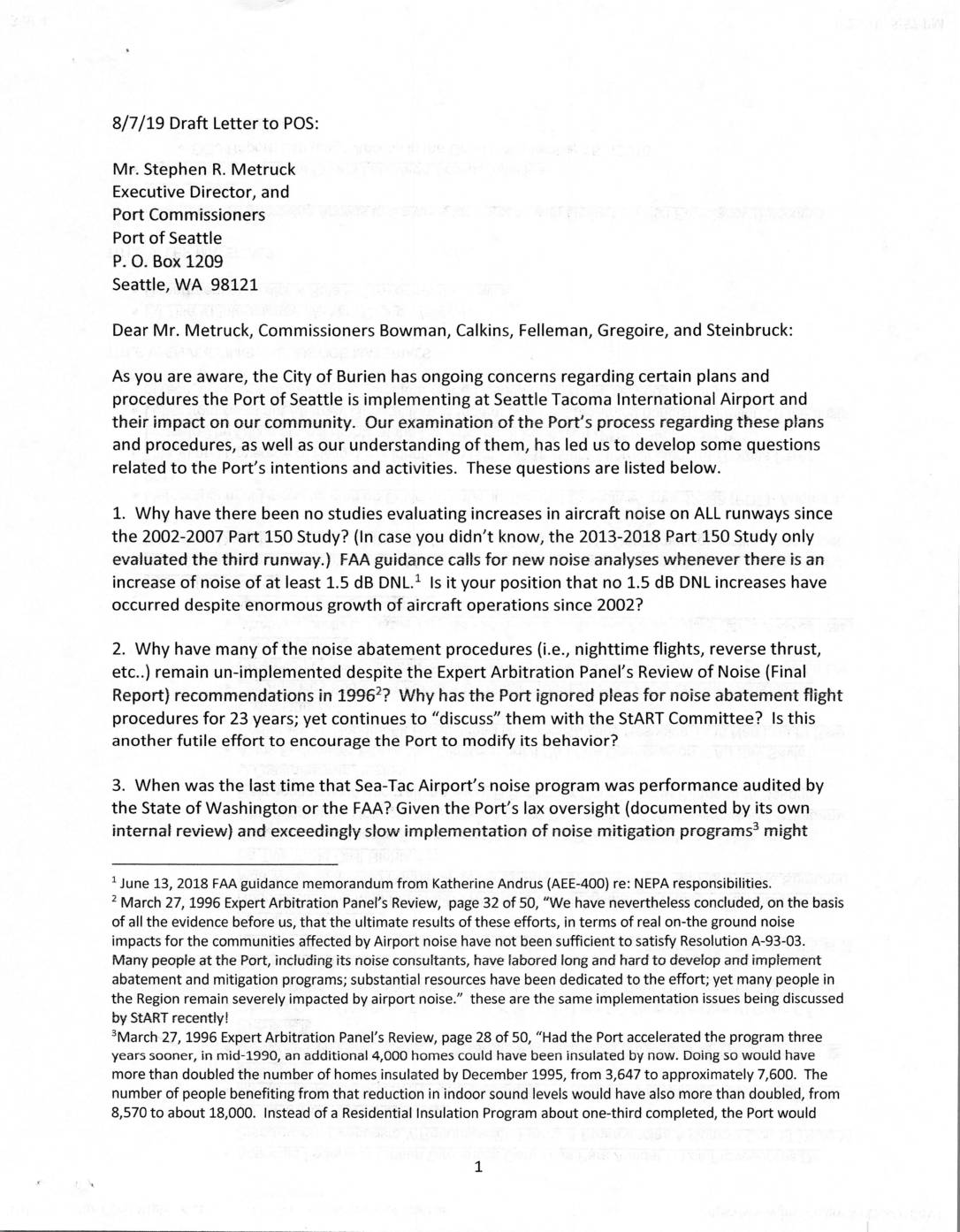
Dear Mr. Metruck, Commissioners Bowman, Calkins, Felleman, Gregoire, and Steinbruck: As you are aware, the City of Burien has ongoing concerns regarding certain plans and procedures the Port of Seattle is implementing at Seattle Tacoma International Airport and their impact on our community. Our exam}nation of the Port’s process regard}ng these ptans and procedures, as well as our understanding of them, has led us to develop some questions related to the Port’s intentions and activities. These questions are listed below. 1. Why have there been no studies evaluating increases in aircraft noise on ALL runways since the 2002-2007 Part 150 Study? (in case you didn’t know, the 2013-2018 Part 150 Study only evaluated the third runway.) FAA guidance calls for new noise analyses whenever there }s an increase of noise of at least 1.5 dB DNL.1 is it your position that no 1.5 dB DNL increases have occurred despite enormous growth of aircraft operations since 2002? 2. Why have many of the noise abatement procedures (i.e., nighttime flights, reverse thrust, etc..) remain un-implemented despite the Expert Arbitration Panel’s Review of Noise (Final Report) recommendations in 19962? Why has the Port ignored pleas for noise abatement flight procedures for 23 years; yet continues to “discuss” them with the StART Committee? is this another futile effort to encourage the Port to modify its behavior? 3. When was the last time that Sea-Tac Airport’s noise program was performance audited by the State of Washington or the FAA? Given the Port’s lax oversight (documented…