TagRCAA(175)
-
 1999-11-02 00:00
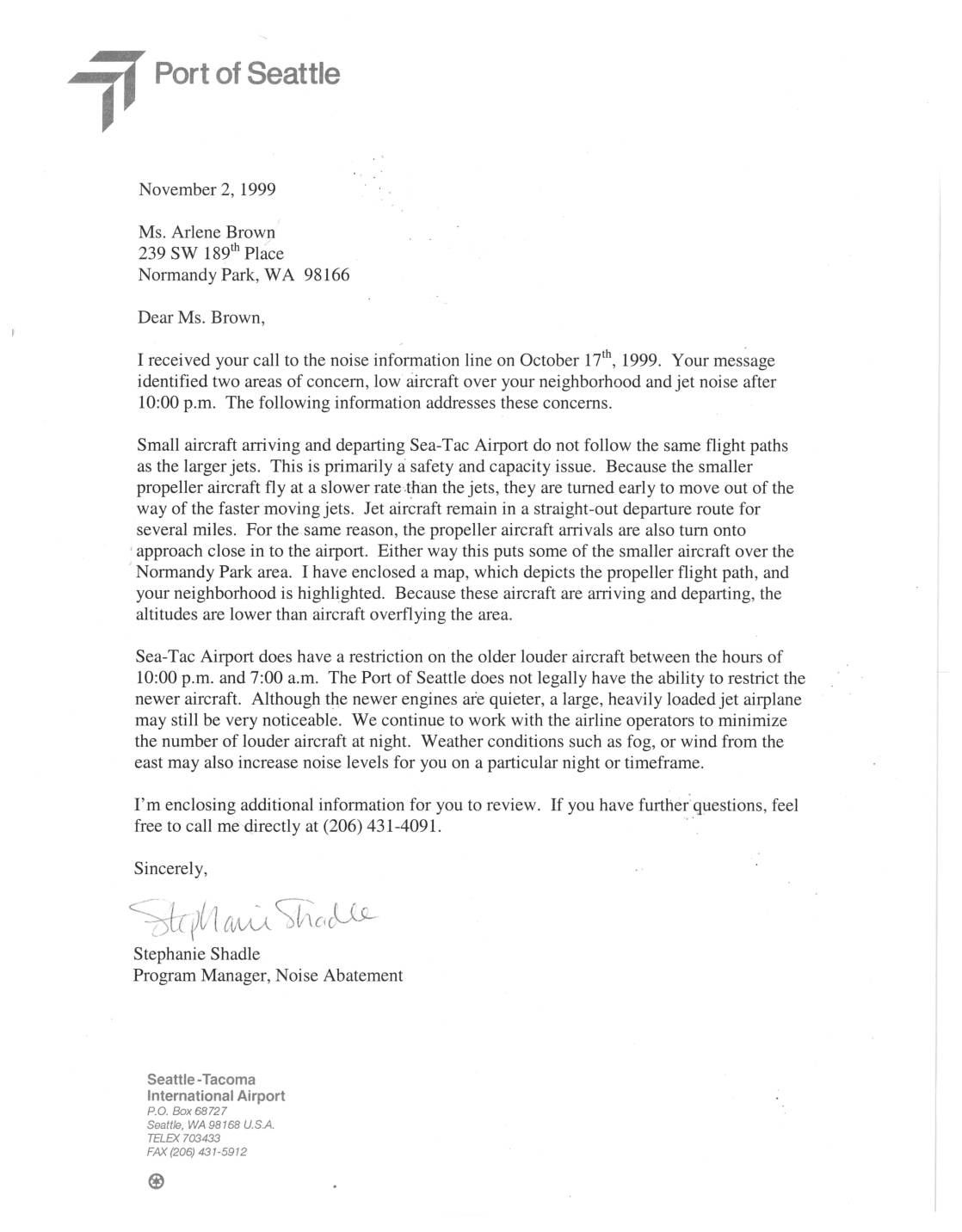
Port of Seattle Letter to Arlene Brown noise information
received your call to the noise information line on October 171h, 1999. Your message identified two areas of concern, low lli.rcraft over your neighborhood and jet noise after 10:00 p.m. The following information addresses these concerns. Small aircraft arriving and departing Sea-Tac Airport do not follow the same flight paths as the larger jets. This is primarily a safety and capacity issue. Because the smaller propeller aircraft fly at a slower rate,than the jets, they are turned early to move out of the way of the faster moving jets. Jet aircraft remain in a straight-out departure route for several miles. For the same reason, the propeller aircraft arrivals are also tum onto ' approach close in to the airport. Either way this puts some of the smaller aircraft over the ·Normandy Park area. I have enclosed a map, which depicts the propeller flight path, and your neighborhood is highlighted. Because these aircraft are arriving and departing, the altitudes are lower than aircraft overflying the area. Sea-Tac Airport does have a restriction on the older louder aircraft between the hours of 10:00 p.m. and 7:00a.m. The Port of Seattle does not legally have the ability to restrict the newer aircraft. Although tl~e newer engines are quieter, a large, heavily loaded jet airplane may still be very noticeable. We continue to work with the airline operators to minimize the number of louder aircraft at night. Weather conditions such as fog, or wind from the east may also increase noise levels for you… -
 1997-03-09 00:00
Why The Port Of Seattle’s Third Runway EIS Fails To Adequately Examine Impacts To Wetlands And Prescribes Inadequate Mitigation
Please place these ln Arlene's mailbox. Thanks. Al 3-1-97 5:21pm p. 1 of 7 Date: 3-1-97 Page 1 of 7 " .. / ~ .. ...,. -·--· ~tHrt THE POF:T OF SEA1TI.E'S 3F.D F.IJlH•]AY EIS FAILS ADEC!fJATEL':.( TO EXAl·fWE B·fPACTS TO ~·)ETLANDS AUD PP.ESCF:IBES m ADEC!fJATE l·HTICJATIOU The FAA Must Comply With Federal Requirements for the Protection of Wetlands Every federal agency is obligated "to minimize the destruction loss or degradation of Vetlands, and to preserve and enhance the natural and beneficial valu~s of wetlands in carrying out the agency's responsibilities for ... providing Federally undertaken, financed, or assisted construction and improvements." 1 Federal agencies, including the FAA, are prohibited from providing funding or other assistance for the construction of projects in wetlands unless they find ·· ( 1) that there is no practicable altemative to such construction, and (2) that the proposed action includes all practicable measures to minimize harm to wetlands which may result from such use." 2 Each of the Master Plan l:"pdate ''Vith Project" proposed alternatives would affect existing wetlands. 3 "Impacts on these wetlands would include: placement of fill material, dredging. removal of existing vegetation, and changes in hydrologic regimes as a result of increase impervious surf ace area and storm water management system restructuring." 4 Section 404 of the Clean Vater Act requires that anyone proposing to discharge dredged or fill material into navigable waters must first obtain a permit from the U.S. Army Corps of Engineers ('Corps'). 5 "Navigable waters" are defined as… -
 1996-03-18 15:31
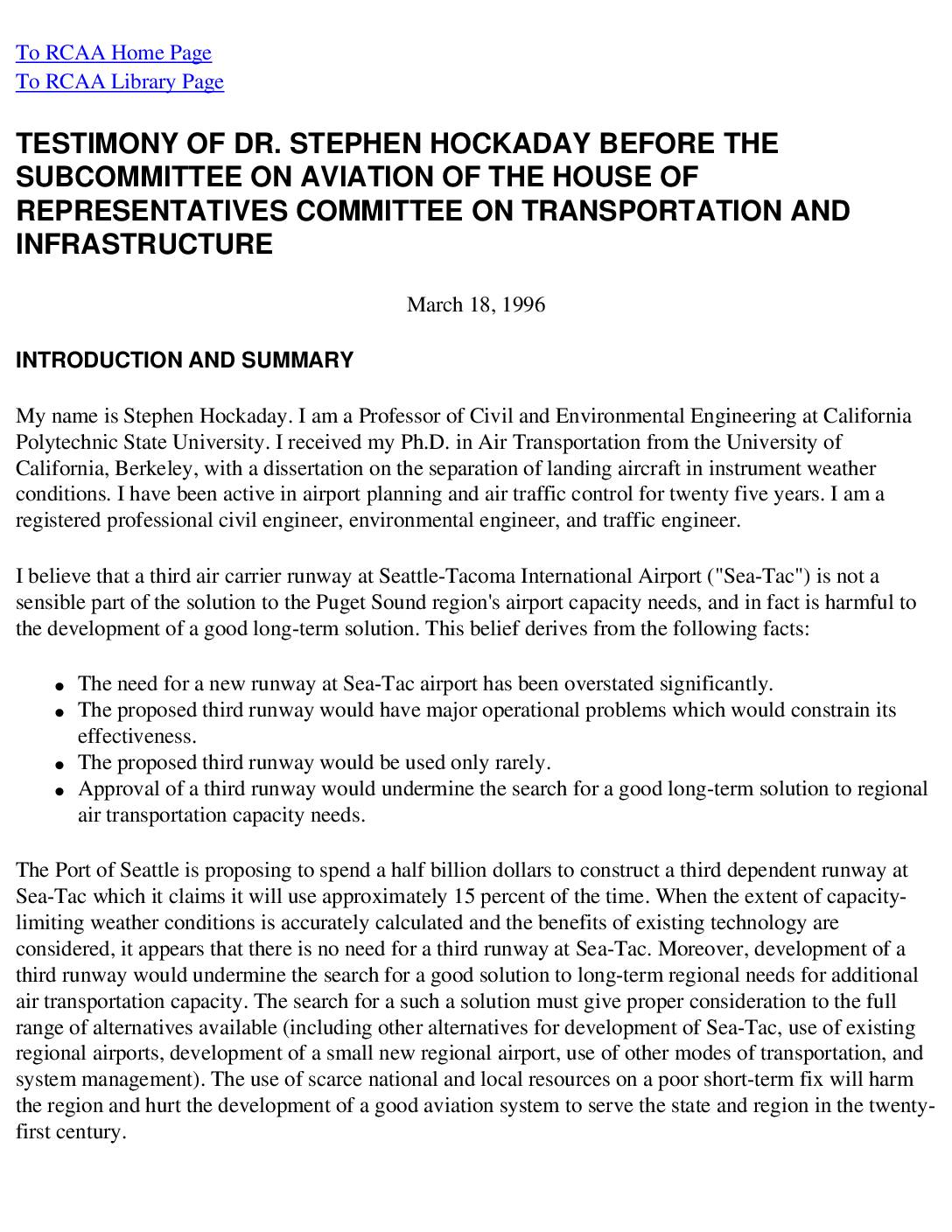
Stephen Hockaday – Testimony, House Aviation Subcommittee
My name is Stephen Hockaday. I am a Professor of Civil and Environmental Engineering at California Polytechnic State University. I received my Ph.D. in Air Transportation from the University of California, Berkeley, with a dissertation on the separation of landing aircraft in instrument weather conditions. I have been active in airport planning and air traffic control for twenty five years. I am a registered professional civil engineer, environmental engineer, and traffic engineer. believe that a third air carrier runway at Seattle-Tacoma International Airport ("Sea-Tac") is not a sensible part of the solution to the Puget Sound region's airport capacity needs, and in fact is harmful to the development of a good long-term solution. This belief derives from the following facts: ● The need for a new runway at Sea-Tac airport has been overstated significantly. ● The proposed third runway would have major operational problems which would constrain its effectiveness. ● The proposed third runway would be used only rarely. ● Approval of a third runway would undermine the search for a good long-term solution to regional air transportation capacity needs. The Port of Seattle is proposing to spend a half billion dollars to construct a third dependent runway at Sea-Tac which it claims it will use approximately 15 percent of the time. When the extent of capacity- limiting weather conditions is accurately calculated and the benefits of existing technology are considered, it appears that there is no need for a third runway at Sea-Tac. Moreover, development of a third runway… -
 1995-04-20 00:00
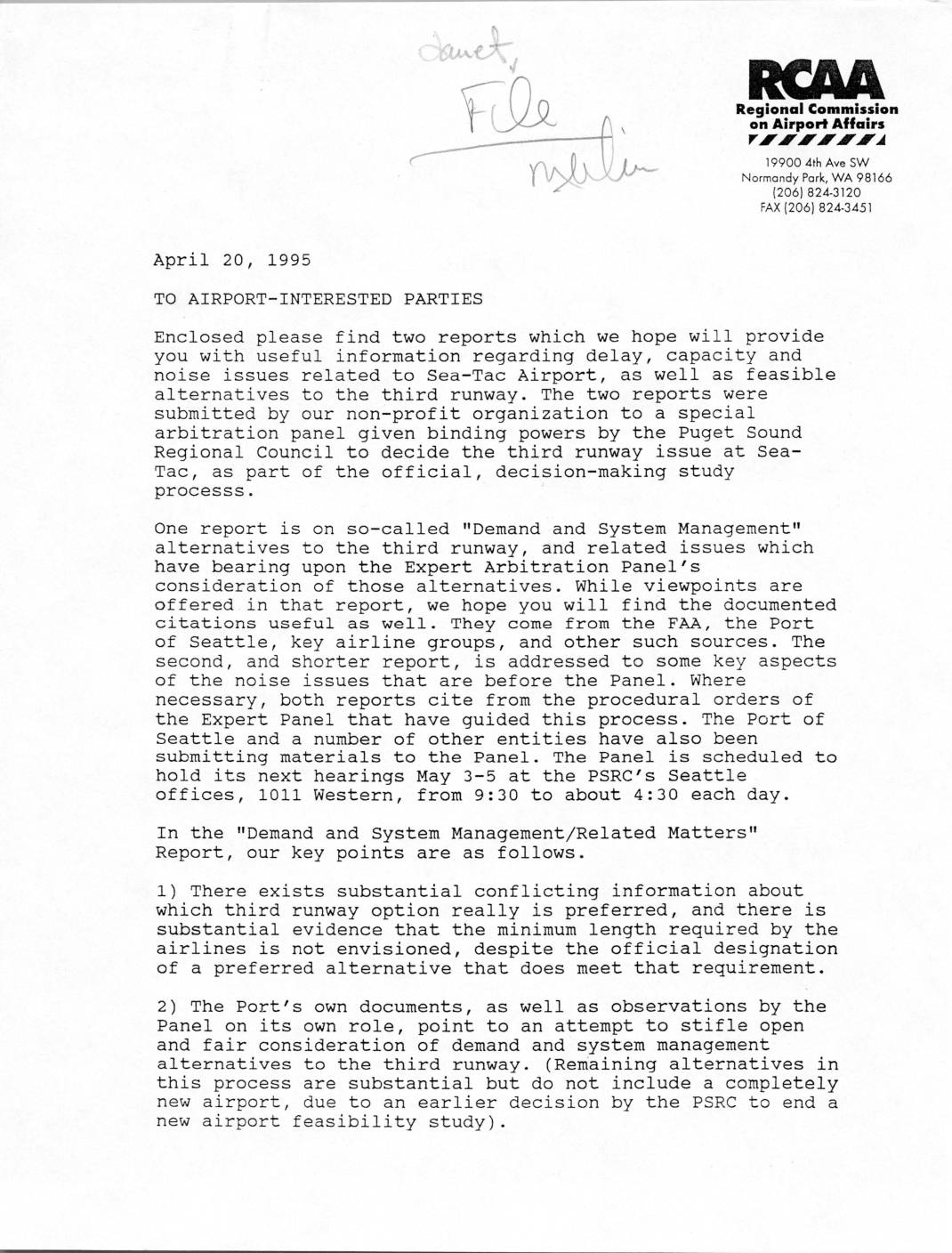
RCAA – Response to Procedural Order, Expert Arbitration Panel, April 20, 1995
Enclosed please find two reports which we hope will provide you with useful information regarding delay , capacity and noise issues related to Sea-Tac Airport , as well as feasible alternatives to the third runway . The two reports were submitted by our non'-profit organization to a special arbitration panel given binding powers by the Puget Sound Regional Council to decide the third runway issue at Sea- Tac , as part of the official, decision-making study processs One report is on so'-'called "Demand and System Management'1 alternatives to the third runway , and related issues which have bearing upon the Expert Arbitration Panel’s consideration of those alternatives . While viewpoints are offered in that report , we hope you will find the documented citations useful as well. They come from the FAA , the Port of Seattle , key airline groups , and other such sources . The second , and shorter report , is addressed to some key aspects of tEle noise issues that are before the Panel. Where necessary, both reports cite from the procedural orders of the Expert Panel that have guided this process . The Port of Seattle and a number of other entities have also been submitting materials to the Panel. The Panel is scheduled to hold its next hearings May 3-'5 at the PSRC’s Seattle offices , 1011 Western , from 9 : 30 to about 4 : 30 each day . In the ’IDemand and System Management/Related Matterst1 Report, our key points are… -
 1992-10-05 00:00
Hansen & Sanders – Adverse Health Impacts of Airport Expansion (Sea-Tac), October 5, 1992
From the Health Subcommittee of the Environmental Impact Committee of the Regional Coalition on Airport Affairs Prepared by : D. Dennis Hansen, M. D. Lee A. Sanders M. D. , Ph. D. With assistance from Mark Bened llm ( Associate Administrator Highline Hospital) Rose Clark (Concerned local citizen) 10/5/92 - P SUWARY OF ADVERSE HEALTH EFFECTS OF AIRPORTS Fiction : Airport noise is a minor annoyance and people living near the airport should be 'lgood sports" and learn to ignore it Fact : Airport noise results in a significant increase in community use of tranquil i z ers and sleeping pills . Airport communities have an increased rate of alcoholism , and admissions to psychiatric hospitals . Airport-related noise can literally drive people mad. II li I1 I1 I1 I1 I1 I1 I1 I1 I1 I1 I1 I1 I1 I1 I1 I1 I1 1 Fiction : Communities near the airport offer affordable housing and would be suitable for young families. Fact : Infants born to mothers living under the flight path have lower birth weights and higher likelihood of prematurity. There is some experimental evidence to suggest that serious birth defects are more likely when the mother is exposed to high noise levels during pregnancy. Airport communities are unsafe for pregnant women and their children II II II II II tIll I II II II II II II II II II II II II Fiction : Although it is annoying, airport noise will not affect your physical health . Fact…