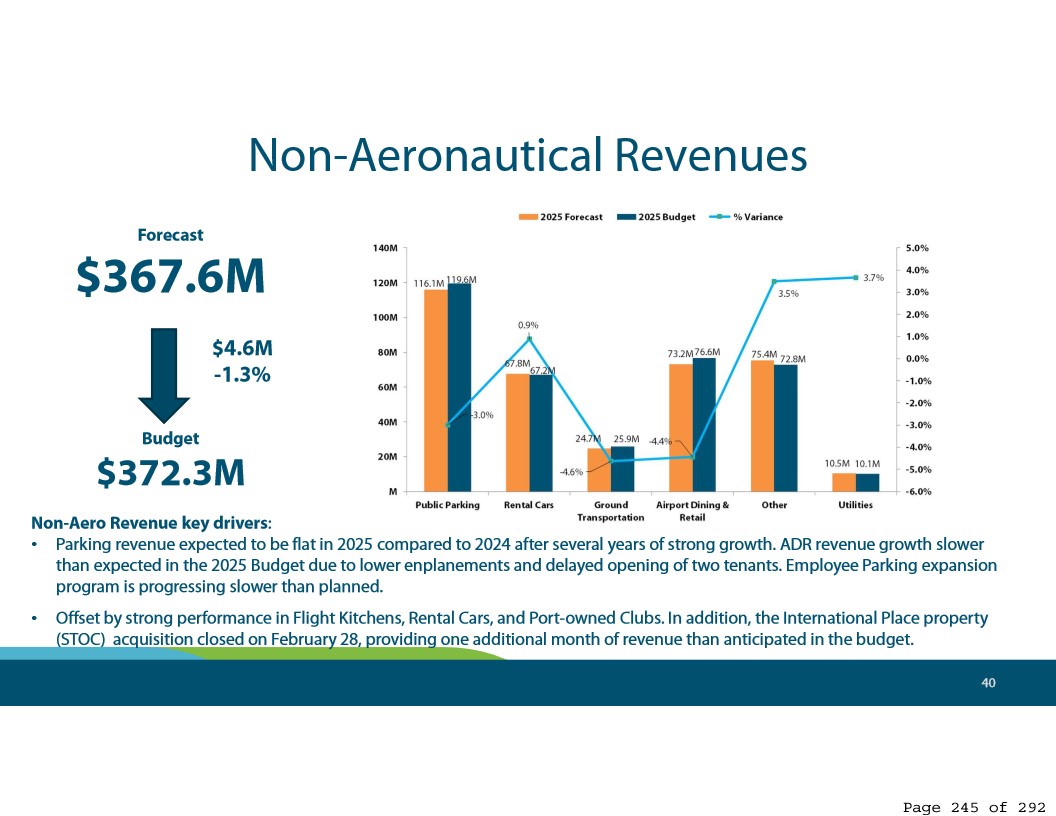
Despite small bumps in non-aero, performance remains strong
August 12, 2025 Agenda and full Packet
Director Metruck had several reasons to smile, not the least of which being the airport’s continued record-breaking weekly operations report. Beyond that this last Commission meeting had two items of interest for us.
SIRRPP
In his opening remarks Director Metruck mentioned updated stats on the Sound Insulation Repair Replacement Pilot Program (SIRRPP). But there is really nothing new. 262 homes were ‘invited’ to receive acoustic testing. 32 tests have been completed, with an ultimate goal of 111. No work has been done, although Metruck said that decision on those thirty would be coming in the next month. The Port has offered to provide ‘expanded assistance’ to homeowners in finding replacement parts on their own.
It has been two years since the Port proposed the SIRRPP. No work has been done and Metruck’s remarks seem to indicate that only the thirty that received acoustic testing will be considered. Ouch. We would remind the Port that there was no such requirement for the original Port Packages. Being inside the DNL65 was considered all the eligibility one needed. Isn’t that the point of having a noise boundary?
- Adding an additional requirement layer, using testing standards from fifty (50) years ago, does not reflect real world experience and is completely out of line with public health.
- Offering to assist home owners in obtaining their own replacement parts is cynical. No homeowner should be encouraged to do this because according to the legislation the Port supports for sound insulation updates, it would almost certainly, permanently remove the home from federal eligibility. Again: if you do the work yourself, you will likely not be eligible for any future Port Package program!
Q2 Financials and us
The second half of the meeting was a presentation on the Port’s Q2 financials. We repeat each time: these reports are worth watching because the Port is such a complex beast. They are extremely well done and it is no small feat to make the empire understandable. We need to understand in order to determine what we can reasonably expect.
The Port has now passed $1B in overall revenue and the majority of that growth comes from the airport – about 80% of gross.
The founding psychology
Though the Marine Division now represents a small fraction of the Port’s revenue, the word ‘port’ will always conjure images of its founding in 1911 as a seaport that serves Seattle. A large percentage of the Port’s efforts, including psychology stays rooted there. If you listen carefully, particularly to long-time advocate Fred Felleman, the Port’s sincerest efforts at environmental stewardship have always been and remain on the water. By watching the passion they express for both Seattle and its waters, we know how much more is possible under the flight path.
 A healthy airport reserve
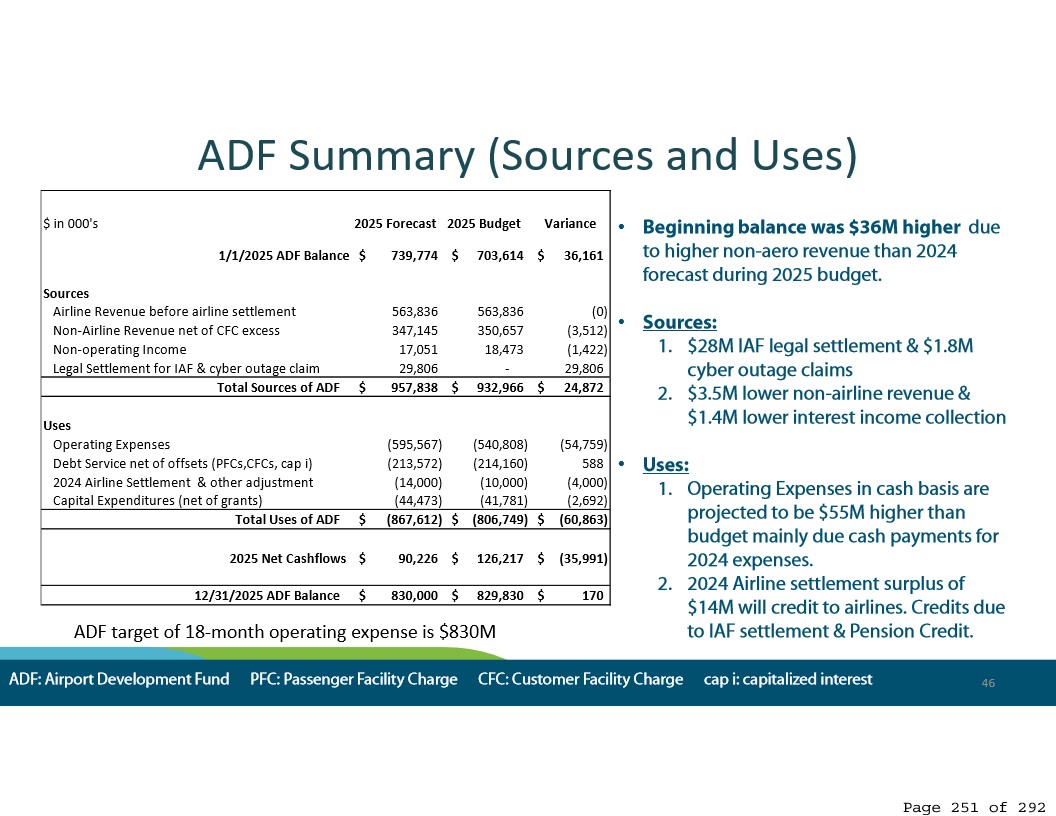
For community members, the Airport Development Fund is of particular interest. Whenever the public looks at the massive revenues generated by airport operations, there is immediate push back that the airport needs every dime to stay in business. And further, under FAA regulations the vast majority of airport revenues must stay ‘at the airport’. This leaves communities confused and angry: how can the airport generate so much money and have nothing for community impacts?
The ADF provides a window into this. The ADF is funded from several sources, including grants PFC charges and aviation fuel taxes. It acts more like the reserve accounts cities maintain. While ADF money cannot be spent at will, it does provide a possible avenue for noise mitigation funding outside the DNL65 – if both the Port and cities are willing to move beyond the false narrative of waiting for congress to act.
Typically cities can afford only to maintain a few months in general reserve. The ADF is currently at $850 million – eighteen (18) months. The airport has been able to achieve this astounding results in spite of the largest capital expenditures in airport history (aka the Sustainable Airport Master Plan).
Why this matters
The SIRRPP has been handled cynically. Rather than begin a simple program that would provide an equitable chance for everyone who deserves relief, it offers a false solution based on 50 year old regulations and antiquated notions of public health that even the FAA agrees is outdated. To avoid spending its own money, they continue to distract airport communities and even encourage electeds and StART members to lobby in order to further that effort.
By watching their work on the waterside, we know what the Port can do in terms of environmental and community stewardship when it takes a sincere interest and has the money. And the meteoric growth of the airport has given it that money.
The ADF is not open to unconstrained uses. However, it provides another avenue that should be explored for noise mitigation outside the DNL65.
In a previous article, we mentioned that the Port had various sources of revenue to pay for community mitigations (including Port Package updates) using its own money. We provided the tax levy as one example. Unfortunately, some readers grabbed onto that as ‘the solution’. It was never the only solution. We understand the issues are complex and readers want ‘simple’ and ‘now’. But all these discussions are complex. The various programs funded by the tax levy took years to negotiate. If we only talk about ‘tax levy’, even before fully understanding the program, we will likely end up with nothing, or another SIRRPP — a solution that makes things worse.
We should not limit ourselves to one solution. At this stage of the SAMP, we encourage readers to stick with a simple message: The Port’s aim is to be ‘the greenest port in America’. It has several sources of its own funding which can be used to achieve that aim for airport communities, including sound insulation and mitigations to reduce noise and pollution. If we agree on that shared aim, we can then negotiate the proper mechanisms to get there.
On Aug 14, mid day, I flew from Seattle to San Jose. Our plane sat on the taxiway for about 30 minutes before we could depart. I asked a cabin crew member if this was normal. “Yes, happens all the time” and “we flew up from San Francisco earlier today (not San Jose), and we had to wait on the ground at SFO for 50 minutes after our schedule take off time because the air traffic controllers did not have space for us to land at Seatac.” I asked “how can Alaska think of adding all these flights to Europe? This place is jammed enough already.” The response, and keep in mind this is not official statements from an official source: “Portland is going to be more of a domestic hub. Seattle will be the international hub. So if you’re flying on Alaska from San Francisco to New Orleans, you’d fly SFO PDX New Orleans.” I said ” but that’s flying two sides of a triangle instead of one. Why would anyone do that?” She said “well yes directs are always better.”
As we sat in line on the runway, I thought about all the air pollution being generated from the planes. The article mentions how some commissioners make a big deal about Puget Sound, but are silent about impacts on the airport. News flash: the pollution from the airport does increase the acidification in Puget Sound. By how much would SAMP increase it? Well by none according to the Port staff, because ‘SAMP won’t allow for more travel, it will just result in less delay for the traffic that is going to occur anyways.’ yeah right. And is that something those staff’s pensions depend on ? Nope.
I tried to find some data about how much a 737 800/900 emits in various pollutants when idling. I don’t understand the data well enough, but I think over time it becomes a significant amount. It appears VOC is worse during cold weather than in warmer weather.
The Port can claim “well if we have more gates and a new terminal, then we can leave the planes under electric power a lot longer.” Problem: they never want to say “no” more flights. They never want to limit capacity. My strong sense is if all gates are added, the taxiways will still fill up. The catchment area for domestic flights is not really right for Portland to be a sub, few people will want to fly north to Portland, or west, then turnaround and fly the opposite direction.
The new terminal buildings are quite wonderful. But it is pretty sickening to realize there’s zero property tax paid for local schools and other services that the Port does rely on, such as fire districts for all the warehouses that are near by (it is much faster for a truck from the Des Moines fire stations to get to 216th and vicinity than a fire truck from the airport runway stations.
The return trip on Aug 17 did not have the delays. But getting luggage was a nuisance. The cabin crew said carousel 14. The reader board was blank for our flight. A bunch of luggage did come off on 14, but it was from a different flight. Eventually a staff person came over and said we needed to go to 15. But few people heard her. A few did go over, then had the kindness to tell the rest of us that our luggage not only was at 15, it had been there so long that some other staff had removed it from the belts and it was sitting on the floor. This is “not fun” when it is already midnight.