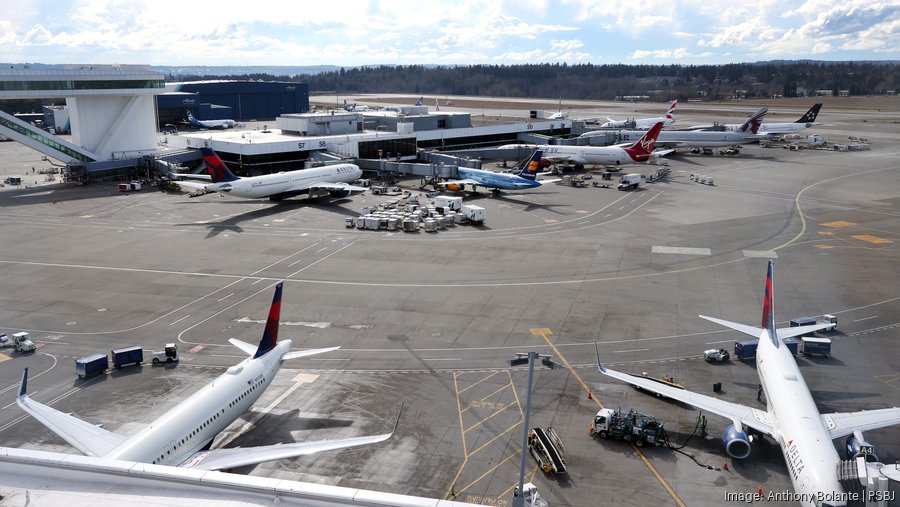
Commercial passenger airplanes are seen parked at Sea-Tac Airport. Taxiing times at airports have been on the rise in recent years, and experts say there are few easy solutions.
Anthony Bolante | PSBJ

By Andy Medici – Senior Reporter, The Playbook, The Business Journals
Nov 3, 2025
Story Highlights
What’s This?
- Average departure taxi time increased to 18.26 minutes in 2024.
- New York area airports lead in prolonged tarmac wait times.
- Arrival taxi times also rose to 8.71 minutes on average.
Airline passengers are spending more time on airport tarmacs than they were before the pandemic, and with a host of factors fueling the increase, experts say a return to pre-Covid norms is likely elusive.
At Seattle-Tacoma International Airport, the average taxi time for departures was 20.67 minutes, compared to 19.93 in 2019. The average arrival taxi time was 11.12, one of the longest times in the nation, and up from 10.29 in 2019.
That’s according to a review of Federal Aviation Administration data by The Business Journals, which found the average departure taxi time — the time it takes from when your plane leaves its gate to when its wheels lift off the ground as it takes off — increased from 17.82 minutes in 2019 to 18.26 minutes in 2024 across 83 major U.S. airports.
The airports with the longest average departure taxi times are a mix of the nation’s largest airports and space-constrained urban airports. The data covers the entire 2024 calendar year.
At the top of the list for airports with the longest average departure taxi times were:
- John F. Kennedy International Airport (New York City): 26.57 minutes.
- Newark Liberty International Airport (New Jersey): 25.11 minutes.
- Chicago O’Hare International Airport: 23.68 minutes.
- LaGuardia Airport (New York City): 23.44 minutes.
- Charlotte Douglas International Airport (North Carolina): 22.56 minutes.
The average departure taxi time at many airports was largely the same in 2024 as it was in 2019. Some airfields, however, saw notable changes.
San Diego International Airport, for example, saw its average departure taxi time grow from 17.28 minutes to 21.45 minutes.
In the case of New York’s LaGuardia Airport, while it’s No. 4 on the list for longest average taxi time, that average of 23.44 minutes in 2024 is markedly down from 27.05 minutes on average in 2019.
New York-area airports also topped the list of airfields with outlier flights that ended up sitting on the tarmac for extended periods of time. Those airports with the highest percentage of departures that saw taxi times exceed 60 minutes in 2024 were Newark, at 2.92%, followed by JFK at 2.74% and LaGuardia at 2.02%.
The national average was 0.75% of flights across the 83 airports with available data.
Arrival taxi times — the time from when a plane’s wheels touch the runway to when it connects to a jetway — tend to be far shorter than their departure counterparts, at roughly 8.71 minutes on average in 2024, up from 8.21 minutes in 2019 across the 83 airports tracked.
The airports with the longest average arrival taxi times were:
- Chicago O’Hare International Airport: 15.76 minutes.
- Dallas Fort Worth International Airport: 13.45 minutes.
- Charlotte Douglas International Airport: 13.42 minutes.
- John F. Kennedy International Airport: 11.97 minutes.
- Seattle-Tacoma International Airport: 11.12 minutes.
Chicago O’Hare also ranked first for the percentage of arriving flights that saw a taxi time above 30 minutes, at 5.98%, followed by Charlotte, with 4.32% of arriving flights seeing a taxi time above 30 minutes.
Nationally, the percentage of flights with an arrival taxi times of more than 30 minutes was 1.73% in 2024, up from 1.43% in 2019.
Complexities of taxi times for airlines, airports
The subject of taxi times is a Gordian Knot of sorts — a complex interconnection of airlines, airports and regulations that’s tough to untangle. Andrew Spatz, an attorney who has represented airlines and airports for decades, said there is reason for cautious optimism, though.
The evolution of airlines and airports toward a “hub and spoke” model means there’s an increasing number of passenger transfers. That creates a heightened sense of urgency among passengers, because travelers need to catch another plane to get to their final destination.
Some of the challenges of taxi times stem from how flights are scheduled. Airlines will pad their air-travel time to ensure they get to a destination ahead of schedule but then often will sit on the runway while passengers might be thinking they arrived early.
“Because you are so early, the plane lands, and there is no gate for it,” Spatz said.
Rushing to reach your flight in time only to sit on the runway is tied in part to incentives, Spatz said. A flight is technically delayed only if the plane hasn’t left the gate 15 minutes after its scheduled time. That means an airline might leave the gate even when there is no departure window for them or if air-traffic control is not ready — in the interest of maintaining an on-time departure.
“They will close the door, pull the jetway away from the plane: That’s considered an on-time departure,” Spatz said.
The intricate air-travel network can be easily disrupted by severe weather and other issues, Spatz said, leading to pileups and massive travel delays. Delays caused by bad weather are not considered the fault of the airlines.
There also is dated airport infrastructure that, while being modernized, still serves as a drag on airport traffic and airplane arrivals and departures, Spatz said.
Newer airports or terminals are now being built in ways that allow for airplanes to prepare for departure and take off faster, which should reduce both delays and prolonged taxi time.
Still, the complex interplay between all the different functions and companies involved means any one disruption can cascade down the chain, Spatz said.
“Everybody has got a role to play,” Spatz said. “If it’s not done properly, it snowballs, and the effects are terribly long delays.”
Other complications that exacerbate taxiing issues include:
- A lack of ground crew. Airlines often are responsible for the availability of ground crew at airports, and companies that try to run lean may not have enough crew on hand during busy times, causing some planes to have to sit and wait before getting to a gate.
- Mechanical or other systems issues. Planes might need to de-ice during cold weather but end up waiting so long on the tarmac they have to de-ice once more, which can cause a domino effect. Mechanical issues or fuel issues also end up messing with timelines and causing planes to sit on the tarmac.
- Air-traffic control systems, which can often be outdated, as well as shortages in air-traffic control staff — an issue that has been in the spotlight in recent years.
Spatz’s biggest worry actually comes from the behavior of passengers in a stressed system. While it’s understandable for passengers to be upset by a bad experience, they should not be taking out their frustrations on front-line workers or fellow passengers.
“There are a number of flights that are getting diverted or delayed because people are acting obnoxious,” Spatz said