Crucial information. Is anyone listening?
This week’s Commercial Aviation Work Group agenda April 28, 2026 meeting in Moses Lake was the latest in a trend of much more useful events under new WSDOT Aviation Director Ann Richart.
The goal of the current group, versus the old CACC is no longer ‘find a second airport’. Now the mission is rather, ‘How do we meet regional aviation capacity?’ This may seem like a loss for Sea-Tac communities. But the old group, and its original goal was never going to happen. We say good riddance to unreleastic goals.
The meeting was broken into three pieces: first a deeper dive into regional capacity–which always focuses on Sea-Tac given its regional dominance. This is excellent information. Presenters always discuss the ‘challenges’ of expanding Sea-Tac–and how demand may peak within the next decade.
Second, an explanation of evTOL, small electric aircraft that will be used for small cargo deliveries and small air taxis. Although testing for safety will take time, the tech is happening now, and Boeing Field (KCIA) is actively preparing for it in their Vision 2045. As anyone who has attended a drone show knows, it may be zero emission, but it is not noise free. It will also require a whole new way of thinking about air traffic control. Vertical layers much closer to the ground will become a new set of ‘lanes’ on the railroads in the sky.
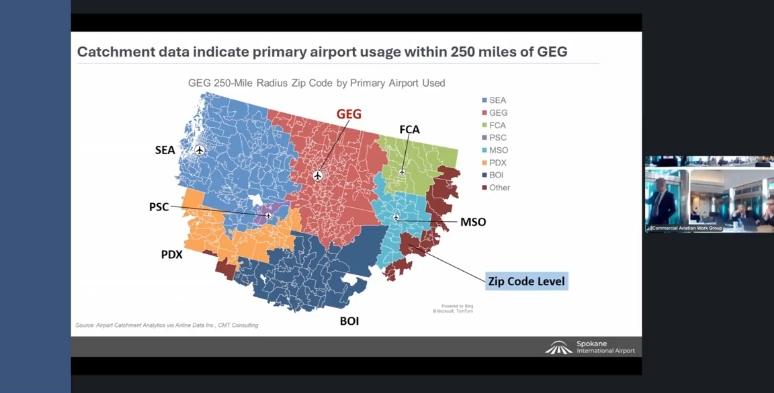
The unexpected highlight for us was a presentation on Spokane International Airport–the second largest airport in the State. This slide showing catchment was revealing–the boundaries where people will choose one airport over another. Despite decades of trying to connect Washington, each area remains isolated. With no foreseeable options for improving ground transportation (road, rail) we are stuck with Sea-Tac as the gravitational center of commercial activity.
For that reason, we remain skeptical of any limits on expansion at Sea-Tac.
These participants–like our own StART roundtable–continue to ask for even more studies. We consider all these a waste of time and footdragging–simply a way to appear like people are doing something rather than addressing what everyone has always known and no one wants to deal with: Sea-Tac is always ‘the answer’. To airlines’ preferences. To politics. To NIMBYism. The question is, why aren’t the people under the flight path ever properly compensated for those inevitable realities?
Over the past 60 years there have been constant moans as to the limits of Sea-Tac. It’s too small. They won’t be able to meet demand. Demand will peak. These are also distractions and also intentional–like offering people some unrealistic ‘hope’ for a future no one really believes.
The one constant in the history of KSEA has been that they have always found a way. The region demands economic growth–and the Port of Seattle delivers. Sometimes with neither integrity or honesty. Often with terrible cost-overruns. But time and again they do deliver for the region.
The real question is: when will we insist they also do so for people living under the flight path.
Transcript
machine-generated00:00:04.080 — Work group members and members of the public, please share to sign in on the appropriate sign-in sheets.
00:00:11.080 — There will be an opportunity for public comment from 1245 to 1 15 PM.
00:00:17.079 — And I will alternate between in-person and online.
00:00:21.079 — Workgroup members, please speak clearly and loudly throughout the meeting, so those in person and on line can hear you.
00:00:28.943 — Hybrid meetings can come with unique challenges, so I appreciate everyone’s cooperation and patience if any technical difficulties arise.
00:00:35.944 — Work group members online, please keep your video on and microphone on mute unless you are speaking during the meeting.
00:00:41.944 — Please speak freely during a meeting or use the hand raise button.
00:00:45.944 — As a reminder, members of the public will be muted unless they are called on during public comment in which I will mute you to speak.
00:00:53.024 — For those in person the emergency exit is located in the back and both sides of the room and restrooms are in The back, and more in a lobby now.
00:00:58.183 — I will pass it on to Evan Well good morning everybody welcome to Grand County and National Airport.
00:01:02.743 — Our host here is Miller.
00:01:02.743 — Thanks for having us thanks for coming out We have quite a good turn out here in-person and then quite if the people on Zoom I Want to specifically welcome the new members of big group We have a fresh lawyers from the watch a state aviation alliance, not voting advisory member Well, thank you for joining us to lawyers And then we have David Parry who Pointing into their audience still pending but he is the airport director of a school fan Your hands all airport Going to join us a bunch.
00:01:47.695 — Okay.
00:01:47.695 — Oh, that’s it right now Why don’t we go around and introduce everyone who’s here in person, and then we’ll introduce the soon-most speakers.
00:02:00.632 — So as I think I mentioned, I’ve been a citizen representative from a airport community in Washington, you know, West Seattle.
00:02:12.352 — Stephen Polonsky with the Washington State Department of Commerce.
00:02:20.960 — courts, court districts in state law.
00:02:23.800 — Friend lawyers, as you mentioned, I’m the representative of the Washington State Aviation Alliance.
00:02:28.639 — Gary Ward, I am a citizen representative from the Eastern Washington.
00:02:32.719 — I have a state representing the 13th legislative state district in law, my district, the state, well the grant can’t interact with her.
00:02:41.159 — You already introduced me, so I passed.
00:02:44.879 — Or I stand on the city representative in West Virginia.
00:02:49.487 — Chris Frocken, who’s a new media documentary, or a little? Yeah, Richard.
00:02:54.807 — I’m the aviation director of Washtop, and I am the Wash top representative.
00:03:00.008 — Hey, good morning, I have chaos, so I should serve as an important representative, following my question.
00:03:08.487 — And now, let’s turn to the folks on, too, because we can.
00:03:16.943 — Under yourselves, and you can probably see who’s there, so we can only see a couple of members.
00:03:16.943 — So I’ll get some call.
00:03:16.943 — I can see.
00:03:27.943 — Good morning, everybody.
00:03:27.943 — Maria Batiola representing a state environmental groups.
00:03:48.463 — Good morning, Allie Lee community member and sorry, my camera is off.
00:03:48.463 — I can’t get it going here.
00:03:58.463 — All right, are there any other members of the working group on Sue? All, right.
00:04:07.463 — Hearing none.
00:04:18.096 — of update on our appointments.
00:04:18.096 — We are still looking for members for voting seats from the pre-boarding community, trucking a statewide environmental organization and citizen representatives both from Eastern and Western Washington.
00:04:39.516 — We also have non-voting seats open from a Western, Washington Metropolitan Planning Organization.
00:04:46.336 — any Western watch to be on airport and I’d encourage anyone who’s listening to our meeting and has the interest to apply to the Goddard website, report to commissions and particularly if you represent clearly represent one of those groups have We are going to review the February meeting, and yeah, meeting we have back to CTAG, but we’re not kind of proud of the meeting.
00:05:26.735 — There’s a presentation on unconstrained demand, and you should have all gotten like email slides for that.
00:05:35.615 — So, I want to follow along But for as far as reading the print, some of the slides might work for you at the time.
00:05:52.207 — Then we’ll have a briefing on airport capacity, which again, there’s a slide back to that who’s distributed by email.
00:05:58.408 — We’ll launch a public comment.
00:06:01.408 — We’re going to have an presentation from N on how to watch this role in advanced air mobility and EVQL integration.
00:06:10.408 — To that, then we will have like kind of a closing discussion.
00:06:15.887 — We’re about to discuss in our work plan and looking at the annual report.
00:06:15.887 — We’ll have a presentation from the hands International Airport and then what’s that our next meeting and that for members of Warford? We have the tour Here for here so it’s full day and That could start it over to you on March after you are Sitting directly behind you Mr.
00:06:45.360 — Chair, Alan Adolph just joined us, so he’s, oh great, he is on the line now.
00:06:52.360 — Uh, Mr, I’d like to you to introduce yourself.
00:06:54.360 — Oh, yeah.
00:06:55.360 — Uh.
00:06:56.360 — Just being a fellow, it should be loving.
00:07:00.360 — Mr and I would like you introduce us all.
00:07:03.360 — Uh good morning.
00:07:04.360 — Alan, eight off regional transportation manager.
00:07:06.360 — We have a conference of governments.
00:07:08.360 — I’m the Eastern, uh, what the state MPO, a non voting member.
00:07:14.096 — Uh, apologies for not being there today.
00:07:14.096 — Just got home from vacation and came down with the illness on the way home.
00:07:14.096 — So, um, trying to keep myself isolated for today, I’m going to go ahead and stay off screen if that’s okay.
00:07:29.096 — Of course, and thank you for joining us and I hope to get well.
00:07:29.096 — Thanks.
00:07:42.144 — Companies part of the consultant team that got started with you back earlier on February timeframe of this year Why don’t you just call But at Peter perch mum or cap 13 all of our football And c-bambi has for harmony Remember I’ve been singing with cedar.
00:08:00.223 — Yeah, so thank you and just I know everybody, you know I have two different participants that I want to just give a little background so as a consultant facilitator to help the work group kind of get into look into some things and understand where we want to go and what we wanna do and hold it forward.
00:08:17.855 — So some of the work we’ve started to do in February, you’re gonna hear more today, will be kind of that continuation of just some foundational elements that we think is important for this group to have as we look and ultimately determine what can we do about this or what With that take for two seconds in and just as a reminder to I think most of you have some of your laptops You don’t have the biggest screen here.
00:08:47.008 — So hopefully some it’s not in a high test But you’ll have somewhat of it in front of view if you can as well So with that though, we thought it’d be good to start every meeting kind of with a Reminder of the workbooks mission from a higher level right there’s a lot of detail within that But, you know the primary is if the Primary role is not to search and find it us spot for a new airport, right? It’s different than the CACT, some of that work that was done there.
00:09:17.008 — We are still reviewing and incorporating a lot of that, so that’s not wasted effort in understanding the opinions and thoughts that went into those discussions and how that might inform this process.
00:09:24.528 — But the group’s goal is really to evaluate the long-range commercial aviation and transportation each of the state, including alternatives for which includes expanding use of existing airports in multi-mobile opportunities.
00:09:42.631 — So just want to kind of reiterate that it’s always going to keep our mission in front of us because we get a lot of conversations, right? And there’s a lotta different things that we will talk about as we go.
00:09:53.552 — But the ultimate goal is to recommend workable solutions that can help meet the demand of the travel, public, and cargo for this region.
00:10:04.912 — And just as a reminder, for those listening the four groups webpage kind of continues and it has a lot of this little detail information.
00:10:17.375 — So back in February, we had some good discussion.
00:10:17.375 — As I said, it was kind of the foundation of foundational elements.
00:10:22.336 — I got to talk about any of that here today, but just as a reminder of some of things we’ve covered as it relates to the airline industry in the airline deregulation and what that means for how airlines make decisions to operate and in certain markets.
00:10:44.768 — The foundational aspects of Washington, what’s happening that we call the traffic patterns about how activity is moving in passengers and cargo are moving through the existing airports What we’re seeing in other areas with regard to airport congestion and slots and what that means doesn’t mean for this area from a control standpoint of who’s deciding what can happen at an airport.
00:11:12.024 — The hub and smoke system as it relates to small community air service, well public smoke systems in general, but as it relate to how that serves some of the small communities here in Washington, and how decisions are made there.
00:11:26.991 — to move people forward.
00:11:28.951 — The public policy aspect of it, how things get paid for the FAA, airport improvement program, and funding of airports.
00:11:36.312 — And then a lot of, as I mentioned, the CAC and other things going on with the PSRC, and some of these past studies, the importance of the literature review, and the other thing’s going on that we are taking into account making sure that you utilize your part of this.
00:11:51.471 — And, then, last week, we didn’t talk in depth about it at the February meeting, but some baseline data.
00:11:56.128 — that you’ll get her as Steve gets into some of his talk on the answering forecast.
00:11:56.128 — So I did actually, I was impressed.
00:12:03.408 — I heard a couple of you went back and watched some other videos so that the recording so you could listen to what was said at the last meeting again.
00:12:08.368 — Because it is a lot, we’re going to throw a lotta at you again today and you can see some more of these in your agenda.
00:12:20.255 — With that, I’ll pause right now.
00:12:20.255 — Steve’s going to come up, but if there are any questions about the February meeting or things you want to ask, we certainly have to be able to answer any of those questions.
00:12:29.855 — Okay.
00:12:29.855 — All right.
00:12:29.855 — Good morning, representative and rich vote.
00:12:46.799 — Thanks for having us here.
00:12:46.799 — It’s not often I get to present on aviation in a facility that’s right on the air side.
00:12:52.639 — So thank you, it’s quite beautiful out here coming from Northern Virginia.
00:12:59.200 — Got to love the high desert and the open horizon and all this pavement.
00:13:03.679 — So it makes for a really good setting here, so very much appreciate that.
00:13:16.687 — So, what we’re doing today is the unconstrained forecast.
00:13:20.927 — And as we talked in February, this really sets a baseline for aviation activity that we see is going to come between now and 2055.
00:13:31.967 — And so, in July, when we talk about constraints, we’ll be working off this model of the un constrained And where does that put the state of Washington for the future? And then after that, we will be going to the parts that Mark reviewed at the top today.
00:13:53.087 — And that is, what do you do about it if you have constraints? What are the value of those constraints, and then what are some other ways that you can try to add aviation capacity? infrastructure and transportation, whether that be the big project that’s going on at Seattle.
00:14:18.991 — So all that will be evaluated against this unconstrained demand that you’re seeing today.
00:14:25.871 — So a couple of things about this presentation.
00:14:25.871 — It’s an extract of a much longer presentation, but we would have been here through lunch if I presented that.
00:14:30.751 — We will make that report or forecast, and you all can review that against what I did today.
00:14:47.799 — And obviously, if you have any questions about any of it, let me know.
00:14:52.799 — What you’re going to see today, though, is a little bit, a couple of the slides are pretty technical because I just want to explain to you how you do a forecast.
00:15:02.799 — And there’s both a bit of science to it or math, So I’ll explain both the science and the art, and we can talk about whether the science in the Art are appropriate.
00:15:14.908 — Well, what we’ve done is you’ll see is we put some checks in our work and that is, we both looked at our forecasts against, if we use that, a very set of variables in that method for looking at the past, how well does it capture what happened? And we also look at it against People like Airbus, who have done analyses globally on propensity to fly, and we sort of lay our forecast against what they would predict for a market like the state of Washington, okay? So, there’s a lot here.
00:15:54.847 — Please interrupt any time, and that includes you, Peter and Mark, especially you Peter.
00:16:00.847 — We work together a lots, so I know what’s coming.
00:16:05.696 — So let’s start off though with, and again, if you have it on your computer, that will help the I charge here a little bit, but we’ve done an unconstrained forecast for the top 17 airports in the state of Washington that really have more than de minimis commercial service that go to them.
00:16:34.783 — unsure of the vocabulary.
00:16:34.783 — You want to know how many total passengers just double up the in-plane.
00:16:39.984 — It’s not exact, but it’s pretty close.
00:16:39.984 — So as you can see, we have one really big airport.
00:16:39.984 — We have a couple of smaller airports, and then beginning at McCourt Field and down to Orcus, you have a few very small commercial service airports.
00:16:55.344 — And we’ll talk about the demand in the main So how do you do a forecast? Here’s your technical slide.
00:17:08.839 — So it’s a methodology based on schedules, macroeconomic conditions and market shares.
00:17:17.240 — So when people say it is based on schedule, what they’re talking about is a short term, what we call bottom up schedule.
00:17:25.319 — So we pull the schedules of airlines like Alaska and Delta.
00:17:30.079 — And that forms sort of the, You know, what’s being flown today, what we predict will be flown in six to eight months, depending on those schedules, and that sort of constitutes the bottom up.
00:17:42.864 — So that tends to be pretty reliable, even though carriers will change their schedules certainly.
00:17:47.763 — And right now with jet fuel, where prices are, they’re doing a lot of that.
00:17:52.564 — But generally speaking, axials are obviously perfect.
00:17:56.263 — You then have schedules and not constitutes the short term or bottom-up approach.
00:18:01.135 — You then, what’s also have a top-down approach, and that’s where you look at the variables that tend to drive aviation demand.
00:18:09.135 — And principally, that is the estate of the economy, both for the state but within the individual regions of this state.
00:18:24.832 — economic worth is what determines their propensity to fly and when you predict overall demand, you’re basically predicting everybody in the state of Washington plus the visitors proclivity to come here.
00:18:36.672 — But Washington is really a state driven by its internal demand for the most part, as we’ll see.
00:18:43.152 — And that varies by region around the State, We also look at some other factors including the price of fuel and sort of elasticity of demand elasticities of demands simply means The change in demand that occurs from a particular variable.
00:19:03.011 — So Increases in economics increase in economic activity tends to lead in to an increase in demand Right, so that’s a positive elastic Increase in airfares, all things being equal, tends to result in a little bit lower level of demand.
00:19:25.188 — So that would be a negative elasticity.
00:19:28.127 — Okay, so you’ll see a chart that summarizes a bit of that later.
00:19:34.488 — And then at the end, as I mentioned, we do these forecasts and then we run some checks on them to determine, do they really represent what should be happening in comparisons to… other airports, aviation demand elsewhere, and we’ll also talk a little bit about some environmental considerations.
00:19:53.728 — Okay, so let’s start with population.
00:19:53.728 — Washington State population accounts for approximately 8 million residents and is forecast to exceed U.S. average growth.
00:20:02.928 — So from an aviation standpoint, that’s good.
00:20:09.807 — That means all things being equal.
00:20:09.807 — There’s going to be more aviation activity.
00:20:15.728 — as you can see between 20, uh, 55, 2025, and 2055, the state of the population’s forecasts grow 0.9%, whereas in the U.S. it’s 0,6%.
00:20:23.728 — Right? And that’s a driver, and you see on the right side the heat map of the darker areas of places where population is projected to grow Secondly, as economic performance, this chart has a couple of lines here.
00:20:49.119 — The blue line right here is the Washington average for economic performance.
00:20:54.920 — Currently, the green is U.S., and then what we’ve done is basically taking the regions and allade them on the X-axis.
00:21:04.799 — So what you can see is two of the region’s driving it, Seattle to Those are well above, not only the Washington average, but the U.S. average.
00:21:16.615 — So that’s where you expect all things being equal for there to be more aviation activity into the future.
00:21:23.455 — Conversely, the ones below, you can see Spokane, Bellingham, which is a little bit above the U S average and the other regions that are here.
00:21:37.759 — but they’re growing above or below the US and the Washington averages.
00:21:37.759 — So where are you going to need more capacity? Probably where you have the greatest growth.
00:21:43.599 — I’m sorry, this chart just lost me.
00:21:50.640 — Sure.
00:21:50.640 — What do the bars represent? The bars represents, think of that as the economic Basically, and when you say region is that the Seattle region or is it the region served by that’s the MSA Metropolitan statistical region, okay? And so the big bar are the are combined at the end of the chart you combine various regions Yes, well, no here.
00:22:24.496 — What we’ve done is put the airports that are within those regions.
00:22:24.496 — I said okay No, it’s a good question.
00:22:31.536 — Some of these slides are busy So please do ask, what is the number that’s at the top of each of the blue bars then? It’s a measure of economic activity and so relative measure so okay then short-term growth remember we stack up sort of the actuals and then the short term growth expected to grow 2.7 percent domestically, 3.8 percent internationally, and 2,5 as an average.
00:23:13.887 — So that’s summer, this is 2026 based on schedules that are out.
00:23:13.887 — Okay, so this is the bottom up portion upon which we’ll put the top down forecast, right? So what you can see, You can see a little bit of downturn in international at the end of 2026 that we project.
00:23:40.559 — This was pulled at beginning of the increase in fuel prices.
00:23:45.160 — So if you don’t know, aviation fuel price has gone up 64% in the last two months.
00:23:51.880 — If that continues, we will probably see the stark or blue line even go down a bit more quickly flights that aren’t making money.
00:24:01.855 — Yes.
00:24:01.855 — Does your projection take into account the World Cup? Yes, in the sense of a measure of airline schedules that are in response to that demand, right? So both anything like the Olympics, big events are, you know, airlines will schedule bottom-up forecast because we’re basing it on airline stations.
00:24:30.912 — Thank you.
00:24:30.912 — But as those change, we may see a drop there.
00:24:37.152 — And we will update this in July because things are so fast moving right now that, you know, we could, if fuel prices improve tomorrow, those could go up.
00:24:49.231 — But I think it’s more likely we are going to see more pressure on fuel All right, so Washington’s forecast for 2026, this forecast to reach 30.6 million in claimants growing 2.7% versus 2025.
00:25:10.000 — And here you can see we’ve stacked the airports on that growth.
00:25:14.599 — So you see 2024 actuals 2025 and 20 26.
00:25:20.720 — And then you could see beginning, Seattle, then we’re up to Spokane.
00:25:26.208 — Pasco, pain field, and all the others are on the top in the yellow.
00:25:31.728 — And the relative growth rates of the four beta-serifords plus everybody else.
00:25:37.407 — So you can see Seattle up to seven, Spokane 3.8, Pain Field 3,5.
00:25:47.728 — That should cleared everybody on their chart.
00:25:51.824 — So, and then Seattle is assumed to reach 27 million in Planets, 54 million passengers in 2026, growing 2.7% versus 2025.
00:26:02.544 — And what we’ve done here is stack the airlines for each one.
00:26:07.064 — And you can see in twenty twenty six, obviously the two big boys in Seattle are Alaska and Delta, And we’ll talk about that because that dynamic of competition between those two carriers is driving traffic independent in some ways of the economics of the region.
00:26:33.488 — In other words, competition there, as we said, that reloads results in lower fares, lower fare results in additional traffic, and so the more competition you have Right, and that’s again incorporated by the schedules from the bottom up Okay, so then we get to the top down and here’s where we’ll get just a little bit technical and That’s our regression model and it says as here we tested linear time series regression models To understand the relationships between domestic passenger traffic and macro economic drivers such as GDP as we mentioned Right? We tested the elasticity estimates against historical traffic and the selected regression model produced an accurate domestic passenger traffic estimate tracking the historic traffic trend.
00:27:31.680 — Okay, so what does that mean? So you see the blue line is the actuals from 1991 to 2024, end of year 2024.
00:27:39.519 — Right.
00:27:39.519 — So what we did was we took our variables in our regression and we tested them, we sort of what we call backcasted that against actuals to make sure that the line would faithfully represent what had been happening historically.
00:27:54.288 — And as you can see, those lines line up pretty good.
00:28:00.048 — So what would then predict all things being equal is if you see the screen line and you just take it out, that would pretty much be where we expect traffic to be.
00:28:14.415 — What’s interesting, just when you look at a chart like this, you can see COVID obviously, but then look, once we got to recovery, you could see how fast that recovery is and it tends to go back up to where that historical pattern has been.
00:28:32.415 — Okay, with some acceleration, I mean, the place where you see we put our foot on the gas for Washington and claimants in a sense was around 2015-2016.
00:28:42.336 — You had two things happening there.
00:28:44.096 — You have lower fuel prices, which drove traffic.
00:28:46.895 — And you also had enhanced competition between Delta and Alaska, which also drove the traffic, so we like this.
00:28:56.256 — Because it’s a very, what we would call, neat statistical representation, it has an R squared of 75%, which is actually very hot.
00:29:06.400 — That means of your total variance, 75% is explained by the variables in the model.
00:29:13.400 — The variables that aren’t in a model, I mean you could add another 98 variables, you would get up to probably 99%, but how in hell would I then explain it to you? Right? So you want to have, you try to something that’s simple and parsimonious at the same time to help explain what’s going to happen.
00:29:32.960 — And that’s statistically what this actually achieved.
00:29:36.920 — And then you see elasticity to GDP.
00:29:40.200 — That’s a factor saying that it’s positive.
00:29:42.920 — When you have more economic growth, we’re seeing more traffic.
00:29:47.880 — So we also do include in this model airfares.
00:29:51.839 — They’ve been included as a driver for long-term demand.
00:29:55.440 — They’re soon to increase at a compound annual growth rate of 0.2%. As noted here, demand for travel is inversely related to price.
00:30:07.920 — Demand increases when characters decrease.
00:30:10.920 — Fairs are used in assumption in our model only post bottom up.
00:30:14.920 — That’s the top down beginning after 2026.
00:30:18.920 — And fairs used for this exercise reflect the energy economic information agencies March 20 26 short term update on jet fuel.
00:30:27.920 — Which by the way has gone up a little bit since then.
00:30:31.311 — Can I ask you a quick question? Sorry.
00:30:31.311 — Hey, this is Charlie reared in up.
00:30:31.311 — Can we slide back to the last slide real quickly? All right.
00:30:39.031 — So, so we got the COVID dip in, you know, 1920, right? And historically, we’re going back the 91 and my question’s kind of going to be historical, but also current.
00:31:00.256 — gosh it recovers extremely rapidly did we see or was there any thought when you look historically like the golf wars uh you know iraq wars the wars we had with when bush was the president and you Those dips aren’t as dramatic as as COVID and the reason I ask is, you know, we’re in some kind of uncertainty right now.
00:31:19.632 — Well, I think we’ll agree if you watch the news.
00:31:30.632 — Um, so the dips are as pronounced for those time periods with, uh, when the United States was in, in the Middle East.
00:31:48.367 — What do we see with, like, how much of a dip was it from those activities and what we’re experiencing now? Was there any thought with that at all? Because you know we are projecting, we project into the future.
00:32:04.367 — I’ll take your answer.
00:32:04.367 — Thank you.
00:32:07.367 — No, thank you, and if we had a little more detail in this graph, you would actually see that obviously in 2001.
00:32:16.672 — after the 9-11 attacks.
00:32:16.672 — We actually had quite a severe death.
00:32:20.672 — We also had another death around 2008-2009 during the Great Financial Recession.
00:32:27.672 — And then we had a little bit of softening around 2011-12 when we had very high fuel prices.
00:32:32.672 — On each of those, you tend to see a recovery period up between 12 and 18 months that occurs after some event.
00:32:44.592 — What I would say about where we are right now is that we’re right in the middle of it.
00:32:44.592 — We hope, in other words, we hope there’s not a real long back end to it, but that’s why I say by July, we can do another update on where the short term bottom up forecast is because since that is the foundation for the longer term forecast, any hit we take now will, the growth will come from a lower aviation in general and know why investors love us, is that nationally we can, even though we have all these dips, we tend to grow over the long term for nationally about two and a half percent.
00:33:27.039 — And in the state of Washington, it’s been higher and in Seattle and the region’s been even higher than that.
00:33:32.240 — And that resiliency is why airports like Eris feel like they can make because of that long-term reliance on growth, even when we have these short- term perturbations, right, or declines.
00:33:48.768 — So I would say, Charlie, I think the best predictor would be take the number of months we’ve been in and sort of double that by the recovery that would occur, but obviously COVID was a really different beast in terms of analyzing Um, sort of dips in aviation, even compared to 9-11 and the Great Financial Recession, which were considered black swan events in Aviation, COVID is just off the charts.
00:34:24.360 — And that’s why the federal government came in and put a lot of money into the airlines in the airports to allow them to recover a little bit more quickly.
00:34:33.503 — this line was a lot flatter on recovery because the Canadian government did not provide anywhere near the aid that the US government had to our aviation industry.
00:34:39.023 — Okay, thank you.
00:34:39.023 — Back to this, I just wanted to make one point that, and you’ll see this in the report that will send tomorrow, but we did Airplane fuel, SAF, and Corsia, which is an international regime where airlines have to report on their emissions and ultimately offset those emissions.
00:35:16.800 — And that’s why everybody’s investing in SAFF these days.
00:35:20.079 — What we’ve done is actually, especially about 2035, assume this would add costs, which will then add to fares, which we’ll have a little bit of a hit on demand.
00:35:31.231 — the long term, but there’s a whole description of that in the report, and if you’d like to take a look at that, if you have any questions about it, let me know.
00:35:39.632 — A quick question, Ben Brooke, from the Alaska Airlines.
00:35:39.632 — Is this, are these fairs in real dollars or are they, or today’s dollars, or do they take into account projected inflation? You can see index 100 Okay.
00:36:01.768 — Thank you.
00:36:02.768 — So again, it was an effect over the next several decades.
00:36:05.568 — If you factor in inflation, we expect airfarers to actually decline in terms of actual dollars.
00:36:11.768 — Yes.
00:36:12.768 — And so we would, too, the issue for us is more the corsia and the mandates on fuel that we think from a policy standpoint.
00:36:22.047 — And admittedly, when I talked about art and science, that’s more of the art than the science happened with domestic and international aviation.
00:36:32.648 — But it’s all explained there.
00:36:33.967 — And one of the nice things about our model is that we can run any scenarios with that model given our data that the group would like us to run.
00:36:43.288 — So we could run it without that.
00:36:45.128 — We could ran it with the higher hit on airline costs because of that, anything that you want.
00:36:52.088 — And we saw that in like the Puget Sound regional councils and some of the past were these concerns about sustainability.
00:37:00.239 — So we bring that in a way to Washington that we might not some other places in the country when doing a study like this.
00:37:04.960 — Hopefully that makes sense.
00:37:11.920 — Okay and then this is just a little bit more technical detail just to tell you sort of what’s behind a lot of these figures.
00:37:17.760 — One thing you’ll notice here just elasticity, the GDP, as you get richer as a state or as a country, you actually you reach a point where you don’t get as much increase in demand as you did when you were growing from, let’s say, a lower level base.
00:37:43.699 — So one of the most exciting things in the world right now, for instance, is the Indian aviation system.
00:37:50.623 — And what they’re finding is, as all these people move into the middle class in India, air traffic demand is exploding.
00:37:57.623 — So what happens is it goes up very steeply as people become richer, but you reach a certain level where people are sort of rich enough and they don’t increase their flying as much.
00:38:08.623 — So the curve kind of goes like this, and we’ll see that in a minute.
00:38:17.648 — people don’t fly with the same increases they did when they achieved a certain level of income.
00:38:24.447 — If that makes sense.
00:38:24.447 — But you’ll see more about that.
00:38:24.447 — And you can see there’s an elasticity with fares, again, which means people fly less, and you could see the elasticities with internationals drop and our averages for those.
00:38:40.927 — But again that information’s in the report.
00:38:40.927 — If you’d like to review that and any of you, please Do you have a critique or comments or questions about it? Please let us know.
00:38:52.335 — Is it fair to say the U.S. went through that post deregulation that’s going to be 1980s phenomenon? Yes, I think there have been bumps over time.
00:39:04.416 — Certainly that was one when we went to the jet age.
00:39:07.791 — That was sort of a mini one.
00:39:07.791 — We went to deregulation.
00:39:07.791 — Absolutely.
00:39:07.791 — You add more competition.
00:39:14.192 — And with that, what happened is obviously with more competitions, Ferris come down, but then at the same time, the country’s getting richer.
00:39:19.231 — So the most interesting thing with aviation really right now is global aviation because so many of the developing countries are getting richer and they’re going to be taking overall global market share.
00:39:35.920 — and so that’s why international aviation has become so much more important than it was, let’s say 30 or 40 years ago in the US and that is what’s driving some of Seattle’s long-term needs.
00:39:47.599 — So lastly here you have the unconstrained demand growing at 2.1 percent and the state sitting where we are today in 2026.
00:40:04.943 — You know, we have about 61 million implements.
00:40:12.384 — So viewed another way, you would say we have another 50 coming and it would be fair to say where are they going to go? Where are you going to put 50 more million implements? Are you able to take 50 million more So, I think we know the answer to that.
00:40:38.351 — So that’s why in July then we will be looking at constraints and that the delta in a way between that 110 and 2055, right, and the 60 now.
00:40:52.911 — And that is why you all have the charge then to look at where are places where capacity can be added.
00:41:04.672 — reducing the amount of constrained demand from the unconstraint.
00:41:13.672 — Okay, so the checks, I mentioned just a couple of checks we have.
00:41:18.672 — The 30 year forecast is in line with the FAA’s terminal area forecast that they put out every year.
00:41:24.672 — We are actually a little more as you will see bullish, so to speak in the short term.
00:41:30.719 — But that’s because we actually use the short-term schedules and the bottom up to build up our long- term forecasts, and that has been faster than what the FAA thought it would be.
00:41:43.820 — But in 2035 to 2055, we are a little bit softer or slower.
00:41:50.260 — As you can see, the tab line then exceeds us, starting in about 2048 to 2050 file.
00:41:58.416 — and some of that’s due to the environmental pieces we put in that we said add an effect on fairs.
00:42:06.335 — But these are, for all intents and purposes, very close.
00:42:12.576 — And then this busy chart is the Airbus propensity to fly chart, which I always find quite interesting.
00:42:26.351 — Right, on the left you have trips per capita, that means how many trips does an individual make a year? And on, the bottom you had the average income of people in these countries.
00:42:40.192 — And what you see is this kind of neat pattern that as I mentioned as people, as, people’s income grows here, right, their number of trips tends to grow.
00:42:55.295 — And so you can see that on the red dots, this is the USA, right, 2025 and where it’s going.
00:43:02.416 — So that’s a pretty good check then that we’re in line with what Airbus would expect with propensity to fly.
00:43:08.416 — And then the same thing, you could see with the green dots for Washington with our forecast, the curve is sort of getting asymptopic and then sort So that suggests to us that it’s a pretty reasonable set of assumptions that we have that have generated our long-term forecasts.
00:43:38.231 — And then if you look at the division between airports, you can see 2019 and then 2025, 2030, 35 and 55.
00:44:07.856 — y-axis, we started the scale at 80 Seattle’s market share.
00:44:07.856 — You can see Spokane, which we’ll hear a little bit earlier.
00:44:13.056 — There’s is going to increase a bit.
00:44:13.056 — Um, you may know they have a capacity enhancing project there.
00:44:20.496 — And then you have Pasco, um, pain field, which will increase with some development that they’re planning 12 new gates in their master 2030 and 2040, and then the rest of the reports at the top, right? So that’s what forecasts reach of those.
00:44:46.367 — International services, you can see Seattle.
00:45:05.679 — And the dog here at 99.9% of international capacity, we do, though, project ourselves, and this is back to the art, that Spokane will begin having to have an incident with the internet.
00:45:34.976 — Can you please repeat the last two minutes, my sound cutout or your sound The same thing over here.
00:46:00.815 — So it’s must be there.
00:46:00.815 — It’s their system.
00:46:00.815 — I mean, it still on the transmit side Thanks Charlie So that’s been a good bill that is going forward this year.
00:47:47.543 — I think another one I worked on recently was workforce housing, which I partnered with our Skagit County Commissioners up where I live.
00:47:55.543 — And that was a priority bill for them and making sure that we have workforce housing cheaper housing security regimes and all sorts of different operational realities for that.
00:48:07.543 — Yes, thank you.
00:48:12.159 — picking the depth of that port.
00:48:12.159 — Is that their commercial stuff that’s calling troops of commercial flights? I don’t know that those would be included for that course.
00:48:19.760 — I’m not sure.
00:48:19.760 — Those would be in T100.
00:48:25.119 — i’m that sure they’re in the FAA with in playments.
00:48:25.119 — But I can, I contract down.
00:48:30.960 — I was curious about how important this sum, what else do you see any commercial flights Yeah, you might know that in your best, well, it could be, but let me let me put some notes in the report.
00:48:51.744 — A lot of these smaller airports.
00:48:51.744 — It’s oftentimes very difficult to track actually who those folks are.
00:48:57.023 — I won’t, I promise.
00:49:09.295 — For those of us who are offline, your sound started cutting off around 10 a.m. Excuse me.
00:49:17.496 — Oh, around ten a,m, ten, let’s see, 1051, so if you can just roll back a little bit and recap, that would be great.
00:49:25.376 — Yeah, it has a lot of issues, but it seems to be fixed now, right? Okay, are you hearing well, now Maria? Yes, all of, us please.
00:49:34.896 — We stopped the presentation and There was a little bit of discussion just about like what is a part 31 35 is the part 121 operator but we didn’t.
00:49:42.592 — I haven’t we know it’s the presentation so yeah I will do that now though.
00:49:50.032 — Can you it can you advance it for me Mark? Okay so this is The Last Last Slide.
00:49:57.711 — This is those 17 commercial service airports.
00:50:06.128 — And what you’ll see is the 2025 uh, in claimants and then what we forecast in 2055 and then uh the actual percentage increase over that period of time.
00:50:24.688 — And so if you take all that then it adds up to what 109.7 million I hear Ben’s comment on that slide as a lot of it is pertaining to what Alaskan is doing.
00:50:48.288 — He probably is just looking at it, but maybe he and some times future let us know if he would quite that very interesting or even the right numbers.
00:51:02.800 — Not that I’ve heard of what’s on the spot, Ben.
00:51:05.159 — No, no, not at all.
00:51:06.800 — I mean, I guess my overall take is this is really great data that seems like it’s very much in the ballpark for our own growth based on our fleet and based on what we’ve seen in demand.
00:51:20.280 — The obviously the big question mark is just the overall capacity, which I know you’ll get into later, airports respectively to handle the the growth, so outside of Artificial or not artificial gives me real constraints of airfield of gates of airspace things of that nature.
00:51:35.027 — I think this is a pretty reasonable of growth assumption for the state When it comes to Alaska’s plans No, thank you and In July, we will say what we believe the available capacity is, and then what the difference is.
00:52:02.016 — And then, what some effects could be with that, right? Just as an example, if a large hub, I’ll speak about a different region for the moment.
00:52:11.916 — If a larger hub like Los Angeles International Airport fills up, you basically then spill traffic.
00:52:19.807 — to places like Orange County, to Burbank, to Long Beach, to Ontario, to all the airports that surround that airport, particularly within a region that’s with reasonable drive time for passengers.
00:52:32.688 — The same sort of thing would happen in the state of Washington, if there were constraints.
00:52:37.728 — At the same time, the airlines will also act, and with their schedules, what they focus on, for their connecting traffic, they may make some different choices for spread, their networks out a little bit, we don’t know exactly.
00:52:53.264 — But those are the kind of things when we start talking about constraints that we’ll look at.
00:53:00.943 — I think that’s an excellent point.
00:53:00.943 — You’re already starting to see that too with Alaska, with our international growth, really focusing on Seattle as a as a facilitation point for the international side and more and more domestic connectivity being pushed over in other hubs or other focus cities in our internet work like Portland.
00:53:23.768 — The one question that I would have on this is, and maybe this something to look at before the July meeting is the impact on overall airport costs and how that relates to the overall growth and demand.
00:53:38.007 — I think LA is actually a really good.
00:53:40.400 — a case in point, because to your point a lot of the traffic has been pushed from LAX, or a lot the growth, rather, has have been push from L.A.X. to some of them more outlying airports, Burbank, and Orange County, and Ontario.
00:53:50.000 — As individual airport costs increase, what impact does that have on the demand growth? And particularly regarding short to mid-hole service up and down the West No, I think that’s a very good point and to Ben’s point just as we look at fuel as a cost to airlines You can’t separate airport costs from airline decision-making about where to both base services and much airports to serve So you see this with jet fuel right now You know a lot of people have a misunderstanding about actually how this works Their line’s yield management systems are very good at determining your willingness to pay a certain amount of an airfare for a particular root.
00:54:38.208 — But what happens is if their costs increase, your williness to pay that declines and then they decide then not to serve a root because the economics don’t work for them.
00:54:53.807 — And those kinds of decisions are being made all over right now, especially some of the European Airlines.
00:55:00.068 — I know United’s pulled down and Delta both pulled out a certain percentage of service.
00:55:05.208 — So airport costs can have that similar contribution.
00:55:10.748 — And sometimes outlying airports take advantage of that and provide a least cost alternative to maybe the metropolitan airport in an area.
00:55:20.487 — So that is a very mobile, definitely attack ban.
00:55:23.072 — Uh, thanks for raising it.
00:55:25.072 — So, Mark, I’m going to get us back on schedule.
00:55:25.072 — So let’s.
00:55:30.072 — Any other questions, comments.
00:55:33.072 — Just a quick quick question.
00:55:33.072 — Are these, uh, these employments? Are those all, um, O and D or.
00:55:39.072 — No, they’re total.
00:55:42.072 — So is there, is it also broken out somewhere else? By through instead of origination and destination.
00:55:52.143 — Is this the only way we look at it? The reason I’m asking, I am sure you’ll get there sometime, because obviously it depends on the capacity, the terminal capacity or run my capacity and access capacity.
00:56:06.304 — So that’s why I asked the question.
00:56:07.583 — Thank you.
00:56:08.983 — And we’re going to hear a little bit of that from Mark with airport capacity coming online.
00:56:13.664 — Again, we’ll send you the report tomorrow.
00:56:15.864 — What you will see in that report is actually a lot of focus on how traffic is moving today in the state of Washington.
00:56:22.128 — We had to actually pull that for the forecast, but for this presentation, I wanted to prioritize the results of the forecasts for you.
00:56:28.208 — So take a look through that and you’ll learn how people are moving from the regional airports to Seattle or having non-stops to other areas, as well as some of their growth in some the very smallest airports, like on San Juan Island I’m interested in which mentioned about spillover effects.
00:56:52.992 — Will your study be looking at any, are there lessons we can learn from that might apply to impact, impacts to the local area or the effects of distance? Like, I think Bush is what, 12 miles from Hobby? Yes.
00:57:07.911 — I mean, Dulles is a little further from Goodism, Regan.
00:57:11.351 — Are there, are, is there other things that we can learned and apply for this work? Yes.
00:57:16.320 — And we will report to you on those as we go through.
00:57:16.320 — Right.
00:57:16.320 — But that we call it fill and spill in the business like the London airports.
00:57:23.199 — When they fill it, he throw then traffic’s pushed out to London City to Gatwick to the other airports and we’ll talk about that We’re going to talk this out about 15 minutes.
00:57:44.391 — Oh, okay.
00:57:45.391 — I don’t have any more questions there anybody wants to call? If not, we can jump to all of you.
00:57:55.391 — We have a great schedule that allows you to meet.
00:57:58.391 — When you said airport costs, you talked about direct costs of landing fees or other categories of costs that are built into that.
00:58:11.056 — landing fees, terminal rentals, and some of that’s dependent upon the nature of the airline airport use and lease agreement.
00:58:18.016 — There are also indirect costs that airlines have, and sometimes what the airlines hope obviously is when airports make investments that it can reduce their costs to operate, even if they’re paying more, let’s say, for a whole room or to land.
00:58:35.295 — perhaps they have a shorter taxiway, or they have better connection for their passengers or whatever.
00:58:41.536 — So it’s not as simple as just saying direct costs and airlines make decisions, but it is in that bucket of factors.
00:58:49.871 — Yeah, I would agree with that.
00:58:49.871 — I think the two primary buckets that I would think of are our airport own M expenses and then airport debt service.
00:58:56.592 — So when there’s debt services being taken to go and do capital development to either make the airport more reliable or expand through putting capacity of that airport, that’s ultimately passed on.
00:59:06.751 — in the form of of debt service to to the airlines and then conversely when you have, you know, maintenance needs or staffing requirements at the airport that would fall under the the oh and bucket I think we kind of view those as two different things but ultimately they’re all wrapped up into the rates and charges of the airport and pass through to two the air lines.
00:59:26.271 — Right so that’s a good point because when I mentioned landing fees and terminal rents those are the way that the costs that obviously to the carriers and now vary a little bit from airport to airport.
00:59:40.208 — In looking at that, is there been, then do you take other charges and when you look at cost-oriented late passenger, it’s not just the airport’s charged directly.
00:59:46.128 — It’s not, just landing the space route.
00:59:52.128 — Is it the cost of service that you contract out that are there other things that go in with that cost operated late pass here that people look to try to make a chance, but whether it’s worthwhile the service than or not.
01:00:11.199 — You know, there are some indirect costs as far as, you know service providers and, and you know the what is ultimately passed on through to us.
01:00:15.679 — I mean, the primary driver of airport costs, the debt service and the operations and maintenance.
01:00:31.047 — But of course, you’re seeing in other places now where there are mandates that increase costs for third party providers that are ultimately passed on through us as well.
01:00:41.608 — My world is mostly focused on airport specific costs, but you right, it’s a significant fraction, but not the total cost to do business at any particular airport.
01:00:53.568 — Yes.
01:00:54.751 — Steve, this is going to sound really elementary, so I apologize to everyone about this.
01:00:59.751 — I just want to kind of think it through.
01:01:02.751 — What you were just talking about, as an airport reaches capacity, then there’s the spillover.
01:01:10.751 — The other airports, particularly those that might be lower costs.
01:01:14.751 — And I would like to compare and contrast that to our predecessor group, was trying to identify a side vacation for a different airport kind of to handle that school.
01:01:31.056 — So, like, what’s the, how are those similar different ways of doing that, say, what I’m saying? I do.
01:01:38.255 — With the CAC, you were looking at if you’re building a new airport, take today at minimum 30 years, probably given environmental, everything else.
01:01:52.623 — So that would actually leapfrog our forecast period for, in a sense, this report, because what we’re looking at is from today to 2055, and what you can do in the meantime.
01:02:04.623 — So if you cannot build a new airport, I think the focus, it was probably deliberate for this group, was not to get bogged down on site selection, but to say, okay, we are kind of in pot boiling here a little bit, where we’re going to have a 50 million constraint, and we know we are not probably going to build an airport between now and then to address that constraint.
01:02:27.552 — What are the things that this group can recommend be done in order to addresses in the meantime? And what are the costs of maybe not fully addressing it or addressing that at all to make sure that people understand for the economy, for travel, business, you know, what those are going So, I think that’s a pretty fundamental difference.
01:02:54.871 — If you build a new airport, what you would see, let’s call it in 2060, you’d basically see then that demand moving there, depending on where it was, that sort of unmet demand.
01:03:08.472 — The issue though, there’s lots of issues because usually airlines don’t like to split their uh airports in the same region so then you have to do a little bit of um a dance and try to find carriers who are willing to sort of move over in that new airport where we’re going to see that and we can talk about this as a comparator later is when um Clark County’s second airport is developed and built in by Las Vegas because McCarran caps at what six fifty five sixty million as well It’s not going to be an answer not to meet the demand eventually, so if they build that new airport and open it, you’re then going to have a little bit of a dance who will serve that new Airport.
01:03:58.880 — Let me just add one more to the camera.
01:03:58.880 — Steve, there’s a couple of things you heard earlier about Airline D&D, and what Steve is looking at is any of that sort of arbitrary assessment, What would, how many people would want to buy a meter per other part of the thing, who are staying here, staying there? Okay.
01:04:22.264 — And the most recent countries in the country like the treatment, just looking under the strength of those areas.
01:04:28.264 — Many regions can’t be.
01:04:30.264 — For any number of different regions to be treated.
01:04:34.264 — That’s where regulations are, I mean, for us.
01:04:37.264 — That is, we can have to meet for a hundred percent.
01:04:42.943 — a trip and leave it as Las Vegas till the accelerator.
01:04:47.824 — Other places that he’s getting his moving ground and he goes regularly for a matter, say he may not buy out of the seat and you may have bought a grand camera or something like that.
01:04:58.704 — And that gets enormously complicated.
01:05:01.304 — Not only does the regulator not like to act right away without him, but you’re also regularly behaving.
01:05:10.320 — How many people would choose that I don’t need to pay for a stranded down unit? How do you people choose by and most of the spread that has seen that? Well, suppose we put some strengths in our target place by saying you would be buying help about all these places that are Seattle, for fairs, that we have rights, will that change? Or WWW.org again? So, and that’s where, if you could see and subscribe, they seem to grow not to be able to.
01:05:38.112 — compared to the x-res with things that we use.
01:05:41.192 — What happens if there is a screen? What if it’s a isn’t? It looks like the scroll board on them.
01:05:49.271 — Excuse me, excuse me.
01:05:54.032 — What he’s saying is very important.
01:05:56.592 — I can barely hear him.
01:05:57.911 — Could he have a microphone? I don’t know, yes.
01:06:08.271 — What I’m saying is that what Steve has presented, they seem very complicated, but it is very, very simple compared to the next step, which is looking at what happens with a constrained forecast and what user group can do to address constraints.
01:06:32.559 — or a large metropolitan area, a larger state, your ability to accommodate going to the strength of forecast is more difficult.
01:06:39.840 — And then the regulatory to be able to start going into play.
01:06:44.719 — So this is really important to understand if all things were equal, if we could do the best, if this was what would happen in Washington State, and then we have to add on all those different things.
01:06:57.568 — when we talk in July, or places like Chicago right now, right, where Chicago improved added capacity to their airport, but both United and American operate hubs out of Chicago airport out Chicago Air.
01:07:14.768 — So even though they added all this capacity, they now have reached a point where the airport can’t handle the schedules that United American have put in.
01:07:25.088 — So, what happens in DOT, U.S. Department of Transportation steps in, and they put together a scheduling process to figure out how many flights that each airline will get during that.
01:07:38.007 — Ultimately, if that can’t solve it, then they’ve put in what are called slot controls, like what they had at JFK and LaGuardia in New York, where they actually limit the number of flights.
01:07:54.719 — or whatever airport authority it is, really is in charge of entry into your airport based on several criteria that airlines, airports, and slot boards have agreed to and U.S. statute and regulation.
01:08:09.920 — You don’t want that at the end of the day if you can avoid it because Washington state would rather it control its aviation than Washington D.C. control it’s aviation.
01:08:23.376 — So, constraints introduce this possibility of regulation that Peter’s addressing.
01:08:29.774 — And so, we’ll unfortunately have to get into that a little bit during the July meeting.
01:08:34.774 — And when we talk about, what do you do about it? What do we do? About the fact that your available capacity can’t address the demand that is likely to be there.
01:08:53.055 — break out how many of these claimants are owed to you versus how they have more connections, because you mentioned that in private presentations that, like Alaska has started building more connections through Portland.
01:09:04.496 — And so how much in the pool box, how much of the demand could be picked up by the tool of encouraging carriers to serve the through Portland’s again, that Vancouver, we have the charge to look at both Portland and Vancouver and we will have forecasts for those available to you in July, but Vancouver BC, yes.
01:09:28.752 — But one has to be careful about being flipped about connecting activity because Seattle has many more flights than it would otherwise because Alaskan Delta operate hubs.
01:09:45.470 — Without that aggregation of passengers that arrive here to fly somewhere else, the sustainability of some of those domestic routes would be in question.
01:09:59.536 — So if you move more connecting activity to Portland, you’re going to move not just the people who connect, but you are changing the economics of the routes that operate in Seattle and Portland when you make decisions like that.
01:10:10.895 — And I, you often hear Ben, I’m sure you hear the same way.
01:10:14.496 — You often here people being flip about this.
01:10:21.583 — then and keep the O&D you’ll be fine.
01:10:21.583 — But that gets out of the fact that these are networks.
01:10:27.904 — That’s exactly spot on.
01:10:27.904 — Around 65% of our Seattle traffic total passengers that go through Seattle are local, but that means 35% are connecting.
01:10:37.344 — And to reduce a reliance, over time it happens more Without that 35% connecting traffic, many of the routes that any hub carrier has at any of their hubs just become on economic, and that’s inclusive of, you know, the shorter haul flying to places like Spokane and Boise and San Francisco and Vancouver, as well as the longer haul international routes, which are far more reliant on that connection traffic than most domestic routes.
01:11:09.760 — So it’s It’s being like that, and it’s important to recognize that decision with a caliber.
01:11:24.832 — Not thought is a decision made by the airlines, not by their employees.
01:11:28.832 — Now, there are some very rare reasons.
01:11:31.832 — And you heard, of course, discourage going to the best event in Las Vegas, because an equal nature market in Los Angeles is the name they make or survive, And so they have implemented a lot of policies to make it uncomfortable for airlines to choose to flow.
01:11:52.904 — They still do it in its own extent, but you have to be very careful because you don’t want to go down the path saying how about with the deal of one of the airports in Washington Cleveland or other airports where the airlines have made this decision not to level your phone to traffic and publics and all of you can activity can come to a scheme to survive the difficult after change and where therefore can have both pieces to come to each company back to your use and well and give them a bit I just want to make one comment on that that’s going to keep you up to future discussions.
01:12:41.279 — Yes.
01:12:42.279 — Because I think I’m the one that started talking about global, about very good media.
01:12:48.279 — But my thought was completely opposite from that.
01:12:52.279 — And it’s kind of based on other modes of transportation.
01:12:56.279 — And my home, I would say, faded the back of the sun, just from my observation.
01:13:03.136 — that my highway colleagues at Washback are really mad when I say this, but I find this rope going through the sea.
01:13:12.735 — And so anybody that lives about in the Hopiian area or so already drives to PX where they’re all deep, because it’s so hard to get on my side and work to see them.
01:13:24.536 — So that’s where I think we’re looking forward to having a conversation about the other modes of transportation there.
01:13:32.000 — The whole plan will map and we have how we get to whatever we would sign our own movie airport is.
01:13:39.359 — Yes, and I would explain that further.
01:13:39.359 — We’re going to go down a rabbit hole if I do.
01:13:44.000 — Yes.
01:13:44.000 — But thinking about catchment areas and who drives to what an airport, depending on drive distance, how long they live from it, and then what the available flights are at Portland versus Seattle.
01:14:01.024 — It’s a necessary component, but it’s a bit of a thicket.
01:14:04.184 — So let’s stay out of the Briar Patch for now, and we’ll come back to it.
01:14:09.264 — OK.
01:14:10.264 — Hey, good.
01:14:11.823 — So for someone on schedule, we had a break.
01:14:14.783 — What we learned from our last meeting is that we wanted to incorporate some breaks for some readers.
01:14:20.184 — So we have a 10 minutes full of resume, have 11.30, and make all of you an airport planner for 30 minutes.
01:14:28.663 — And I’ll teach you about capacity.
01:14:30.895 — All right, back on it, 11.30. Okay, thank you, Eddie.
01:14:38.895 — All all right.
01:14:38.895 — Thank you all.
01:14:38.895 — And I have rare when I get told I have to speak up.
01:14:42.895 — So my voice tends to be on the louder side, but please don’t hesitate if somebody on mine can’t hear me.
01:14:49.895 — And we want to speed up So, like I said earlier, before we broke, I want to try to make an airport planner out of you.
01:14:57.431 — This airport capacity is just one topic of many things that get planned for airports over time.
01:15:05.431 — So it is like a lot of this stuff is technical.
01:15:10.431 — I tried to bring it up to a high level, give you about 20 minutes.
01:15:23.055 — as we move forward and look at various aspects of the airports in this region.
01:15:30.256 — So I’ll talk a little bit about what is airport capacity, why it’s important, and then how it is applied to this.
01:15:42.655 — So within a component of airport capacity is airspace capacity.
01:15:49.095 — So it really not.
01:15:50.224 — The airspace side of this effort is not really a focus of of this group, right? That’s maintained and controlled by the FAA.
01:16:00.064 — There is significant air traffic people control modernization effort ongoing.
01:16:05.984 — That could bring some solutions and efficiencies to this region, but we just don’t know that yet.
01:16:12.384 — But there’s a lot of things that play into that.
01:16:18.560 — An aeronautical chart.
01:16:18.560 — If you haven’t seen this before, it just has the various aerospace classifications.
01:16:23.100 — On there, right, there’s different levels of activity, different control within certain activities.
01:16:29.720 — But to pogger, we play as a big role in aerospace, the water in the mountains.
01:16:37.020 — It can only do certain things as you can line up aircraft for approaches.
01:16:37.020 — All aircrafts land and take off into the wind, so there are other prevailing wind considerations location and layout as well.
01:16:47.823 — There’s also noise sensitive areas around the established airports and a lot of airports have established noise programs where they’re doing sound attenuation at certain noise levels to help alleviate and mitigate that noise.
01:17:00.064 — And then proximity to military issues and restricted airspace.
01:17:07.184 — So with joint faceless and some others, there’s in the airspace.
01:17:15.792 — So again, just wanted to not leave out airspace, but it’s a it is a factor within how many aircraft can land take off into the air space system, but we are focusing more on the ground slopes.
01:17:34.992 — So you’ve seen one airport, you seem to want airport right they can vary significantly.
01:17:39.712 — We say that a lot in this industry.
01:17:41.807 — The Washington State has a system plan, they’re currently airport system plans where they look at the entire system, all of those airports.
01:17:41.807 — So, there’s 134 public use airports in the state of Washington.
01:17:53.807 — There’s six 17 that see said to have in plane, and plane activity and about six that fall into this major category.
01:18:08.463 — the activity that we’re talking about as it relates to passengers and cargo.
01:18:18.703 — So what is the airport capacity? Really the supply side of the demand factor? So I’m going to cover three areas, right? They’re all different air side capacity, terminal capacity and ground transportation to the front of airports.
01:18:31.984 — The airfield is really based off of design aircraft.
01:18:38.448 — So a lot of the airfield, the runway length, the width, the taxiway separation, the taxway width is all based on the aircraft that uses it.
01:18:50.328 — The most demanding aircraft that use is that air field for most.
01:18:53.247 — So it’s a FAA threshold, there’s at least 500 operations here annually, but that sets the standard.
01:19:00.448 — And then they have various criteria where this is the high level view, right? We’re not going to get into all the criteria, right, there is different levels of Actually, Winston categories of aircraft that really fall into laying out an airfield in all of the different separations pieces that you have there.
01:19:16.743 — But it’s really determined by, I’ll get into some details in a second about number of operations and how that’s viewed.
01:19:22.163 — The terminal is based more off of an average day peak month average and then even we get in to peak hour and in certain aspects of that as well.
01:19:38.224 — And then ground transportation is similar based off of those peak months, those average days and how many vehicles and parking facilities.
01:19:38.224 — So I’m going to touch on each of these a little bit.
01:19:50.224 — And I have some examples, we didn’t analyze any of the airports.
01:19:50.224 — We just really pulled from existing information of some of existing airports, but this goes back to our last meeting where those three components is the probably one of Where the capacity of one doesn’t exceed the other and they can but Working through that and understanding how that all plays into you know having a a terminal.
01:20:14.176 — Let’s you Can’t accommodate the amount of people that you’re bringing in the airfield So we’ll talk through some of that right, but that’s any important a factor in an air side industry wide industry Trends with the updating of aircraft have made air sides more efficient recently, and now that’s why we’re seeing a lot of capacity challenges within the terminal and the land side facilities, as we were able to move and get more people into in and out of airports.
01:20:53.807 — Again, if you have questions, feel free to just pause or interrupting.
01:21:01.680 — A lot, a lot of what affects the man, you’ve heard a lot this from Steve, I’m not going to spend much time here, but really the demand is the people in cargo that want to want go places, right? And it depends on where they want to go.
01:21:13.760 — There’s economic factors, the density to travel, that Steve mentioned.
01:21:16.720 — The aircraft capacity, how many people fit, but then also what that drives to the airport, even just the sea tech and the number of employees they need to the facility as well.
01:21:31.488 — So on the airfield capacity side, really gets holistically speaking the maximum number of operations in airport could accommodate with the Airfield configuration that they have.
01:21:49.488 — There’s various levels that play into that, but ultimately as you approach and aircraft will start to take the lay, you know, if you have taxi out and you pilot tell you we’re number 12 for takeoff, right? That’s that’s where you’re in a situation where your you are in a delay mode and the demand for that airfield is greater than its capacity.
01:22:11.247 — So we they’re working to get the aircraft out or in as fast as possible.
01:22:17.247 — Weather can play a role in that so a lot of the really are good weather, a good observation type approaches, and then it just deteriorates from there as you bring weather into the fact.
01:22:34.304 — So that just reduces that capacity as well.
01:22:41.344 — But generally speaking, as I mentioned, right, there’s a lot of details here.
01:22:44.783 — Annual service volume is an operational number that the FA will utilize to say this 300,000 operations, 400, 000 operations based on its existing configuration under a certain condition.
01:23:02.680 — When your airport starts getting into reaching about 60% of that threshold, the FAA wants to see some level of planning for increasing the capacity or how you’re going to deal with that.
01:23:14.000 — And then by the time you get to 80, they like to see actual projects moving forward to the If you don’t do that, right, that’s where you get into this factor of breathing.
01:23:31.615 — So, this is a quick example that I want to just demonstrate the difference in a gauge of aircraft.
01:23:40.336 — So if we have two equal runways and we had two different aircraft, one bigger than the other.
01:23:47.503 — The bigger one can hold 250 passengers, the smaller one could hold 75 passengers.
01:23:53.203 — So ultimately, if you apply 10,000 operations to each of those aircraft, one of them can move 1.75 million more passengers with the same operation.
01:24:05.663 — So that that operation and those two aircraft take the same amount of time in the airspace for the most part and on the ground when they’re taking off and landing.
01:24:16.064 — So that that, that upgaging of the aircraft that we’ve seen in the industry is really what you found enhancing the efficiency of air fields and why we can push more people into terminal in and out of terminals.
01:24:28.064 — And now we have the capacity problem going to turn even fast.
01:24:32.064 — So just a quick example of what that can do to the air field.
01:24:37.064 — And then again, just want to reiterate, we did not analyze any of their airports.
01:24:42.064 — Is there just some samples of.
01:24:44.832 — of things that come out of the capacity assessments of master plans.
01:24:49.311 — And I’ll take a step back, the FBA generally requires an airport to have a 20 year master plan where they go through the inventory, they goes through a visit forecast for their facility.
01:24:59.952 — What are the requirements to meet that demand? What do you have today? And then this capacity is just a component of that 20-year plan for those airports.
01:25:14.655 — when we get into some of that and it talks about a lot of some of the limitations might be for that, and if there wasn’t improvements to some of these areas you might see that delay be reduced within, you know, pain field in Bellingham both had reported about the sufficient capacity in that 40 to 60 percent range as well.
01:25:37.216 — And then on the right is the piece that’s being updated from Washington DOT And while the percentages are low because they look at it as a system, all things being equal, there were some things noted in regard to the cargo being able to be accommodated at some of the facilities currently.
01:25:58.159 — So, again, as we get into the next meeting and we start to look the constraints of these facilities, we are going to do specific analysis for each airport.
01:26:11.984 — Let me think of that, right? I’m constraining the band.
01:26:14.783 — Question.
01:26:14.783 — Sure.
01:26:14.783 — Yeah, I noticed PAE and BLI have the percentage for annual capacity, but I didn’t see one for CTAC.
01:26:14.783 — What would that be? So, it could be in the report.
01:26:28.543 — We just tried to bring out some examples.
01:26:28.543 — Like I said, we didn t analyze any of these, and we just try to pull some key information of some of the things noted.
01:26:39.631 — and the capacity assessments of those measures.
01:26:43.952 — I’d appreciate it if you can just email it to me because I’m mindful of that FAA order that they need to have a plan as they approach 60, then actually see a project at 80%.
01:26:56.952 — Yeah, and a key aspect to remember too is that there probably pass those percentages Right, so that’s why they’re into the delay, uh, the, the uh delay notation so they may not have been those percentages uh within each of those plan.
01:27:19.055 — Any other questions? Okay, I’ll keep going.
01:27:22.895 — Yeah, i do.
01:27:22.895 — I do on the delay um you know there’s so many factors that the capacity of the airline and so forth.
01:27:37.167 — Can you speak to how that criteria weaves with FAA requirements? I’m not sure I understand the question.
01:27:48.167 — Just as it relates to, you know, aircraft has maintenance or.
01:27:52.167 — The other factors that aren’t really related to the airfield.
01:27:57.167 — Okay, let’s roll back.
01:28:00.800 — Your previous statement about the delay, but that is a factor.
01:28:00.800 — And then I’m just trying to figure out if that delay really is a capacity, an airfield capacity issue, and how does FAA treat that piece of information? Do they restrict delays to the airport capacity itself and not the responsibility of the airline or the promise of in terms of what their turnaround time is.
01:28:31.796 — I’m just trying to assess it.
01:28:33.536 — And again, I could get information afterwards.
01:28:37.195 — My understanding in the air might have a perspective on this as well as that FAA is primarily evaluating airport capacity on safety bases, not on as much on a delay basis.
01:28:50.475 — So the FAA restrictions are primarily whether the the Airfield is, it’s a binary choice, whether it is safe or not.
01:28:58.064 — not as not is a how much stress it might be under from a from a delay standpoint.
01:29:02.304 — Thank you, Ben.
01:29:07.583 — Hey, Mark.
01:29:07.583 — When we get into constraints, when we get to constraints we will certainly deal with factors around delay.
01:29:16.743 — Some of it is volume.
01:29:16.743 — Obviously, some of it as weather.
01:29:22.351 — And how your infrastructure is built determines, in a part, what your susceptibility to whether it’s a laser, for example, if you’re in San Francisco and 28 left and right, are very tight.
01:29:35.351 — There’s only a certain volume that can go because that traffic has to be separated.
01:29:41.351 — And the FAA just took some measures to make sure that they’re separated even more than they were.
01:29:47.007 — And then you also obviously have some airline sources of delay, sometimes FAA equipment sources of the leg.
01:29:54.847 — So what you’re dealing with here is really just sort of capacity volumes outside of operational considerations.
01:30:03.728 — But we’ll provide a slide or two on that back to the grid.
01:30:07.927 — Okay.
01:30:08.927 — Good.
01:30:09.927 — Thanks, Steve.
01:30:14.000 — Okay, so I want to jump in the terminal capacity again, right? There’s a lot of different areas of a terminal, right, it’s not that come into play with regard to that, but it gets down to an average day peak month.
01:30:28.000 — And then as Steve noted, some of the, a lotta that’s derived from the design day flight schedules of the airlines.
01:30:33.000 — So you put those in a profile chart and you can kind of see when your busiest hour is how many passengers are expected to be coming to the airport.
01:30:42.944 — And and leaving the airport and then all of these areas have to get assessed, right? How many how many gates do you need? The check-in positions to search security screening.
01:30:50.984 — How much passengers can be processed? So all that aspect of the terminals get analyzed down to the pretty detailed levels to understand what’s needed there, and different factors fall into play there.
01:31:04.944 — But this is really gets that as far as in terms of a level of service as well.
01:31:10.895 — So I’m going to talk about level of services on the ground transportation side as, well, but ultimately, right, when an airport is jam-packed and you can’t get around people, it’s just not as great of an experience as when there’s an easy flow of passengers doing the problem.
01:31:30.416 — Again, just pulling a sample on me.
01:31:37.488 — Wanted to really just show the team the level of detail that an airport gets into when they’re looking at their facilities All of the aspects that get measured.
01:31:44.328 — You’ll see a reference to PAL PAL 1 2 3 those are planning activity levels and ultimately So that that while there’s years associated with that with the forecast expects you to get to that level Regardless of when you get there if you can get their faster or if they get they are slower that planning activity level, you know what you need at the airport to accommodate that level of passengers.
01:32:10.576 — So you can see, in Seattle’s case, right now from the west planet, they’ve exceeded most most of those areas.
01:32:24.815 — Jumping over to the Ground Transportation Center, our ground transportation and ground Three primary areas, the roadways leading to and from the airport, then the circulation within the airports, the terminal curbside as that plays a role in the passengers and then ultimately the parking.
01:32:45.920 — So what you see here is just a more of a generic diagram from their airport cooperative research program and things that need to get considered as you look at that.
01:32:57.328 — My five was mentioned earlier, access to the airport plays a role.
01:33:02.028 — How long it takes you to get to the Airport and is an important factor.
01:33:05.988 — Once you’re on the Airport, how long does it take you get to where you need to go, right? That’s not just from a passenger standpoint, there’s a lot of different uses of those roadways, right, there are shovels bringing you to and from some of the hotels that might be surrounding the airports or airport employees that need to give to them from their jobs or parking lots.
01:33:26.560 — as well.
01:33:26.560 — So the terminal curbside is another important factor, right? That’s where that keeps that piece of real estate in front of the terminal building, that’s critical to drop off and pick off.
01:33:37.680 — And a lot of things that get factored there within those various vehicles.
01:33:46.800 — And then parking.
01:33:46.800 — There’s different parking, short-term parking Different factors all all things that require space based on the amount of activity that an airport has So yeah, just two more slides on these to talk about the different things at all into here, right, so I mentioned You’d like to determine all the roadway gets into the level of service, Right? So a through f you’re not familiar or the generally the six categories that are used.
01:34:27.720 — In this case, level D is usually about at capacity where there’s traffic is still free-falling.
01:34:34.939 — It’s not good luck, but it’s busy, right? And it is an open school.
01:34:41.640 — There’s some examples here that I don’t know.
01:34:44.039 — I chart, just showing some of that.
01:34:47.920 — But within the terminal curbside, the number of lanes has a Back there in that the vehicle and use characteristics the big piece on the terminal curbside is the dual time So how long how much how Long does a vehicle pull up to the curb and take that piece of real estate? Before they do what they’re there for before they move on right and that that’s well time can impact the backup within that circulation So there’s different ratios that are used to assess whether You know It’s functioning efficiently or not, but really it really gets into that level of service aspect.
01:35:36.144 — The next piece is really on parking and the parking aspect is interesting because I would say it’s more can be controlled a little bit with economics as it relates to the space in the utilization time that you’re using within an aircraft or within a parking garage.
01:36:01.712 — So most of that is, you know, most the parking at an airport is public parking.
01:36:06.671 — You’re paying to be there, right, and then how long are you there? Right, the duration of the trip.
01:36:09.872 — Those serrations of, the trips can change by the time of year seasonal factors when more recreational travel So there’s various factors that fall into that.
01:36:22.416 — What’s charged the pricing of those parking spaces, you can really use that as a demand to control demand, to some extent as well.
01:36:29.775 — But how people are getting to the airport really plays a role, right? If they’re using mass transit rail, If you’re getting picked up and dropped off at an airport, you are probably impacting it the most, because it’s actually four trips to the airport.
01:36:53.087 — And then somewhere in the middle is your car, TNCs, if they’re being rematched, tubers, and lifts, so there’s various factors I can play into, you know, how and why you want to increase capacity on the land size, but a lot goes into With all of that, just a couple of examples from the Seattle Master Plan or some of the challenges they were having, are having on the land side what’s in there.
01:37:33.720 — And then some analysis from campaign field master plan in Bellingham, that was available to us just to see, you know, you’re generally looking at how many public parking spaces are needed, the circulation that’s required, how its circulation is performing today.
01:37:47.328 — And so forth and then using the forecast to make some decisions on alternatives and improvements to the facilities to increase those or make them want to do.
01:38:05.328 — Any questions.
01:38:08.328 — That was a quick very quick overview.
01:38:08.328 — It’s a lot more complicated than that.
01:38:08.328 — So that’s kind of hard to distill it to be honest with you up to a high level.
01:38:16.992 — But as Steve had said, as we looked at the unconstrained aspects of the demand, the capacity in what that 50 million, how do we accommodate that 15 million in the next 20 years, 30 years? It’s really the crux of what we want to help this group get through the intent of this airport that triangle of how they’ll all play together to some extent, and then how do we help the system.
01:38:57.184 — The big piece of the July is the first bullet.
01:38:57.184 — Look at the, you know, the demanding constraints look at it more as a system, instead of there’s some of their individual airports.
01:39:01.984 — We are going to look at Vancouver and Portland.
01:39:06.944 — And we do need to understand the constraints at airport level, but we won’t be going into the level of analysis set up that they’re individual master players.
01:39:19.391 — So, you know, the big question, so for the next meeting and really beyond, we’ve got some time this afternoon to have some dialogue with this group about like we set up these first three meetings to build up a baseline and some foundational information, but really want to a dialogue of the group, about where, you what do we start to get into and dive into as we get to the fall and those next time.
01:39:42.560 — So, what do we do about it, right? What can this thing here for Tandrel expand to accommodate? How do the other most player role, and how do we to do it in a sustainable way as well? Leave it at that.
01:39:58.840 — Art, question, yeah? I would just add one thing that I thought was interesting, February meeting, that is also There’s a decision to be made about whether you want to accommodate all demand because there is obviously a clause to accommodating demand in a variety of different strategies and a Mindful the fact that several people that offered us questions in February Looked at some of the externalities of them You know, and I think that’s all fair and in terms of what we do about it you know, in the economic costs of not beating it, I think it’ll also be on us to identify the economic cost of beating that demand.
01:40:41.247 — And so expect that we’ll do sort of both ends of it as we go through them.
01:40:49.007 — Thanks, Pete.
01:40:49.007 — Oh, it’s an excellent point.
01:41:05.712 — you’re giving us a lot to read over so yes and think about thank you so I think we’re at the point where we had we have Disney some time for some old discussion before or launch so it doesn’t have to be on the capacity stuff for say if there was other or anything.
01:41:36.688 — Anything you guys have heard so far today between the forecast and other things that I’ve questioned about or why we’re not looking at something.
01:41:45.967 — Just from the process perspective, can you give us the context of where you are and what you’re going to deliver Really, what we set up, always set up so far is these first three meetings.
01:42:09.319 — This is the second of those three meetings referring to.
01:42:13.279 — In the February, I did the recap of the February kind of what we’ve covered there more from the industry perspective.
01:42:19.359 — This one is on constrained forecast of demand.
01:42:23.279 — And then we’re going to talk about some of the constraints in July.
01:42:26.359 — And it’s up to this group to determine where we want to go.
01:42:31.880 — Thank you.
01:42:34.655 — Is there just a question on the on ground and not necessarily to cover right now, but in the future are there Are there some good examples of airports where they can actually do the full Check in at a remote site and then just shuttle over the airport just because it’s been straight on-ground Yeah, I mean Las Vegas is doing that to some extent They’re a couple of airports beginning to know that even by fall, is it everybody done? Yeah, right.
01:43:10.975 — Yeah.
01:43:10.975 — Now, nowhere in the U.S. Is that is that done.
01:43:15.975 — Right.
01:43:15.975 — I mean, I’ll say this is an event.
01:43:18.975 — No, there’s no one in in U S that does full remote check into that.
01:43:33.680 — They were trade-offs, right? If you do that on the land side, it could be very helpful to take the pressure off, to check points, but then take most buses off to the airfield to introduce the director of the stairwell side that could present a challenging, a very straight, paper environment.
01:43:51.840 — So, it’s, well, it is something.
01:43:55.119 — We’re just curious looking at it.
01:43:59.520 — Thank you all.
01:44:01.615 — I recall Hong Kong has a city check-in but you’re still still going through security at an airport where I’m not taking your bags to the train.
01:44:09.456 — That helps I guess to run a, uh, or separate a youth for your bag.
01:44:09.456 — It makes it easier to put on a train, get out of the airport.
01:44:16.416 — Well, human in Seattle now, the port will let you check your bag on the cruise ship when you come off of them and you don’t see your You can do a tour of the city, go to the airport and check in, but your bags are taken care of.
01:44:35.703 — If so, cool.
01:44:38.703 — So how will your study accommodate or be affected by Canadian active? Well, we’re going to factor in the Vancouver, um, going start the factory in some of the venture.
01:44:50.703 — Well I think there are a couple elements to the Canadians, right? One is, Is Vancouver a place where we might be able to accommodate some demand and be at that ball, but I think what you’re probably asking about is the fall in Canadian demand to the U.S. and is that what your thinking about it? Go, go run with it.
01:45:26.528 — And the Canadians, the outbound traffic from Canada, has very much softened coming into the US.
01:45:33.528 — And so for some particular airports like South Florida, in the U.S. and for a lot of land crossings places like Vermont and otherwise, the economics are down because the amount of visitation is down.
01:45:48.528 — And that’s an issue for the airlines, that is an issues for communities.
01:45:54.304 — like with Canadian airlines is a rebalancing away from U.S. traffic to more Canadian domestic destinations and more international destinations.
01:46:00.863 — I think the hope of the U S industry and travel partners within the US industry is those tensions are abeliorated so that we can get back to it.
01:46:21.536 — places like Montreal, Toronto, Vancouver.
01:46:24.536 — And the effects are pretty demonstrable.
01:46:27.536 — Try ordering a Kentucky urban in Montreal these days, for example.
01:46:32.536 — So the economics of that on a macro level are important.
01:46:38.536 — At a micro level at the airport level, they’re also important, but for markets like Bellingham and for Seattle, Some opportunity and constraints, for example, Bellingham for many years was a, received as an attractive airport for Canadians to drive a cross-pronged to avoid some of the fees that otherwise they would have been put on their tickets in Canada, so in Buffalo, Niagara, as they went.
01:47:13.224 — So, there’s a lot of different aspects of that, but we will… We will talk about that and on a macro basis, schedules will incorporate that as we happen into our four weeks.
01:47:25.207 — I think that’s fair, just maybe one point on forecasting Canadian travel, whether it’s from Canada or to Canada, you know, there’s a lot of implications to currency volatility in those markets.
01:47:38.927 — I thank the Bellingham example is really good when the Canadian dollar was stronger, was more out of the US and then as the dollar strengthened, the U.S. dollar strengthen, the Canadian relative to the K and dollar, it became less economic.
01:47:49.967 — So while some of it is driven by geopolitical factors, some that is just raw economics of currency, I actually would argue that that’s probably one of stronger reasons why you’re seeing less Canadian demand either coming across the border to use US airports or traveling in to US in general.
01:48:15.247 — We just have to take the currency volatility into account.
01:48:15.247 — It’s an added risk.
01:48:23.328 — This is Charlie.
01:48:23.328 — I just like to add him there.
01:48:25.007 — I’m glad you brought the Canadian aspect up.
01:48:25.007 — Some of your responses, if we would ask you this question two years ago, your response would have been completely different than what you gave as far as like, you know, the challenges we have with what the current administration is doing with the foreign countries.
01:48:44.511 — But, we’re talking years out, so we need to look at this from a high level about what traffic was doing and the type of traffic we had coming from the West side of the cascades, you know, that’s why we are talking about Canada.
01:49:04.895 — That’s what we’re talking about Vancouver, BC.
01:49:09.136 — As well as Bellingham, as well the others.
01:49:09.136 — So all this has to, in my opinion, all of this, has been included as far as, uh, so we have the data to look at to make the best decision we can make when we make up a recommendation down the road.
01:49:20.496 — But, um, you Know, our popular population is going to grow.
01:49:27.695 — Our population is going to grow, obviously, mostly on the west side of the Cascades.
01:49:32.655 — So that’s very relevant to everything from PDX to Olympia, to Sea-Tac, to Vancouver and Bellingham.
01:49:39.695 — All of that has been included.
01:49:39.695 — Thank you.
01:49:56.815 — Alright, while our next segment will be going to be lunch, this time we promise not to, well, we can talk over lunch but we’re not going try to present or do anything over a lunch officially.
01:50:04.015 — So we are going break until 1245 and then we’ll be back in that 12 45 we will start the public comment period.
01:50:17.136 — We’ll do that for 1 15 and we have a couple presentations for this afternoon along with some more discussion.
01:50:24.015 — All right, I’ll make you guys speak a little bit more.
01:50:26.216 — All Right, thank you for that.
01:50:31.136 — Recording stopped in progress.
01:50:33.815 — Thank you, everyone, for coming back.
01:50:39.815 — We will now start a public comment portion of this meeting.
01:50:43.015 — If you have 30 minutes for a comment and at least first it has two minutes to speak, and if you will have a chat from the screen so you can keep up with the chat.
01:50:53.551 — If you would like to comment and you’re online, please raise your hand and raise the hand raise if there’s anyone in the person who can form a line.
01:51:09.551 — I think then when you go in and then you first start, oh you know what? Okay.
01:51:24.015 — Thank you for having us having me here today, my name is Kristen Pryor and I’m part of the public.
01:51:41.015 — I wanted to reiterate my interest and concern when I guess this group still continues to consider multi-level aspects that are really important in this holistic commercial aviation and transportation project, so I hope to keep them light.
01:52:01.359 — The other thing that I wanted to bring up again was something I think that Steve mentioned, and considering when we look at what the unconstrained growth not expanding current aviation.
01:52:20.384 — Again, that being found is my quality of life issues, other issues for impacted communities, sustainability, etc.
01:52:29.663 — So I’m just really hoping that that will be Then you want to apply that leg speed that I’m standing in, hand sprays, but I’ll give it a moment.
01:53:04.703 — Yeah.
01:53:18.800 — Okay, I don’t see anyone online but their hands raised so I got points to the public department and turn it back over to Ed.
01:53:30.800 — Okay.
01:53:31.800 — All right.
01:53:36.800 — Well, our next speaker.
01:53:45.840 — We’re going to hear from Anne Richard on our Washington’s role in advanced air mobility and electric curve.
01:53:54.439 — We’ll take off the landing integration pilot, but we’re calling on Anne a little bit early, but I figured I’d get ready to go.
01:54:14.832 — Okay, so this is going to seem kind of like non sequitur and what are you talking about, changes new technology that’s happening in the aviation sector, and maybe that will have some impact on what we’re talking about here today.
01:54:47.391 — Not sure.
01:54:47.391 — So I want to be clear that the goal of my presentation today isn’t to try and express some opportunities that could be the group on some new things that are happening in the aviation work.
01:55:10.167 — So, advanced air mobility, supply payments.
01:55:15.167 — All right, so first off, advanced thermal ability for AAM is a term that encompasses a lot of different things.
01:55:24.167 — In the AVH chemistry, we kind of use that as a catch-all.
01:55:28.167 — A AM is the way that we’re referring to a lotta different changes.
01:55:33.887 — Part of advanced air mobility is alternatively fuel aircraft, so electric is the one that we talked about all the time, could also be hydrogen powered aircraft.
01:55:43.087 — Hybrid of things, or also SAF, which is sustainable aviation fuel.
01:55:52.368 — Sustainable aviation fuel is jet fuel that’s not made out of petroleum problems.
01:56:02.511 — And all of these, it could be new aircraft that are powered with these alternative sources, or there are even a couple of Washington state companies that that can be retrofitted on to existing aircraft.
01:56:24.003 — So it’s not necessarily new aircraft, so normally that’s what we talked about.
01:56:29.083 — So even on this first part, the alternative energy, that encompasses a lot of different things.
01:56:35.684 — And then another part of advanced air mobility is, who flies it? So crew, that is like what we think about airplanes is there’s a pilot that flies.
01:56:44.323 — So AAM aircraft could be that.
01:56:47.792 — Or they can have remote piloted.
01:56:50.792 — So that’s kind of what we think of as thrones, where there’s somebody flying it, but they’re on the ground with a controller, or in a room someplace, or it’s autonomous, which is kind like AI flying.
01:57:04.912 — So all of those things are things that we were talking about.
01:57:08.752 — And these are all, again, aerospace industry things that are happening in Washington state.
01:57:17.391 — methods of moving people and carving around, but it’s also part of who we are as Washingtonians with our aerospace industry.
01:57:29.391 — Okay, so what does AAM look like? And I apologize if part this is educating everybody on these acronyms because boy that’s what drives us in aviation.
01:57:44.992 — E, literally, be total.
01:57:48.032 — Little E means electric.
01:57:49.952 — And then B total means vertical, take off, and look.
01:57:54.032 — So when we talk about A, B, total aircraft, that’s kind of when people are talking about advanced durability, A and typically, that what they’re reviewing is B B 12 aircraft.
01:58:09.551 — So those of you that are aviation professionals that don’t live this as a way of life.
01:58:14.623 — VTOL was a helicopter, that’s, you know, vertical take up and landing in the olden days.
01:58:20.304 — That’s what we told it.
01:58:20.304 — But in modern times, it’s a VTol.
01:58:25.724 — E-V-Tol is elected to happen.
01:58:25.724 — So then, there’s also Stol, STOL, which is short take off of landing.
01:58:33.203 — And then of course, if you’ve got VTL and Stole, then you have to have Conventional take-off, I think.
01:58:41.536 — That’s a regular airplane that we can all make it.
01:58:47.136 — So that kind of the definition is like what we used.
01:58:47.136 — And then how big is it? So an AAM aircraft can be a drone.
01:58:58.015 — Like a this size drone, that’s advanced air mobility.
01:58:58.015 — All the way to kind flying themselves in this aircraft up to two to six passengers, up to however big.
01:59:17.760 — Like I mentioned earlier, we’ve got a couple of companies in Washington that are manufacturing alternatively fuel engines to be retrofitted on existing aircraft.
01:59:26.000 — So those might be like 50C.
01:59:32.079 — You know what we used to think of as any of those could be advanced air mobility.
01:59:41.511 — So don’t think in your mind that this is one certain thing.
01:59:44.872 — It’s a whole bunch of different stuff.
01:59:46.792 — And by the way, I want to add that with advanced air-mobility, the line between what we think of as drones and what you think as airplanes is blurry.
01:59:58.752 — Because if you’ve got a drone that’s a really big drone versus an aircraft that What’s the difference between that and the and a drill? So So it’s it like I said, the lines getting blurred about what the words that we use to describe these things Okay, this is what state of Washington is doing right now, and this where we put it all together So don’t worry.
02:00:26.587 — There’s not going to be a test on this so you don t have to memorize all this stuff But you must do to you.
02:00:31.728 — You know what that is, right? That’s that the United States for transportation they put together this new program to figure out what it’ll look like to bring all these different kinds of aircraft that I just talked about into the National Air Space System.
02:00:43.872 — And how do we do that? And so they’ve put it together a program that’s called the Electric Vertical So that’s a program that U.S. taught, you’re laughing.
02:01:10.456 — You should have some appropriate response.
02:01:12.456 — Yeah, I’m enjoying it.
02:01:14.456 — I’ve learned a lot.
02:01:16.456 — Okay.
02:01:17.456 — This is a big program like USDA team put together over the last year, which was this pilot program to, again, see how we could, what’s it going to look like and how are we each? federal government and states and operators, how do we integrate this new type of aircraft into our airspace system? So USPOT put together this program, the EIPP program entities, such as state DOTs, had to apply to be a part of the program.
02:01:55.095 — But we’re applying for a grant.
02:01:57.136 — There’s no money associated with it.
02:02:00.975 — to partner with FAA and the rest of USDOT on this program to see how it works.
02:02:09.136 — So here’s the quote on Secretary of Transportation, Sean Duffy said, the EIPP program aims to transition AAM for concept to operational reality.
02:02:22.735 — So that transition is just beginning right now.
02:02:26.176 — Washington State was selected as part of a group.
02:02:29.935 — I think that’s my next slide, I’ll get to it.
02:02:32.095 — But it was only a couple of weeks ago.
02:02:34.055 — So we’re now figuring out, okay, yay, we won.
02:02:37.376 — We’re part of this program.
02:02:39.115 — What does that mean? What do we do now? So here’s the Washington program we were, as I said.
02:02:47.615 — We were selected to be one of the participants in the EIPP program within a group of other states.
02:02:56.536 — There’s 13 of us in total.
02:02:58.832 — We call ourselves a multi-state collaborative.
02:03:02.832 — It’s not by PENDOT, so it’s, it is not regional based.
02:03:06.832 — So Pennsylvania and POT put together this home package, but also Virginia and Oklahoma, and I can’t even think of a whole bunch of states from all over the country.
02:03:18.832 — But then as part of our multi state collaborative, it was not just the 13 states.
02:03:24.832 — We also have two aircraft developers.
02:03:28.192 — One of them is called Beta Technologies, and another one is called Electra, Electradot Arrow, it was their website.
02:03:36.912 — And there were seven other teams that also got selected by the NISTI OT to be part of this.
02:03:43.192 — In case any of you go off and Google List to read up on it, it is a little bit confusing because there’s one group that was selected that’s kind of referred to as the Northwest, the IPP group.
02:03:57.328 — That’s not us.
02:03:57.328 — That was Oregon and Idaho and Utah, and maybe there’s another state and They decided they didn’t want state of Washington to play.
02:04:04.528 — So Bye And we both need them and the thing is we’re all working together on all of the same.
02:04:09.648 — Sorry We’re working for dinner.
02:04:17.807 — So then I wanted to show you here the beta technologies aircraft They’ve got a couple of different ones, but I want people that understand from this, this is not no longer science fiction, this happening right now.
02:04:31.743 — They don’t have certificates to operate and carry passenger circuit there like that.
02:04:37.264 — But there are some aircraft around flying.
02:04:37.264 — This one has been to Washington, a couple of The Electra aircraft.
02:04:55.024 — This one is a stall aircraft, so you can see it looks a little bit more Like a regular airplane.
02:05:00.944 — It’s got wings and stuff.
02:05:00.944 — These are both electric aircrafts And so then just a bit about what AAM means in Washington state So the goal is to integrate the faster mobility into a pipeline model statewide transportation That will get a great EV tool.
02:05:26.655 — So that’s the electric vertical take-off and landing there We’ll passenger and cargo as a transport and then this is the way I like to talk about it because this This concept meets the Washington Values the things that are important to those of us that live in that state sustainability because they don’t use fossil fuels.
02:05:48.287 — Resilience because these kind of aircraft can provide emergency services to rural communities or maybe island communities that if bridges wash out or if something happens to the ferry system and whatever people are isolated.
02:06:07.568 — So this is a way to to communities, even though Mother Bath at least happened, and then TAC, of course, that’s another thing that Washington State’s all about.
02:06:21.807 — And that is why I mentioned that we’ve got a couple of these manufacturers working on these aircraft that are in Washington state.
02:06:25.967 — By the way, if they’re not part of our programs, I don’t have a picture here, but I can’t help but naming also WISC, Technically, they’re an Oregon company because they are in Hood River, but they are a wholly owned subsidiary of Bowdoin.
02:06:46.720 — So I can’t, that is a wash of dirt right there.
02:06:56.000 — All right, so this is just a little graphic.
02:06:56.000 — This isn’t based on anything, but it’s just to try and get the idea of how to reviews these A and aircraft.
02:07:11.503 — providing emergency services for regional cargo delivery.
02:07:11.503 — And this kind of shows now, well here’s the city, and there’s an airport.
02:07:18.144 — So earlier I made that comment about sometimes I-5 just doesn’t work anymore.
02:07:27.904 — So if we’re talking about other ways to get around, not in your own personal vehicle on the highway, These are kind of some of the ways that we can see.
02:07:38.032 — So this shows when I’m going from your neighborhood to the city, or to a different city.
02:07:42.511 — Again, that’s just a graphic to kind of show what I was talking about.
02:07:48.992 — But this is all based on our planners at Washtop trying to what the manufacturer doing, what that demand is.
02:08:04.479 — But what will really drive this is when there’s somebody to operate, when the aircraft are officially produced, and then there is somebody operating them, flying them.
02:08:16.560 — And then people willing to pay for the services.
02:08:18.880 — So that’s what we’re looking to see is how is this actually going to be accepted by us as citizens? So this is me again.
02:08:29.792 — This is real.
02:08:29.792 — It is happening.
02:08:29.792 — I mentioned that Beta has already done several demonstration points in Washington.
02:08:37.792 — Um, this was kind of a funny thing that just happened to us in the office like last week, maybe the week before.
02:08:44.671 — We got a call from City Planner in Puyallup that said, zoning regulations because local Wal-Mart wants to put a drone up in Puyall.
02:08:57.680 — And we don’t know really as a small city planner we’re not like prepared to figure out how to do that.
02:09:13.279 — So we had already been working on some sample language for that but this is what I was just Our call to action is when people have a need.
02:09:23.908 — People say, hey, this is going on.
02:09:25.648 — What do we do about that? And even though the call we got was from two hours, there’s Walmart’s everywhere.
02:09:33.287 — So I’m guessing every Walmart has planned for having that grown up.
02:09:37.887 — So this not science fiction folks.
02:09:40.328 — This is happening right now.
02:09:44.688 — So.
02:09:46.224 — This is kind of the part, this last bullet point is in what we are doing right now, I was washed out to kind be prepared for this.
02:09:50.944 — So airports are electrifying, so airports are already installing charging services for brown vehicles, and I don’t just mean rental cars, but there’s a couple of airports that have electric sweepers and one that has a So they need to have charging facilities on the air at that, and that’s the GSE is ground service equipment.
02:10:21.800 — So that is what I just mentioned, so they are purchasing electric equipment to be used on the airport right now.
02:10:30.680 — Also airports are installing solar farms on their airport, which is to me part of that resilience.
02:10:40.448 — but the airport’s operating off of electric aircraft, electric ground service vehicles, whatever.
02:10:46.207 — If the airports make a low energy, then it’s all right.
02:10:46.207 — The power grid can go down, and life is still happening.
02:10:53.967 — And the air force still connecting the members’ roles.
02:10:59.007 — And I have three reasons.
02:10:59.007 — I also want to enforce sustainable future development.
02:11:09.199 — The legislature has funded for us, which provide grants to air quotes to do exactly this kind of stuff.
02:11:21.199 — Okay.
02:11:23.199 — So that’s what Washlight is doing in this.
02:11:23.199 — And like I said, this doesn’t necessarily pertain to what we’re talking about today.
02:11:38.192 — a different manufacturer of one of these e-veterals.
02:11:42.511 — So I asked them, what’s your use case? Like, where do you imagine flying? And their example was, oh, yeah, we’ll pick up passengers in some world community in Eastern Washington, and then we’re flying the CTAC so they can connect with the airlines then.
02:12:03.832 — But what they said was.
02:12:07.600 — Because of the power characteristics and the way these aircraft operate, they can’t really hover.
02:12:16.939 — Once they get to CTAC, in the pattern, so they have to have priority landing.
02:12:22.500 — I said, okay, first of all, that’s not going to work because of CTATAC already has a capacity issue.
02:12:30.899 — There’s no way that they’re going—ATC is going give priority to an aircraft that has versus, you know, the air mites.
02:12:36.591 — Second off, if you do that, that’s really awesome, but then you’re going to have TSA at what else or world place you were talking about, and that kind of expensive.
02:12:47.152 — So how are you going pain for TSA with four passengers at a time? So I had to be like the bummer, like bringing reality to But that’s kind of where we are right now.
02:13:04.520 — So we’ve got technology developing, and then that has got to match with the use case and get all the financial values.
02:13:14.159 — So any questions about any of this? Yes, Steven? And thank you for that presentation.
02:13:22.520 — What I hear you saying is that while it’s It’s real and it’s very likely that we will see AAM in various incarnations probably focused at least destination-wise in the more populated areas and Probably with their actual destination being outside of the this of these security at the airfield Yes, or maybe not even on there These EV tools don’t have to operate on an airport.
02:14:01.192 — So one way that we’re planning for that is Washington State Fairies, as you probably heard, has a plan to electrify all the fairies.
02:14:13.271 — So they’re figuring out plans to how they are going to put charging capabilities at the ferry terminals.
02:14:20.471 — So then we’ve said.
02:14:21.728 — That’s awesome.
02:14:21.728 — So if you’re going to do that, why don’t we just put a verteport, which in the whole days, I think we called that a helipad, convocate a vertical at the ferry terminal so that you don t have to drive your car.
02:14:35.648 — You can walk on the Ferry and then when you get off the Fairy, I’ve got family on Whidby Island, so I often think of the muckle-tio ferry and from Whidsby Island.
02:14:56.975 — Once I get into mucker-to-teo, but then I don’t want to go to CTEC, no roof no fence there, the paint field would work well for me.
02:15:05.055 — So maybe an EV tool would take me up the hill from muckle-theo to paintfield, and it would or augment augmenting that system.
02:15:15.631 — Is it fair to say that there’s a higher likelihood of acceptability in the urban areas, especially for electric planes because they tend to be quieter, they don’t require fuel, so they can be placed on tops of buildings or in small fields or various they tend to have multiple propellers, and therefore, they don’t have the single point of failure issue that some other aircraft might.
02:15:45.551 — All of those things and that also makes them cheaper to operate so that the usual kind of cost structure that we make about, you know, like flying a helicopter, this is much, much cheaper than that.
02:15:58.832 — But then also we have one of the issues Well, the general public bus, are we ready to make that change? Because even if we’re just talking about public transportation in New York City, there’s lots of people that live their whole entire life without driving cars.
02:16:24.712 — On the west coast, I’m not sure that we are ready for that.
02:16:27.992 — So are you ready, to give up our car and do something like this? I don’t know.
02:16:33.992 — But the technology might be there.
02:16:35.832 — I have one more.
02:16:36.832 — Yeah.
02:16:37.950 — Other than, other than the need to comply with FAA regulations, are there any constraints or regulatory structures? So these could be public sector, private sector.
02:16:47.950 — Yes, all of that.
02:16:47.950 — And the constraints.
02:16:54.950 — That’s kind of what we’re exploring with the VIPP because even the FAA, there are really a, a bay regulations governing.
02:16:54.950 — Yes.
02:17:03.950 — And we are trying to figure out what this is.
02:17:06.847 — When I talk about the call from a city planner that says, what do I have to do to plan for a drone hunt? We’ve done some research in Texas that are already thrown hubs.
02:17:20.647 — And neighborhoods are really, you know, a drama isn’t way quieter than a traditional airplane.
02:17:26.007 — But still makes noise and has different kind of noise than so people are complaining.
02:17:29.888 — And so we’re starting to have, OK, so what are the? What are the noise-related restrictions that we want to put about? No, no.
02:17:37.486 — So all of those, that’s exactly where we are right now, is trying to understand the situation and how we create safe and acceptable environments for what stuff is.
02:17:49.486 — Thank you.
02:17:52.288 — What I’m just thinking about is one of the barriers I’d see to broader public acceptance is maybe a poor reputation of traditional helicopters for safety.
02:18:02.079 — in terms of both had split arms and also per passenger or a file file.
02:18:07.920 — That’s the statistic that I mentioned.
02:18:10.318 — The GAA is already less safe than commercial carriers than helicopters or less, say, G.A. The brothers.
02:18:17.520 — Due to the designers and planners for AAM, say electric, you need to be told, do they anticipate those aircraft being meaningfully You know, toward helicopters? Yes, and I’m sorry I am not educated enough to get into a lot of detail, but electric engines have less things that can go wrong with them, a gas engine.
02:18:47.424 — So those sorts of things we expected to occur less likely.
02:18:58.478 — FAA certification testing like any other aircraft, but FAA, like I said, is still trying to figure out what does that mean, so that safety is part of where we are, right? I will say, potentially we see out here the attention to redundancy of systems, even on the early aircraft is impressive, um, But you’re right, we were, at least I tell it, that’s all over the place.
02:19:27.550 — I think giving them the reality check that you did was appropriate.
02:19:32.550 — Alright, so I’m going to direct the question over to you guys in the back.
02:19:40.550 — Have you considered AAM in any forecast models of what the impact might be? To this point, we’ve done some forecasts for companies that operate, things like that.
02:19:57.167 — So we’ve done that kind of thing.
02:19:57.167 — Only in the long term because we don’t see these really ubiquitous till 2035 to 2040 right now.
02:20:06.647 — I mean, there’ll be some, I think, initial efforts.
02:20:14.007 — And I, think it’s likely to start in China and maybe the Gulf States But I wouldn’t say yet, like for big airports or for state plans, we’re really integrating these transit, but for long-term planning there are things like we are doing a plan for New York, and one of the issues is that for some airports like Binghamton and some of the others in upstate New york that have lost service, the sort of treating, let’s say like a Syracuse as a hub where some traditional airports feed into Syracuse, aggregate about passengers, like a little bit of a mini-hook, and then connect with commercial service.
02:20:58.528 — There are states starting to look at those kinds of Hey, this gets on.
02:21:10.064 — I would also add I know and you touched a little bit on TSA for smaller rural airports But JSX is doing their own security and they’re operating smaller aircraft at a small airports into other smell airports And they don’t necessarily have TSA, but they have their Screening so I think there are options out there and more and More commercial carriers are trying to find a way Yes, this is Charlie again.
02:21:39.920 — I’d like to jump in real quick.
02:21:51.920 — I know New York has a plan for these from Manhattan to JFK and Manhattan, to LaGuardia, as well as Miami also has plan.
02:22:08.463 — And I think L.A. Los Angeles also has a plan.
02:22:08.463 — I know, I know Anne’s presentation had a lot of these, but different scenarios, which you know there are a lot a, lot different scenarios for these.
02:22:18.543 — But I know that there some communities that, like I think LA’s got a planned for the FIFA, just as demonstration.
02:22:29.775 — For the soccer games or football games and but I know New York’s got a plan for it already and I know Miami’s gotta plan forward integrating these from You know not not replacing small small community or service But you know taking the burden off of the off the interstate system and or surface travel system And, and working them to the to their ports, but, you know, it’d be worth it to me to have a look at some of this, uh, you, know for us, you 30, you.
02:23:07.064 — You know 2035 is not that far away.
02:23:09.584 — Uh, thank you Yeah, New York helicopter has been operating since the 80s, I believe, from downtown Midtown Manhattan into JFK and LaGuardia.
02:23:26.863 — We can’t hear her.
02:23:28.863 — Okay, just a little louder.
02:23:30.863 — Yes, we’re going to we can hear you.
02:23:33.863 — If you can speak.
02:23:36.863 — I’ve never been told that.
02:23:41.863 — No, I was just saying it’d be great to talk to New York helicopter.
02:23:44.863 — They’ve been operating since the eighties from Midtown Manhattan into LaGuardia JFK and Newark.
02:23:50.863 — Can you hear me now? I guess I’ll just add one thing about how we are all willing to accept this.
02:24:03.968 — I don’t know if anybody’s written in an autonomous taxi.
02:24:09.968 — I’ve done that in Phoenix a couple of times.
02:24:12.968 — And actually, I thought it was really smooth.
02:24:15.968 — And I wrote in it enough so that I experienced all the things that you would expect would be weird.
02:24:24.943 — It was raining really hard and it was late at night and we were going through a neighborhood that I had a whole bunch of speed bumps and the car slowed down appropriately for the speed bump and then speed it up again and kept doing that.
02:24:36.463 — It wasn’t much better driver than me.
02:24:36.463 — I also had a situation where we’re at an intersection, a signalized intersection making a left turn.
02:24:49.487 — And I could see that the car on the other side of the intersection was also autonomous making a left turn.
02:24:49.487 — And so I was just like, okay, this will be interesting.
02:24:59.487 — But they, the computers are better at talking to each other and figuring it out that we are as individual drivers.
02:24:59.487 — So it was smooth and easy.
02:25:19.056 — I think we’re getting there, and it’s just a, you know, part comfort of it.
02:25:25.376 — All right, Mr.
02:25:25.376 — Chair.
02:25:25.376 — Thank you.
02:25:25.376 — All, right.
02:25:25.376 — Well, thank you very much.
02:25:30.656 — I should recognize we when they joined, but we have Ruben and Mr Rookman, both members of the work we joined that we got started again.
02:25:43.615 — We were going to switch up the schedule just the bit.
02:25:47.536 — and ask for our presenters for Spokane International Airport to go now.
02:25:53.236 — Then we can include their materials as part of our discussion.
02:25:57.915 — So we’re going to switch to 130 block and the field clock block.
02:26:04.156 — Before that, so we think that we’ll be giving it a good set up.
02:26:13.647 — Well, Joe’s getting set up.
02:26:13.647 — I’ll kind of introduce myself.
02:26:16.647 — I haven’t had the chance to meet everybody yet.
02:26:17.968 — So my name is Dave Herring and I have had the privilege to serve as the CEO for about the last seven months.
02:26:23.048 — So one of the reasons I enjoy these presentations is I figure that now that I’m hearing it two, three, four times, eventually, it’s going to sink in and in a month.
02:26:30.327 — Some of other things that I am trying to absorb at the airport.
02:26:33.208 — But it has been a privilege for me to see that don’t on my background, my entire 25 years and aviation priority here has all been non-op primaries.
02:26:43.040 — coming into an airport that has sort of a mature air service system as well as an air service team where I don’t have to come in and basically find another kid to sell to try to beg air services to coming to my community has been kind of her privilege and enjoyment on me to focus on other parts of the airport aswell.
02:26:58.159 — So I do want to introduce I think Todd is going to talk a little bit about some of projects we have going on just with our terminal and I think we’ll turn it over to Joe to really be the feature speaker on what’s going Great.
02:27:12.727 — Thank you, Dave.
02:27:13.727 — Thank y’all for having us today.
02:27:15.727 — Opening image, if you could look at this part of the screen and for a bit and others on the call.
02:27:24.727 — It’s the Alaska troubles.
02:27:26.727 — We like to call it.
02:27:27.727 — But this is a sea converse expansion project, which, honestly, from a planning standpoint, we’ve been engaged to the last.
02:27:41.263 — programmatic way.
02:27:41.263 — We had a softball thing about two weeks ago, we’re getting ready to move American back over.
02:27:47.984 — And then so the region and the sub-country as well.
02:27:47.984 — So it will house Alaska, Asia, and subcountry frontier in America.
02:27:55.584 — It’s a beautiful facility.
02:27:55.584 — Then once it’s, it’ll be done.
02:28:03.584 — We’ve got a big grand opening on May 26th.
02:28:03.584 — Dedication ceremony.
02:28:08.384 — And then we will be kicking off here before even the dedication, the Central Hall project, which is really kind of the crowning jewel of this program.
02:28:13.343 — Central hall consolidates package claim and passenger screening in one facility.
02:28:19.263 — And from the first time ever really connects the two or the three disparate compresses.
02:28:24.623 — So the A and B and C, all being connected by an elevated bridge which allows for better economies of skill, use of employees, better access to concessions, our revenue position as well.
02:28:37.615 — And then the most important is central hall helps with the TSA security be having it all consolidated in one location.
02:28:43.136 — That project should kick off in earnest in about two weeks at the beginning of the utility locates and then go on for about four years.
02:29:02.799 — Not so great, but it doesn’t work in a deep, deep ball.
02:29:05.799 — Is that right, Ed? Right.
02:29:07.799 — Good job, Todd.
02:29:09.799 — It’s kind of bringing it all back.
02:29:11.799 — Trying to control.
02:29:13.799 — I think we’re here.
02:29:17.799 — Hold on.
02:29:20.799 — Okay.
02:29:22.799 — Sorry.
02:29:25.799 — You can just see some of the images that we have.
02:29:32.191 — on places to provide the traveler, the visitor to our region, kind of the sense of place who we are, where we work, when we play.
02:29:40.191 — We ended up soft opening at a dinner with a member of our business community and our stakeholders, so tell your business organizations, one of them is actually their 14th-3 cognitive programming resort, which is if you’re a golfer, I’m not a coach.
02:30:00.368 — That 14th grade is a floating green that they grew around and all the resort people have their picture did because they were little bit, they’re pleasantly surprised.
02:30:05.567 — But you can see the ticketing, all the chairs, every chair every service has electric power to it to be able to go forward and then it just the all of the materials that went into the floor were all riding with a 500 miles of We have a song, the tile, I can’t quite see the tiles on the wall or actual real facade block from the dunes.
02:30:38.448 — And then there’s about, i want to say almost 10 different types of seating, particularly seating.
02:30:44.608 — It’s hard to see here, but these are actually elevated for folks that are elderly.
02:30:48.847 — And we have an extensive family changing station.
02:30:52.847 — And it’s really geared towards, I’ve been older and though, as we get older, and our parents get older.
02:30:57.247 — And we have more elder care considerations.
02:30:57.247 — There’s a hoist.
02:30:57.247 — So you can take care of your adult family member without injury yourself.
02:31:03.647 — But then we are very, very elaborate of others’ nursing room.
02:31:09.167 — It’s very clean, it is very open, its very bright.
02:31:09.167 — Considers that, you know, mom and dad might also be traveling with a toddler in addition to a newborn.
02:31:21.808 — you know, it can’t leave them as well.
02:31:21.808 — It’d be close access to the gates and move forward.
02:31:25.327 — The concessions are all there.
02:31:27.647 — The concept is all regional earnings.
02:31:27.647 — We just had one portrait that opened.
02:31:31.487 — Uh, we had melts.
02:31:31.487 — If you never run a court of lane, there’s a high end note of toasted cheese sandwich.
02:31:38.608 — They have any wild toasty cheese.
02:31:38.608 — This thing is out of this flip of the world toasting cheese, so if you just think it’s really good.
02:31:43.567 — Um, Thomas Hammer’s coffee and So there are difference between a toasted cheese and a grilled cheese Toasted more sophisticated.
02:31:57.224 — I think it goes back to type of breading.
02:31:57.224 — It’s actually No, panini’s not no panise All right, let’s make this the Joe metal show All Right, so thanks.
02:32:09.984 — Hi, I’m Joe Neville again I have to hear service development manager at Spokane or National Airport And I just want to walk walk you through a little bit about are marketed instead of other people.
02:32:23.896 — Okay.
02:32:23.896 — And kind of what we look at when we look the market and how we talk to airlines about what’s going on in the Spokane market.
02:32:31.695 — So this is just a quick snapshot of where our nonstop air service market is today.
02:32:36.976 — This summer, 23 non-stop destinations.
02:32:40.976 — Friends of Alaska added March County back in January that just started up.
02:32:50.703 — as well, and then the United, our friends at United are at it, we used to intercontinental push, starting in June, but that started in May, as we’re all.
02:33:00.703 — So 23 nonstop destinations, but that’s not all we connect over 240 destinations in the U.S., but won’t stop, and over 70 destinations worldwide will stop some pretty much So, Spokane scheduled seed growth.
02:33:17.935 — If you look at 2025, we were up at 8.4% over 2019 levels, up 4.1% percent over a year over year.
02:33:27.935 — And if you compare that to the U.S. on the far left side, I was up a little bit less versus between 19 and 7.2% and year of year was at 1.20. So we are growing a little faster than the US, which is good.
02:33:46.399 — And if you look at the U.S. in general, U-S passed again up 70.2% over 2019 levels.
02:33:53.000 — You can see the green dots, the ones that are bigger means more traffic growth versus 2019, darker and higher percentage.
02:34:01.120 — So, you know, if Denver is growing really, really strong, Seattle, not 3.5%, it’s put cams up, 8.4%. We also have some growth in Nashville, which is one of the hot markets in the US right now.
02:34:15.775 — as well as Florida, land though at any poor law available area.
02:34:15.775 — There are a couple markets, obviously in the U.S. they’re not up-curses 2019 levels for various reasons.
02:34:22.175 — Atlanta, you may wonder why is that down? That’s where Southwest pulled some of its schedule out full of it’s crew base down.
02:34:32.095 — The West Coast San Francisco and L.A. were still down relative And then going into 2026, we still expect quite a bit of growth going this new year, first quarter of 20 26, this purple line you can see here on the top is 26 26 levels with light blue line right there that’s last year that is 2025.
02:35:11.200 — 12% in seats year to year.
02:35:11.200 — Summer is roughly flat, actually down a little bit.
02:35:11.200 — We were up 13% last year in our summer period.
02:35:18.559 — And in this fall, we’re expecting a bit of a bump as well as doing the weather.
02:35:24.959 — So at Spokane, if you look at seats, you know, 80% of our seats, Alaska Delta and Southwest in price of over 80 percent of our seat.
02:35:44.768 — But we also have United American roughly below 9 or 10 percent and then three ultra low cost carriers, a legion of frontier and sun country.
02:35:53.567 — And again as I mentioned, total record passengers over 4.3 million 2025 and we expect that.
02:36:06.079 — number to be a little bit higher at 26.
02:36:09.020 — We were up 8% last year in seed surgery at 20-19 points.
02:36:17.620 — And then if you look at passenger share in Spokane, again, it’s kind of the same story.
02:36:22.420 — Alaska is our largest carrier at 31%, Delta 26, and Southwest 22%.
02:36:28.940 — Those three make up 80% of our passengers.
02:36:32.064 — But then again, you know, we’re we have a really strong mix of airlines.
02:36:32.064 — We have United American 9 and 8% and our three ultra low cost carrier.
02:36:37.324 — I guess you just call them low-cost carriers now, but I can fly it’s all true But the interesting thing here is if you if You look at revenue as a way of looking at carriers Delta is actually our largest carrier at 31%.
02:36:53.984 — It’s in the carrier carry traffic further than, say, Alaska.
02:37:02.688 — Alaska’s 27, Southwest 17, so we’ve got those three making up 74% of our revenues, and then, of course, So, if we look at Spokane’s combined reager, when I say combined reef, I mean Spokane, Florida Lane, and then even up into the San Juan area, Northern Idaho, our study shows that that’s 810,000 population.
02:37:40.559 — So pretty big area.
02:37:42.479 — If you go out of 100 miles from Spokane we’re looking at 1.5 million at population, so really, and that population is up 11 percent over 2018.
02:37:51.391 — We look at, you know, the next couple years, five years out, another 12 percent growth.
02:37:58.912 — So we’re growing about at the U.S. level or slightly higher.
02:38:05.951 — One of the really, really interesting things we look at is migration.
02:38:08.111 — And if you look compared to our median age of the population about 40 years old.
02:38:20.352 — So we’re having a slightly younger group in.
02:38:26.031 — Some of that’s due to hybrid work schedules being nearly out to orders cheaper cost of living, so on and so forth.
02:38:32.752 — That’s something that airlines would be talking to carriers that are really, really interested in looking at some of this demographic type of And then another, you know, another so data, if you look at top visitor origins, it’s probably a little hard for you to see, but the red fox, those are our top 10 visitor origin markets and six out of 10 of those part in California, primarily the LA-based area.
02:39:05.167 — So that kind of, again, underscores why Southern California LA basin are important to the Colorado, Texas.
02:39:20.288 — But then I mentioned we look at migration.
02:39:20.288 — This is information.
02:39:20.288 — Airlines are always telling us to bring us something to the table that we don’t know.
02:39:25.087 — We look it the same data you do.
02:39:25.087 — They want to see things that, we know about our community involved.
02:39:30.208 — Migration is something looked at.
02:39:30.208 — If you look at you down and out that migration, you can see some of the clear markets.
02:39:35.327 — I’ll just kind of read Obviously, Seattle, and a lot of that’s probably able to drive in after they moved to Spokane.
02:39:50.440 — The Phoenix, Portland, you know, Arizona pops up quite a bit.
02:39:55.940 — We actually reached out to Gladys at UMA.
02:39:59.239 — Turns out that there’s a lotta snowbirds that go back and forth to Uma, moving down there, moving into Spokane, Southern California, Chair Riverside area, LA Basin, Boise.
02:40:11.551 — The last thing is to sign in San Diego.
02:40:13.791 — So you start to see a theme of Southern California, Arizona.
02:40:17.592 — And as we go through even the next study, which is second homes, we identified it for 24,000 second loans in the Spokane region.
02:40:27.672 — And same thing as I pointed out.
02:40:29.512 — A lot of those second ones are from the Seattle and the Portland area, that’s for the owners of it.
02:40:36.191 — Which in that case, you might be talking about drive traffic back to the Fort.
02:40:40.335 — stroke to have with some fly.
02:40:40.335 — But a big portion of our second unknown are slipping California, Bay Area, Southern California.
02:40:48.736 — L.A. Basin as well as Phoenix Mesa, Arizona.
02:40:54.095 — And when Alaska was looking at Orange County, which was our top unserved market in Southern, California one of the things that really caught their attention was second homes again.
02:41:06.816 — Orange County, Huntington Beach area.
02:41:06.816 — So that thing that had a lot to do with, you know, actually pushing that market over the fence and making this theology.
02:41:15.816 — I’m also, just, we have an anchorage service starting in June.
02:41:15.816 — There’s actually a fair number of second home owners that live in the Alaska and Anchorage area, so as a little girl, I’d love to see that kind of information.
02:41:29.816 — And that’s made a big difference in thinking air service.
02:41:35.216 — So if we look at our, what we call our catchment area, this is on a dry time basis, the red line around Spokane is a drive time of an hour.
02:41:44.216 — The blue is two hours.
02:41:44.216 — See, it’s a pretty big area.
02:41:44.216 — We’ve got a large catch condition area and it really, blue line is probably just around this area maybe slightly less to figure out.
02:42:04.255 — Now, population.
02:42:04.255 — This catchment map is a zip code map.
02:42:04.255 — See the little white lines.
02:42:04.255 — Each one of those areas is the zip codes and the red zip, the zipped codes with red are counted in zip codes that have a preference for a Spokane based on self-care.
02:42:17.935 — So those are the primary Pasco is down a little bit southwest of obviously a Spokane, so there is an inflection point somewhere west of Spokane probably of where we stand today where people are going to decide whether to go to, you know, east to Spokane or west to Seattle, but this is really great information.
02:42:46.935 — We’re talking to airlines so they can kind of understand where our catchment area triggers, and who uses a Do you have a question? Oh, I just was going to say, and I presumably you had data for Canada, too, because Spokane has advertised as the gateway.
02:43:11.332 — That’s a good question.
02:43:13.371 — So we do believe we know that we’ve been doing Canadian traffic across the border, however, this is something we’re grappling with, we are trying to get to the bottom of it.
02:43:22.152 — We do not have cell phone data per Canada.
02:43:30.111 — that they do at the United States.
02:43:30.111 — So tracking the cell phone data, I mean, in my own habit, I think if I live in Calgary and I have a Canadian cell and I cross the border and U.S. and Tana, it should say, oh, this is different.
02:43:40.752 — This should say intuitively right.
02:43:46.992 — We’ve not quite been able to get there.
02:43:51.231 — We we’ve had some folks take a run at it because we did believe there’s a significant market for Calvary, as well as even Edmonton, you know, a lot of economics are going to be up and down, that side that we want to know.
02:44:03.183 — So, it’s something you look at all the time, we just think about today.
02:44:08.304 — But unfortunately, doesn’t have the state lines on it to my dad, but our Kashmiri is red.
02:44:13.984 — Those go obviously over into Idaho.
02:44:18.783 — Actually, over a week, we do have traffic that comes west from Zula.
02:44:23.615 — are going to be allowed to push that collection on further to the west, I mean, have more people, you know, further the less to less use will get.
02:44:29.536 — This is kind of what we show the air lots right now in terms of where we can work as areas.
02:44:40.216 — Just to back his data, looking at my Seattle, it matches, does it? It’s a different consultant.
02:44:45.575 — Yeah, but it’s pretty much.
02:44:51.183 — It’s a little bit about our landscape that, you know, there’s challenges as well as it benefits.
02:44:58.783 — Again, we have over 4 million passengers a year currently that it continues to grow.
02:45:04.224 — 8,000 and 10, 000 population in our region and 1.5, they have 500 miles low leakage.
02:45:11.463 — We don’t really leak a lot of traffic to other airports.
02:45:18.736 — Obviously, the Seattle, so that’s an interest that means being routine more of our traffic.
02:45:24.896 — And then therefore, we have high seats per capita.
02:45:24.896 — In other words, higher than our peers in terms of seats for population.
02:45:30.816 — And that is because, you know, you have to drive so far to use a different category.
02:45:34.175 — But then, there are challenges.
02:45:42.015 — When I moved here almost two years ago, one of the things that I immediately noticed about this air is how rumble.
02:45:47.744 — Obviously we’re close to Seattle and close to Portland, but other than that, all other hubs that we use to carry our traffic are pretty far away.
02:45:56.304 — So distance to airline hubs is an important thing because airlines look at that in terms of that cost more to get somebody into that to carry them further.
02:46:08.144 — GDP, you know, we love our market, but bottom line is our GDP is little less robust than our friends at Boise compared ourselves to quite a bit.
02:46:21.128 — So that’s something that we’re offset by the back that beat on as well traffic.
02:46:26.847 — And then we do have a fall of winter seasonality.
02:46:30.167 — You guys live in the same region, so you know what your winter is like here.
02:46:33.048 — Traffic tends to deteriorate in that period.
02:46:36.048 — That’s somethin’ that you see when you realize to go down past a period of this period time.
02:46:41.280 — We do have great mitigating those challenges, great community partnerships, our marketing, we retain a competitive cost structure and have a great industry relationship, especially with our characteristics.
02:47:03.280 — And then I mentioned seats per capita.
02:47:03.280 — We have an near-monopolistic that supports higher capacity.
02:47:09.711 — That’s just because we don’t leak traffic.
02:47:09.711 — We break very little traffic, so we are, you know, our region has about 800,000 population similar to where I was prior so again, and Colorado Springs about the same population.
02:47:23.791 — But we have twice as much traffic as Colorado springs, simply just as we do not lose it, so it would be super important for students.
02:47:35.951 — So compared to our peers, see we have 4.4 seats per capita compared to some of our tiers, right? All our springs to one plant, basically.
02:47:49.551 — This is a little hard to see, but kind of touched on GDP, and that’s another area that is for that population GDP.
02:47:57.672 — Here we had GDP across the x-axis, and then GDP per capital And you can see right here, this is Spokane, the red dot.
02:48:08.216 — So we’ve got about 40.3 billion GDP.
02:48:13.056 — But our friends in Boise that I keep referring to, they’re here a little bit higher GDP, actually 11% higher than Spokane.
02:48:23.575 — And the GDP per capita is about 4% highest in Spokane No Boise seats and passengers.
02:48:30.783 — There are 20% fired in this full can.
02:48:30.783 — So that GEP makes a big difference the robustness of the economy and the population in determining as well as other things like geographical position.
02:48:44.384 — How much capacity makes sense of particular market flexibility? So, if you look at a Spokane or non-stop markets, these are the biggest O&D markets for Spokane in the top 25.
02:49:03.376 — The O and D is origin and destination.
02:49:07.575 — Local markets not connected.
02:49:09.095 — So Seattle of 489, that is our largest O & D local market at Spokane, followed by Phoenix Las Vegas and LAX at 225.
02:49:19.567 — So if you look at the top markets, you know, I’m just defying for you.
02:49:26.847 — Oh, all right.
02:49:26.847 — Passengers per day, it’s not going to use a lot in air service and network planning for doing some passengers per-day each way, direction.
02:49:42.128 — So our largest markets in terms of the view, Lando, 76 passengers, per The challenge with that market for us, you know, we’d love to have Orlando service, but it’s a continent away.
02:49:54.808 — It’s over 2,300 miles away, makes it a real big challenge for an airline.
02:49:59.407 — But other markets like Ontario, Nashville, Austin, potentially make more sense.
02:50:06.847 — And then we are the biggest, actually second thing is we’re right tied with Boise in terms without service to one.
02:50:17.631 — So that’s obviously what I rate art.
02:50:21.471 — Now, if you look at our top 20 Metro markets, we do have non-stop service at 80% of those markets.
02:50:29.352 — Metro Markets are markets that have more than one airport, like LA Basin has five airports.
02:50:35.631 — New York City has a movie, Chicago has two.
02:50:38.752 — So if look, at those top Metro Market, Seattle’s still our largest.
02:50:43.216 — But PLEX is our second largest, the LA basin, as our second-largest Metro market, over 440 passengers per day, Purdue, followed by Phoenix area, which has Phoenix and Mesa Airport in 300.
02:50:57.216 — And again, like our largest Metro market that we don’t have service to is Washington, D.C. Followed by Orlando, New York City, but again those are so far away.
02:51:10.384 — They represent a really big challenge for an air like a tie-up in aircraft all day due to the block bathroom trans-confident.
02:51:14.224 — It doesn’t mean it’s not possible that it is such an action.
02:51:23.343 — And then we do have a number of new and expanded air service markets this year in 2026.
02:51:29.584 — Again, I mentioned Orange County earlier that started up at January at the last step on a daily Houston, Bush, and in the middle airport of the United, Saturday nonstop, starting May 23rd.
02:51:42.399 — Southwest is also expanding.
02:51:45.399 — Saturday only, San Diego service, they started in March to five times a week starting at June.
02:51:52.399 — In Anchorage, we’re super excited about on Alaska.
02:51:56.399 — Thanks, Ben.
02:51:56.399 — Two times of week, seasonal non-stiles starting June to, so super exciting about some of these new markets.
02:52:07.263 — And then we’re looking beyond our current markets.
02:52:09.623 — These are just some of our top targets.
02:52:11.664 — These aren’t everything, look at apps.
02:52:13.904 — We are focused on, you know, Algory and Vancouver, as well as a regional market pain field, something particularly interested in their connections to the aerospace that was trained.
02:52:26.543 — In Southern California, the big markets that were really after burbing, materials, plants, springs have been still there.
02:52:35.680 — And then Austin and San Antonio and Texas, those are growing markets.
02:52:41.680 — Nashville has been growing like a weed, not just to Spokane, but everywhere.
02:52:46.680 — That’s something that we really have our eye on as well as mentioned Washington, D.C. either Baltimore or Delos, but then again, the distance represents a little bit of a challenge.
02:52:57.680 — And Troy, I think that’s actually our choice.
02:53:07.343 — I wanted to talk a little bit about the Spokane Seattle Market, since it is our largest market.
02:53:15.224 — So Spokane, Seattle transitioned from three airlines prior to 2012, prior to 2013, to two airlines starting in 2012.
02:53:24.543 — So if you look back to 2006, 2007, we had three airline in the Spokan Seattle Market.
02:53:32.664 — We had Alaska.
02:53:34.463 — Southwest was actually in market and United, I don’t know if it was flying in Brier’s to market, but then as we went forward southwest, and in United dropped exit at the market.
02:53:43.551 — We had a year with only Alaska market and then Delta entered the Market in 2015.
02:53:50.512 — Alaska was still in the market and we kind of went through a period, around 2016 to 2019, of what I’m calling excess capacity.
02:54:00.832 — Both airlines were in market but they hadn’t kind And then COVID came along, and then after the, after COVID, the market has kind of been right sized.
02:54:11.824 — We’re actually down about 14% seats currently in the markets versus 2018 and versus 2006.
02:54:18.863 — And I think, you know, this market continues to be right-sized, continues kind of to come down a little bit and talk a bit about that.
02:54:35.968 — Connections and destinations No, this is so when I say Spokane sale, it’s 25% of our Well seats or passengers that were planning spoken No matter where they’re going Question Can you tell me how many flights that is per day each way? Yes here we go.
02:55:00.288 — So if you look at the total market, it blew our local pastors again.
02:55:07.167 — That’s pastors just going to Spokane soon to see how they’re not connecting, right? So that’s 34% of the passengers, that 486 passengers per day each way to do.
02:55:20.927 — Now the baffling thing is twice as many connecting.
02:55:20.927 — These are people that are on our flights.
02:55:27.711 — 934 passengers per day each wave or connecting that are on the Spokane to see out of flight each direction.
02:55:34.672 — That’s 66% of the 1420 people per day that have flying each directions for Kansas yet.
02:55:40.272 — So not everyone’s a local passenger that’s only about 35% percent of our passengers, the biggest percentage of passengers on flight from Spokane and Seattle are connecting each See Alaska, they have 10 on the average in 2025 blue, 10 round trips per day.
02:56:03.984 — They carry about 40% of their traffic are 375 past years in today’s way.
02:56:10.984 — We’re global and 560 connected past year’s per days way or 60% are traffic was connecting.
02:56:17.984 — Delta is a smaller player and part of it.
02:56:21.984 — They have about eight flights.
02:56:25.120 — per day each way, 111 passengers local, which is about 23% of their traffic and then 374 passengers per day, or 74%, 77% are connecting.
02:56:35.520 — So I think the story here is you got a really big, it is our biggest local market, but it’s a huge connecting part.
02:56:44.319 — And I’ll show you that Seattle is the biggest connecting Any questions about this to this? Accents.
02:56:55.231 — I have a question When you say CEL is that? SEA or is it all the the regional sort of airports around such as BFI and others? No, it’s just that’s.
02:57:06.592 — Just the ass and then in your calculations I’m sorry Then your calculation is overall for for charter services such is the smaller ones that are daily flights that have three or four Is that calculated into? your overall numbers as well? No, this is only between Spokane and SCA’s Seattle.
02:57:21.376 — So, anything like charters or anything you could call those restricted flights, those are not being, right, because you’re out there.
02:57:33.935 — Right, so this, and she 100 data, 135 of the show up, but in this case, we’re just looking at Spokane too, Let’s go ahead, let’s see.
02:57:58.000 — All right, I was going to say, subjectively, it seems like a lot for life tweets, the analysts will can or on set 37s now, instead of at least 15 plus years ago, flying at a fair and awful work.
02:58:10.760 — It was always 2,400.
02:58:13.040 — 2-400s are gone, but it’s a mix.
02:58:17.440 — Alaska does have a larger.
02:58:19.487 — called cage size or side average seats of her departure in Delta Delta these days has come down a little bit there Primarily he looks at five or a big one Glasses are really good mix.
02:58:30.808 — The other thing I’ll point out in a few minutes It’s just I go the next slide again, you know Seattle, but it’s our biggest connecting hub 338,000 passengers last year each direction between Spokane and Seattle.
02:58:50.296 — That is, those are just connections.
02:58:52.716 — So that by far is we rely on Seattle as our biggest connect of Denver and Salt Lake, Atlanta, X but they’re compelled comparison to the size of Seattle The one I wanted to point out is Portland which last year carried almost 60,000 connection passengers needs direction.
02:59:14.896 — Alaska is up gauging or increasing the size of the aircraft on Portland Spokane flights.
02:59:21.056 — Currently they’re at two main line or large aircraft out of five frequencies.
02:59:25.855 — But by this October it’ll go to four out of 5.
02:59:29.656 — So what Alaska’s doing is pushing more flow traffic over Fort Worth.
02:59:35.396 — Taking it off, some of it will come off Seattle, do it over the I believe is that once that half of the seats that are vacated over Seattle aren’t just going to stay empty.
02:59:48.896 — They’re going to be backfilled with other traffic.
02:59:50.335 — The elasticies is more valuable.
02:59:57.376 — So definitely our biggest connecting hub.
02:59:57.376 — And then also, you know, why is Seattle so great? Why is it a great connecting hubs? Well, it’s the closest hub to us.
03:00:08.656 — So it is really cheap and easy for an airline to get the traffic into its network by not having to spend too much money to get out of there, right? So they can fly some of the Seattle, they’re easy to connect on.
03:00:16.703 — So you’re part of those, all that connecting 900 passengers a day that are connecting over Seattle.
03:00:21.263 — But then again, Portland is really good too, it’s only 279 miles.
03:00:26.144 — Last is upgaging flights to Portland, they were going to push more connecting traffic over Portland.
03:00:35.664 — So those are two really big ways to be the people into the network.
03:00:35.664 — Delta’s not too far behind it.
03:00:41.040 — You know, 546 miles, but your other hubs are, you know pretty far away, so it takes a lot more aircraft resources to get passenger hit to look at it.
03:00:53.040 — Stop me if you guys have a question.
03:01:10.592 — 500 origin destination markets.
03:01:10.592 — So you pretty much say, everywhere in the world, we carry traffic over soon.
03:01:16.592 — I mean, you know, our upload factors, these are all places we connect traffic from Spokane, averages about 18% of load factor.
03:01:26.992 — Um, so if you wanted to push, these were really the bigger connecting hubs over the left.
03:01:31.791 — If you want it to high load factors.
03:01:40.432 — So there’s not really room there to keep the traffic to without those airlines increasing the size of those parts.
03:01:45.631 — And Spokane, you know, Seattle load factor is pretty acceptable.
03:01:55.471 — I mean, it’s it goes in the 79 to 80 percent range of being a former airline planner.
03:01:55.471 — I’d say I would be happier if that was in my 83 to 85 percent of range you’re kind of using that capacity So that’s seen in general capacity come down a little bit in the market.
03:02:10.239 — Again, it’s down 14 percent over 2018.
03:02:16.079 — But you know, at these kind of load practice, you can see the capacity of potentially come back down in a bit.
03:02:23.200 — Kind of between Alaska and Delta.
03:02:30.639 — So don’t wait to see this.
03:02:30.639 — Seaport, and you guys might be familiar with had previously started Part 1 35 service Boeing Field to Portland.
03:02:42.567 — March the 9th they launched a service to Spokane Speltsville just a piece in the city.
03:02:51.468 — Four round trips per day on a lot as a PC 12, max 36 seats per day, really great experiences kind of how they’re pushing it but without TSA.
03:03:04.575 — So we’re not really going to leave the dial and turn some seats or pass a curse with a nine-seat aircraft, but it does kind of open up the door and thinking, I believe, about home and fail, and how that could potentially, you know, maybe relieve some local traffic.
03:03:21.216 — Can’t really connect traffic over Bellic Mill, but could essentially relieve the future of whether airlines decided to fly there.
03:03:30.095 — And they say this is really really well, but it’s exceeding their expectations.
03:03:38.736 — Swishing gears a little bit on cargo.
03:03:38.736 — So we have seen cargo decline since COVID peak in 2021.
03:03:49.536 — Our cargo last year was down 11% here over here, 25% versus its peak compared to the US, the U.S. is roughly black versus 2018, actually up by percent, while we are down 15 percent.
03:04:09.528 — U S cargo is down 3 percent year over year, this last year and also down 15% versus the peak at 20 to 25.
03:04:20.528 — So US cargo, we also have seen a slight decline, but we’ve seen them bigger decline in Spokane.
03:04:27.824 — we’re working to try to understand a little bit more.
03:04:27.824 — One thing that we do now is that we live in I chart here, the red line is FedEx, ground line as UPS, UPS.
03:04:34.543 — US Postal Service and So FedEx continued to come down, it’s been down pretty substantially, even though UPS has picked up some of that, itself a little bit, as well as trying the air started up in 2021, has helped relieve that.
03:05:05.816 — But really wasn’t enough to offset it in the art down your base of San versus 2018, something we continue to look into.
03:05:22.079 — but through Spokane and try to sit and say we just like Spokane so when you might figure out let me know so like you know we’re just, like I said we don’t have those answers let’s go to the next slide yeah is this a regional? oh yeah this is the regional cargo map and you’re right back we used to get more cargo from you I think a lot of this was going on truck to park on my truck this year I like this as well for Ann and your presentation on alternative power plants because I didn’t think of a place like Spokane and the presence, a good presence of UPS and FedEx, which is a good test site if you will, for the commercialization of some of those emerging technologies, electric, autonomous.
03:06:07.391 — I know both were represented by both Marifly, based on a DALs for work, and then Empire, which is that X is largest variable over base of a core length, but we continue to talk to those folks in the L.
03:06:30.559 — And then just the concentric circles, I believe all are within today’s technology and trust in life.
03:06:36.459 — So you’re not going to have to push the envelope if you are all in technological advances.
03:06:40.860 — Technology arms exist.
03:06:43.360 — So much a year or four where you’re taking an existing carebed for any kind of stuff, so you are putting a different type of carbon plant on, you get to get tight, you can be going to change this a lot easier for this type to work with you.
03:06:53.200 — So those are some of the things that we play around with.
03:06:57.760 — And of course, when we talk to the carbon carriers, we talked with them.
03:07:02.959 — That’s something we continue to look at.
03:07:02.959 — And again, you know, somebody cargo may be, could be some trucking involved, We’ve had cargo in the past but Western Air Express left in 2024 today.
03:07:13.200 — There’s it’s not hardly any cargo to speak of.
03:07:20.559 — It’s less than 3,000 pounds per year.
03:07:20.559 — So that’s something it is not going to be a big comparison, you know.
03:07:26.719 — They are a spoken.
03:07:32.360 — So, that is it in a wrap.
03:07:32.360 — Any questions? Any other questions I can answer? We were talking this morning about the ground transportation side, and Spokane seems to have some challenges.
03:07:47.399 — It’s either expensive or the bus service doesn’t match the air service.
03:07:52.799 — What are you all looking at for the future of your ground transport station? Could you follow up on the next episode? about your work in the country.
03:08:07.424 — And cost me like 50 something dollars to take a TNC from the airport to the garland industry.
03:08:14.863 — Oh, I see.
03:08:15.424 — Oh that time.
03:08:16.384 — I think we said, I said be a parking bit facility.
03:08:19.263 — I’m a park and I, yeah, I could see that.
03:08:23.183 — You know, it’s something we continue to push.
03:08:24.783 — We don’t have a lot of control over what something the customer continues to grow the day and ask.
03:08:38.448 — Thank you.
03:08:41.087 — So, you said that United was adding once a week between Houston and Fortan on Saturday’s own.
03:08:47.487 — That was kind of what it is as an air service development director.
03:08:56.048 — That seems like such a niche What does that do for you? Well, it’s, yeah, we have regular shifts with our airlines, but that one is probably tough.
03:09:13.128 — It’s a little bit of a stretch.
03:09:14.128 — It so far and you’re applying your oven bender.
03:09:17.208 — But well, the way we see that is a test of the marking.
03:09:21.847 — If they can make it work, then, you know, they may come back.
03:09:24.608 — That’s your flag Saturday and Sunday, that’s why they made that after a period.
03:09:29.327 — We’ve seen other kind of test slides.
03:09:31.824 — with other airlines like Southwest, like Dallas Lovefield.
03:09:35.824 — They do fly out on the weekend in the summer.
03:09:38.343 — We obviously want to see more of that, but it’s got to prove us.
03:09:41.463 — So airlines look for two things.
03:09:43.943 — Couple of things, one is, you know, can you get the revenue piece to a profit, load factor, it didn’t really go with us yet.
03:09:54.343 — So this one’s the jury’s out and we’re going to see a little bit of the farm soil and get it back Spokane has a large energy cluster because of the hydroelectric, but there’s a lot of engineering, a ton of talent, a bunch of companies that engage electrical and natural gas.
03:10:13.103 — France, Canada has an episodating spook and now we’ve ran it at STC Energy.
03:10:18.543 — We have our company hot start that manufactures They have not officially done in team business as well.
03:10:32.023 — So we have a lot of energy sectors.
03:10:34.023 — So there’s a ton of economic affinity with Houston.
03:10:37.023 — And Saturday is also a low air capitalization base.
03:10:40.023 — And so it’s the way to say, man, I can just make incrementally more riveting of this Spokane Houston, and then as Joe said, then we just wrote it.
03:10:49.023 — And we market it really hard.
03:10:50.023 — Then we grow it, and we communicate back to the curator.
03:10:54.023 — We meet the end of the agenda.
03:10:58.384 — You know, what you’re displacing on Saturday is made out be as valuable.
03:11:01.863 — So it’s kind of a more aircraft availability up Saturday.
03:11:05.623 — We did the same thing.
03:11:06.863 — Think with Anchorage kind of displaces another line on the lower days of the weekend.
03:11:13.824 — Since then, let’s see.
03:11:15.504 — We’re still looking at, you know why it kind of maybe doing something similar on Lulu.
03:11:20.943 — Displacing other trapped other blind doing something like, yeah, makes sense when we get it.
03:11:31.664 — All right.
03:11:31.664 — Any other questions? Thank you.
03:11:42.144 — It takes us to the next item on the agenda.
03:11:42.144 — Thanks so much.
03:11:51.824 — I think that’s a door actually or in that presentation that All right, so we’re up to Consideration comes in second half of the year worth planning for us.
03:12:15.551 — Put them for our annual report to the legislature.
03:12:19.551 — Okay.
03:12:30.319 — Right, as we think about, well, first on an annual report, I think that’s coming right back to November by the end of each year.
03:12:42.760 — So, you know, considerations on some things that we started to do, right? And so I’ve made a lot of progress that were starting to build from the left home based aspect.
03:12:51.600 — So we have to start thinking about what we want to tell the legislature this year, just up to for this, so some of that.
03:12:59.727 — Can be us working on that as it’s all the things on a working group Combination, they had a fold into the work plan for the very second half of the year But you know we want to have that Done by October diagram Finalizing for November right so it’ll push back In August probably Start start that if not sooner So that’s one thing There’s some things in there right from the last report about the supporting trail to deal with the last years.
03:13:34.528 — We’re talking about the importance of sustainability, aviation fuel to the industry, production of that, there’s something that this group can do regarding that.
03:13:42.608 — And the other one was what we talked a lot about, the import and so maintaining on our service.
03:13:49.087 — So those are kind of the three that have come up.
03:13:54.448 — in various conversations that we kind of put out in front of us.
03:13:58.247 — We’ve got help with other things to discuss or other things for us to look into on our heads, couple of meetings, and we did through them.
03:14:08.208 — So that’s the one thing.
03:14:09.448 — And then, as I mentioned, in the course of some of our presentations today, we set out with this group initially in our initial work plan, these first three meetings to build that population and some of that information for this crew to consider.
03:14:24.000 — And then thinking more about, that’s great if you know all this information on what we’ve been doing with it for the battle.
03:14:32.000 — So, the intent here is this, I’ve just grouped in about that, and that was not a lot of the conceit here, the giant hair involved in it.
03:14:41.040 — I think that battle was about to write us through the best game.
03:14:51.183 — One of the questions you all should think a little bit about is what kind of things want to outline and how does that line up with maybe what Washington DOT would like or what groups like the Puget Sound Regional Council have said.
03:15:04.144 — In that sense, there may be some things that is easier for this group to say than some of constituent members of Just give you one general example, and that would be, how do you make most effective use of Western Washington’s mediation capacity, passenger, cargo, airports? How much you try to better operate those assistance and provides incentives for certain traffic to be at a certain type of airport? Tenants, constituents, boards, but it might be easier for this group to say something.
03:15:55.623 — And I think as we get to constraints, and then we got to what do you do about it, you know, there might something non-high speed rail that we would want to said, there may be something about where would you like cargo traffic to be? where how can you better utilize individual airport systems? I mean, Spokane didn’t refer to it today because we didnít ask them to, but theyíre an airport system, and they can move their own traffic.
03:16:28.031 — I think Seaport Airlines serves Belts Field, which is kind of wild.
03:16:34.672 — So, what does that open up elsewhere? So itís really, in many ways, up to you all, we can make some suggestions and say steps that we think might be important.
03:16:46.463 — But I think you have to think about how what your capital is and how you want to spend it in the way what we say it reports.
03:17:13.824 — I think at the end of that presentation, private use will tee up what some of those are and I have you all may be choose from the ones we tee-up, the one she would like to see for the following meeting, if that makes sense.
03:17:29.384 — So, you and I fact about this before, but when we start talking about how we relieve the Maybe I can wash that, give us a little presentation on that high-speed rail budget and power it might have said Seattle.
03:17:49.855 — Because as we’ve kind of talked about a bit, if that High-Speed Rail, the wind vision which is quite a few years I don’t know if they’re really seriously thinking about some stations and seats and what will be the value of that, but it would be worth it.
03:18:42.095 — Thank you both is that it will, in absent, provide an avenue to relieve these flights to and from abroad, for example, because if you envision 225 mile an hour service, which I think the high speed rail is, and for that matter Vancouver, it could relieve some flights, So, yeah, I was thinking about drawing forward to the rest of your hands.
03:19:12.311 — Let’s take a look at more how to.
03:19:15.311 — The people that are working on the Hestania I see drawing objects, they’re probably watching us on TV right now.
03:19:25.311 — They’re kind of sensitive and they get too weak.
03:19:28.311 — And we’ve talked about when to see a full period of time.
03:19:32.479 — the cause of gender for them to kind of let me from that.
03:19:32.479 — So if that’s one of the more different things to consider.
03:19:37.520 — I think we have to be careful because the last time this came up there was an article of you newspaper that said high speed rail is going to come to CPAC and they’re supposed to leave us all.
03:19:50.319 — Like you say, it’s not going to wait for the next 20 years.
03:19:54.799 — We can build another airport quicker and you can get high And I didn’t say we’re going to build it up.
03:20:03.304 — All right.
03:20:04.304 — Correct.
03:20:05.304 — I would really like as a member of the thought.
03:20:19.304 — We’ve talked a lot today and the last meeting about the data from.
03:20:26.368 — the airports about their traffic and how they’re growing and where people are coming from and where they are going to.
03:20:33.968 — I would really like to hear from some of the business community about the economic drivers for the Puget Sound region and what the port C-TAC is to them.
03:20:54.528 — and fears are about the future of CTAG.
03:20:58.528 — Maybe some of the other kind of industries that I might not be able to build.
03:21:06.528 — Well back I was looking at the tours of Washington website and I just traveled to Washington.
03:21:10.528 — And how much of that’s driven by seven-time cruises, but also just, you know, the Minneapolis Department of International Park.
03:21:18.528 — But you basically have to run to car to get there.
03:21:22.847 — Either of those vaccines, I think you might have reached a transportation system, made it easier for people to fly to whichever airport and to get from there to our outlying tours and destinations if not half to rent a car that helps you transport.
03:21:56.111 — Why thank you.
03:21:56.111 — I have a request and then also just a couple of suggestions for things that we could talk about number one is I know that we in our last report had pain field in there as far as for light rail or sand transit, but I think it’s really a multimodal question that the TEC willa station or the Boeing field access area.
03:22:24.239 — All of those are connecting community, community that then feeds into the larger airport and it also decreases our decarbonization.
03:22:37.680 — And that’s something we haven’t talked about as far as your outside the fence neighbors.
03:22:42.319 — When we’re talking about it and looking at the percentage of sort of clean fields that we are talking Fuel, sorry, they say by 2050 that’ll go up to 22% and that’s from an aviation sort of conference that just happened recently in February.
03:23:03.095 — With that, CTAC is the second largest parking lot in the world.
03:23:03.095 — So with that can we then figure out ways that we can decarbonize the area, not just through sustainability of each airline or each airport working on it, but then working together on what that full over.
03:23:22.128 — multimodal plan looks like coming to and from along with electrification.
03:23:22.128 — I think the economics portion as well, we’re missing some key pieces as far as dollars that are feeding into the regional areas that feed into, the larger sort of airport itself by not adding cargo in the sort not adding some of the smaller sort of key components that lead into the airport and out of it.
03:23:52.703 — From what I understand from SEA, it’s sort a destination.
03:23:52.703 — So if that’s a destination to where you have more shops there, you’ll have people coming.
03:23:56.623 — They’re not only coming there to travel, but they’re also coming there then to have an experience.
03:24:05.584 — So with that you’re going to increase the number of people you are going to increases the traffic.
03:24:08.064 — We think if we look at the ecosystem overall that surrounds it, And bringing it back forward, I think that’ll give us a better picture because commercial aviation means encompassing both scheduled airlines and charge services that involves anything having to do with something that you’re charging.
03:24:27.871 — So I just wanted to add that in there.
03:24:27.871 — Thanks.
03:24:44.335 — a few thoughts for consideration to the extent that we’re talking conceptually about the airport of the future.
03:24:50.896 — If what we have the opportunity to plan ahead and think about, there are considerations that might want to take into account.
03:25:01.775 — For example, if the atmosphere is heating, then that affects the physics of lift and that could mean longer run lengths, for example, unless the technology of the aircraft is such that it mitigates that.
03:25:15.840 — We talked about sustainable aviation fuel, we may want to break that down into the components, the generation, the blending, transportation, and then the storage at facility.
03:25:27.680 — And we might want And almost the same breath, consider hydrogen as we’re talking about SAV as well, or future technologies that are just very nascent right now.
03:25:47.111 — And the two more things that I would like us to potentially consider is the workforce component when we talk about the context and the security component.
03:26:04.144 — Obviously, need our critical infrastructure and critical transportation infrastructure, and there’s ongoing cyber security concerns, but there are also concerns from drone incursions and those sorts of things.
03:26:19.103 — So those are perhaps, those things all carry some implications for the planning and then how for providing efficient and clean transportation and mobility for Washingtonians, those may be something that we want to include consideration.
03:26:45.775 — Thank you very much, Steve, for saying that.
03:26:45.775 — I just wanted to kind of reflect on some of your It’s so huge that it’s maybe the instrumental.
03:27:01.536 — So I just want to remind us of the first slide that we looked at this morning, which was what our mission is, what we’re here to accomplish, and we don’t have to solve the problem.
03:27:14.136 — What we have is to make recommendations to the legislature, let them split it, so we can break it down into the little tiny pieces, that those recommendations mainly tell something else.
03:27:35.695 — Yeah, somebody else is here now.
03:27:37.695 — Yeah.
03:27:39.695 — Miss.
03:27:40.695 — I’m thinking about the early distinction between the work of the CAC and the, of our COG, which, and if I, hopefully I heard this correctly and I took it down correctly.
03:28:00.144 — Is that we’re looking at today to 2055 and the question of what do we do in the meantime.
03:28:00.144 — So there’s that dynamic tension between really redesigning a multimodal transportation in Washington as opposed to what are we doing the mean time to deal with.
03:28:18.144 — The unmet needs for.
03:28:30.639 — I thought about it as a strategy because there are so many ways to do this study and to come up with recommendations.
03:28:38.239 — And I tend to look at Anne in these instances because they are dynamic and opposing and whatever foundation we do in the interim has to be useful for the long term.
03:28:59.087 — You know, I’m local.
03:29:01.087 — The greenhouse gas contribution from the aviation from CTAC airport is 13% at King County of all King county emissions.
03:29:01.087 — So that’s where you sent to us at that level.
03:29:14.087 — And the other piece that I I am hoping for that we really take a look is.
03:29:26.608 — Mr.
03:29:26.608 — Feis recommend laws that he passed is really to just do the map of Washington and put down on there the EJ environmental justice sensitive areas.
03:29:40.608 — And so that we know in reality what areas and options we’re dealing with.
03:29:54.912 — I believe from the last meeting we’re in, the smaller airports that are looking at electrification, they have these, what appears to be an organic evolution of similarly electric planes that can do local services or whatever is the appropriate word.
03:30:10.432 — That’s another layer that I think we might want Again, looking at local impacts, if there’s a way to decarb the carbon portion, that would be really helpful to local communities.
03:30:34.015 — Thanks for listening.
03:30:37.015 — Chairman, I would like to put a little bit of pressure on the gentleman which in the room he was looking for out of this group and he’s here now and I’d like for a career to reiterate that because we seem to get a long ways away from what you said if you’d talked to us the last time that you would like to have this move during the video.
03:31:04.768 — Do you mind doing that? I mean that microphone is coming here, I’m going, do you want it? Well, I don’t even have to build, okay.
03:31:21.304 — So, it just talks every part of it.
03:31:24.304 — You’re owning it together.
03:31:24.304 — Okay.
03:31:26.304 — And then, you know, a big part was Vida.
03:31:29.304 — So it was a little bit handicapped.
03:31:32.304 — But the fertile history, I think it’s about 10 years ago.
03:31:36.304 — We had the first meeting around this issue at Sea Tacker.
03:31:39.304 — And I like we call it Blue Ribbon Commesture or something, but.
03:31:42.832 — You know, I was there.
03:31:42.832 — There were several legislators in the room and its mother folks, who was not allowed aviation supplies, transportation, expertise there, okay.
03:31:53.152 — But there were people who recognized we had an issue.
03:31:53.152 — The issue being, CTAC is going to be capacity.
03:31:58.191 — Now we’re going ahead of that, okay? So there’s them, you know all kinds of talking, you don’t know that around what we do.
03:32:04.031 — And so in The Bill that we, this is the second I’m sure it’s going to get turned out to you know, this one’s a new better, but what I would like to know what we want to see is what is a pragmatic solution to our over capacity problem with CTAC and other airports.
03:32:24.420 — I mean, can we expand? And we’re showing expansion ever.
03:32:27.860 — Can Portland take on more air traffic? You know, I have to do that.
03:32:31.340 — It’s, there’s been Eastern Washington airports who want to that, it’s probably a business moving fever.
03:32:36.100 — You, you know.
03:32:36.940 — Yakima, all of a sudden, how do you go 50,000 people who they can go by sign to, yeah, come on, right? That’s a challenge.
03:32:43.540 — And the high-speed rail, she, we can’t hardly build bridges.
03:32:50.399 — in this state, right? I mean, it takes forever.
03:32:50.399 — How are you going to be able to challenge? So, you know, what is the pragmatic solution while we’re looking at, you know? And the technology that is there, having aviation expertise, have the table of transportation expertise.
03:33:04.159 — And what will work and what won’t work, that’s what we need to know.
03:33:08.959 — But we have to have a pragmatic solution, recommendations come back that legislates you because you’re going have something 147 people I’m going to tell you there’s only a few of us there that really understand this issue okay so it has to be written so they can understand that and get a grasp of where we’re trying to go and what we want to do is we don’t want see and Andy said earlier we need to talk to the They need to be weighing in on this and telling us what they do, but they want what they would like to see in the future.
03:33:39.471 — You know, and what does the future look like? So for the state of Washington and how important is the air transportation, air cargo, etc.
03:33:45.871 — you know and so much of our air cargo is barely framed.
03:33:49.551 — See, so you don’t just have a you don’ t have an air car facility, crank out the international air seat because so many of us have been afraid.
03:33:56.272 — Number two, how do you get all that air carbon to the other side already over capacity Right? So it’s a big picture.
03:34:04.832 — And I know it is a complex thing and I’m really grateful for all you folks that are sitting and working on this problem because that’s the problem and that we know what it says.
03:34:17.072 — But you know, sit down and sharpen our missiles and get out of the box a little bit and see what maybe can work, what can’t work.
03:34:22.512 — I’ve heard some good stuff here today, Keep list, right? I mean, I just came to list and, you know, as those sponsors, it’s like, it should be created.
03:34:35.680 — It’s good.
03:34:35.680 — You know.
03:34:35.680 — I really want to see it be successful.
03:34:39.200 — Want to, see if, get the firm we want you to need to go.
03:34:39.200 — But, uh, um, I’m, ah, You know, we’re getting closer to the day the seat exit capacity What is what is that right? Actually, you should be like so.
03:34:52.296 — I think that’s Put it in the bill purposely to look at rail in different other aspects, right So we had a complete picture But way in or not, You notice that stuff kind of up to you guys to kind sort out you know personally I’d like to speak read having You’re talking to Gary about me and in Japan, I mean, that high-speed rail system, oh, there’s a federal, you know, really enjoyed that.
03:35:18.095 — And what can we do that? You know? That’s the challenge.
03:35:24.816 — It’s hard to do.
03:35:24.816 — In the state that is so regulated, we are regulated in state of Washington, I think.
03:35:30.736 — So, get cutbacks on this stuff and get some of these things in there to help.
03:35:30.736 — But I leave the gate, that congestion, CTEC, you know, to you know that’s going to be best challenge you have and then how we how do we pick up the extra capacity how to we have that makes us see what you’ve said before right there the others that yeah oh but I thank you all for doing what you don’t I really appreciate your you roll up your sleeve you work in I know I’m a member of this group, but I don’t want to get that love because you guys are doing such a great job.
03:36:17.015 — Thanks.
03:36:24.015 — Thank you for that.
03:36:31.015 — I think we’re at the face.
03:36:31.015 — We’re kind of like talking about what we want.
03:36:39.504 — Can we ask our consultants somewhere down the road to put a dollar value on the cost of doing nothing? So it’s a challenge for us to do this work and it is a challenge to move forward as a group and then as a state community and a State moving forward.
03:37:03.360 — the capacity starts to become constrained as the demographics grow in the future.
03:37:03.360 — Well, if we do nothing, is there a dollar value that like economic lost opportunities from doing nothing as we sit here and try to decide what to do in future? So, you know, somewhere down the road, uh, the marble down down the road.
03:37:32.656 — Well, some low, low hanging, if your fruit’s got a fall, fall off the tree that’s not going to be taken advantage of.
03:37:38.575 — So, I mean, maybe that is something we could also look at from a economic perspective of doing nothing.
03:37:43.695 — I’m going to know it’s a negative economic prospective, but yet, and it is very real.
03:37:49.296 — Thank you.
03:38:01.615 — Hi, thank you.
03:38:01.615 — One more thing I was thinking about is really getting clarification of sort of the work we’re doing being on a lot of boards.
03:38:10.615 — Are we a working group or an advisory group board? I think would help me or is the idea that we are breaking into different committees by specialty as far as and reporting back and working on the report together.
03:38:25.727 — For me, I like to roll up my sleeves and get going.
03:38:28.368 — So it’s a no-insertive what we are as a group, I think will help me a little bit in these meetings and sort of calculating my head a little big, especially now that we have consultants on board.
03:38:44.288 — And secondly, have we heard any updates as far as the status of our expiration date also? Thank you.
03:38:53.087 — That’s my only two questions.
03:38:58.479 — As far as the people reapplied and expiration date of terms, I reapply and have not yet heard back yet, but we’ve got the marching orders to proceed as if we’re all sort of constructively reappointed.
03:39:12.239 — And as far the first point, the legislation sets out where to make the annual report is It’s their recommendations to those.
03:39:30.072 — The idea of breaking up, kind of identifying some key points that where we want to make recommendations and having different members of the group work with the consultants to write those pieces of annual work.
03:39:47.432 — That could be a way of making as good life work as we get further in the year and closer to our data.
03:39:57.487 — Or that annual report is our way of going into your working bank and, you know, whether or not it’s in debt or has any great answers.
03:39:57.487 — It’s not necessarily important.
03:39:57.487 — You know you proceed forward.
03:40:10.487 — So, and I know all you are, perhaps any final, if you were, but the rest of the committee doesn’t, they’re not engaged like we are.
03:40:10.487 — Okay.
03:40:10.487 — So that’s kind of what that about a little bit.
03:40:25.343 — You put penises around you to keep you contained like you do a straight video that all these that work for himself Because we’ve allocated money for this to happen.
03:40:32.463 — Oh, that’s One thing I think that we might want to instruct our Solts to do we have a fairly good idea about CTAC is going to reach capacity those numbers are fairly well locked in unless you have another moment or something like that.
03:40:58.783 — Shouldn’t we be trying to come up with say before that date, here are things that we can do in this period of time.
03:41:05.183 — 10 years after they get to the past.
03:41:05.183 — If we now have four years or three years And I, it looks like our job right now is to figure out how to make that number of when they’re going to reach the past team move further about the schedule down the line.
03:41:31.631 — And, I think that’s probably one of the dates we’re here to do.
03:41:47.744 — I think, Boris, that’s exactly how we’re trying to proceed with the work we do.
03:41:54.304 — I mean, I think it’s great if we make recommendations in the annual report that the legislators and people agree.
03:42:00.543 — I think it is much more powerful if the evidence that we’ve presented to you and the work that we have done supports those recommendations.
03:42:06.703 — And so the way I think about it is our reports are really proceedings of this group.
03:42:15.824 — And then the group uses those proceedings and to make recommendations.
03:42:19.824 — We can roll that up into an annual report.
03:42:22.824 — So it’s actually a document that you can open up and get the full story, not just sort of what we’ve done, but what you’ve got and what would be recommended based on what was done.
03:42:33.824 — And I think by the end, by end of July, I will be in a really good shape to sort a report on Part 1 of that.
03:42:44.368 — and then start providing the options on what do you do about it and what are the set of alternatives.
03:42:49.927 — Be they multi-modal, additional radiation capacity, maybe downstream, a new airport, whatever it might be, but what those choices are and then it’s up to legislators to make choices.
03:43:13.456 — I, I think a question that I have in order to be the best position to do exactly that is because what, what I figure suggesting we do is help the legislature identify statutory barriers to whatever the public sector and the private sector determine is, is their capable of doing and moving forward and advising the Legislature where they might want to address those.
03:43:42.048 — One of the tools that the legislature has used in recent years to advance projects and economic development is the programmatic environmental impact statement.
03:43:52.688 — I don’t know if there are statutory barriers to developing a programatic EIS for a transportation facility of nature that this statute may or may not be talking about.
03:44:06.487 — Do we have access to legal resources to make those determinations? Very good, thank you.
03:44:19.791 — Well, I’ll see anybody’s can’t brace on the line.
03:44:46.319 — We said they are too loud.
03:44:48.319 — You did, July 8th.
03:44:50.319 — And it was tentatively for Shephelis.
03:44:53.319 — I don’t, not certain that that means necessarily I think she does.
03:44:56.319 — Airport.
03:44:57.319 — I thank you.
03:44:59.319 — But I, I’m think that would go to mine.
03:45:01.319 — I just said, yeah.
03:45:03.319 — Okay.
03:45:06.319 — Have they given us a thumbs up for that location? Okay, now.
03:45:11.319 — Okay? Okay One, are we sure they have the facility or that’s that part of the work? I see.
03:45:24.391 — I haven’t been there.
03:45:26.391 — Right.
03:45:27.391 — Yes.
03:45:28.391 — Yeah.
03:45:32.879 — And then I’ve actually got to start, we already have to start out by the agenda.
03:45:38.159 — Yeah, I think based on the content and then it’s going to be something even harder, dark three-step plan here.
03:45:43.479 — So we’ll have a pretty full agenda on that before three.
03:45:47.920 — So I’ll be able to think three things out and that will get the work on a second and a half work plan based on this conversation as well.
03:46:02.879 — July 8th, yes, we didn’t go as we did.
03:46:07.879 — That’s how you were at meeting.
03:46:08.879 — We had, uh, and this tower.
03:46:11.879 — Yeah.
03:46:12.879 — Wednesday, July.
03:46:13.879 — And that’ll be.
03:46:17.879 — Or.
03:46:20.879 — Peace.
03:46:22.879 — See.
03:46:24.879 — We got this.
03:46:26.879 — So what’s the.
03:46:27.879 — Yeah, I think thinking ahead a little bit.
03:46:33.200 — We’re kind of had this every other long day and so is that the right day? And I think there was an August meeting last year that was all virtual.
03:46:41.280 — Don’t think about that meeting whole July, but I’ll answer that today.
03:46:47.920 — Well, what does that look like? I don’t mind.
03:46:47.920 — That might get to be a little bit of a shorter time run because of the next meeting being pushed to July.
03:46:59.440 — What’s the rest of your room? So there’s, because of the deadline for 16th of January, 14th legislature, and there is a deadline ahead of that, the staff that will wash that.
03:47:11.399 — That is why we did that I’m having, and I think a couple of people close together in that Q3 time frame, because we needed to get us to grab, and have it put out, and then fruit, and staff, and send them out.
03:47:27.840 — So I don’t think that’s… You’re on to something.
03:47:30.263 — Yeah.
03:47:31.263 — So this thing threw that again, like back from that.
03:47:34.263 — I think that’s how you guys did it last time.
03:47:36.263 — Yeah, that done from the big submitted it.
03:47:39.263 — So as we’ve been through that next.
03:47:42.263 — Work plan for the rest of the year.
03:47:44.263 — That’s kind of conversation.
03:47:46.263 — Then those miles help them.
03:47:48.263 — Then.
03:47:49.263 — Well, anything else before we adjourn and move on.
03:47:59.183 — When we decide there is July 4th, probably come up with a specific date.
03:48:05.424 — Yes, it’s not Wednesday, July 8th.
03:48:07.343 — July, 8.
03:48:07.343 — Anything after that that we’re going to take about for now.
03:48:14.144 — So I think we may need to have that discussion about getting the beginnings of drafting the annual report and then looking at what we need I don’t think we should try to pick up needing after to live right now, but we probably should do is talk soon and then circulate dates so that we know when we need to roughly have and how many meetings we So let me point out a question.
03:48:58.396 — So is it good to have a head around what before it should be and how to put it together? Or would it be helpful if I had some of our staff or our congrats to Bill, if they did put together now, might as well as that help make sure.
03:49:16.656 — Certainly if you have something like the annual report the last couple of years, it’s just been a letter.
03:49:21.656 — So if have specific things you would like us to include.
03:49:25.263 — And then that’s, yeah, then.
03:49:30.263 — Well, I was with public folks, and I might get help with something else.
03:49:36.263 — Or not.
03:49:39.263 — Anyone else? Sorry, real quick.
03:49:45.263 — I just wanted to do.
03:49:49.136 — Get my facts right here.
03:49:49.136 — I’ve heard a couple of reports when I’d been to a couple lectures that 2032 is the marker when CTEC or SEA should be at capacity.
03:50:02.175 — So just as a reminder that’s only six years.
03:50:02.175 — So hopefully these recommendations can go through soon and make a difference.
03:50:08.816 — But my question is that 2022 marker is something that is real that the airport’s looking at or is that just an estimate from the data that’s out? Yeah you know initially we were thinking that we reached that in 2027 with the pandemic etc.
03:50:33.440 — It was a point in that way so we pushed it out five years because we’re still thinking mid-2030s that we would adapt to more capacity.
03:50:48.200 — And that, you know, what we talk about in our master plan, the goal there, with the second term, et cetera, is to, was initially to be in place by the time we hit a certain capacity, so the level of service can be accepted.
03:51:08.440 — So I think what you should expect is a community, no matter how much we try, and we will.
03:51:13.103 — to try to make tweaks and improvements that we should expect to be in something with that.
03:51:19.343 — Aim for a while before we had the capacity to continue to increase.
03:51:24.144 — As I saw this morning for the presentation, no matter what happens, there are dips because of the economic situation being cyclical, et cetera, but the trend has always been Even with the second term, when it’s bad against us, we’re going to hit the wall at some point, just won’t get put anymore people to be in the system.
03:51:49.448 — Then that’s why advocating for the capacity of the individual at night.
03:51:54.968 — That’s correct.
03:51:56.688 — Thank you.
03:51:58.007 — Good.
03:51:59.647 — Is the 20-32 day anticipated that as soon as we go later in a second, Yeah, we’re very invited to the set by 22.
03:52:16.183 — We’re going to add more people coming in.
03:52:20.183 — Even so, if you build that new terminal, you’re still limited by a readily capacity.
03:52:27.183 — Right? I mean, the gains is one thing, but also you have the capacity limit on the existing runways.
03:52:35.183 — Yeah.
03:52:38.592 — we have been able to take a deep plan.
03:52:41.592 — That our foster plan is based on what we feel is a hard thing.
03:52:49.592 — That’s why you have to do what they would be accustomed to.
03:52:53.592 — So is there any more room than technology? Well, I think we should jerk and the line of order stands available.
03:53:08.592 — The red ocean.
03:53:10.592 — No second.
03:53:12.592 — Second.
03:53:13.592 — Put it in favor.
03:53:15.592 — Aye.
03:53:16.592 — Both.
This is a machine-generated transcript generated on the fly by Google/Youtube/AI. Accuracy totally not guaranteed. Provided only as a convenience and to help people with disabilities. Caveat lector!
1This is a machine-generated transcript generated on the fly by Google/Youtube/AI. Accuracy totally not guaranteed. Provided only as a convenience and to help people with disabilities. Caveat lector!