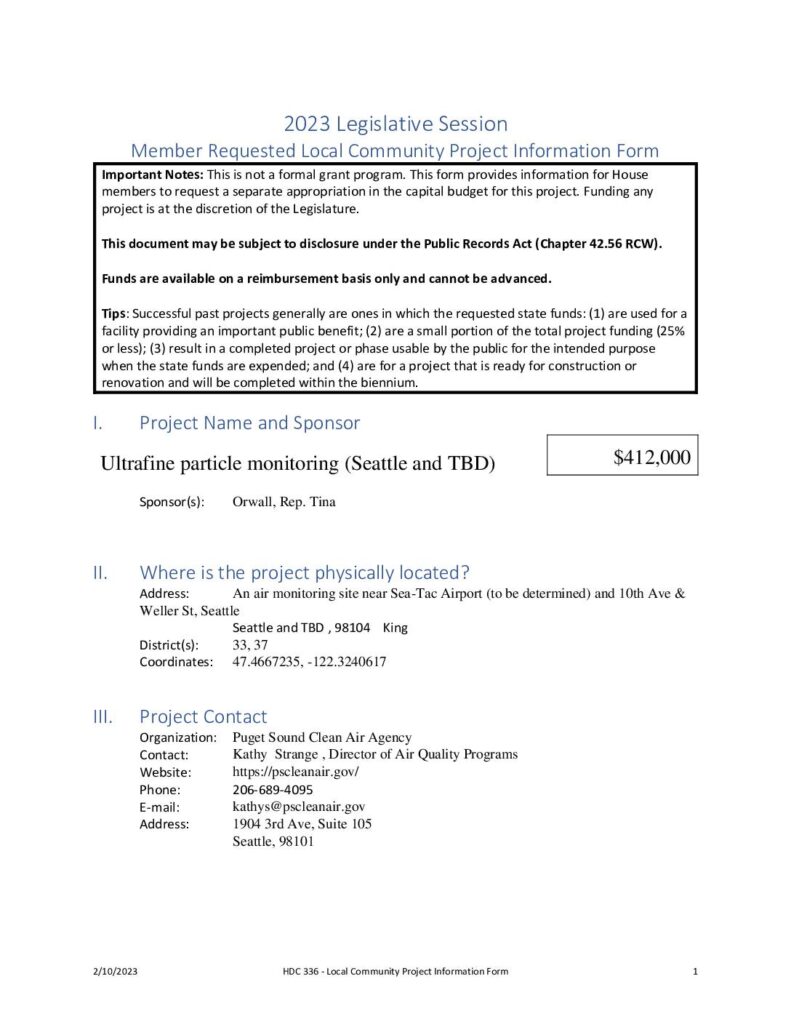
A 2023 Washington State legislative funding request of $412,000 seeks to establish two ultrafine particle air quality monitors near Sea-Tac Airport and the I-5/I-90 interchange in Seattle, operated by the Puget Sound Clean Air Agency. The project aims to measure tiny airborne particles — particularly those produced by aircraft and vehicle traffic — that are not currently tracked routinely in Washington State. The University of Washington would analyze the collected data to identify pollution sources and establish health-impact baselines, with monitoring expected to begin in spring 2024.Open full document
Notes
A 2023 Washington State legislative session form requesting $412,000 in capital budget appropriations for the Puget Sound Clean Air Agency to establish two ultrafine particle monitoring sites—one near Sea-Tac Airport and one near the I-5/I-90 interchange in Seattle. The University of Washington would conduct data analysis to identify contributing pollution sources. The project aims to establish a baseline for understanding health impacts of ultrafine particles from transportation sources including aircraft and vehicles.