TagStART(267)
-
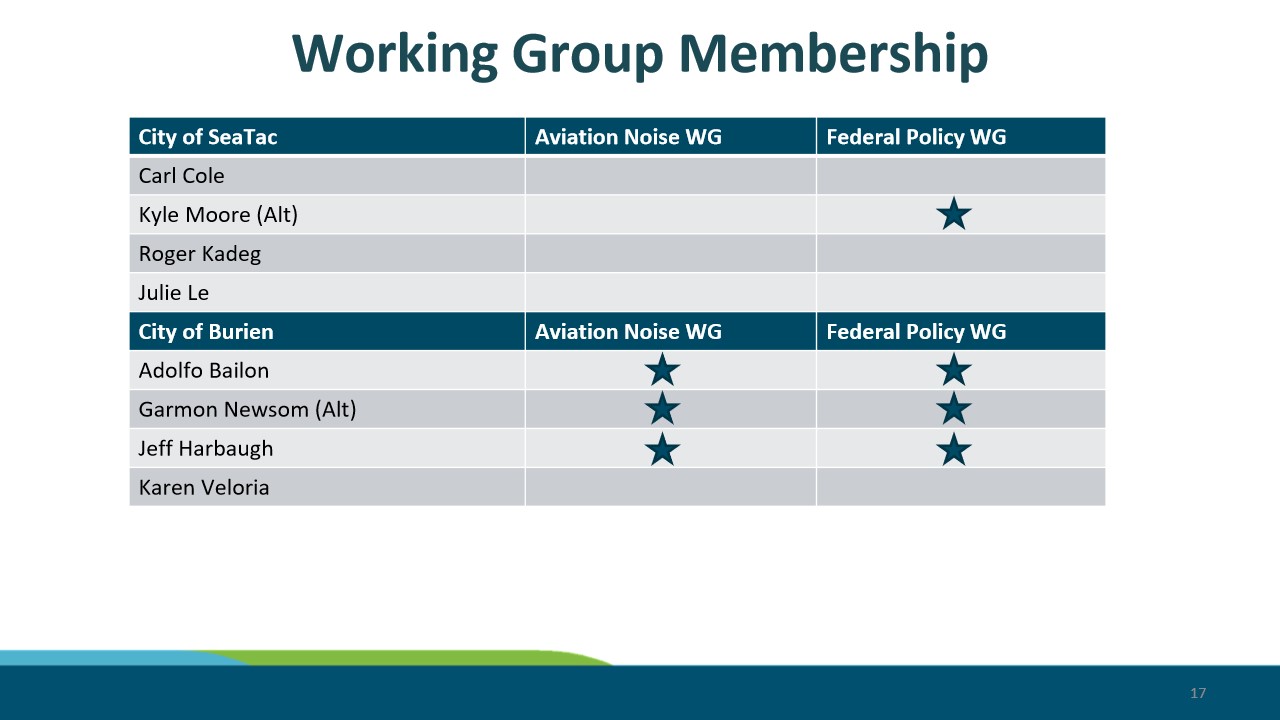
-
StART State Leg Agenda Slides (Final Adoption) 10.17.24
1. Effectively implement the Noise Insulation Repair and Replacement Program 2. Make tangible progress toward identifying additional regional airport capacity in the next three years 3. Sustain existing State programs to enhance air quality 4. Maintain and expand Sustainable Aviation Fuel (SAF) production and use in Washington 5. Decarbonizing ground transportation, reducing transportation emissions, and electrification Statement of Purpose • The growth of operations at Seattle-Tacoma International Airport (SEA) has provided significant benefit to the region, however near-airport communities also face elevated levels of aircraft noise and emissions from transportation. • Meanwhile, the airport will reach its capacity within the coming decades, meaning that the region must identify additional capacity to move people and goods, or else risk increased congestion and a chokepoint on economic growth. • To help address these issues, the Port of Seattle and near-airport communities suggest passage and implementation of the following state-level policy and budget items. • We hope to partner with the State Legislature and State Government to create these new tools, resources, and approaches that can make a tangible difference in our communities. Noise Insulation Repair and Replacement • As necessary, pass legislation amending RCW 53.54 and the Port District Equity Fund / Grant, to ensure that State regulations and programming are complementary to Federal and Port programs and funding. • Ensure that existing State resources are utilized for maximum return on investment. • As appropriate, advocate for additional resources from the State to ensure continual progress with the goal of addressing the… -

SAMP NEPA EA NTP Envr Review Overview Presentation Oct2024
Release of the FAA NEPA Draft Environmental Assessment and Public Comment Period October-November 2024 Seattle-Tacoma International Airport (SEA) was built in 1949 to handle half a million passengers annually and is now handling more than 50 million passengers. Regional Growth and SEA SAMP Overview The Sustainable Airport Master Plan (SAMP) proposes improvements needed at Seattle-Tacoma International Airport (SEA) to meet future, forecasted demand. • The master plan process was completed in 2018 & identified 31 Near-Term Projects Completed Project Milestones 2018 Port of Seattle completed the Sustainable Airport Master Plan FAA conditionally approved the Airport Layout Plan FAA and the Port initiated NEPA for the NTPs and held Scoping meetings with agencies and the public 2019 Aviation Activity Forecasts were updated 2020 – 2022 Pandemic occurred and process slowed 2022 Baseline conditions and Aviation Activity Forecast updated 2023 Aviation Activity Forecast validated 2024 Completion of analysis; drafting and publication of NEPA document Environmental Review and NEPA What is Environmental Review? • The purpose of an environmental review is to assess the potential environmental impacts of a proposed project before it is undertaken. • An environmental review is a process to assess how projects at Port of Seattle facilities may impact the environment in a variety of categories that include air quality and climate, water resources, biological resources, and noise, among others. What is NEPA? • A federal law requiring federal agencies to assess the environmental effects of their proposed actions prior to making decisions. • The purpose of this Environmental… -
Missed Go+Around & How FAA Manages Demand+PPT
For the SEA Stakeholder Advisory Round Table (StART) Meeting October 22, 2024 2 Missed Approach • A missed approach procedure is followed if an approach cannot be continued to an airport. • Missed approach procedures are designed to protect aircraft from other aircraft, terrain, and obstacles on the ground. • Some reasons for executing a missed approach: • The pilot cannot transition to the visual portion of the approach (e.g., fog). • Wind and weather issues. • The approach and/or transition to the landing phase has become unstabilized. • The runway is not clear. • A landing clearance has not been received or is canceled by air traffic control (ATC). • The missed approach is being flown for training (pre-planned and approved by ATC). October 22, 2024 2 October 22, 2024 3 Go-Around • A go-around is a normal operation used when approach or landing parameters deviate from expectations or may be hazardous. • Go-arounds: • Can be initiated by the pilot or ATC when landing conditions are not satisfactory. • Are a routine safety maneuver that may also be used during emergency situations. • Are well practiced and known by pilots as an alternative to landing. • Factors that can lead to a go-around: • ATC initiated action due to overtaking another aircraft, prioritizing the handling of an aircraft in distress, or other issues. • Unexpected hazards on the runway, such as wildlife, debris, other aircraft, or vehicles. • Wind shear. • Wake turbulence from preceding aircraft. • Unstable… -
Go-Around Presentation 10.23.24 FINAL
Go‐arounds are part of normal aviation practice and are a basic tool for pilots and controllers to ensure safety is not compromised during approach and landing. Scenarios when a go around may be initiated: • A go-around may be requested by the pilot or tower initiated by FAA Air Traffic Control • Typically initiated if a pilot or FAA air traffic controller is not satisfied that the requirements for a safe landing. • Unstable approach due to many factors, including adverse weather conditions • Loss of separation on final approach Flight Go-Arounds: SEA and Other Airports FAA Air Traffic by Numbers Report (data collected from FY 17-19, FY23)*: -Annual average: 0.39% of all aircraft arrivals SEA (data collected by Noise Office from 2017 – 2024 thru Sep) -Annual average: 0.4% of all aircraft arrivals *FAA data is collected from 30 core US airports, FAA Air Traffic by the Numbers May 2024 Flight Go-Arounds: SEA and Other Airports Flight Go-Arounds: SEA and Other Airports SEA Go- Arounds 2017 -2024 LAX Go-Arounds June 2023 - June 2024 San Diego Go-Arounds 2023 Flight Go-Arounds: Summary Go-arounds are a normal aviation practice to ensure a safety is not compromised during final approach • SEA averages 2-3 go-arounds per day • SEA's go-around rate is not unusual or excessive when compared to other commercial airports • Typically, there are higher rates of go-arounds during the fall and winter months Slide 1: Overview Flight Go-Arounds Slide 2: Flight Go-Arounds: What is it? Slide 3: Flight Go-Arounds:… -
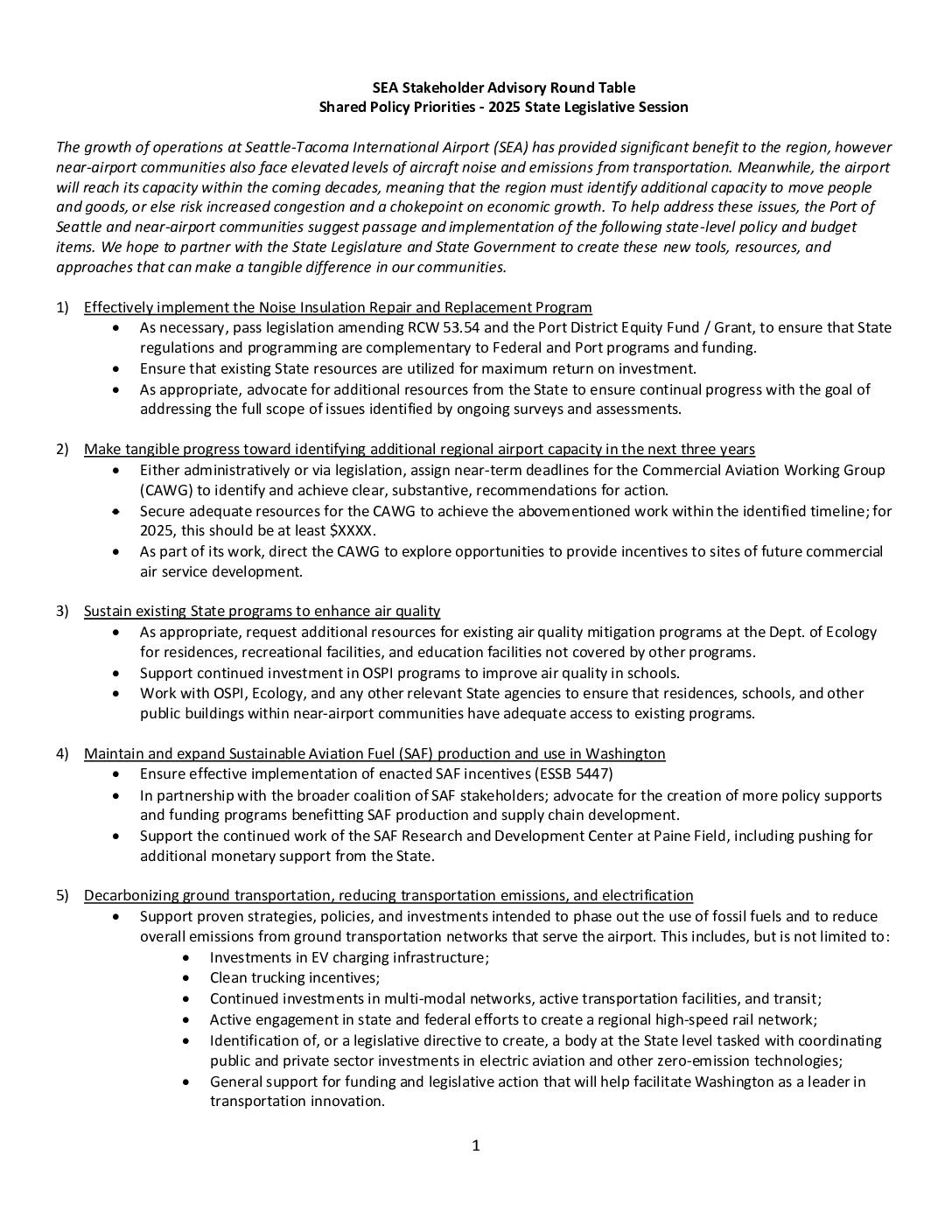
2025 StART State Leg Priorities 10.17.24
Shared Policy Priorities - 2025 State Legislative Session The growth of operations at Seattle-Tacoma International Airport (SEA) has provided significant benefit to the region, however near-airport communities also face elevated levels of aircraft noise and emissions from transportation. Meanwhile, the airport will reach its capacity within the coming decades, meaning that the region must identify additional capacity to move people and goods, or else risk increased congestion and a chokepoint on economic growth. To help address these issues, the Port of Seattle and near-airport communities suggest passage and implementation of the following state-level policy and budget items. We hope to partner with the State Legislature and State Government to create these new tools, resources, and approaches that can make a tangible difference in our communities. 1) Effectively implement the Noise Insulation Repair and Replacement Program • As necessary, pass legislation amending RCW 53.54 and the Port District Equity Fund / Grant, to ensure that State regulations and programming are complementary to Federal and Port programs and funding. • Ensure that existing State resources are utilized for maximum return on investment. • As appropriate, advocate for additional resources from the State to ensure continual progress with the goal of addressing the full scope of issues identified by ongoing surveys and assessments. 2) Make tangible progress toward identifying additional regional airport capacity in the next three years • Either administratively or via legislation, assign near-term deadlines for the Commercial Aviation Working Group (CAWG) to identify and achieve clear, substantive, recommendations for action.… -
UW Health Schools Healthy Air Presentation
Elena Austin, Timothy Gould, Nancy Carmona, Tim Larson, Edmund Seto Healthy Schools, Healthy Air • Inform schools, districts and state legislators on the current ability of building ventilation systems to effectively remove outdoor sources of particles. • Quantify the current ability of ventilation solutions to remove indoor generated particles. • Identify any additional benefit and cost of in-room filtration and air handling interventions. • Based on the experimental measures in an unoccupied classroom, describe the size fractioned infiltration rates of 1) ultrafine particles of aircraft origin 2) ultrafine particles of traffic origin and 3) wildfire smoke. • Communicate study results to partners. * Funded (50k) by cities of the cities of SeaTac, Burien, Federal Way, Normandy Park and Des Moines Project Timeline and Activities • Developed communication plan with school districts around study goals (January 2021) • Identified 5 schools of interest based on age, proximity to flights and ventilation characteristics February 2021 ) • Measurement Period (March – August 2021) • Measured outdoor air exchange rate • Measured indoor and outdoor pollutants • Evaluated a portable air cleaning unit (HEPA) • Analysis and report back Period • Synthesize Results • Report back • Final Report (December 2021) • Timothy Gould • Edmund Seto • Elena Austin • Timothy Larson • Nancy Carmona • Jeff Shirai Goal • Understand the impact of outdoor air pollution on the air quality indoors – Are outdoor air pollutants significantly removed by current air filtration approaches? – Can indoor air quality be improved through… -
StART Wk Grp 2018 Year End Recap Presentation
• Formed to work on achievable noise reduction efforts Noise Working Group Members • Terry Plumb • Chris Hall • John Resing • Earnest Thompson • Mark Hoppen • Eric Zimmerman • Robert Akhtar • Joe Scorcio • Ken Rogers • Jason Ritchie • Tom Fagerstrom • Robert Tykoski • Tim Toerber • Steve Ostredahl • Marco Milanese • Scott Ingham • Tony Gonchar • Randy Fiertz • Yarden Weidenfeld • Scott Kennedy Near Term Aviation Noise Action Agenda • Runway Use Agreement • Fly Quiet Voluntary Late Night Noise Limitation Program • Glide Slope Analysis • Ground Noise Analysis • A320 Arrival Noise Retrofit Runway Use Agreement • Revise / update the previous Runway Use Plan. • Purpose of the plan is to establish a clear understanding of the preferred way in which all of the runways will be used in various operating conditions. Sea-Tac Runways R C L R C L Runway Use Daytime and Evening Hours • The third runway (16R/34L) will be used primarily as an arrival runway. • The east runway (16L/34R) and center runway (16C/34C) will be used as arrival and departure runways. Runway Use Late Night Usage • During regular late night operations between the hours of 12:00 a.m. and 5:00 a.m. in normal weather patterns, the FAA plans to reduce its use of the third runway (16R/34L). • Departures and/or arrivals will use 16L/34R and 16C/34C • 16R/34L will only be used when required for safety or efficiency reasons. North Flow Preferential… -
START Presentation 01 FAA Briefing June 26 2019
Aviation equipment (aircraft, spacecraft, and related equipment) is largest export sector in U.S. economy accounting for over 8% of total exports. SOURCE: FAA Air Traffic Organization Federal Aviation Administration AEE Mission and Vision Mission: To understand, manage, and reduce the environmental impacts of global aviation through research, technological innovation, policy, and outreach to benefit the public Vision: Remove environmental constraints on aviation growth by achieving quiet, clean, and efficient air transportation Federal Aviation Administration Environmental & Energy Strategy Notes: 1. Aviation E&E Policy Statement (Federal Register 77-141, 2012): http://www.faa.gov/about/office_org/headquarters_offices/apl/ environ_policy_guidance/policy/media/FAA_EE_Policy_Statement.pdf 2. U.S. Aviation GHG Emissions Reduction Plan: http://www.icao.int/environmental- protection/Pages/ClimateChange_ActionPlan.aspx 3. Environment and Energy Website: http://www.faa.gov/go/environment Technology Fuels Operations New Entrants INNOVATION ADVANCE SCIENCE AND INTEGRATED MODELING Aviation Environmental Tool Suite Source characterization Health and welfare impacts Propagation and dispersion POLICIES & PROCEDURES • Aircraft and Engine Standards • CORSIA • Community Engagement ANALYSIS • Inform decision making • Evaluate progress toward goals PLAN • Environment and energy policy statement 1 • U.S. Action Plan 2 • Research roadmaps 3 GOALS • Noise • Air Quality • Energy FAA VISION Reach the next level of safety, efficiency, environmental responsibility and global leadership Federal Aviation Administration Environment and Energy (E&E) Research Programs Continuous Lower Energy, Emissions and Noise (CLEEN) • Reduce aircraft fuel burn, emissions and noise through technology & advance alternative jet fuels • Cost share partnership with industry Additional Efforts • Commercial Aviation Alternative Fuels Initiative (CAAFI) • Contract mechanisms (e.g., SEMRS, PEARS-II) • Volpe Transportation Center ASCENT Center of… -
StART MeetingSummary 20210623
StART enhances cooperation between the Port of Seattle and the neighboring communities of Seattle-Tacoma International Airport StART MEETING SUMMARY JUNE 23, 2021; 5:00 PM – 7:00 PM VIA ZOOM V IDEOCONFERENCE Agenda Items: • SAMP Public Process • Seattle-King County Public Health: Community Health and Airport Operations Related Pollution Study • Federal Policy Working Group meeting update • Aviation Noise Working Group meeting update • Public Comments Meeting Summary: I. Facilitator welcome, introduction, and agenda, Brian Scott from BDS Planning & Urban Design II. Opening Remarks, Lance Lyttle, StART Chair/SEA Managing Director A. Welcomed Amy Arrington, new Normandy Park City Manager and Bob Leonard, Des Moines Community Member. III. SAMP Public Process, Clare Gallagher, POS Capital Project Delivery Director A. The SAMP NEPA (National Environmental Policy Act) EA (Environmental Assessment) draft document is currently underway. B. NEPA EA Agency and Public review is targeted for Q3 2021. C. A SEPA (State Environmental Policy Act) draft is expected to be released toward the end of 2021 or early 2022. D. Port of Seattle (POS) will provide a briefing on the results of the draft NEPA EA when it is published. IV. Seattle-King County Public Health: Community Health and Airport Operations Related Pollution Study, Dr. Kris Johnson, Senior Social Research Scientist, Seattle/King County Public Health and Dr. Elena Austin, Assistant Professor, UW School of Public Health A. The state funded study, a provision of House Bill 1109, requested that Seattle/King County Public Health create community health profiles for areas one-mile, five-miles, and…