TagSea-Tac Communities Plan(236)
-
Part 1 Overview Of The Plan
e1 JOint J I rt f tt t of s - t t1 n i ki -'1· n F N/ :O Rl EC1' NS ANn i DLJ ITf O, S Enc l o · d arc dd ion H t yo u op y r th " REDIWOK" (F I. a l Sc, -'Ia Commun i J. Plan). Pl. <' l.ns •r h' mn • l n l in ppropriflte loc.1 tion ( s 8 c p ~~0. numb er l · h b om . a h uld b nH n m -n1 n m king 6. 2 . 1 p£1, . 6. 2 . 2 pp, . , (j, 2 . pg . , . 6 . . pg . 2 , 6. 6 ./1 P ~ · 2 , . 6 . ~ P ~ · , 6. 7.0 pg . l. ' 7.0 . 0 - nll (j L~ , 1- . 7 27- ') (W. 6, 20, 10 ' .] ! l ·· ·cd (1 (~ .s t t; Co you c r ct i o n ~ nc luded i n llu r,.r l 1g p ges shou l d tq . r Nt ) v •r ion ir .:1) hnv , 0 If you 'v • go qu ~ Lon n •eu .u ll C" r lt Corm ion pl t1 ca ll : s unty -
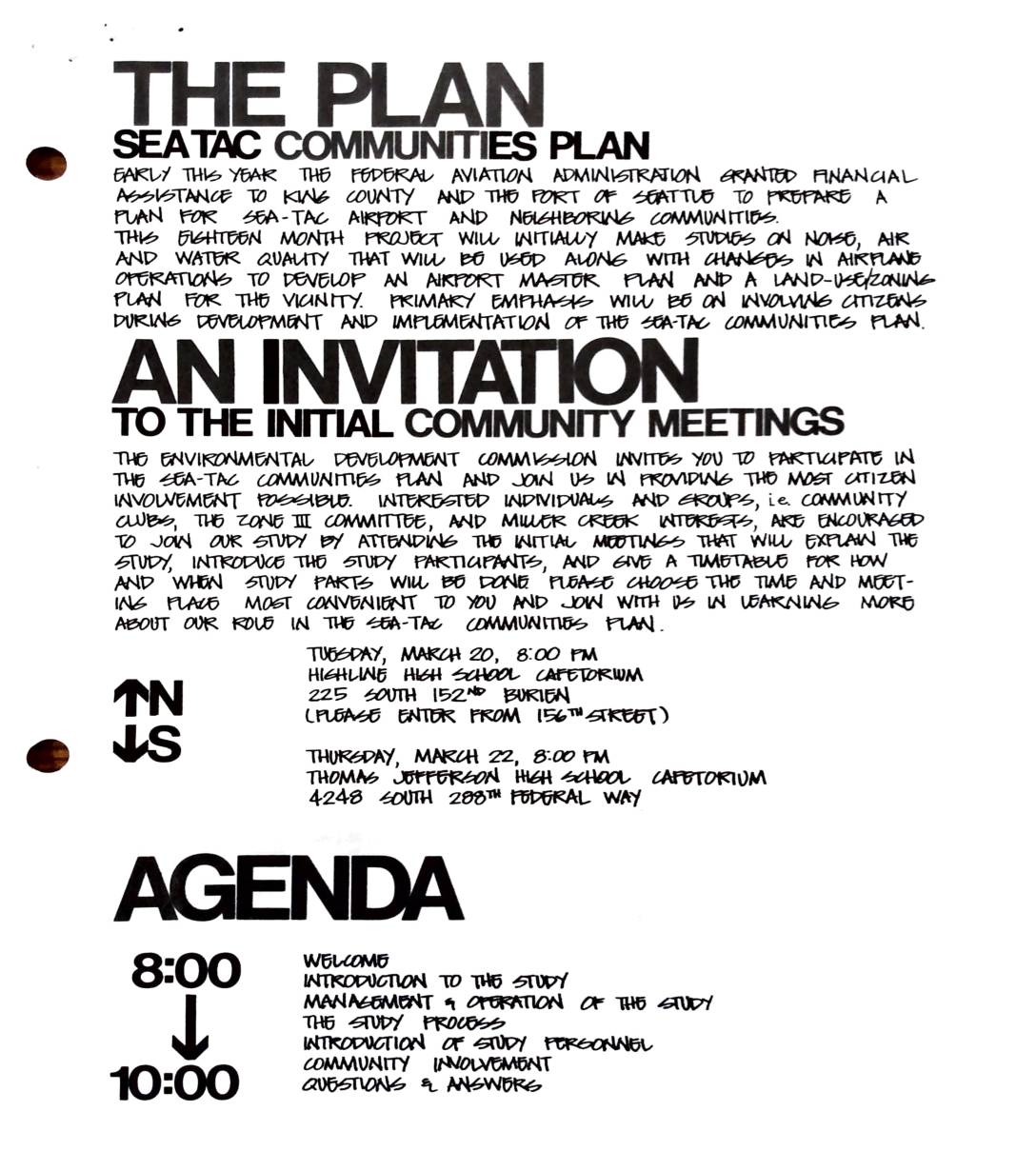
Sea-Tac Communities Plan Open House Flyer
AsSTANa W KN OUNTY AND THO FORT OF SEATTUo D KEPARE PUAN FOR THI HTGEN MONTH FROT WllU NITIALUY MAKG STUDIOS ON NOV6, AlR AND WATER 2UAITY THAT WIU BO VOD ALDNG wITH CHANEDS N AHKPLAN5 OPTRAToNS TO DEVELOP AN AIKFORT MAAUR PAN ANDA AND-EzoNIN PLAN FOR THG VCANTY. PRIMAKY EMPHAS WIW B6 ON NVOMAS anzENS DURING VEDPMENT A EA-TA AKFORKT AND NGLEHEORNG MMUNITIOS AND IMPLEMENTATON OF THO AT COMMUNITIES PAN AN INVITATION TO THE INITIAL COMMUNITY MEETINGS THO ENVIRDNMENTA PEVBLOPMENT COMMeON INVITDS YOU w PARTAPATT IN THO A-TAC COMMUNITSS fAN AND N N PKOMPING THO MOST CTIZEN AVOUNEMENT WAPD INTERBSTED INDVIDUALS AND EROPs, ie COMUNITYY CuWe THO ZONG I COMMITTEE, AND MUTR CREOK TO JON UR STUDY P NTERDS, AKG ENCOURALED ATTENIDNG THO NITIAL MaOTINGS THAT W EXrLAN THG AND STUDY INTRODUCO THO STUDY PARTIAPNTS, AND ENG A TIM5TABLO OR HOW AND WHON STUDY PARTS WI BO PONE POAD HOOEO THO TMG AND MGT ING PAU6 MOST ONVEANIGNT D wU ND JoN WTH D IN GAKNING MOR5 ABOUT OUR ROLE lN THO SA-TA COMMUAINBS FAN. TN JS TU6SPAY, MARCH 20, 8:00 PM HiHLING HH O CArEWRUM 225 0UTH 152 BURIEA LEAO ENTER FROM ISTSKEBT) THUREDAY, MARZH 22, 8:0o M THOMA JorrGRAON HiAH HOL CAFBTORIUM 4243 OUTH 288 FODGRAL WAY AGENDA 8:00 WGLOM5 INTKODUTON TD THG STUDY MANAEOMENT 4 OrRATION 0F TH5 ADY TH5 SUY PROUOLS INTKODUOTiON UDY FUReONNGL COMMUNITY IANOUNGMENT aVbSTONS A NSWORE 10:00 FCIAL NO TAL wNOM an invitation to participate in the sea-tac Communities- plan sponsors port… -

Noise Study 1974 Port of Seattle
This report was funded in part by grant number DOT-FA73NW-0111 from the Planning Grant Program as authorized by the Airport Airways Aat of 1970. September 1974 POS 208103 PORT 0012683 r ' ~ ( ' c ACKNOWLEDGMENTS The combined efforts of a large number of people are required in a program of this magnitude and the authors gratefully acknowledge their contributions. These personnel include members on the staffs of the King County Division of Land Use Management, Port of Seattle Department of Plan- ning and Research, and the Airlines operating at SEA-TAC. Also, FAA personnel at Seattle-Tacoma Airport and from the Northwest Region office have been unusually helpful. The authors wish to extend special thanks to Ken Whitehead and Dick Coykendall of United Airlines who aided the program in many ways. POS 208104 PORT 0012684 r ~ -, ~ .. ,. ' r . c- '-- (b ·:t * B)Lk'-;~ Q,R•...r,r.'NJTENT·C: .,. •::r ~ •r 9 J:J£JJ .... !f-:~._,f":o'J . .. . _ .. LVN'_ . + .. .... ~ .... J t ...Lt·-..J. - -- Page: .s.2LI;iT Pf .F.IQU.R~$. •• vrG : ~J_,c.~ i H~:)a3.G .u-vru02- T '·L~nO,~oli~'Yi 2HUOT~:IO :J Ni ~.1T2Y2 NOISE EVALUATION UNITS. . . . . . . . . . . . . . 1 c •••• • 2TJU23:H ';{ :.J : : C I T!'~!IJqq..-,, Qvl /o_ ALJ~iTIH:-) SOUND NOISE EXPOSURE LEVEL - A . • . . . . . . 2 (lC.C't).1::{~L.A;:'J.V~ )•4E.A~'Q.R_;E OF. NQI~E ••• 2viOJ ;:~~JJ:JViO:) Oc'.R~ltA.TlO.N?IiiJi? .Of .N.OlSE EXPQS.U~~… -
5.8 Community Attitudes Survey Port of Seattle
The Social Impact of the Seattle-Tacoma Airport on the Community r By Fred E. Fiedler University of Washington and Judith Fiedler, Principal Investigator Battelle Memorial Institute Pacific Northwest Division Human Affairs Research Centers March 1974 The prc~arntion of this report was financed in part through an Airport !·laster Planning Grant from the Federal Avitttion Admin- istration under the provisions of Section 13 of the Airport and Airway Development Act of 1970. POS 807573 ] INTRODUC'flON This study investigates the imp~ct of the Sea-Tac International Airport on the life of the surrounding conununity. It examimes hmV" the residents of an airport conununity and of appropriate comparable areas cope with various environmental problems. Sea-Tac is the 15th largest airport in the United States. During the year 1973 it handled 5,300,000 passengers and 375 flights per day. It covers over 2,000 acres and is clearly the dominant fea- ture of the surrounding area. The airport is staffed by 7,000 employ- ees, and managed by the Port of Seattle, a regional governmental body headed by five elected Port Commissioners whose responsibility also encompasses the harbor and shipping facilities. This partic•lar study was commissioned by the Port of Seattle and King County, ~ashington as part of the Sea-T~c Intern~tional Airport Vicinity Master Plan ~tudy. A section of the report deals with qu~~- tions of concern to the Metropolitan Municipality of Seattle (".M.E:tro") which has a direct interest in the drainage problems surrounding Sea- Tac. The more general questions concerning the public's stance on related ecological… -
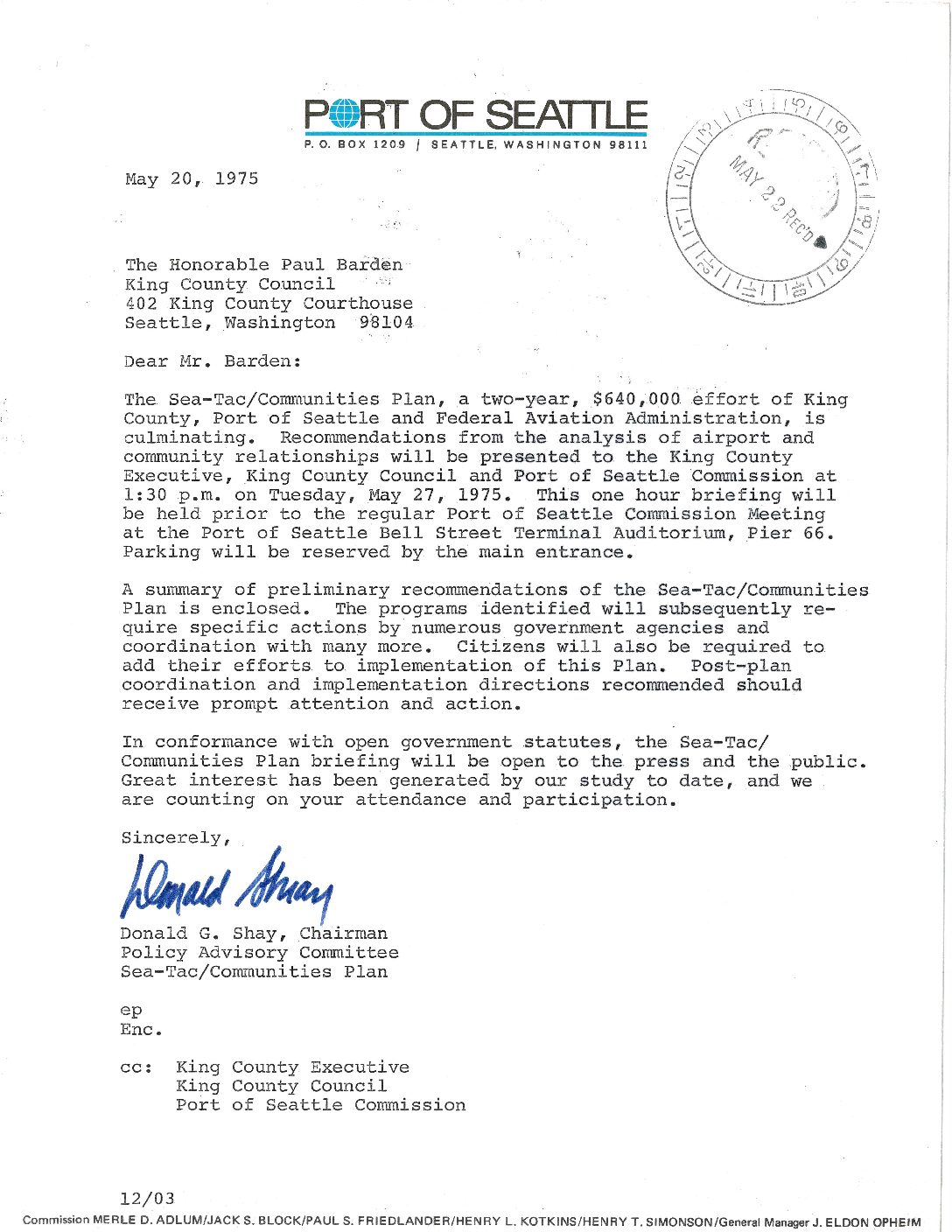
SeaTac Communities Plan Advisory Committee Letter to King County 750520
The Sea-Tac/Communities Plan, a two-year, $640,000 effort of King County, Port of Seattle and Federal Aviation Administration, is culminating. Recommendations from the analysis of airport and community relationships will be presented to the King County Executive, King County Council and Port of Seattle Commission at 1:30 p.m. on Tuesday, May 27, 1975. This one hour briefing will be held prior to the regular Port of Seattle Commission Meeting at the Port of Seattle Bell Street Terminal Auditorium, Pier 66. Parking will be reserved by the main entrance. A summary of preliminary recommendations of the Sea-Tac/Communities Plan is enclosed. The programs identified will subsequently re- quire specific actions by numerous government agencies and coordination with many more. Citizens will also be required to add their efforts to implementation of this Plan. Post-plan coordination and implementation directions recommended should receive prompt attention and action. In conformance with open government statutes, the Sea-Tac/ Communities Plan briefing will be open to the press and the public. Great interest has been generated by our study to date, and we are counting on your attendance and participation. i;~ Donald G. Shay, Chairman Policy Advisory Committee Sea-Tac/Communities Plan ep Enc. cc: King County Executive King County Council Port of Seattle Commission 12/03 Commission MERLE D. ADLUM/JACK S. BLOCK/PAULS. FRIEDLANDER/HENRY L. KOTKINS/HENRY T. SIMONSON/General Manager J . ELDON OPHEIM J. - ,.. ·'J' :; ""f ;. ' i . ·. ( ' ,, • . J. -z~~ !11 -- ( . ' •., t· .. • V I… -
Part 8 References
The references listed below are products and outputs resulting from the study effort by the Port of Seattle staff, .King County staff, consultants, and citizens involved in the project . A library of these references will be maintained in the offices of the King County Land Use Management Division (The Courthouse and the Burien Communities office) and the Port of Seattle Planning and Research Department (Pier 66) . 1. Sea-Tac Airport and Vicinity Master Plan Application, King County and Port of Seattle, Dec . 1974 2. Element Report 1 . 0: Inventory, King County , Port of Seattle and F .A .A., 1973 . / 3. Element Report 1. 5-1: Photo Interpretive Land Use Account 1943-1972, University of Washington Department of Urban Planning, Feb. 197 4. . Element Report 2 .0: Aviation Demand Forecast- Final Report, Peat, Marwick, Mitchel and Co and Port of Seattle Planning and Research Department, November 1973 . . Element Report 3 . 0: Demand Capacity Analysis . 8.0.1 1 6. Element Report 5. 2: Air Quality Analysis - Final Report, Environmental Systems, Laboratory - Sunnyvale, Cal., June 1974. 7. Element Report 5. 3: Water Quality Analysis - Final Report, Stevens, Thompson and Runyan, Inc., August 1974 . 8. Element Report 5. 4: Solid Waste Analysis, Stevens, Thompson and Runyan Inc., July 1974. 9. Element Report 5. 5: Noise Exposure Analysis '- Volume I, Robin M. Towne and Associates Inc., July 1974. 10. Element Report 5. 5: Noise Exposure Analysis - Volume II, MAN - Acoustics… -
Part 7 Implementation
As of the present time, the five-member Port of Seattle Com- mission is authorized by law to levy taxes on the assessed valuation of the taxable property within the Port district (King County) as follows-- 1. Not to exceed .045 mill for general Port purposes. 2. An additional millage as. required to service in- terest and principal payments on general obliga- tion bonds. The issuance of general obligation (GO) bonds by the Port is governed by certain legal limitations. They include-- ~. 1,3 1. Without the approval of Port district voters, GO bonds may be issued in an amount not to exceed (together with an existing indebtedness of the Port district not authorized by the voters) 3/4 of 1% of the actual value of taxable property in the dis- trict as determined by the King County Assessor. 2. With the assent of 60% of Port district voters, GO bonds may be issued in an amount not to exceed (together with an existing indebtedness of the Port district not authorized by the voters) 3/4 of 1% of the actual value of the taxable property in the Port district as determined by the County Assessor. In addition, the Port of Seattle is authorized under the Washington Aircraft Noise Impact Abatement Act of 1974 to fund noise remedy programs through a single general obliga- tion bond issue of not more than 1/8 of 1% of the value of taxable property within the Port district. The provisions of this Act permit the Port to… -
Part 6 Plans, Policies And Programs
Sea-Tac International Airport is a regional asset and makes a sub- stantial contribution to the economy of the Pacific Northwest. More than 15,200 jobs accounting for a gross annual payroll of over $16,000,000 and $390,000,000 in yearly business activity in King County are related to the commercial traffic of Sea-Tac Airport, A forecasted rise in air traffic levels points toward even more economic benefits associated with the Airport. Population and employment forecasts also suggest increases to the Airport's economic impact (for the overall Sea- Tac study area, 1978-1993 growth in population, 23%; growth in employment, 48%). However, the local benefits of the Airport's presence in the community have, for the most part, been eclipsed by an unsatisfactory physical and en- vironmental relationship between the Airport and the surrounding areas. Communities surrounding Sea-Tac possess characteristics, problems , and potentials that are unique to their particular relationship with what has emerged as an international airport. Yet, there is a com- monality amongst communities, neighborhoods, families, and individuals whose lives or lifestyles have been affected by the presence of the Airport. In a broad sense, they are all seeking a kind of compatibility; a reduction in aircraft noise and the annoyance it brings; the knowledge of what the ultimate growth and expansion of the Airport is to be; the ability to market a house in the normal way, when the need or the desire may arise; neighbor- hoods that are safe from encroachment by businesses and apartments; .1.0 1 (Revised 4/22/75) pleasing visual… -
Part 5 The Environment
The consulting firm of Environmental Systems Laboratories, Inc. conducted the study to collect, analyze and predict air pollution elements at and around Sea-Tac Airport. Specific operational and land use alternatives were to be recommended to minimize the impact of aircraft operations on air quality. Existing air quality for the Airport passenger terminal and vicinity was calculated to identify pollutant levels of particulates, carbon monoxide, hydrocarbons, nitrogen oxides and oxidants. Predicted air quality utilized aviation forecasts and community development plans to present the "most probably" and "worst case" conditions. The Puget Sound Air Pollution Control Agency (PSAPCA) was the only source for historical records for air quality data about the study area . Their three stations are located in Des Moines, Me Micken Heights, and Tukwila. The data reflected a general high purity of air quality. Because of the predominate wind patterns, it is not expected that significant amount of pollutants would be measured at the PSAPCA monitoring sites. For this study, the Consultant used an air monitoring van located at sites near the Airport during June and September of 1973, and February 1974. The three sites are shown on the following map as 1, 2 and 3. The three PSAPCA sites are 5, 6, and 7 . Also, air samples in the terminal area, site 4, and the surrounding community were analyzed for carbon monoxide. Sites 1 and were chosen as areas of major impact based on the north- south prevailing winds, aircraft movements, and areas of population . Pursuant… -
Part 4 Trends And Forecasts
In order to determine adequancy of existing Airport facilities and future facility requirements, as well as future relationships between the Airport facilities and the surrounding communities , it is first necessary to estimate demand for facilities generated by future air traffic volumes . The volume and type of air traffic generated in an area is a reflection of the socio-economic character of that area. Thus , the first step in the develop- ment of the Master Plan for Sea-Tac International Airport was to analyze current and projected population and economic growth. The Central Puget Sound Region is located in the northwestern corner of Washington State . Near the center of this area, which surrounds Puget Sound, is Seattle , the largest city on the West Coast north of San Francisco . Other notable urban areas include the cities of Tacoma, Bellevue, Everett , Bremerton , and Renton . In 1970 , the four- county area had 1, 934 , 628 inhabitants, accounting for 56% of the State' s population. The area experienced substantial population growth during the 1950's and 1960's. The average annual rate of growth during the 1950' s was 2.4% approximately 1 . 3 times the national average. The population of the region increased from 1 , 196 , 172 in 1950 to 1, 512 , 979 in 1960 . The annual rate of population growth was almost double that of the national average during 1965 and 1968 . This trend has reversed itself in the 1970's .…