TagRv(3131)
Excerpt generated from Relevanssi PDF content
-
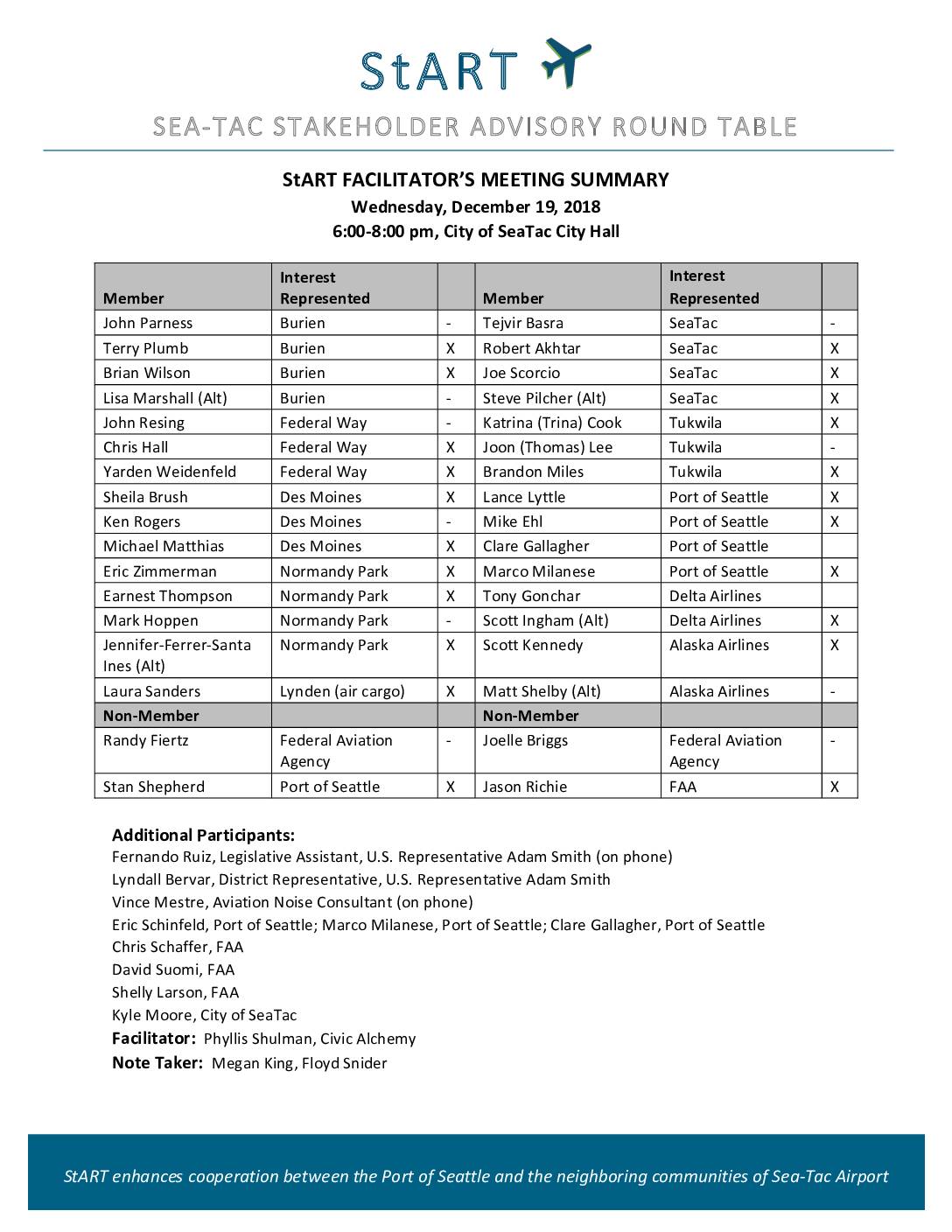
START Dec 19 2018 Meeting Summary 0
StART enhances cooperation between the Port of Seattle and the neighboring communities of Sea-Tac Airport StART FACILITATOR’S MEETING SUMMARY Wednesday, December 19, 2018 6:00-8:00 pm, City of SeaTac City Hall Member Interest Represented Member Interest Represented John Parness Burien - Tejvir Basra SeaTac - Terry Plumb Burien X Robert Akhtar SeaTac X Brian Wilson Burien X Joe Scorcio SeaTac X Lisa Marshall (Alt) Burien - Steve Pilcher (Alt) SeaTac X John Resing Federal Way - Katrina (Trina) Cook Tukwila X Chris Hall Federal Way X Joon (Thomas) Lee Tukwila - Yarden Weidenfeld Federal Way X Brandon Miles Tukwila X Sheila Brush Des Moines X Lance Lyttle Port of Seattle X Ken Rogers Des Moines - Mike Ehl Port of Seattle X Michael Matthias Des Moines X Clare Gallagher Port of Seattle Eric Zimmerman Normandy Park X Marco Milanese Port of Seattle X Earnest Thompson Normandy Park X Tony Gonchar Delta Airlines Mark Hoppen Normandy Park - Scott Ingham (Alt) Delta Airlines X Jennifer-Ferrer-Santa Ines (Alt) Normandy Park X Scott Kennedy Alaska Airlines X Laura Sanders Lynden (air cargo) X Matt Shelby (Alt) Alaska Airlines - Non-Member Non-Member Randy Fiertz Federal Aviation Agency - Joelle Briggs Federal Aviation Agency - Stan Shepherd Port of Seattle X Jason Richie FAA X Additional Participants: Fernando Ruiz, Legislative Assistant, U.S. Representative Adam Smith (on phone) Lyndall Bervar, District Representative, U.S. Representative Adam Smith Vince Mestre, Aviation Noise Consultant (on phone) Eric Schinfeld, Port of Seattle; Marco Milanese, Port of Seattle; Clare Gallagher, Port of… -
Sound Insulation StART Briefing April 2021
4. New FAA policy for homes insulated prior to 1993 Noise Mitigation Accomplishments • Sound Insulation Completed • Began in 1985 • Approximately 9,400 homes • 9 Highline Schools • 5 condominium complexes, 246 units • 14 buildings on the Highline College Campus • Acquisition Completed • 5 mobile home parks, 359 mobile home units • 69 homes north of the 3rd runway • 1,400 single family homes including 3rd runway acquisition • Approximately $300 million spent on sound insulation • Approximately $100 million spent on acquisition programs Project Funding • FAA Airport Improvement Program (AIP) Grant Funded – 80% of eligible costs (direct acoustical) – 20% airport match • Airport funds all non eligible costs through other sources of revenue. SEA Noise Remedy Boundary Based on 65 DNL Noise Contour Sound Insulation Requirements • Homes must be built prior to 1986 in Des Moines and 1987 in all other areas – building codes meet or exceed FAA standards after these dates • Homeowners are required to sign an avigation easement • Homes with mortgages must obtain a subordination agreement from their lender(s) • Homes must have a 45dB DNL or greater interior noise level during a noise audit to be eligible Ongoing Sound Insulation Programs Single-Family Sound Insulation • Began in 1985 • Over 9,400 Single-Family homes completed • Approximately 140 homes remain eligible – 39 homes in process • Continuous outreach to get remaining homes into the program • Goal of completing 10 or more homes in 2021… -
Seattle-King County Public Health – Airport related pollutants and community health June 23 2021
Kris Johnson with Public Health Seattle and King County And Elena Austin, Jianbang Xiang, Timothy Gould, Sukyong Yun, Jeff Shirai, David Hardie, Michael Yost, Timothy V. Larson, Edmund Seto with University of Washington, Seattle June 23, 2021 Understanding the community health effects of pollution related to Seattle- Tacoma International Airport (SeaTac) operations a) Airport community health profiles b) Strength of evidence to date c) UW School of Public Health Study on UFP d) Recommendations to address health issues Presenter Presentation Notes This study and work is state funded. Thank you, Senator Keiser and Representative Orwall for requesting and sponsoring the work. The Public Health study was a proviso in Washington state’s House Bill 1109 which requests that Public Health – Seattle & King County produce Airport community health profiles for a one-mile, a five-mile, and a 10-mile radius of the airport Comprehensive literature review assessing the strength-of-evidence for health effects of airport operations Summary of findings of the University of Washington School of Public Health study on ultrafine particulate matter Recommendations to address health issues related to the impact of the airport on the community The results we share with you are descriptive only – it is not possible to causally link the adverse health conditions we’ll discuss to airport-related pollutants. The radii of one mile outside of airport, 1-5 miles and 5-10 miles are based on methods from prior studies of airport pollutants. For example, see: Hudda N, Gould T, Hartin K, Larson TV, Fruin SA. Emissions from an… -
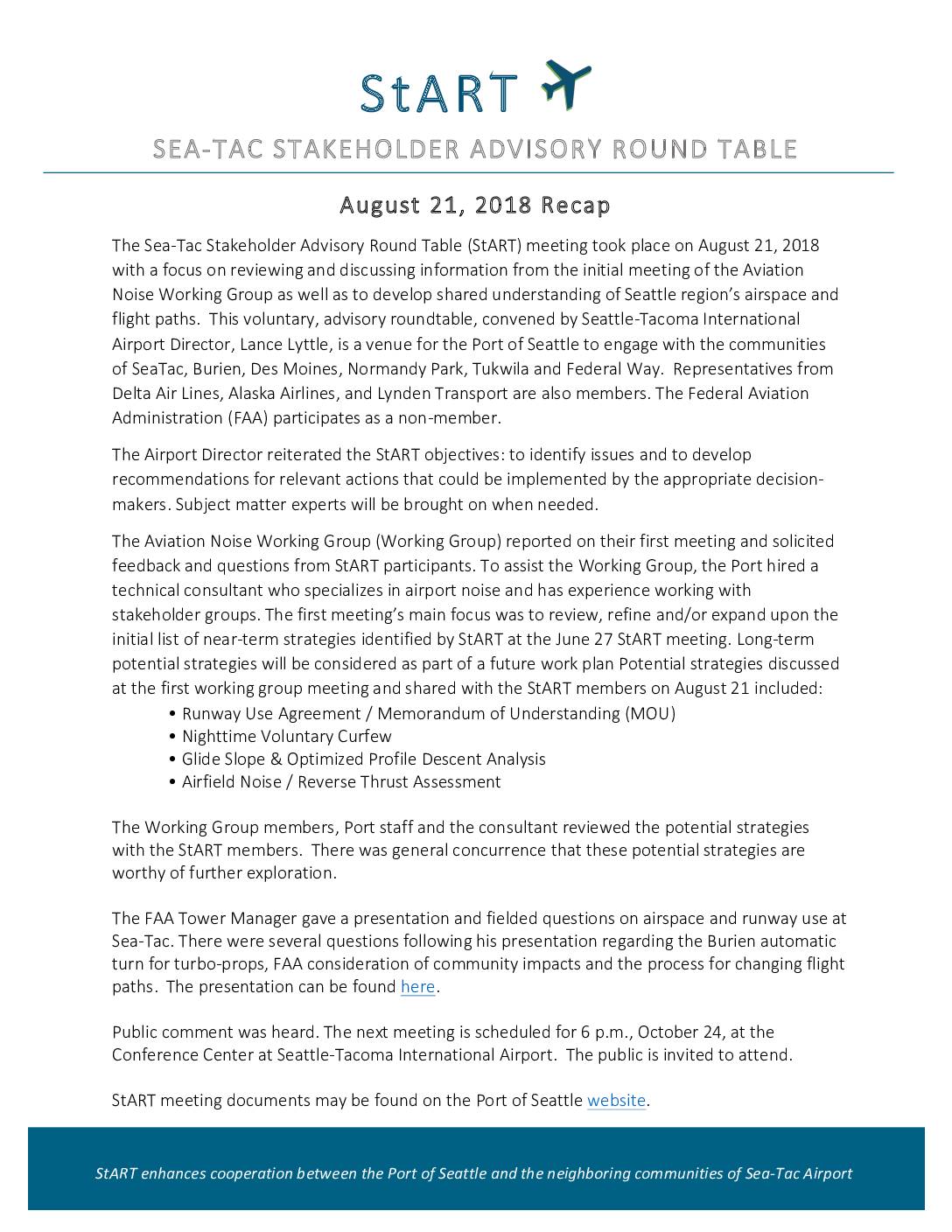
Sea-Tac Stakeholder Advisory Round Table 180821 Meeting Recap 2
StART enhances cooperation between the Port of Seattle and the neighboring communities of Sea-Tac Airport August 21, 2018 Recap The Sea-Tac Stakeholder Advisory Round Table (StART) meeting took place on August 21, 2018 with a focus on reviewing and discussing information from the initial meeting of the Aviation Noise Working Group as well as to develop shared understanding of Seattle region’s airspace and flight paths. This voluntary, advisory roundtable, convened by Seattle-Tacoma International Airport Director, Lance Lyttle, is a venue for the Port of Seattle to engage with the communities of SeaTac, Burien, Des Moines, Normandy Park, Tukwila and Federal Way. Representatives from Delta Air Lines, Alaska Airlines, and Lynden Transport are also members. The Federal Aviation Administration (FAA) participates as a non-member. The Airport Director reiterated the StART objectives: to identify issues and to develop recommendations for relevant actions that could be implemented by the appropriate decision- makers. Subject matter experts will be brought on when needed. The Aviation Noise Working Group (Working Group) reported on their first meeting and solicited feedback and questions from StART participants. To assist the Working Group, the Port hired a technical consultant who specializes in airport noise and has experience working with stakeholder groups. The first meeting’s main focus was to review, refine and/or expand upon the initial list of near-term strategies identified by StART at the June 27 StART meeting. Long-term potential strategies will be considered as part of a future work plan Potential strategies discussed at the first working group meeting… -
SAMP Primer 2021-08-25 StART Briefing
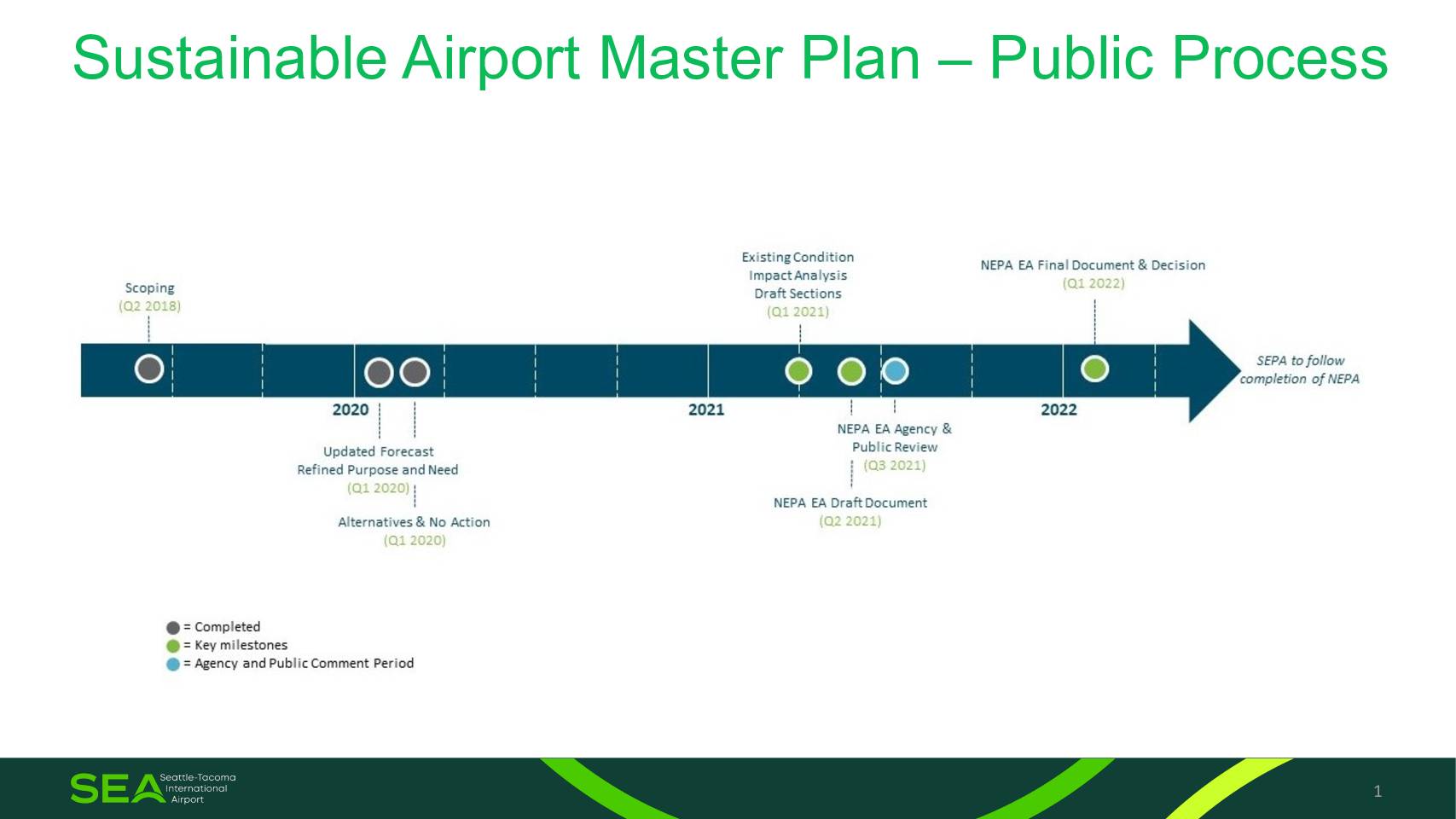
• Scoping for the Environmental Review occurred in 2018 • Currently working with the FAA to finish draft Environmental Assessment (EA) within NEPA. • Goal is third quarter publication of draft EA and public comment period • Standard public comment period is 30 days; we have received requests for a sixty-day comment period and have passed that along to the FAA • Once the schedule is confirmed with FAA, we will provide as close to a 30- day notice prior to beginning the public comment period Environmental Review Schedule cont. • Port Commission will be briefed in public session at the beginning of the public comment period and our outreach and engagement will follow • Presentations will be offered to stakeholders, including each of the Airport cities, and there will be three (virtual) public hearings • Public hearings will be offered on a mix of days and times, but with identical materials • Once the public comment period begins, comments can be made electronically (by email or directly on the website), in writing by mail, or verbally during one of the public hearings Project Planning Process ü Long-range plan (e.g. SAMP) – Campus wide, comprehensive planning – Facility requirements for airport activity in 5-year increments to 20-years – Alternatives analysis for major plan elements – Narrowing alternatives down to Preferred Alternative(s) – 20-year facilities development plan • Balance capacity in all key functional areas to fixed capacity of 3-runway airfield • Phasing plan to maintain adequate level of service and… -
SAMP PPT 6 23 21
Sustainable Airport Master Plan – Public Process Sustainable Airport Master Plan – Public Process -
Port of Seattle PHSKC letter 062221
Senior Social Research Scientist, Assessment, Policy Development & Evaluation Public Health—Seattle & King County (PHSKC) Sent via email: krijohnson@kingcounty.gov Re: Initial Concerns and Questions for Public Health-Seattle & King County Dear Kris: Thank you for our recent discussion with you regarding the PHSKC report, Community Health and Airport Operations Related Noise and Air Pollution: Report to the Legislature in Response to Washington State HOUSE BILL 1109. We understand the County was tasked with completing this report. However, we do not understand why the County chose not to notify or coordinate with the Port of Seattle in developing such a report. The Port of Seattle works closely with Puget Sound Clean Air Agency and other regulatory agencies in managing its airport-related noise and air pollution and if contacted, we would have supplied additional rigorous scientific and technical information that could have aided this study. We have reviewed the report and have a number of questions and concerns regarding the County’s methodology, data sources, scope, analysis, and conclusions. We appreciate the chance to have had a preliminary discussion with you, and we look forward to submitting a more detailed follow-up letter to the County soon. In the meantime, we plan to share some of the attached concerns at the June 23 SeaTac Stakeholder Advisory Roundtable (StART) meeting, where the County will be presenting this report. These items are a partial list and represent some of our biggest concerns. Our overarching intent is that accurate, scientifically supported information be presented regarding the airport’s… -
KLane BU Presentation on Aviation Emisions 8 25 2021
expressed in this material are those of the author(s) and do not necessarily reflect the views of ASCENT and FAA sponsor organizations. Kevin J. Lane PhD, MA Assistant Professor Department of Environmental Health Boston University School of Public Health August 25th, 2021 Boston University Slideshow Title Goes Here Boston University School of Public Health Aviation Activities Activities involving flying aircraft A number of social and economic benefits Fastest growing transportation mode Environmental and public health concerns Boston University Slideshow Title Goes Here Boston University School of Public Health Background Ultrafine particulate matter: Particles < 100 nm in aerodynamic diameter Typically combustion products Large reactive surface area Limited removal in lung Potential to translocate effects beyond respiratory system Epidemiological evidence fairly limited 10 years ago, growing rapidly Ohlwein 2019: 85 studies 2011-2017, including long-term studies Boston University Slideshow Title Goes Here Boston University School of Public Health Particle Matter Pollution Measured as Particle Number Concentration (PNC – particles/cm3) Boston University Slideshow Title Goes Here Boston University School of Public Health UFP Health Effects: Cardiovascular • Increases in biomarkers of inflammation related to cardiovascular disease (Lane et al. 2016; Devlin et al. 2014) • Changes in heart rhythm and vasomotor function (Vora et al. 2014) • Decreased microvascular function (Karottki et al. 2014) • Recurrent myocardial infarction (Wolf et al. 2015) • Systolic blood pressure and hypertension (Corlin et al. 2018), though with mixed evidence (Magalhaes et al. 2018) •… -
DRAFT Runway Use LOA
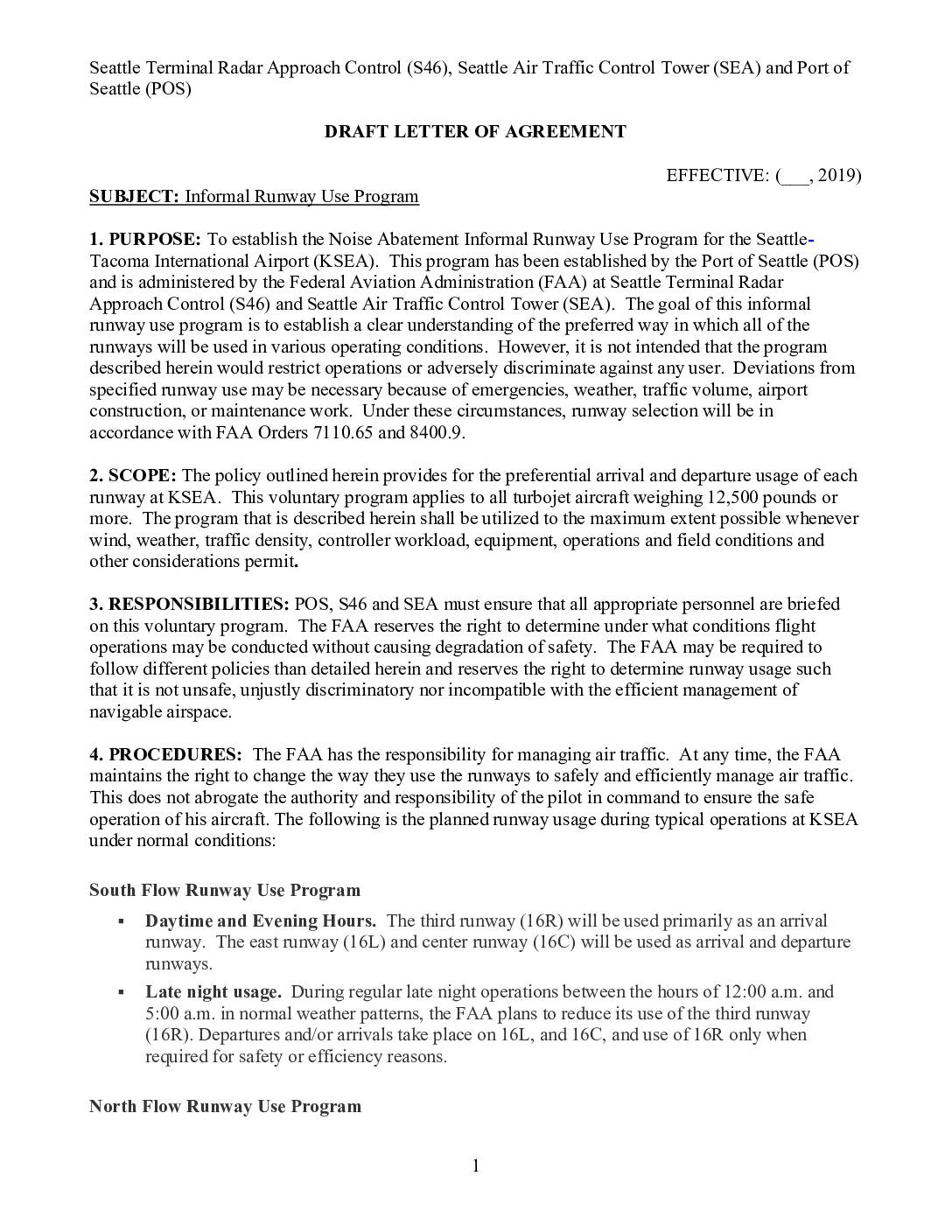
Seattle Terminal Radar Approach Control (S46), Seattle Air Traffic Control Tower (SEA) and Port of Seattle (POS) DRAFT LETTER OF AGREEMENT EFFECTIVE: (___, 2019) SUBJECT: Informal Runway Use Program 1. PURPOSE: To establish the Noise Abatement Informal Runway Use Program for the Seattle- Tacoma International Airport (KSEA). This program has been established by the Port of Seattle (POS) and is administered by the Federal Aviation Administration (FAA) at Seattle Terminal Radar Approach Control (S46) and Seattle Air Traffic Control Tower (SEA). The goal of this informal runway use program is to establish a clear understanding of the preferred way in which all of the runways will be used in various operating conditions. However, it is not intended that the program described herein would restrict operations or adversely discriminate against any user. Deviations from specified runway use may be necessary because of emergencies, weather, traffic volume, airport construction, or maintenance work. Under these circumstances, runway selection will be in accordance with FAA Orders 7110.65 and 8400.9. 2. SCOPE: The policy outlined herein provides for the preferential arrival and departure usage of each runway at KSEA. This voluntary program applies to all turbojet aircraft weighing 12,500 pounds or more. The program that is described herein shall be utilized to the maximum extent possible whenever wind, weather, traffic density, controller workload, equipment, operations and field conditions and other considerations permit. 3. RESPONSIBILITIES: POS, S46 and SEA must ensure that all appropriate personnel are briefed on this voluntary program. The FAA reserves the right… -
Air Traffic Briefing Presentation 180821
– SEA is slotted to receive Wake Turbulence Recategorization in October 2018. • Minimal foreseen impact to AAR/ADR due to fleet mix. – Glide Slope angle on 34R of 2.75 degrees was the industry standard when created • Still within current standards of 2.5 – 3 degrees Federal Aviation Administration Four Post System Federal Aviation Administration Four Post System Federal Aviation Administration Four Post System Federal Aviation Administration Fleet Mix Changes In 2005, turboprops accounted for 33% of the aircraft operating at SEA. In 2017, the percentage of turboprop aircraft was 17%. The percentage of aircraft classified as “heavy” have also increased during this timeframe. Federal Aviation Administration SEA Traffic Counts • 1998 – 407,597 • 1999 – 433,660 • 2000 – 445,677 (steady drop 2001 to 2012) • 2012 – 309,597 • 2016 – 412,170 • 2017 – 416,136 (10% increase year over year 2013-2016) • 2018 – projected – 435,000, about 1999 numbers Federal Aviation Administration Thank you.