TagRegional Commission On Airport Affairs(36)
-
 2022-09-12 15:32
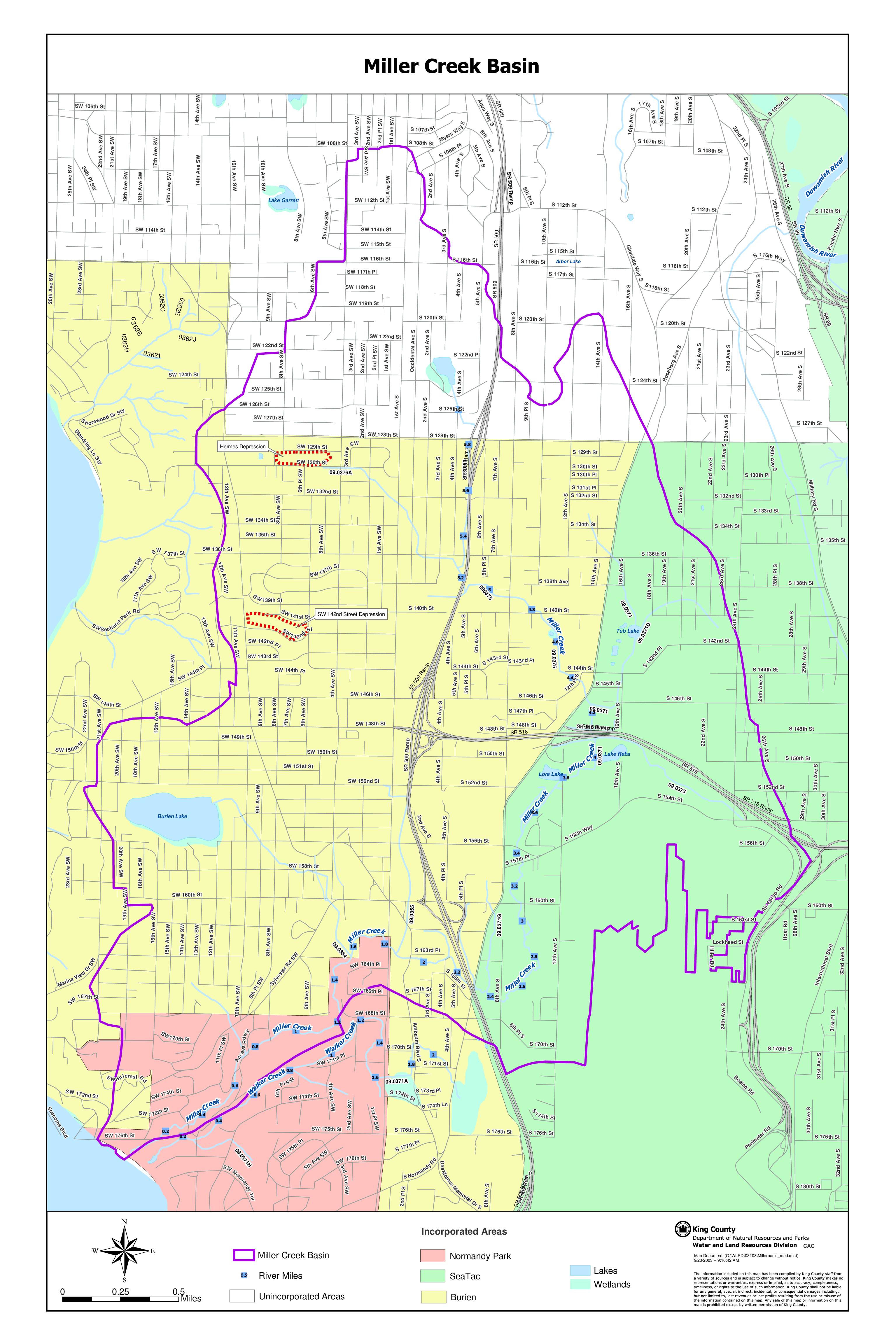
King County – Miller Basin Map, 2004
-
 2022-09-12 15:32
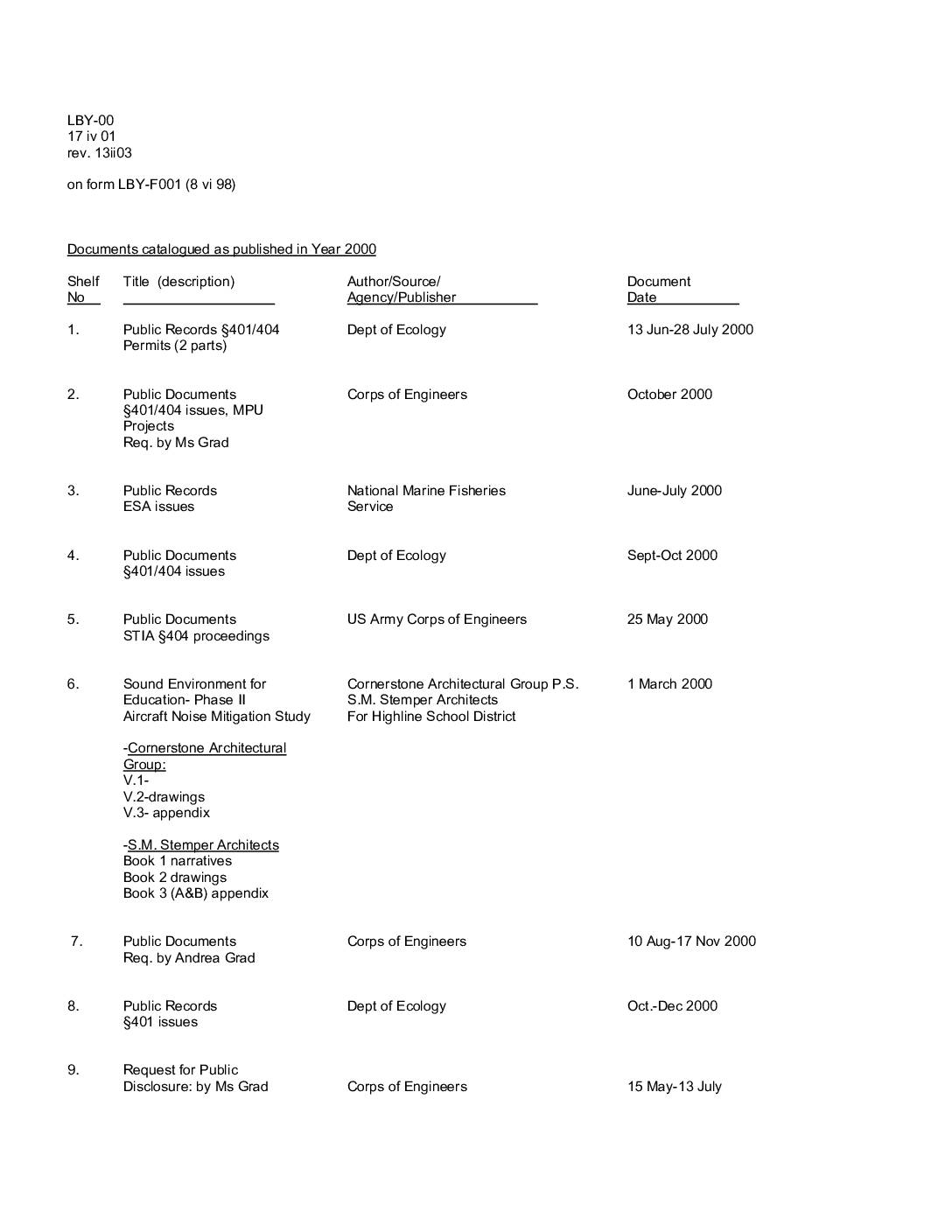
Lby 00
Documents catalogued as published in Year 2000 Shelf Title (description) Author/Source/ Document No Agency/Publisher Date 1. Public Records §401/404 Dept of Ecology 13 Jun-28 July 2000 Permits (2 parts) 2. Public Documents Corps of Engineers October 2000 §401/404 issues, MPU Projects Req. by Ms Grad 3. Public Records National Marine Fisheries June-July 2000 ESA issues Service 4. Public Documents Dept of Ecology Sept-Oct 2000 §401/404 issues 5. Public Documents US Army Corps of Engineers 25 May 2000 STIA §404 proceedings 6. Sound Environment for Cornerstone Architectural Group P.S. 1 March 2000 Education- Phase II S.M. Stemper Architects Aircraft Noise Mitigation Study For Highline School District -Cornerstone Architectural Group: V.1- V.2-drawings V.3- appendix -S.M. Stemper Architects Book 1 narratives Book 2 drawings Book 3 (A&B) appendix 7. Public Documents Corps of Engineers 10 Aug-17 Nov 2000 Req. by Andrea Grad 8. Public Records Dept of Ecology Oct.-Dec 2000 §401 issues 9. Request for Public Disclosure: by Ms Grad Corps of Engineers 15 May-13 July Documents catalogued as published in Year 2000 page 2 of 7 Shelf Title (description) Author/Source/ Document No Agency/Publisher Date 10. STIA Wildlife Hazard Dept of Ecology July 2000 Management Plan 11. Public Documents-Water Dept of Ecology 4 April 00 Issues POS & Dept of Transportation Port of Seattle 22 Feb 00 509 Interchange Stormwater Management Plan POS & Parametrix August 00 Appendix A Stormwater Management Plan POS & Parametrix 14 Sept 00 Appendices C through W Dept of Ecology: Dept of Transportation 24 0ct 2000 Miller &… -
 2022-09-12 15:32
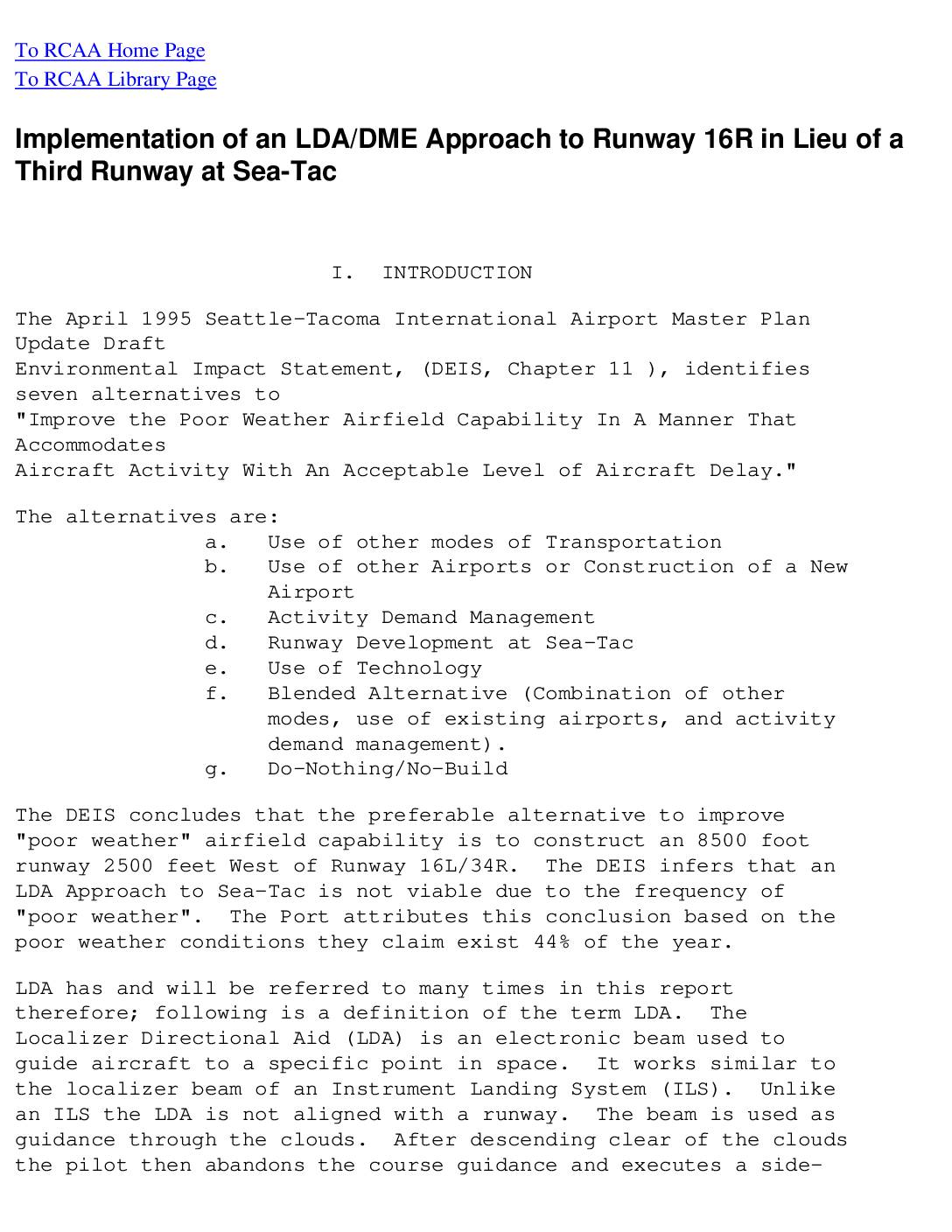
Bogan
Implementation of an LDA/DME Approach to Runway 16R in Lieu of a Third Runway at Sea-Tac I. INTRODUCTION The April 1995 Seattle-Tacoma International Airport Master Plan Update Draft Environmental Impact Statement, (DEIS, Chapter 11 ), identifies seven alternatives to "Improve the Poor Weather Airfield Capability In A Manner That Accommodates Aircraft Activity With An Acceptable Level of Aircraft Delay." The alternatives are: a. Use of other modes of Transportation b. Use of other Airports or Construction of a New Airport c. Activity Demand Management d. Runway Development at Sea-Tac e. Use of Technology f. Blended Alternative (Combination of other modes, use of existing airports, and activity demand management). g. Do-Nothing/No-Build The DEIS concludes that the preferable alternative to improve "poor weather" airfield capability is to construct an 8500 foot runway 2500 feet West of Runway 16L/34R. The DEIS infers that an LDA Approach to Sea-Tac is not viable due to the frequency of "poor weather". The Port attributes this conclusion based on the poor weather conditions they claim exist 44% of the year. LDA has and will be referred to many times in this report therefore; following is a definition of the term LDA. The Localizer Directional Aid (LDA) is an electronic beam used to guide aircraft to a specific point in space. It works similar to the localizer beam of an Instrument Landing System (ILS). Unlike an ILS the LDA is not aligned with a runway. The beam is used as guidance through the clouds. After descending clear of… -
 2022-09-12 15:32
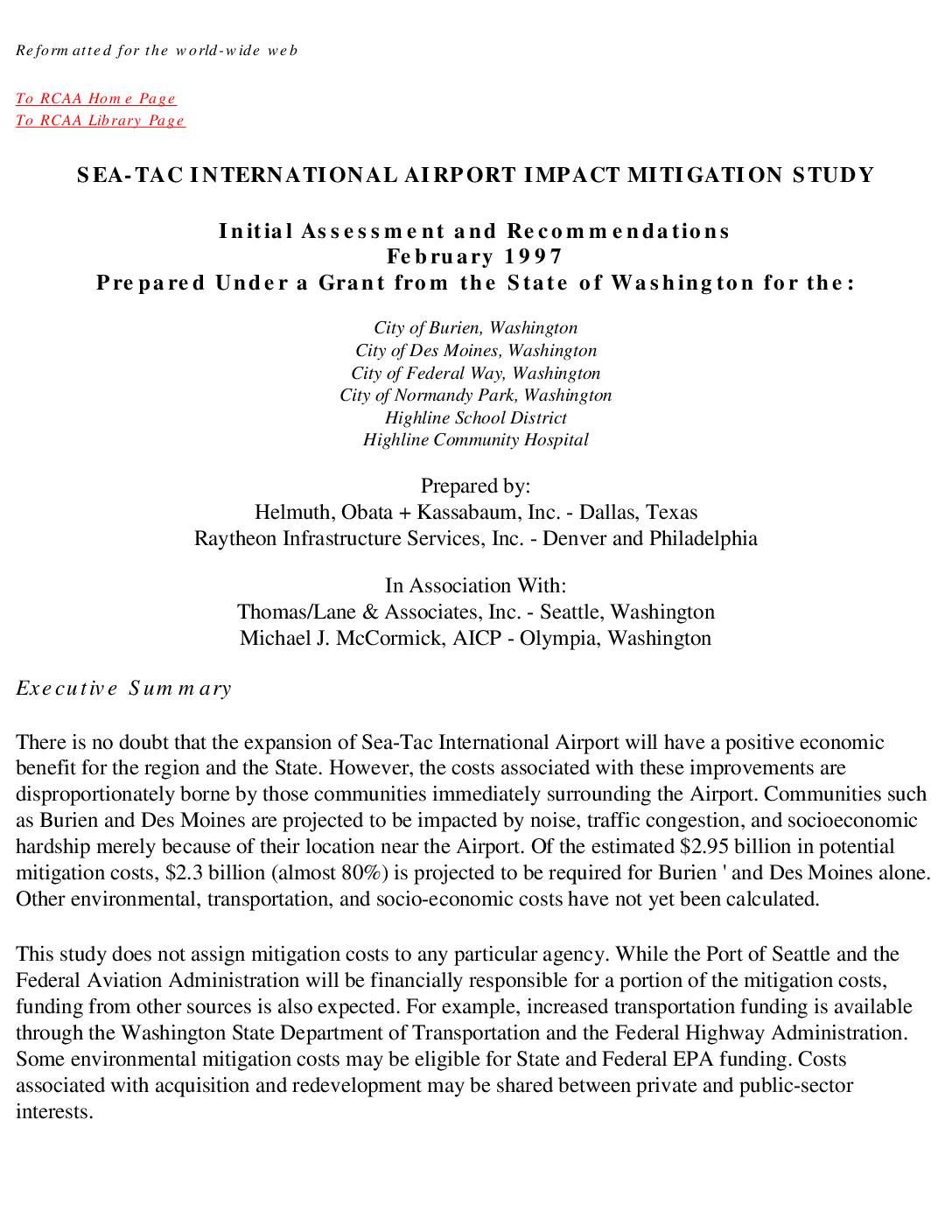
HOK Sum
Prepared Under a Grant from the State of Washington for the: City of Burien, Washington City of Des Moines, Washington City of Federal Way, Washington City of Normandy Park, Washington Highline School District Highline Community Hospital Prepared by: Helmuth, Obata + Kassabaum, Inc. - Dallas, Texas Raytheon Infrastructure Services, Inc. - Denver and Philadelphia In Association With: Thomas/Lane & Associates, Inc. - Seattle, Washington Michael J. McCormick, AICP - Olympia, Washington Executive Summary There is no doubt that the expansion of Sea-Tac International Airport will have a positive economic benefit for the region and the State. However, the costs associated with these improvements are disproportionately borne by those communities immediately surrounding the Airport. Communities such as Burien and Des Moines are projected to be impacted by noise, traffic congestion, and socioeconomic hardship merely because of their location near the Airport. Of the estimated $2.95 billion in potential mitigation costs, $2.3 billion (almost 80%) is projected to be required for Burien ' and Des Moines alone. Other environmental, transportation, and socio-economic costs have not yet been calculated. This study does not assign mitigation costs to any particular agency. While the Port of Seattle and the Federal Aviation Administration will be financially responsible for a portion of the mitigation costs, funding from other sources is also expected. For example, increased transportation funding is available through the Washington State Department of Transportation and the Federal Highway Administration. Some environmental mitigation costs may be eligible for State and Federal EPA funding. Costs associated with… -
 2022-09-12 15:32
RCAA – Scoping Comments on Sea-Tac Master Plan Update EIS
This document constitutes the comments of the Regional Commission on Airport Affairs (RCAA) in response to your request for written comments for your scoping process on the "Sea Tac Master Plan Update, including a third runway." The RCAA is a coalition of various citizen groups, municipal governments and individuals who have a long-standing interest in airport issues and has submitted extensive comments, professional reports and testimony on behalf of our members and member groups in various forums on this subject. This document will also constitute the individual comments of the various participants in the RCAA coalition, though individual members may submit separate comments. In addition to the comments provided herein, we incorporate by reference previous our comments on the related Puget Sound Air Transportation Committee Flight Plan Environmental Impact Statement (hereinafter referred to as the Flightplan E.I.S.) and testimony and presentations to the Puget Sound Regional Council (PSRC) during their consideration of the Flightplan E.I.S. We also reviewed the comment submitted by the PSRC asking that all issues identified in the Flightplan Final E.I.S. as "items be covered in the site specific E.I.S" be covered. We concur and incorporate their comment by reference. Rather than repeat all these instances, we ask that each and every instance in the Flightplan E.I.S.--whether in that instance was in the body of the document or response to public comment--was deferred to the "site specific" or a later E.I.S. must be included in this Environmental Impact Statement. In our comments we will repeatedly use certain… -
 2022-09-12 15:32
Williams
The Seattle Tacoma International Airport currently has no air-pollution monitoring system in place. The Washington State Department of Ecology (DOE) studied how seriously the airport is affecting the quality of the air we breathe. The Seattle Tacoma International Airport covers 2500 acres of land in King County. This a mere 0.18% or less than 1/5 of 1% of the land in King County. The DOE found that Sea-Tac Airport contributed 8% of the carbon monoxide and 5% of the nitrogen oxide emissions in all of King County in 1991. The following air pollutants, classified as either Criteria or Toxic http://www.rcaanews.org/ file:///C|/AA_RCAAwebsite/water/libr1.htm Pollutants, are not being monitored by Sea-Tac Airport staff: Total suspended particulates, particulate matter, carbon monoxide, oxides of sulfer, oxides of nitrogen, hydrocarbons, ozone and lead (criteria pollutant) Phenyl, benzene, dioxin, toluene, manganese, xylene, formaldehyde and chloroform pc.,[Ed. note: unreadable text]. Benzene, one of the toxic pollutants, is a known carcinogen. Sea-Tac airport, according to the DOE study, contributed 12.7 tons of benzene in 1984. This amounted to about 0.16 parts per million or 24,000 parts per trillion. New WAC 173-460 proposes the acceptable impact levels for benzene at 0.063 parts per trillion. There is no baseline for a study of air pollution at the Seattle-Tacoma International Airport. There is no system set up at this time to study air pollution. This is a fatal flaw in the [FlightPlan] Environmental Impact Statement which must be corrected. Airport currently has no air-pollution monitoring system in place. [Page 3] Our creation… -
 2022-09-12 15:32
NASA Technical Memorandum 2003-212649
Area and Noise Levels at Certification Points Clemans A. Powell Langley Research Center, Hampton, Virginia The NASA STI Program Office . . . in Profile Since its founding, NASA has been dedicated to the advancement of aeronautics and space science. The NASA Scientific and Technical Information (STI) Program Office plays a key part in helping NASA maintain this important role. The NASA STI Program Office is operated by Langley Research Center, the lead center for NASA’s scientific and technical information. The NASA STI Program Office provides access to the NASA STI Database, the largest collection of aeronautical and space science STI in the world. The Program Office is also NASA’s institutional mechanism for disseminating the results of its research and development activities. These results are published by NASA in the NASA STI Report Series, which includes the following report types: • TECHNICAL PUBLICATION. Reports of completed research or a major significant phase of research that present the results of NASA programs and include extensive data or theoretical analysis. Includes compilations of significant scientific and technical data and information deemed to be of continuing reference value. NASA counterpart of peer- reviewed formal professional papers, but having less stringent limitations on manuscript length and extent of graphic presentations. • TECHNICAL MEMORANDUM. Scientific and technical findings that are preliminary or of specialized interest, e.g., quick release reports, working papers, and bibliographies that contain minimal annotation. Does not contain extensive analysis. • CONTRACTOR REPORT. Scientific and technical findings by NASA-sponsored contractors and grantees. •… -
 2022-09-12 15:32
2004 Np Esp Appeal
Puget Soundkeeper Alliance jointly move the Board for an Order determining that Seattle- Tacoma International Airport's NPDES Permit is invalid. Appellants respectfully request the Board to direct the Department of Ecology to reissue the permit consistent with all applicable requirements of state and federal law. WAC 371-08-540. APPELLANTS' MOTION FOR PARTIAL SUMMARY JUDGMENT re: AKART- 1 Smith & Lowney, p.l.l.c. 2317 East John Street Seattle, Washington 98112 (206) 860-2883 OVERVIEW NPDES Permit No. WA 002465-1, issued September 4, 2003 (the "2003 Permit") is invalid and must be remanded because it does not require the Port of Seattle to implement AKART -- all known, available, and reasonable methods of preventing, controlling, and treating pollution. The NPDES Permit allows the Port to continue discharging essentially untreated industrial wastewater contaminated with biochemical oxygen demand (BOD)-inducing glycols into Puget Sound. The Permit allows these discharges to continue even though the Port identified and recommended an AKART Alternative providing biological treatment for all of its industrial wastewater. The Permit allows these discharges to continue even though they contain concentrations of BOD that are many times greater than the levels routinely achieved with biological treatment. In fact, the Permit allows these discharges to continue even though the Port is going to build an "AKART pipeline" to the King County sewage treatment plant to provide biological treatment for some of its industrial wastewater. Two of these points merit repeating: even though the Port recommended biological treatment as AKART for its industrial wastewater, and even though the Port… -
 2022-09-12 15:32
RCAA – NPDES Permit Comments, April 2003
RCAA comments on the draft of a renewed NPDES permit for Seattle-Tacoma submitted on 21 April 2003 The following comments on the draft of a renewed NPDES permit for Seattle-Tacoma International Airport & accompanying Fact Sheet are submitted on behalf of the Regional Commission on Airport Affairs (RCAA). The interest of RCAA in matters relating to Sea-Tac Airport is well-known to the Department of Ecology & need not be restated. Our comments primarily address the actual permit, after a brief mention of concerns as to the Fact Sheet. The comments on the permit itself follow the format of the permit, so that we deal with the three specific sections: “Industrial Waste Water (Section I), Non-Construction Stormwater Runoff (Section II), and “Construction Stormwater Discharge Limitations and Monitoring (Section III) in that order. The text of these comments was previously sent to you via e-mail, with a copy also sent to Tricia Miller, Water Quality Permit Coördinator. The formatting & pagination in this hard-copy letter are slightly different from that in the e-mail version. The text is unchanged, except for correction of a few minor typographical errors. * * * * * * * FACT SHEET Most NPDES Permit Fact Sheets include a section on compliance with the previous permit. This lets the public know how a facility is doing in terms of compliance and informs the public what actions Ecology is taking as a result to correct any problems. The instant Fact Sheet does not have a section on compliance with… -
 2022-09-12 15:32
2004 Pos V PCHB Op 1
PORT OF SEATTLE, a port district ) of the State of Washington, ) Petitioner, ) ) No. 73419-4 v. ) THE POLLUTION CONTROL HEARINGS ) BOARD, an agency of the State of Washington, ) EN BANC Respondent, ) ) Filed May 14, 2004 ) AIRPORT COMMUNITIES COALITION; ) CITIZENS AGAINST SEATAC EXPANSION; ) and STATE OF WASHINGTON, DEPARTMENT ) OF ECOLOGY, an agency of the State of ) Washington, ) Respondents/Cross-Petitioners ) BRIDGE, J.--Construction of the third runway at the Seattle-Tacoma International Airport (SeaTac) will require placing fill into area wetlands. Before the Army Corps of Engineers may issue a permit to fill wetlands, the project proponent must obtain certification from the State, pursuant to sec. 401 of the Clean Water Act (33 U.S.C. sec. 1341), stating that there is reasonable assurance that the project will not violate applicable state water quality standards. On September 21, 2001, the Washington State Department of Ecology issued a sec. 401 water quality certification to the Port of Seattle (Port) for the third runway project. The Airport Communities Coalition (ACC) appealed the certification to the Pollution Control Hearings Board (PCHB). After a lengthy hearing, the PCHB affirmed the certification but added 16 new conditions it deemed necessary for reasonable assurance that state water quality standards would be met. All parties appealed and this court accepted direct review of the PCHB decision. We conclude that there is reasonable assurance that the third runway project will not violate state water quality standards. We uphold some of…