TagRCAA(175)
-
We Tl Back 2
The process—in general. As noted in the discussion about the wetlands regulatory process, in order to receive permission from the U.S. Army Corps of Engineers to fill wetlands, a project proponent, such as Sea-Tac Airport, must first obtain a certificate from the appropriate State agency (Department of Ecology, in Washington) that the project can be constructed with "reasonable assurance" that State water-quality standards will not be violated. Ecology has six months from the date of an application to act on it. Decisions by Ecology can be appealed to the Pollution Control Hearings Board, a panel of three administrative-law judges with environmental expertise. The PCHB hears such appeals "de novo"—in other words, the parties may present oral testimony from their experts. Decisions of that Board can be appealed to the courts. "State water quality standards" include the specific requirements of State statutes, various regulations issued by the Department of Ecology, and, as a practical matter, the stormwater-management regulations and plans adopted by King County. Water-quality standards are important for protection of fish and other aquatic life forms, and wildlife protection plans and rules issued by the Department of Fish and Game, and by local groups are also to be taken into account. First application. Sea-Tac Airport submitted its first application in December 1996, and Ecology granted a sec. 401 certificate on that first application. But Ecology withdrew its approval while the matter was on appeal to the Pollution Control Hearings Board. Sec. 401 certificate. Second application. A second application was filed.… -
We Tl Back 3
Review by the U.S. Army Corps of Engineers The Army Engineers have repeatedly indicated that they were on the verge of rendering their decision on the third application. But each of these reports has failed to pan out. Early on, the Corps said that it would not act until the State had finished its part of the process. The Corps seemed to be unsure whether the certificate was in force, after the Pollution Control Hearings Board (the State’s official body for reviewing such certificates) had ruled that it was not. The Corps has a huge mass of materials under consideration, hundreds upon hundreds of documents, including everything submitted to Ecology and much more. The Corps is considering difficult issues of “public need”, the stability of the proposed runway embankment, and issues of Federal water-quality and wildlife standards. The Corps has said in the past that this is the largest sec. 404 proceeding that has come before it to date. It is certainly the largest public works project in our State since the Grand Coulee Dam. RCAA believes that the civilian technicians in the Seattle District Office are drafting possible conditions that might be included in a permit, as a way of gauging whether there is any way to approve the application. This work is separate from the Corps’ necessary evaluation of the “public need” for the runway, and of course writing a draft is not the same as making a decision to issue it. Typically, in a complicated situation, the… -

Chron App 2
September 1999. The Port submitted its second application to the U.S. Army Corps of Engineers and to the Department of Ecology, after having to withdraw its 1997 application because of gross under-statement of the amount of wetlands involved. Ecology had 365 days to pass on the application. The Engineers had previously announced that they would not decide till after Ecology had finished its work. Spring & Summer 2000. Port of Seattle submitted voluminous revised documents, attempting to justify the plan, some as late as late August. Ecology, Engineers, and King County stormwater experts, as well as experts retained by Airport Communities Coalition, RCAA, and C.A.S.E., raised a host of questions. September 2000. A meeting—not publicly announced—was held at the office of M.R. ("Mic") Dinsmore, Executive Director of the Port of Seattle. Those present included: Joe Dear, the Governor's Chief of Staff; Mr Dinsmore; Tom Fitzsimmons, the Director of the Department of Ecology; Ray Hellwig, head of the regional office of Ecology; and others. Mr Dinsmore was a major fund-raiser for Gov. Gary Locke in the last general election. The Governor and Ecology have denied that there is any political pressure in this affair, though Ecology has been officially warned that there is interest in this project "at the highest levels" of State government. The Ecology folks brought with them their draft letter of decision on the sec. 401 application, dated that day, and shared it with the others. The letter flatly denied the application, because of multiple shortcomings. "At this… -

ST Appendix C
5. Summary of Corps Assessment of Existing Landscape Functions .........................3 6. Impact Assessment Summary.................................................................................6 7. Adequacy of the Port’s December 2000 NRMP Compared to the Corps Impact Assessment.........................................................13 8. Corps’ Coordination of Concerns with the Port .....................................................19 9. Port’s Additional Mitigation Submittal/Corps Overview..........................................20 10. Findings Regarding Port’s November 2001 Revised NRMP, as amended in January 2002 ................................................................................22 11. Literature Cited......................................................................................................24 ENCLOSURES Enclosure A – Wetland Classes Found in the Project Area Enclosure B – Corps Aquatic Resource Functional Assessment by Project Area Enclosure C – Corps Wetland and Aquatic Resource Impact Analysis Enclosure D – Corps Analysis of the Adequacy of the Initial Mitigation Plan (Port of Seattle, December 2000) FIGURES Figure 1 – map of project area and wetlands in Miller/Walker Creek watersheds Figure 2 – map of project area and wetlands in Des Moines Creek watershed TABLES Table 1 – Summary of On- and Off-Site Impacts by Project Area, Creek Basin, Acreage, and Cowardin/HGM Classification Table 2 – Corps Determination of Temporary Impacts Table 3 – Details of On- and Off-Site Permanent and Temporary Impacts by Project Area, Creek Basin, Acreage, and Cowardin/HGM Classification Appendix C 1 APPENDIX C TO THE RECORD OF DECISION FUNCTIONAL ASSESSMENT, IMPACT AND MITIGATION PLAN REVIEW FOR SEATTLE, PORT OF (1996-4-02325) 1. INTRODUCTION: Appendix C contains the U.S. Army Corps of Engineers (Corps) independent analysis and review of aquatic resource functions and potential project impacts. This information was used to determine the adequacy of the Port of Seattle (Port) compensatory mitigation plans for… -
2003 09 Op Briefcase
PORT OF SEATTLE, a port district of the State of Washington, Petitioner, -
-
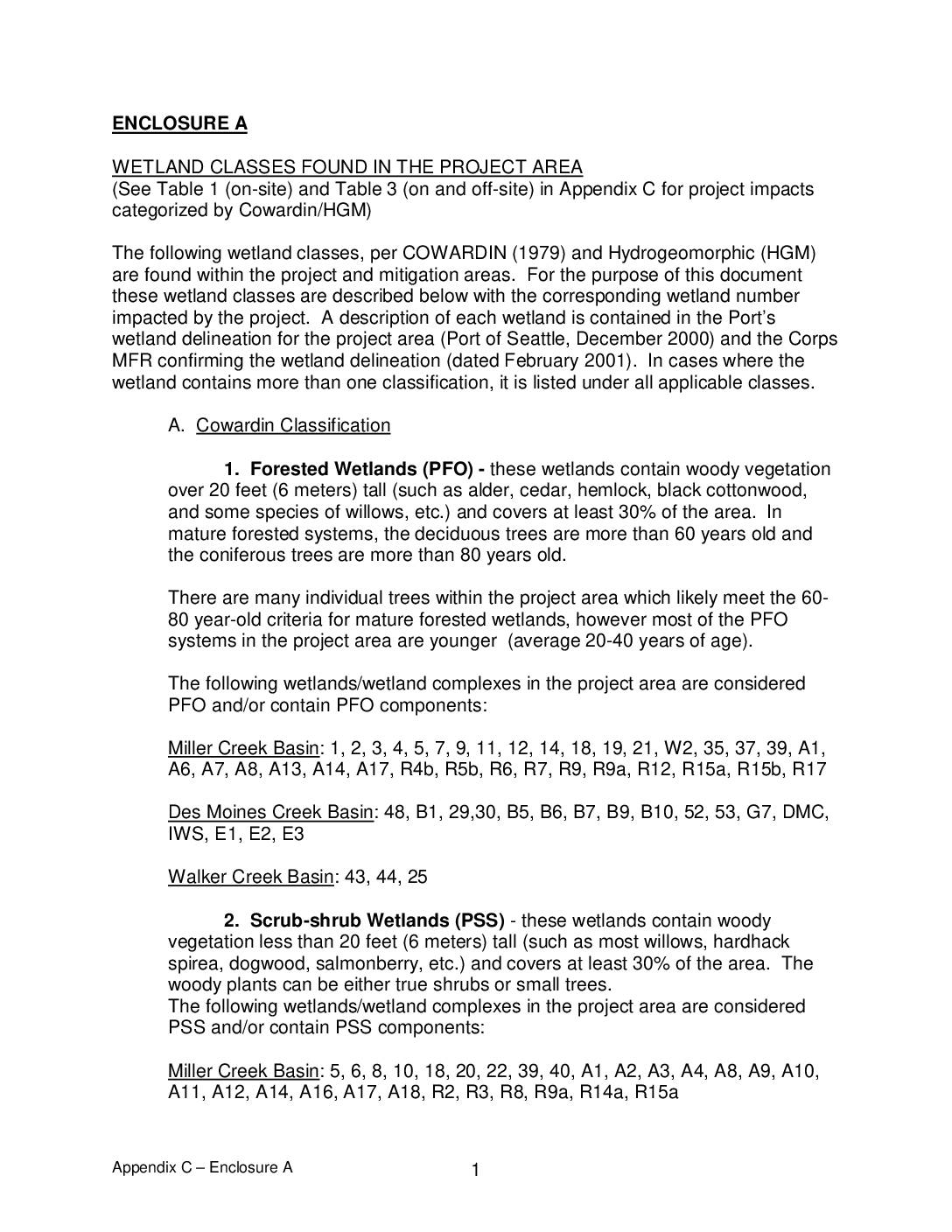
ST Enclosure A
(See Table 1 (on-site) and Table 3 (on and off-site) in Appendix C for project impacts categorized by Cowardin/HGM) The following wetland classes, per COWARDIN (1979) and Hydrogeomorphic (HGM) are found within the project and mitigation areas. For the purpose of this document these wetland classes are described below with the corresponding wetland number impacted by the project. A description of each wetland is contained in the Port’s wetland delineation for the project area (Port of Seattle, December 2000) and the Corps MFR confirming the wetland delineation (dated February 2001). In cases where the wetland contains more than one classification, it is listed under all applicable classes. A. Cowardin Classification 1. Forested Wetlands (PFO) - these wetlands contain woody vegetation over 20 feet (6 meters) tall (such as alder, cedar, hemlock, black cottonwood, and some species of willows, etc.) and covers at least 30% of the area. In mature forested systems, the deciduous trees are more than 60 years old and the coniferous trees are more than 80 years old. There are many individual trees within the project area which likely meet the 60- year-old criteria for mature forested wetlands, however most of the PFO systems in the project area are younger (average 20-40 years of age). The following wetlands/wetland complexes in the project area are considered PFO and/or contain PFO components: Miller Creek Basin: 1, 2, 3, 4, 5, 7, 9, 11, 12, 14, 18, 19, 21, W2, 35, 37, 39, A1, A6, A7, A8, A13, A14, A17, R4b,… -
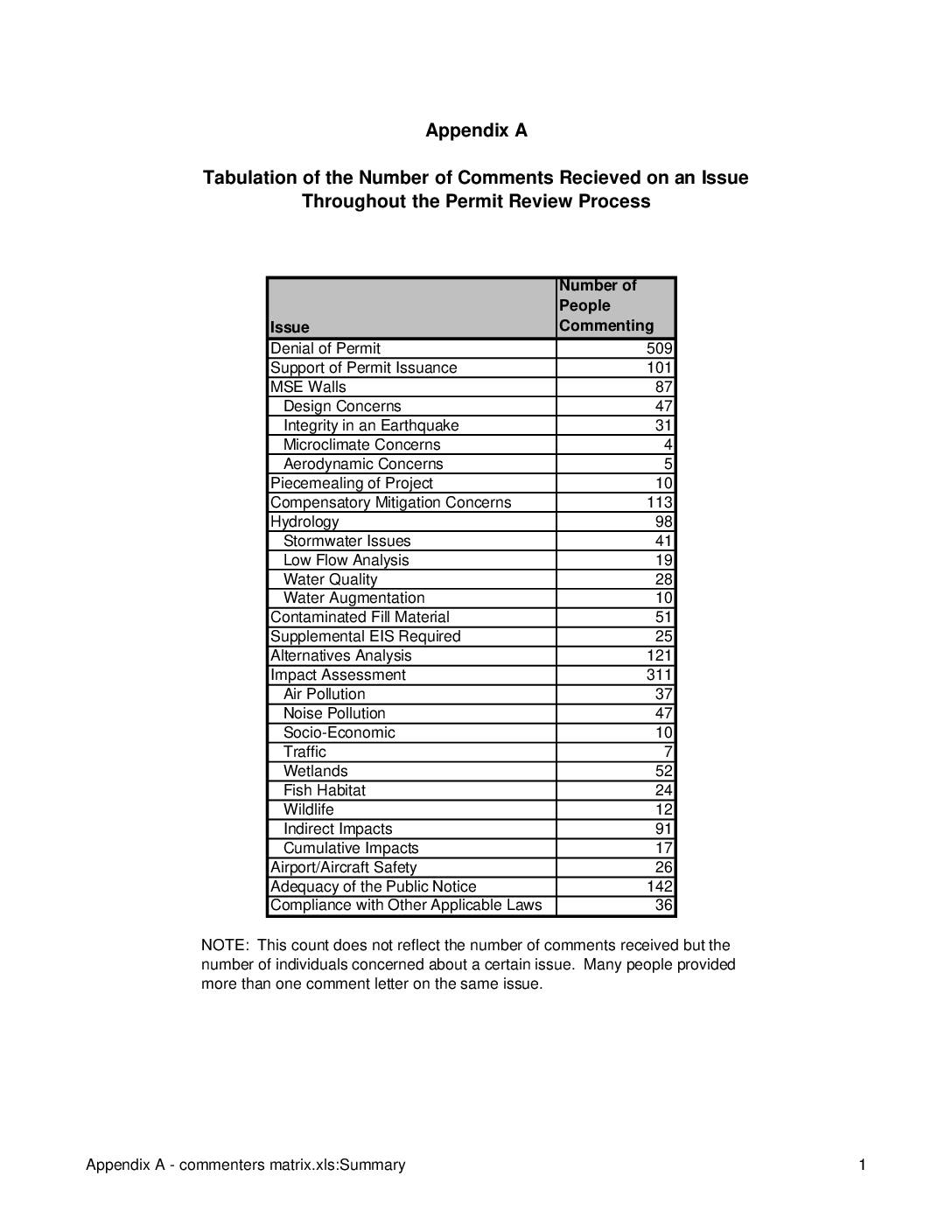
ST Commenters Matrix
Tabulation of the Number of Comments Recieved on an Issue Throughout the Permit Review Process Issue Number of People Commenting Denial of Permit 509 Support of Permit Issuance 101 MSE Walls 87 Design Concerns 47 Integrity in an Earthquake 31 Microclimate Concerns 4 Aerodynamic Concerns 5 Piecemealing of Project 10 Compensatory Mitigation Concerns 113 Hydrology 98 Stormwater Issues 41 Low Flow Analysis 19 Water Quality 28 Water Augmentation 10 Contaminated Fill Material 51 Supplemental EIS Required 25 Alternatives Analysis 121 Impact Assessment 311 Air Pollution 37 Noise Pollution 47 Socio-Economic 10 Traffic 7 Wetlands 52 Fish Habitat 24 Wildlife 12 Indirect Impacts 91 Cumulative Impacts 17 Airport/Aircraft Safety 26 Adequacy of the Public Notice 142 Compliance with Other Applicable Laws 36 NOTE: This count does not reflect the number of comments received but the number of individuals concerned about a certain issue. Many people provided more than one comment letter on the same issue. Appendix A - commenters matrix.xls:Summary 1 Appendix A - Index of Comments Recieved Throughout Permit Review Process A B C Name Issue Paragraph Number Abeyta, Janeen and Robert Denial of Permit 10(A)(1) Adair, Will Alternatives Analysis 10(A)(9) Affiliated Tribes of NW Indians Economic Devel. Corp. (M. Ufkes) Impact Assessment - Fish Habitat 10(A)(10)(f) Air Line Pilots Association, International Support of Permit Issuance 10(A)(2) Air Transportation Association of America (E. Merlis) Support of Permit Issuance 10(A)(2) Airport Communities Coalition (ACC) (B. Sheckler) Denial of Permit 10(A)(1) MSE Walls - Design Concerns 10(A)(3)(a) MSE Walls - Integrity in… -
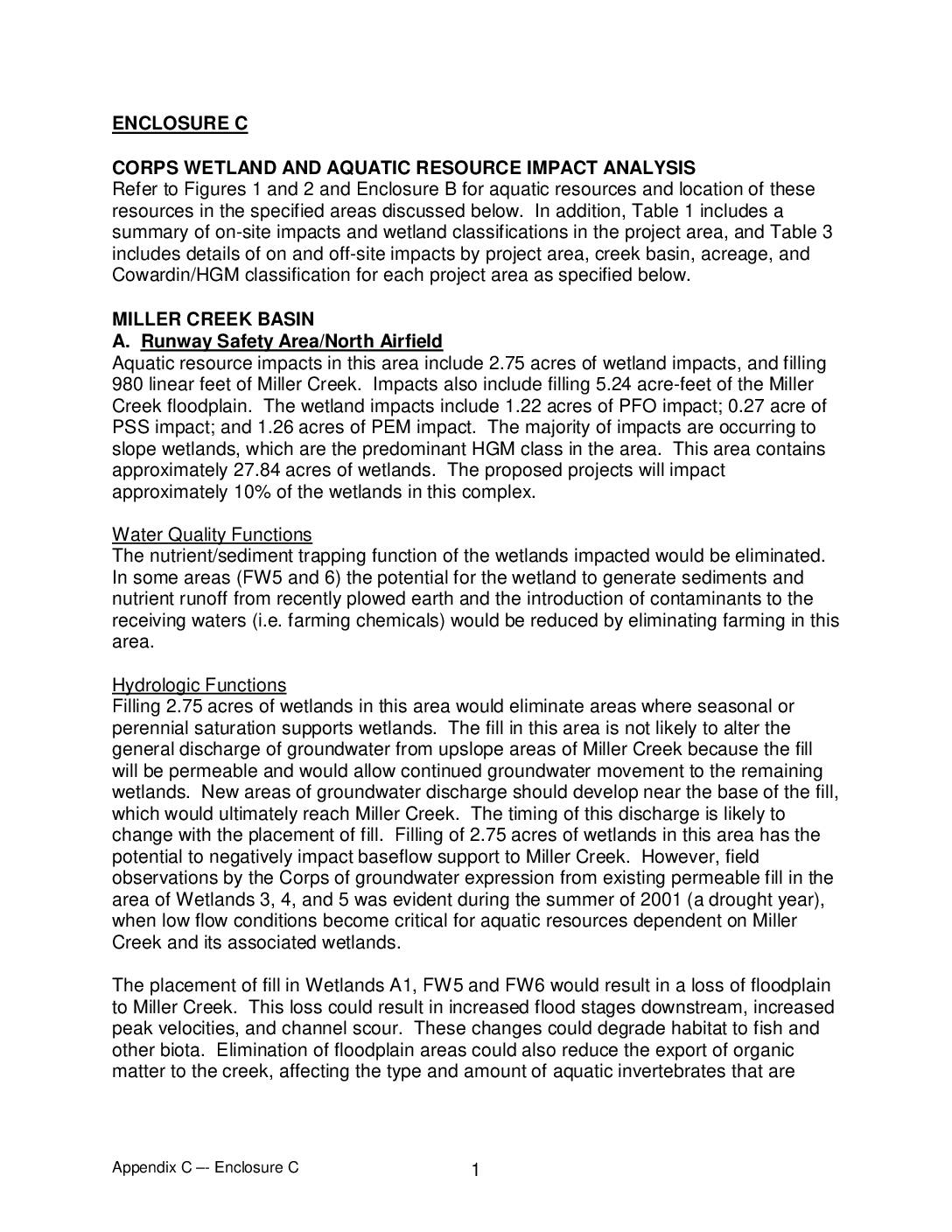
ST Enclosure C
Refer to Figures 1 and 2 and Enclosure B for aquatic resources and location of these resources in the specified areas discussed below. In addition, Table 1 includes a summary of on-site impacts and wetland classifications in the project area, and Table 3 includes details of on and off-site impacts by project area, creek basin, acreage, and Cowardin/HGM classification for each project area as specified below. MILLER CREEK BASIN A. Runway Safety Area/North Airfield Aquatic resource impacts in this area include 2.75 acres of wetland impacts, and filling 980 linear feet of Miller Creek. Impacts also include filling 5.24 acre-feet of the Miller Creek floodplain. The wetland impacts include 1.22 acres of PFO impact; 0.27 acre of PSS impact; and 1.26 acres of PEM impact. The majority of impacts are occurring to slope wetlands, which are the predominant HGM class in the area. This area contains approximately 27.84 acres of wetlands. The proposed projects will impact approximately 10% of the wetlands in this complex. Water Quality Functions The nutrient/sediment trapping function of the wetlands impacted would be eliminated. In some areas (FW5 and 6) the potential for the wetland to generate sediments and nutrient runoff from recently plowed earth and the introduction of contaminants to the receiving waters (i.e. farming chemicals) would be reduced by eliminating farming in this area. Hydrologic Functions Filling 2.75 acres of wetlands in this area would eliminate areas where seasonal or perennial saturation supports wetlands. The fill in this area is not likely to alter… -
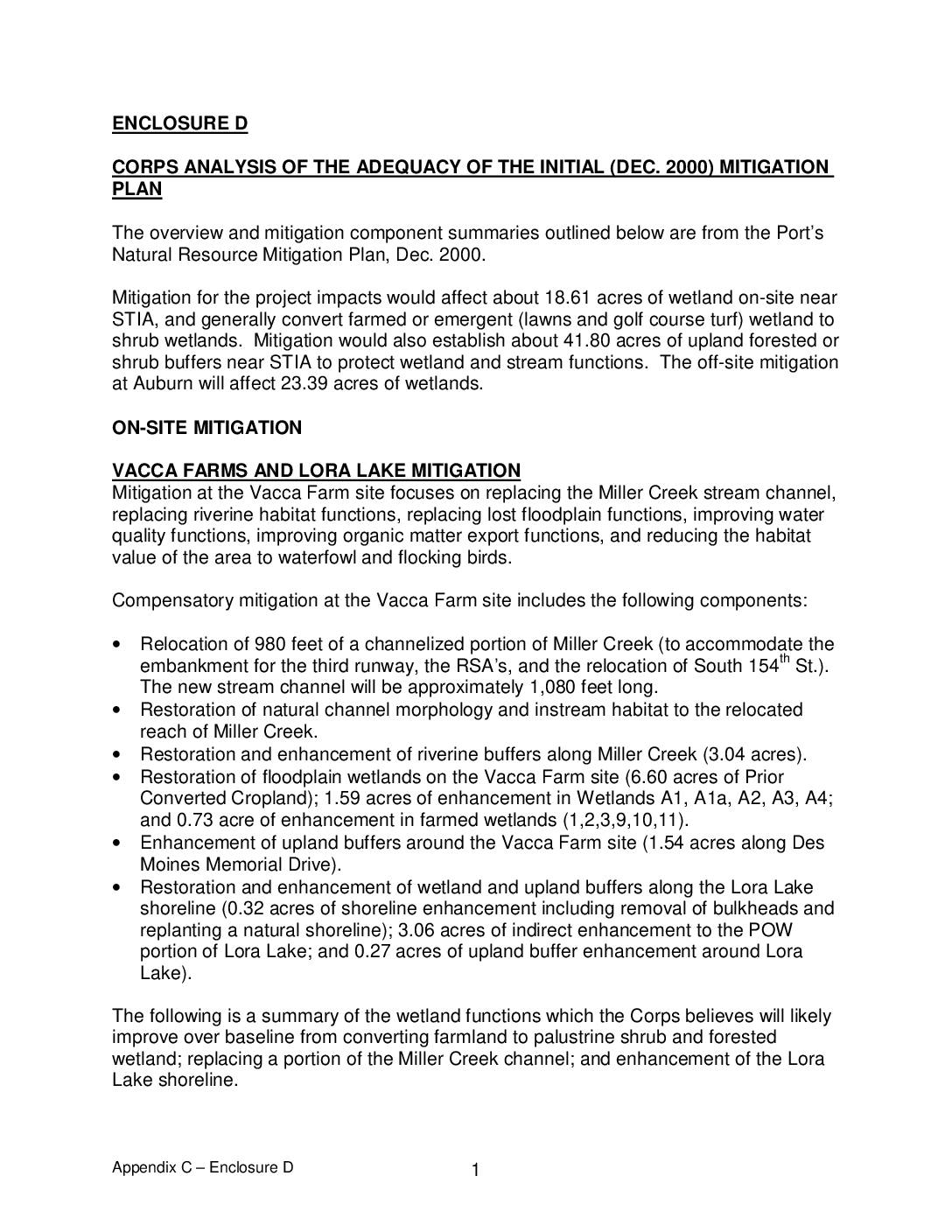
ST Enclosure D
The overview and mitigation component summaries outlined below are from the Port’s Natural Resource Mitigation Plan, Dec. 2000. Mitigation for the project impacts would affect about 18.61 acres of wetland on-site near STIA, and generally convert farmed or emergent (lawns and golf course turf) wetland to shrub wetlands. Mitigation would also establish about 41.80 acres of upland forested or shrub buffers near STIA to protect wetland and stream functions. The off-site mitigation at Auburn will affect 23.39 acres of wetlands. ON-SITE MITIGATION VACCA FARMS AND LORA LAKE MITIGATION Mitigation at the Vacca Farm site focuses on replacing the Miller Creek stream channel, replacing riverine habitat functions, replacing lost floodplain functions, improving water quality functions, improving organic matter export functions, and reducing the habitat value of the area to waterfowl and flocking birds. Compensatory mitigation at the Vacca Farm site includes the following components: • Relocation of 980 feet of a channelized portion of Miller Creek (to accommodate the embankment for the third runway, the RSA’s, and the relocation of South 154th St.). The new stream channel will be approximately 1,080 feet long. • Restoration of natural channel morphology and instream habitat to the relocated reach of Miller Creek. • Restoration and enhancement of riverine buffers along Miller Creek (3.04 acres). • Restoration of floodplain wetlands on the Vacca Farm site (6.60 acres of Prior Converted Cropland); 1.59 acres of enhancement in Wetlands A1, A1a, A2, A3, A4; and 0.73 acre of enhancement in farmed wetlands (1,2,3,9,10,11). • Enhancement of upland…