TagRCAA(175)
-
2004 NPDES Psk T Brief
PSA will play a limited role in the hearing on the merits. The issues that PSA brings forward in this appeal are based generally on undisputed facts and stipulated exhibits. Based on these undisputed facts, the law supports reversal of the Port’s 2003 NPDES permit for Sea-Tac. In the 10 year since the 1994 NPDES permit was issued, Ecology has not required, and the Port has not implemented AKART at Sea-Tac. Moreover, despite knowing that the Port discharges significant amounts of BOD5 and toxic pollutants from its deicing and anti-icing activities, and that those discharges likely violate water quality standards, Ecology has not established enforceable effluent limitations for pollutants such as BOD5. Nor has Ecology required acute or chronic toxicity testing of IWTP discharges. Instead, Ecology has willfully and knowingly allowed the Port to continue its significant and unchecked discharges into Puget Sound. In 1998 Ecology determined that the “clock” on the State’s 10 year limitation for compliance schedules began running on June 30, 1994. Consequently, Ecology determined and publicly stated that Sea-Tac must comply with the Clean Water Act and Washington’s water quality standards by June 30, 2004. The October 2003 NPDES permit, however, impermissibly extends the State’s 10 year limitation to 13 years. Because the 2003 NPDES permit is inconsistent with both Washington law and the Clean Water Act, the permit is invalid. II. RELEVANT AND MATERIAL FACTS This case concerns NPDES Permit No. WA-002465-1 issued to the Port of Seattle on September 4, 2003 for discharges from… -
-
-
2003 NPDES Notice
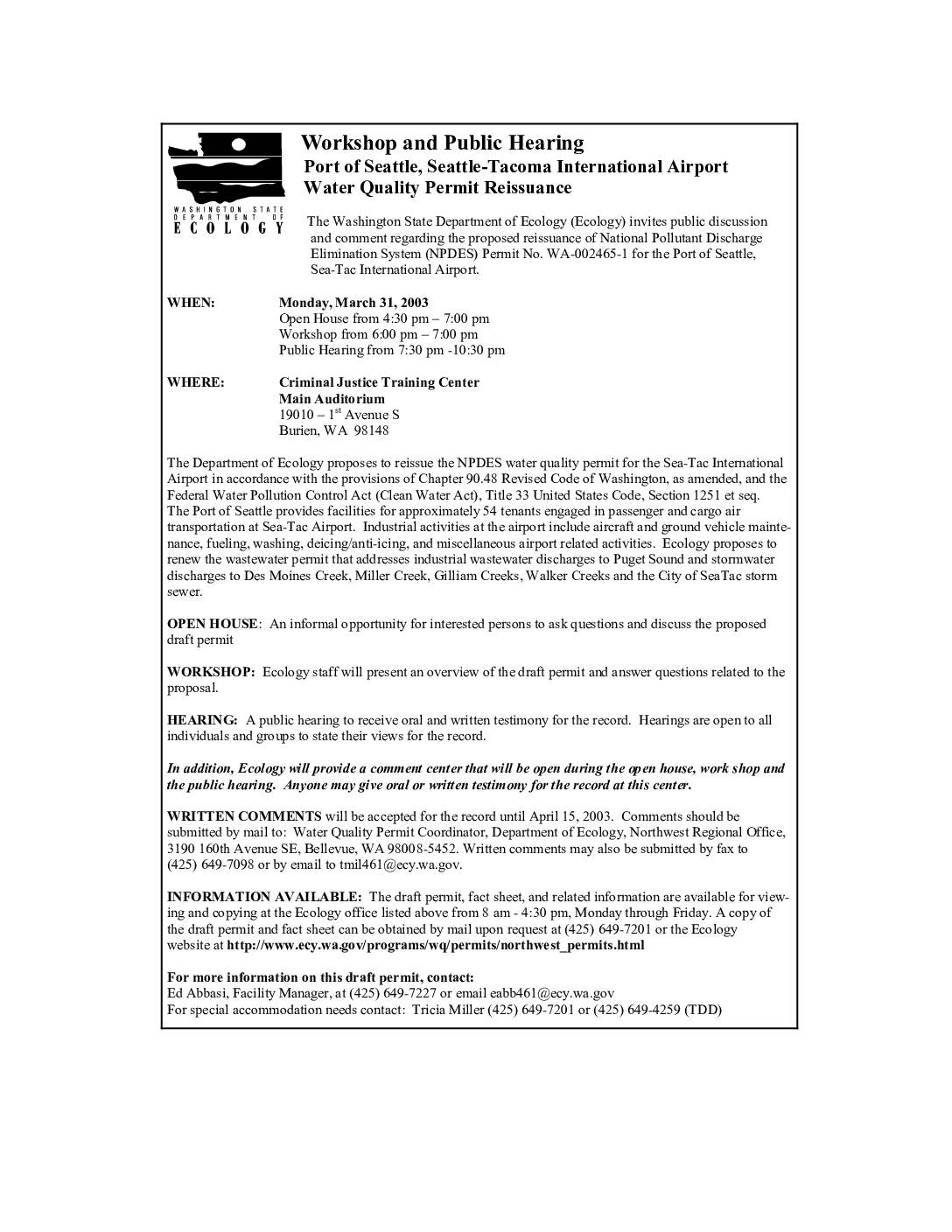
and comment regarding the proposed reissuance of National Pollutant Discharge Elimination System (NPDES) Permit No. WA-002465-1 for the Port of Seattle, Sea-Tac International Airport. WHEN: Monday, March 31, 2003 Open House from 4:30 pm – 7:00 pm Workshop from 6:00 pm – 7:00 pm Public Hearing from 7:30 pm -10:30 pm WHERE: Criminal Justice Training Center Main Auditorium 19010 – 1st Avenue S Burien, WA 98148 The Department of Ecology proposes to reissue the NPDES water quality permit for the Sea-Tac International Airport in accordance with the provisions of Chapter 90.48 Revised Code of Washington, as amended, and the Federal Water Pollution Control Act (Clean Water Act), Title 33 United States Code, Section 1251 et seq. The Port of Seattle provides facilities for approximately 54 tenants engaged in passenger and cargo air transportation at Sea-Tac Airport. Industrial activities at the airport include aircraft and ground vehicle mainte- nance, fueling, washing, deicing/anti-icing, and miscellaneous airport related activities. Ecology proposes to renew the wastewater permit that addresses industrial wastewater discharges to Puget Sound and stormwater discharges to Des Moines Creek, Miller Creek, Gilliam Creeks, Walker Creeks and the City of SeaTac storm sewer. OPEN HOUSE: An informal opportunity for interested persons to ask questions and discuss the proposed draft permit WORKSHOP: Ecology staff will present an overview of the draft permit and answer questions related to the proposal. HEARING: A public hearing to receive oral and written testimony for the record. Hearings are open to all individuals and groups to state their… -
2004 PCHB 402 Ruling
National Pollutant Discharge Elimination System (NPDES) permit for discharges associated with the Port of Seattle’s Seattle International Airport – NPDES No. 002465-1 in 2003. (2003 Permit) The Port of Seattle (Port) appealed certain terms and conditions of the permit in PCHB No. 03-140. The Airport Community Coalition (ACC) and Citizens Against SeaTac Expansion (CASE) filed a separate appeal of the NPDES 002465-1 permit in PCHB No. 03-141, and -
ST Enclosure B
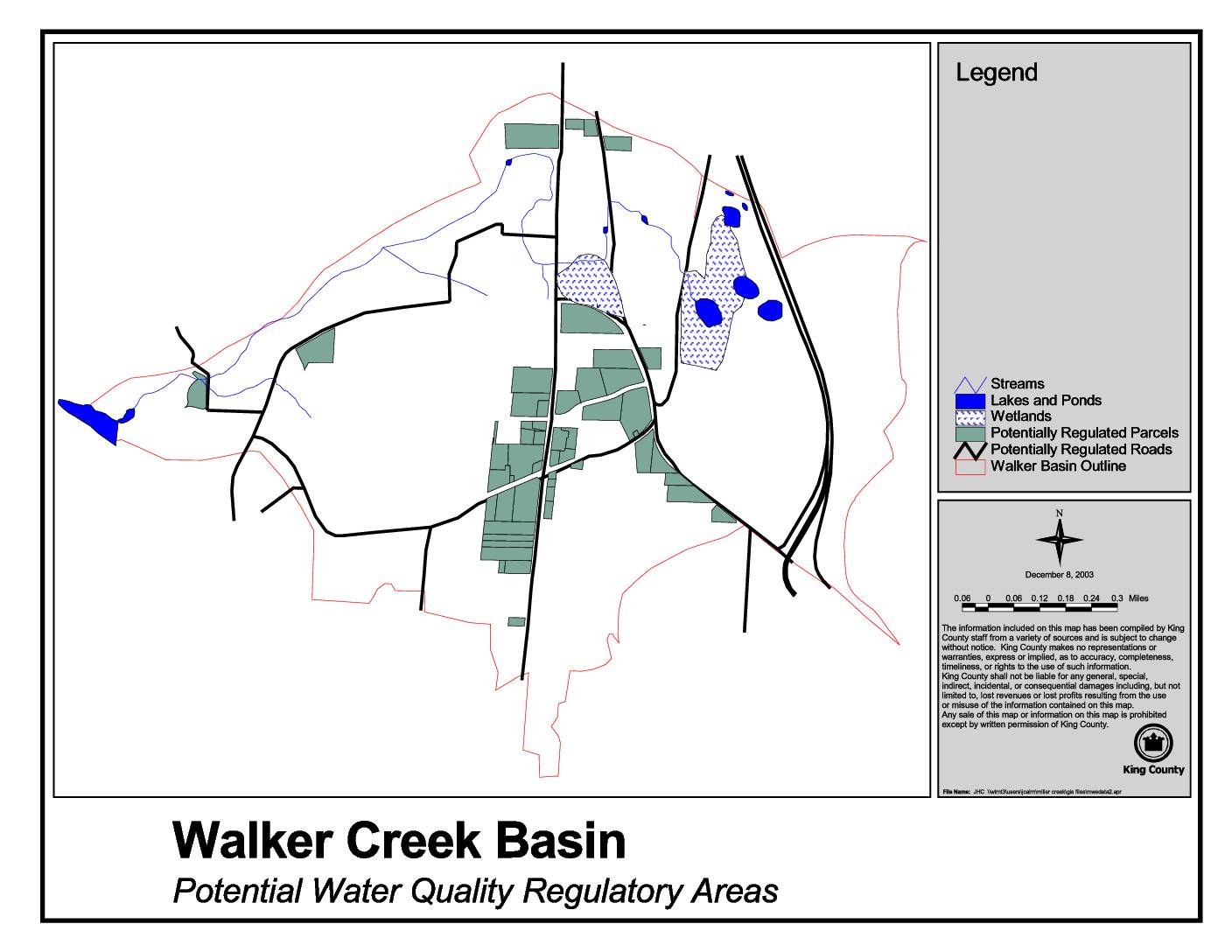
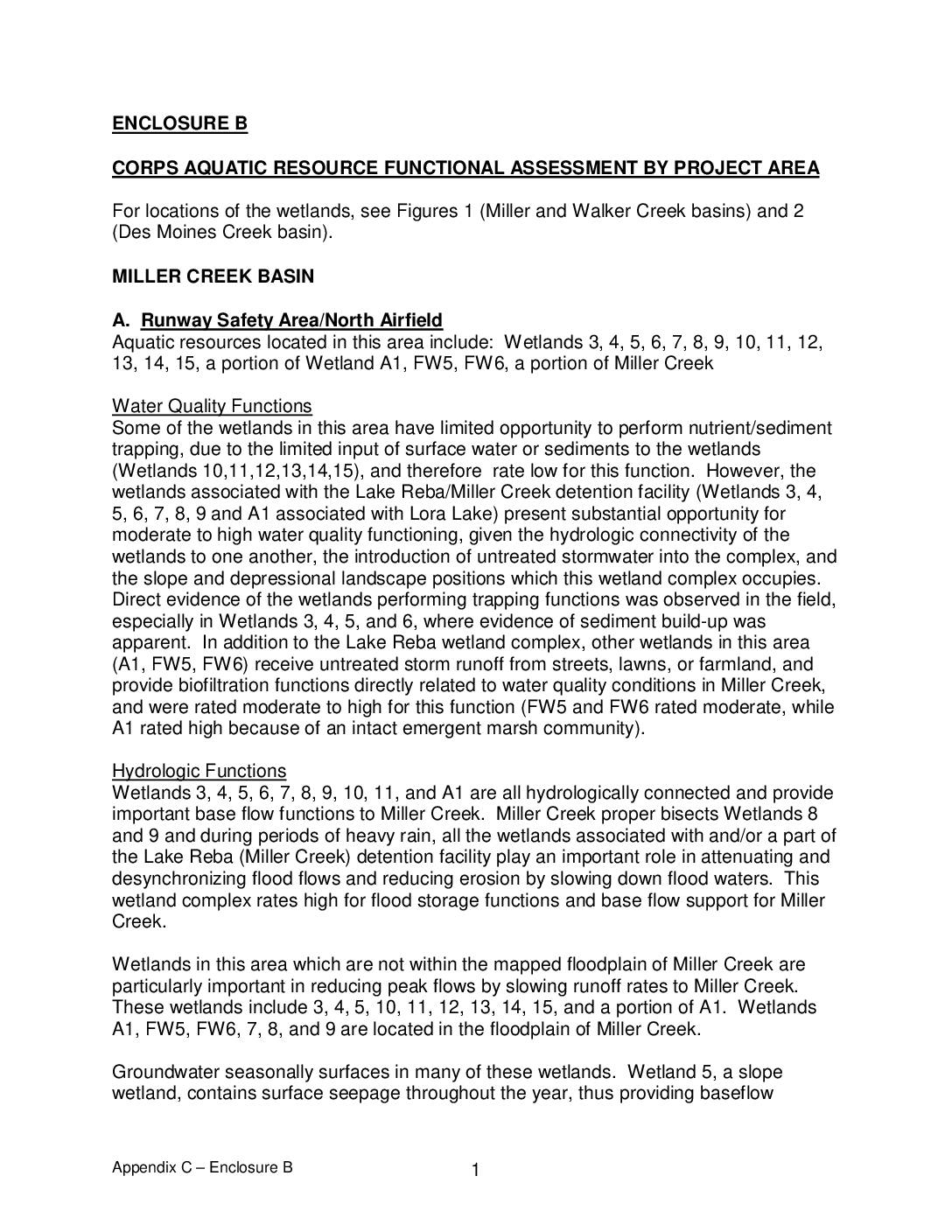
For locations of the wetlands, see Figures 1 (Miller and Walker Creek basins) and 2 (Des Moines Creek basin). MILLER CREEK BASIN A. Runway Safety Area/North Airfield Aquatic resources located in this area include: Wetlands 3, 4, 5, 6, 7, 8, 9, 10, 11, 12, 13, 14, 15, a portion of Wetland A1, FW5, FW6, a portion of Miller Creek Water Quality Functions Some of the wetlands in this area have limited opportunity to perform nutrient/sediment trapping, due to the limited input of surface water or sediments to the wetlands (Wetlands 10,11,12,13,14,15), and therefore rate low for this function. However, the wetlands associated with the Lake Reba/Miller Creek detention facility (Wetlands 3, 4, 5, 6, 7, 8, 9 and A1 associated with Lora Lake) present substantial opportunity for moderate to high water quality functioning, given the hydrologic connectivity of the wetlands to one another, the introduction of untreated stormwater into the complex, and the slope and depressional landscape positions which this wetland complex occupies. Direct evidence of the wetlands performing trapping functions was observed in the field, especially in Wetlands 3, 4, 5, and 6, where evidence of sediment build-up was apparent. In addition to the Lake Reba wetland complex, other wetlands in this area (A1, FW5, FW6) receive untreated storm runoff from streets, lawns, or farmland, and provide biofiltration functions directly related to water quality conditions in Miller Creek, and were rated moderate to high for this function (FW5 and FW6 rated moderate, while A1 rated high because of… -
2003 NPDES Facts
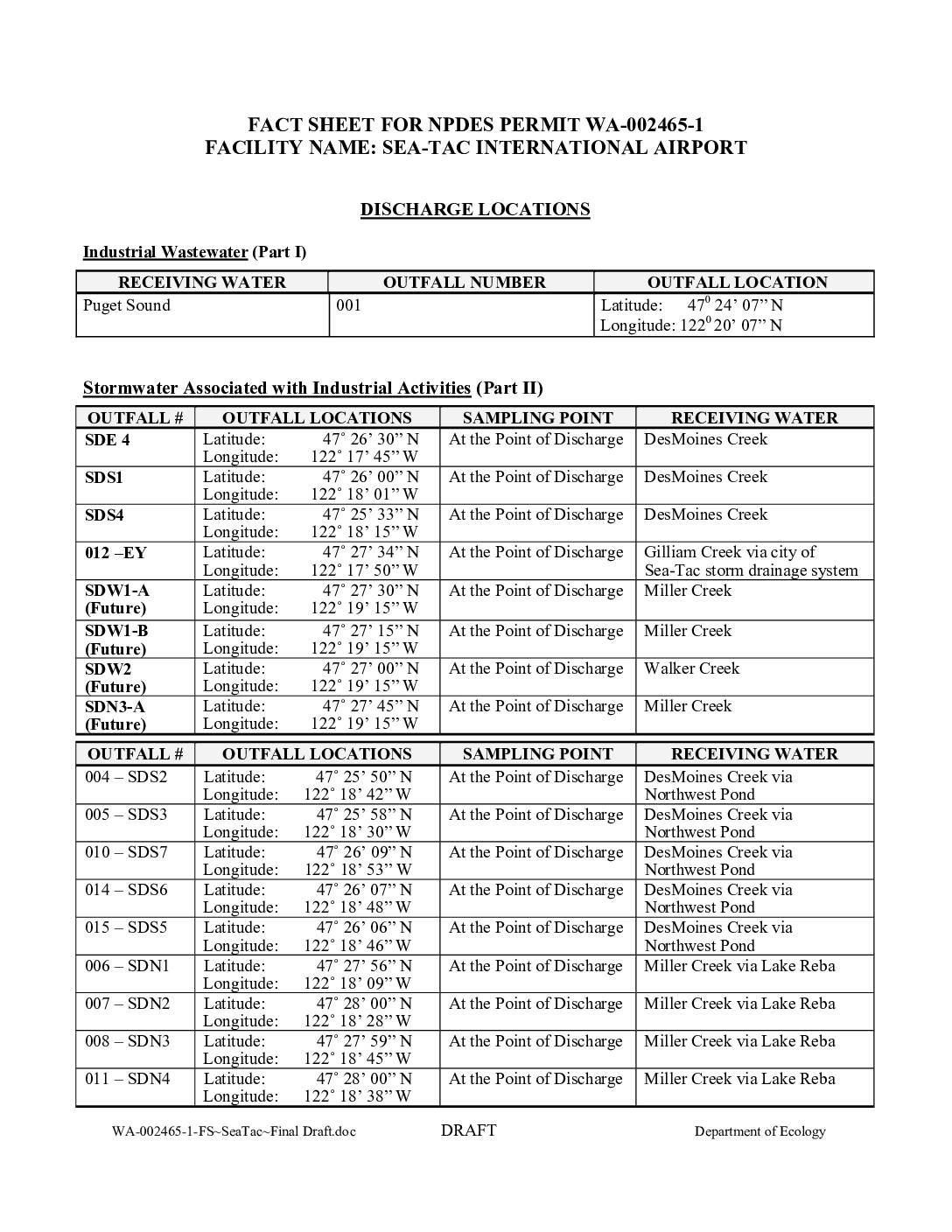
Puget Sound 001 Latitude: 470 24’ 07” N Longitude: 1220 20’ 07” N Stormwater Associated with Industrial Activities (Part II) OUTFALL # OUTFALL LOCATIONS SAMPLING POINT RECEIVING WATER SDE 4 Latitude: 47˚ 26’ 30” N Longitude: 122˚ 17’ 45” W At the Point of Discharge DesMoines Creek SDS1 Latitude: 47˚ 26’ 00” N Longitude: 122˚ 18’ 01” W At the Point of Discharge DesMoines Creek SDS4 Latitude: 47˚ 25’ 33” N Longitude: 122˚ 18’ 15” W At the Point of Discharge DesMoines Creek 012 –EY Latitude: 47˚ 27’ 34” N Longitude: 122˚ 17’ 50” W At the Point of Discharge Gilliam Creek via city of Sea-Tac storm drainage system SDW1-A (Future) Latitude: 47˚ 27’ 30” N Longitude: 122˚ 19’ 15” W At the Point of Discharge Miller Creek SDW1-B (Future) Latitude: 47˚ 27’ 15” N Longitude: 122˚ 19’ 15” W At the Point of Discharge Miller Creek SDW2 (Future) Latitude: 47˚ 27’ 00” N Longitude: 122˚ 19’ 15” W At the Point of Discharge Walker Creek SDN3-A (Future) Latitude: 47˚ 27’ 45” N Longitude: 122˚ 19’ 15” W At the Point of Discharge Miller Creek OUTFALL # OUTFALL LOCATIONS SAMPLING POINT RECEIVING WATER 004 – SDS2 Latitude: 47˚ 25’ 50” N Longitude: 122˚ 18’ 42” W At the Point of Discharge DesMoines Creek via Northwest Pond 005 – SDS3 Latitude: 47˚ 25’ 58” N Longitude: 122˚ 18’ 30” W At the Point of Discharge DesMoines Creek via Northwest Pond 010 – SDS7 Latitude: 47˚ 26’ 09” N Longitude: 122˚ 18’… -
2004 402 Analysis
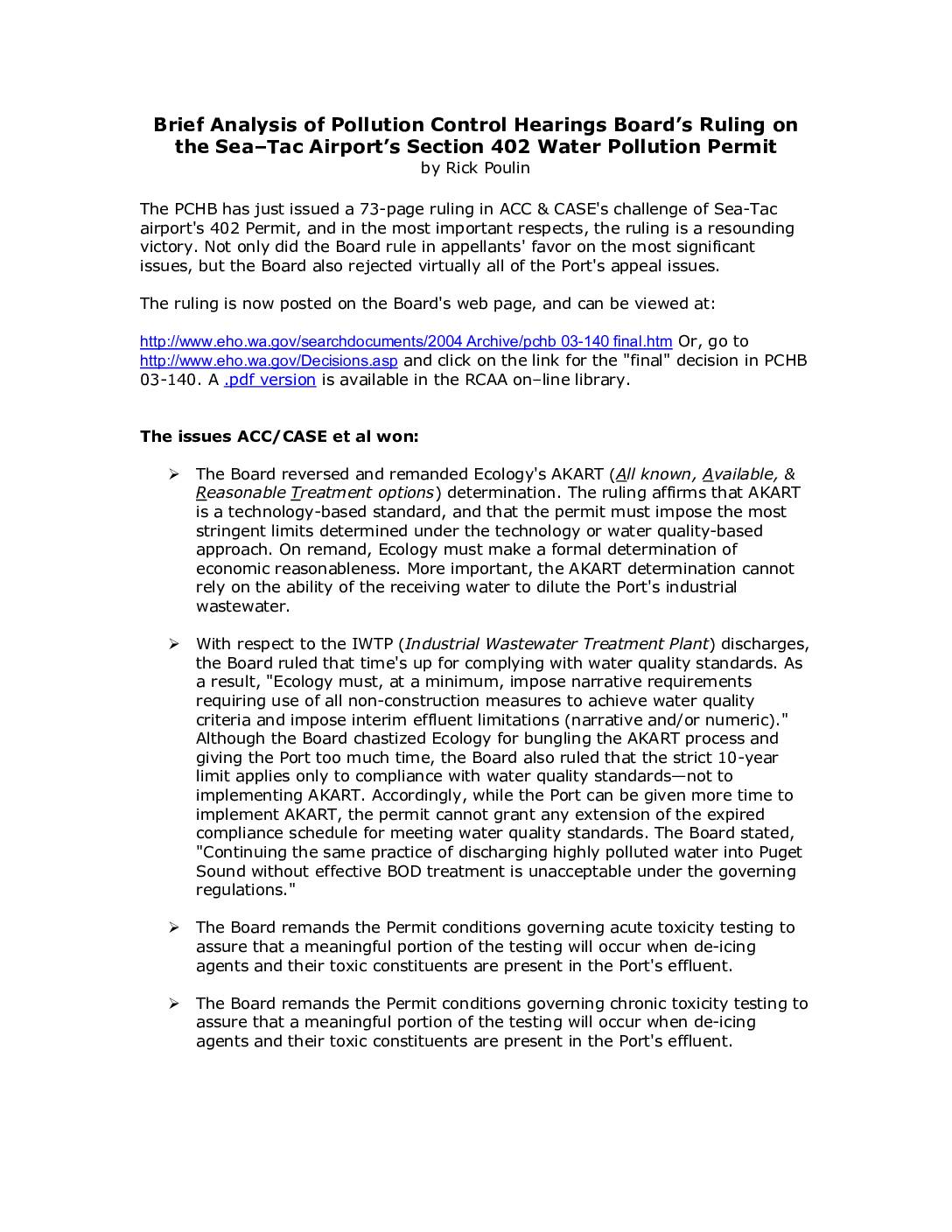
the Sea–Tac Airport’s Section 402 Water Pollution Permit by Rick Poulin The PCHB has just issued a 73-page ruling in ACC & CASE's challenge of Sea-Tac airport's 402 Permit, and in the most important respects, the ruling is a resounding victory. Not only did the Board rule in appellants' favor on the most significant issues, but the Board also rejected virtually all of the Port's appeal issues. The ruling is now posted on the Board's web page, and can be viewed at: http://www.eho.wa.gov/searchdocuments/2004 Archive/pchb 03-140 final.htm Or, go to http://www.eho.wa.gov/Decisions.asp and click on the link for the "final" decision in PCHB 03-140. A .pdf version is available in the RCAA on–line library. The issues ACC/CASE et al won: The Board reversed and remanded Ecology's AKART (All known, Available, & Reasonable Treatment options) determination. The ruling affirms that AKART is a technology-based standard, and that the permit must impose the most stringent limits determined under the technology or water quality-based approach. On remand, Ecology must make a formal determination of economic reasonableness. More important, the AKART determination cannot rely on the ability of the receiving water to dilute the Port's industrial wastewater. With respect to the IWTP (Industrial Wastewater Treatment Plant) discharges, the Board ruled that time's up for complying with water quality standards. As a result, "Ecology must, at a minimum, impose narrative requirements requiring use of all non-construction measures to achieve water quality criteria and impose interim effluent limitations (narrative and/or numeric)." Although the Board chastized Ecology for bungling… -
Port – NPDES Appeal, Final, October 2003
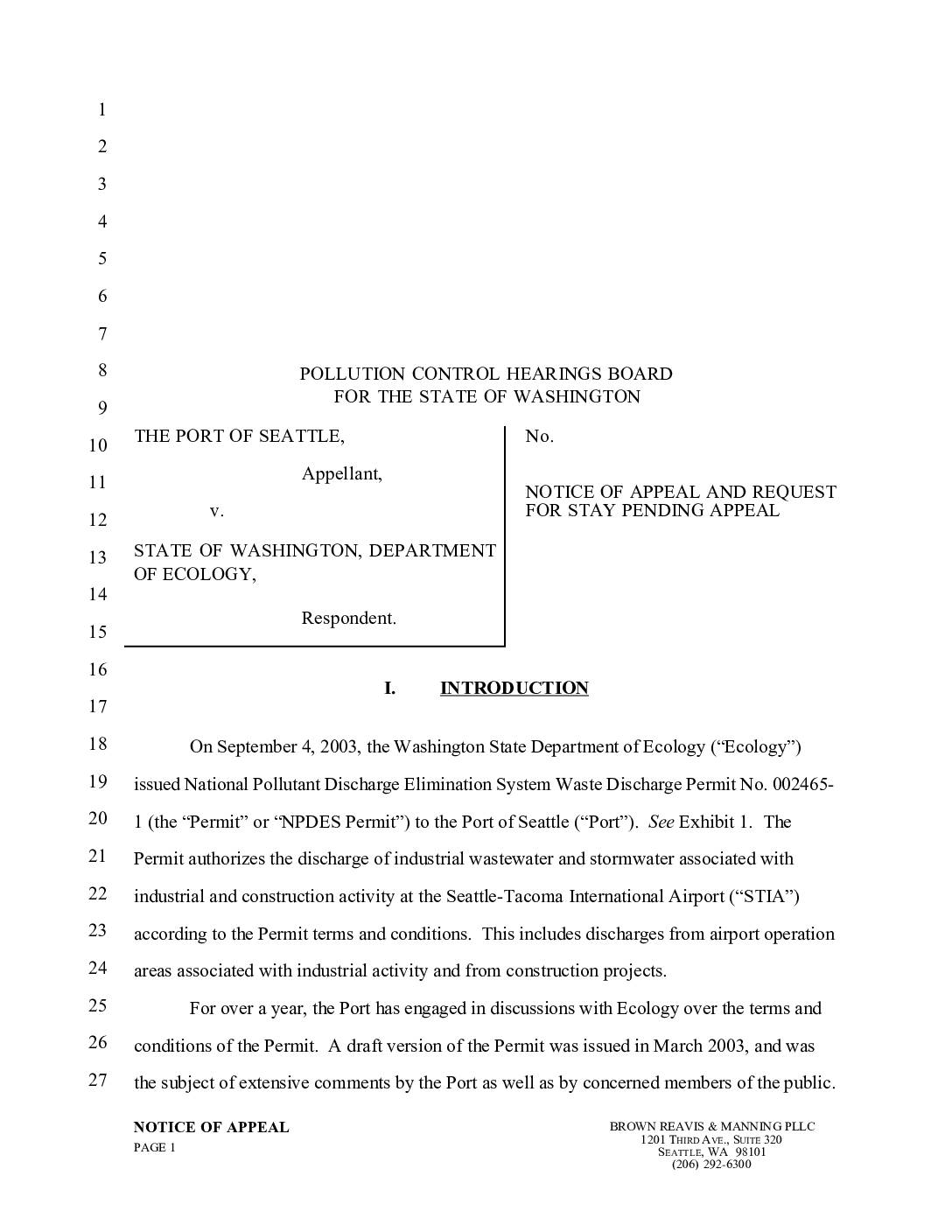
issued National Pollutant Discharge Elimination System Waste Discharge Permit No. 002465- (the “Permit” or “NPDES Permit”) to the Port of Seattle (“Port”). See Exhibit 1. The Permit authorizes the discharge of industrial wastewater and stormwater associated with industrial and construction activity at the Seattle-Tacoma International Airport (“STIA”) according to the Permit terms and conditions. This includes discharges from airport operation areas associated with industrial activity and from construction projects. For over a year, the Port has engaged in discussions with Ecology over the terms and conditions of the Permit. A draft version of the Permit was issued in March 2003, and was the subject of extensive comments by the Port as well as by concerned members of the public. NOTICE OF APPEAL PAGE 2 BROWN REAVIS & MANNING PLLC 1201 THIRD AVE., SUITE 320 SEATTLE, WA 98101 (206) 292-6300 Ecology responded to many of these comments either by revising draft Permit language and conditions, or by explaining in its Responsiveness Summary why proposed changes were not made. Despite the Port’s efforts to resolve these issues through the comment process, the Permit contains a number of terms and conditions that are unsupported by the law and that impose undue burdens on the Port and its STIA operations and projects without achieving any corresponding environmental benefits. This appeal is being filed to address those issues. II. BACKGROUND STIA has been subject to an individual NPDES permit for its industrial waste system since January 2, 1980. Since 1980, STIA’s NPDES Permits have been… -
We Tl Back 1
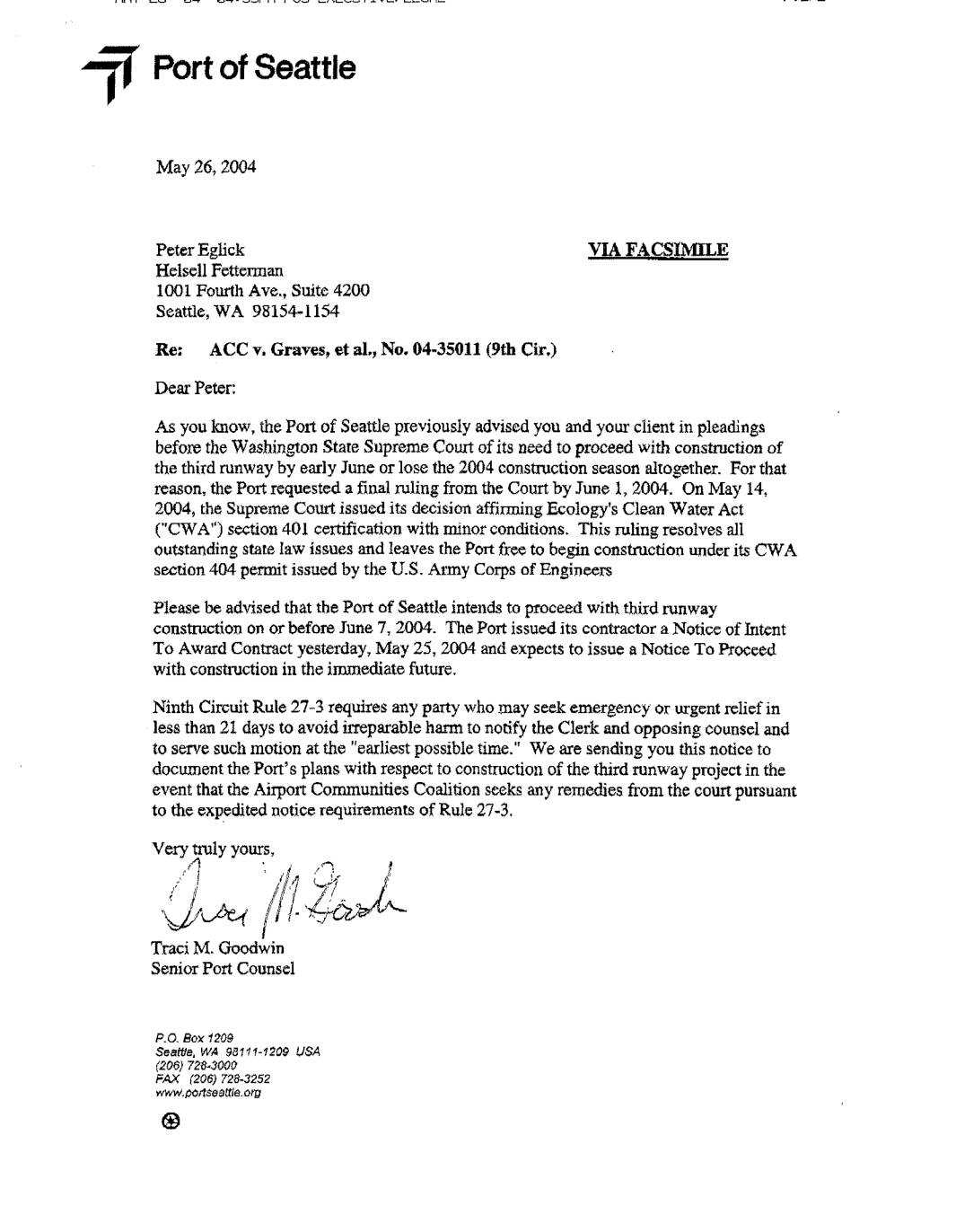
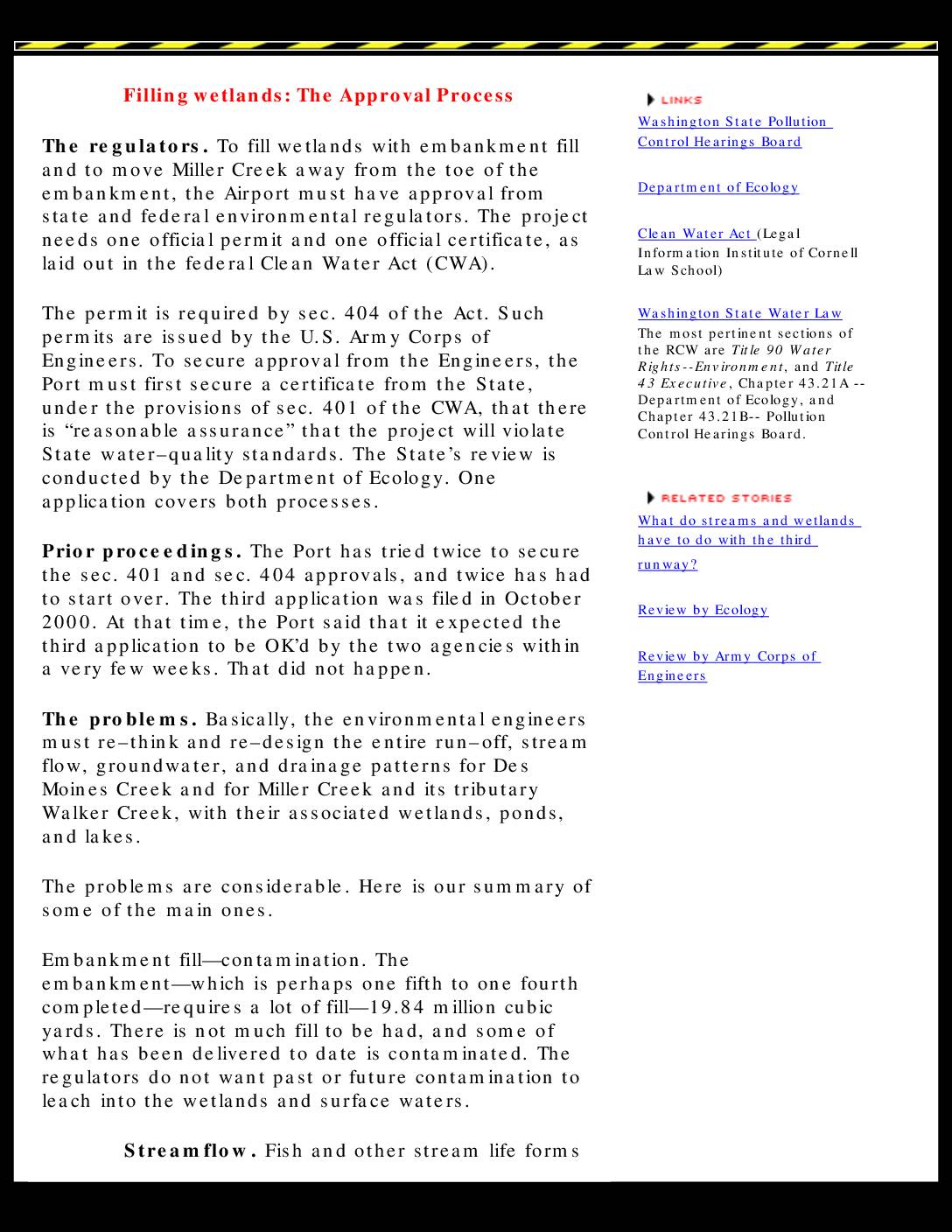
The regulators. To fill wetlands with embankment fill and to move Miller Creek away from the toe of the embankment, the Airport must have approval from state and federal environmental regulators. The project needs one official permit and one official certificate, as laid out in the federal Clean Water Act (CWA). The permit is required by sec. 404 of the Act. Such permits are issued by the U.S. Army Corps of Engineers. To secure approval from the Engineers, the Port must first secure a certificate from the State, under the provisions of sec. 401 of the CWA, that there is “reasonable assurance” that the project will violate State water–quality standards. The State’s review is conducted by the Department of Ecology. One application covers both processes. Prior proceedings. The Port has tried twice to secure the sec. 401 and sec. 404 approvals, and twice has had to start over. The third application was filed in October 2000. At that time, the Port said that it expected the third application to be OK’d by the two agencies within a very few weeks. That did not happen. The problems. Basically, the environmental engineers must re–think and re–design the entire run–off, stream flow, groundwater, and drainage patterns for Des Moines Creek and for Miller Creek and its tributary Walker Creek, with their associated wetlands, ponds, and lakes. The problems are considerable. Here is our summary of some of the main ones. Embankment fill—contamination. The embankment—which is perhaps one fifth to one fourth completed—requires a…