TagRCAA(175)
-
-
-
-
-
-
-
-
2003 Cost Pptp Res
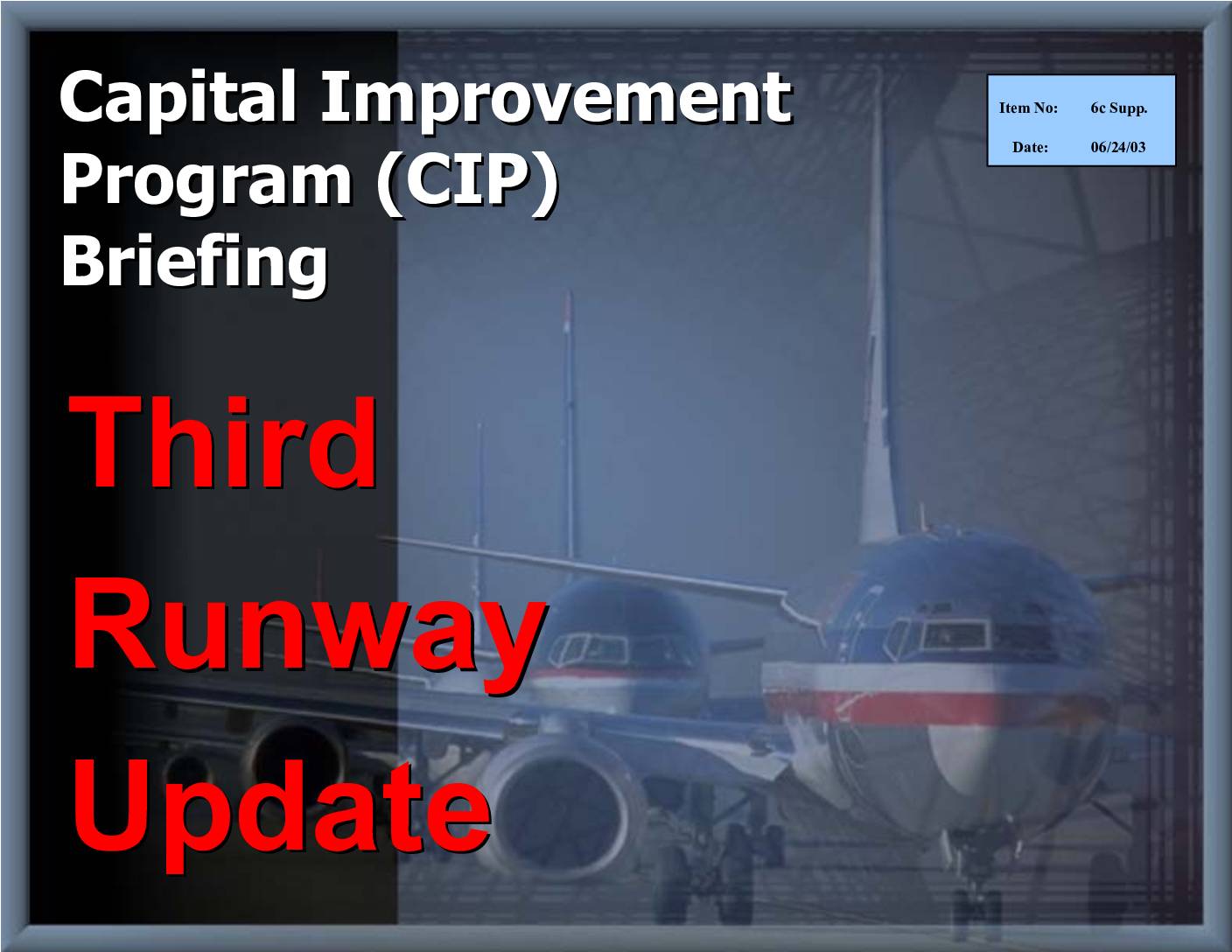
July 1999 - Revised Project Cost and Schedule Approved by Port of Seattle Commission Project cost $773 M Project completion Fall 2006 Army Corps of Engineers 404 Permit assumed by December 1999 July 1999 - Revised Project Cost and Schedule Approved by Port of Seattle Commission Project cost $773 M Project completion Fall 2006 Army Corps of Engineers 404 Permit assumed by December 1999 Third Runway 1999 Project Schedule Third Runway 1999 Project Schedule PREVIOUS 1999 SCHEDULE Permit Runway Embankment Runway Pavement 19991999 20002000 20012001 20022002 20032003 20042004 20052005 20062006 20072007 20082008 2009 20102009 2010 Progress To DateProgress To Date Third Runway UpdateThird Runway Update Project Cost to Date - $361 M * Acquisition - 497 parcels purchased million cubic yards of fill imported Constructed 150,000 square yards of pavement Facilities relocated FAA Remote Transmitter/Receiver (RTR) Facilities Weyerhaeuser Facility Automatic Surface Observation System (ASOS) Equipment FAA/POS Magazine Facility POS Maintenance Decant Station FAA Airport Surveillance Radar (ASR)-9 Facility (in progress) Project Cost to Date - $361 M * Acquisition - 497 parcels purchased million cubic yards of fill imported Constructed 150,000 square yards of pavement Facilities relocated FAA Remote Transmitter/Receiver (RTR) Facilities Weyerhaeuser Facility Automatic Surface Observation System (ASOS) Equipment FAA/POS Magazine Facility POS Maintenance Decant Station FAA Airport Surveillance Radar (ASR)-9 Facility (in progress) * Costs as of 12-31-02* Costs as of 12-31-02 Third Runway UpdateThird Runway Update Future Work Relocation of East 156th Way Relocation of Miller Creek Embankment construction of north/west walls On-site excavation - 3 million… -
2003 Port C Cost INC
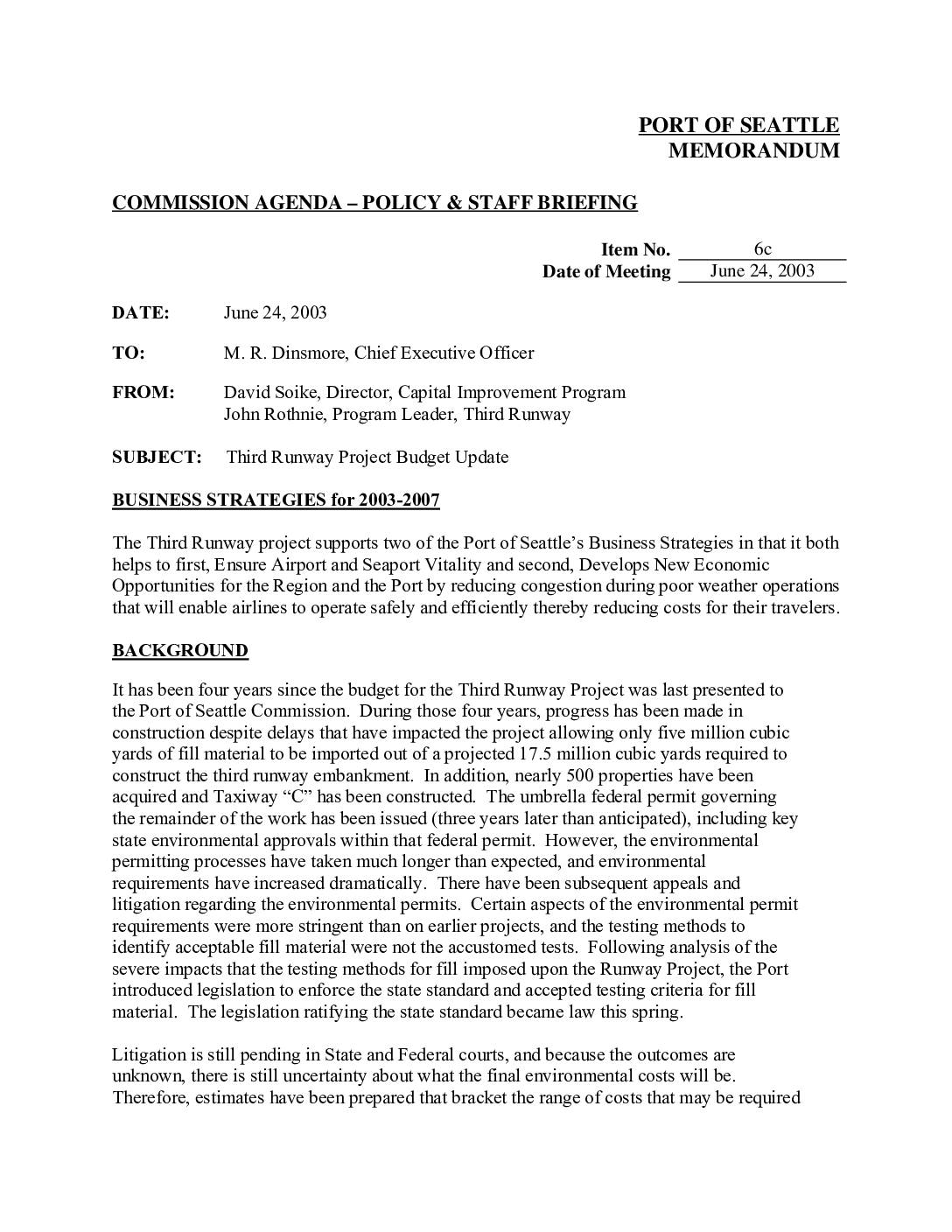
TO: M. R. Dinsmore, Chief Executive Officer FROM: David Soike, Director, Capital Improvement Program John Rothnie, Program Leader, Third Runway SUBJECT: Third Runway Project Budget Update BUSINESS STRATEGIES for 2003-2007 The Third Runway project supports two of the Port of Seattle’s Business Strategies in that it both helps to first, Ensure Airport and Seaport Vitality and second, Develops New Economic Opportunities for the Region and the Port by reducing congestion during poor weather operations that will enable airlines to operate safely and efficiently thereby reducing costs for their travelers. BACKGROUND It has been four years since the budget for the Third Runway Project was last presented to the Port of Seattle Commission. During those four years, progress has been made in construction despite delays that have impacted the project allowing only five million cubic yards of fill material to be imported out of a projected 17.5 million cubic yards required to construct the third runway embankment. In addition, nearly 500 properties have been acquired and Taxiway “C” has been constructed. The umbrella federal permit governing the remainder of the work has been issued (three years later than anticipated), including key state environmental approvals within that federal permit. However, the environmental permitting processes have taken much longer than expected, and environmental requirements have increased dramatically. There have been subsequent appeals and litigation regarding the environmental permits. Certain aspects of the environmental permit requirements were more stringent than on earlier projects, and the testing methods to identify acceptable fill material were not… -
Port Spin 2002 2003
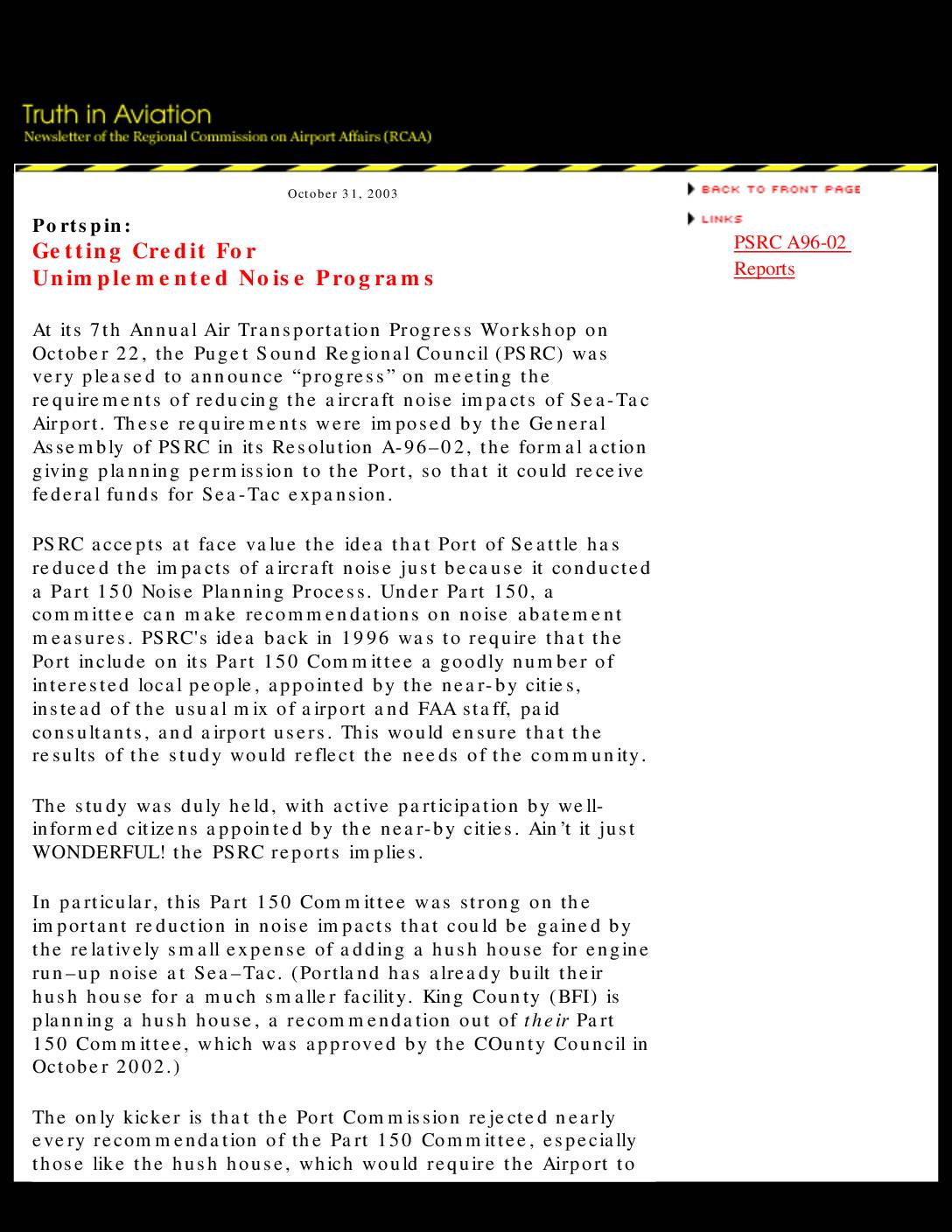
At its 7th Annual Air Transportation Progress Workshop on October 22, the Puget Sound Regional Council (PSRC) was very pleased to announce “progress” on meeting the requirements of reducing the aircraft noise impacts of Sea-Tac Airport. These requirements were imposed by the General Assembly of PSRC in its Resolution A-96–02, the formal action giving planning permission to the Port, so that it could receive federal funds for Sea-Tac expansion. PSRC accepts at face value the idea that Port of Seattle has reduced the impacts of aircraft noise just because it conducted a Part 150 Noise Planning Process. Under Part 150, a committee can make recommendations on noise abatement measures. PSRC's idea back in 1996 was to require that the Port include on its Part 150 Committee a goodly number of interested local people, appointed by the near-by cities, instead of the usual mix of airport and FAA staff, paid consultants, and airport users. This would ensure that the results of the study would reflect the needs of the community. The study was duly held, with active participation by well- informed citizens appointed by the near-by cities. Ain’t it just WONDERFUL! the PSRC reports implies. In particular, this Part 150 Committee was strong on the important reduction in noise impacts that could be gained by the relatively small expense of adding a hush house for engine run–up noise at Sea–Tac. (Portland has already built their hush house for a much smaller facility. King County (BFI) is planning a hush house, a…