
Analysis
As reported in Part I: Between November 3rd and November 13th, city councils in Burien, SeaTac, and Des Moines each voted unanimously to enter into an Interlocal Agreement (ILA). The agreement retains outside legal counsel to challenge the Federal Aviation Administration’s Record of Decision (ROD) Finding of No Significant Impact (FONSI) for the Sustainable Airport Master Plan (SAMP). The original 2018 four-city partnership included Normandy Park. However, without (public) explanation, have chosen not to participate.
Typically, when important strategic partnerships are announced, corporations and agencies make a real effort to harmonize their messaging. However, the great differences between these three meetings (and the absence of a fourth) should give those concerned about our airport communities real pause. This lack of harmony and coordination is not mere optics.
There are many opinions on the SAMP. Mostly indifference, followed by a wide spectrum of frustrations.
One frustration comes from a large group of residents and electeds who have always thought that any attempt to achieve improvements with the airport is a waste of time. At the November 13 meeting, Des Moines Councilmember Mahoney repeated his long-standing opinion that the game was up in 11994.
 At that same meeting 1Councilmember Harris expressed a different kind of frustration — pointing out that the SAMP was proposed in 2012 — and yet a vote on a legal agreement of any kind has waited until two weeks before the final deadline. Cities have had thirteen years to prepare for this.
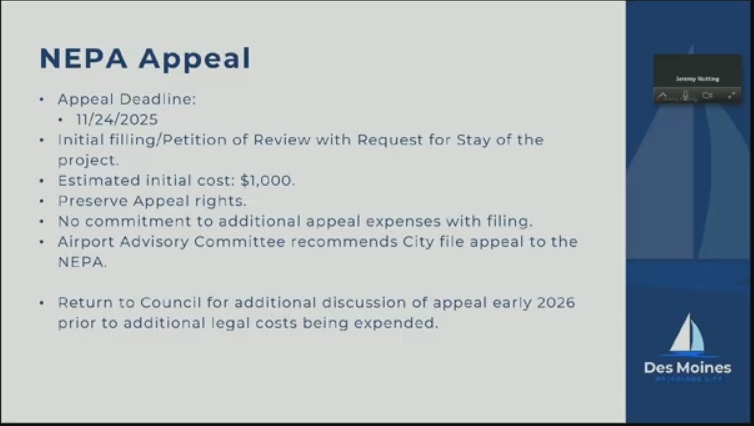
In response, Deputy Mayor Steinmetz scoffed at concerns over deadlines — since the initial filing fee was described as “$1,000” and even after what was described as an “80-day” decision point “We can just file for an extension.”
In our opinion, that is entirely beside the point.
False urgency
In the weeks leading up to these votes, we watched both Burien and Des Moines airport committee meetings and saw the kind of nervousness that comes from being out of the loop. For them, the decision seemed to be to convince their councils to do something before November 24, even though that choice had effectively been made over two months ago. But even after thirteen years of notice, we don’t see that either city has a clue as to what “something” might be.
Portraying this agreement as essentially a clerical first step is a willful blindness. This is not like asking for a filing extension on one’s taxes. It is like asking your professor for more time to submit the final paper you were told about on the first day of class — and haven’t begun studying for the night before, let alone writing.
Worse, even recognizing the agreement heavily advantages SeaTac, people in other communities were either so indifferent, or so desperate to “do something”, there was no interest in considering a better agreement — even over details such as cost share. We find this particularly noteworthy given the financial struggles of both Burien and Des Moines.
We see a false sense of urgency, paired with a cavalier attitude towards the stakes involved. At the Des Moines City Council vote, 3Harris referred to the process as ‘demolition by neglect’ — a common strategy; showing just enough concern to satisfy public concerns, while quietly allowing important projects to fail.
Meanwhile in SeaTac
Just watching their meeting, it was clear that the only city that had been taking the SAMP seriously was SeaTac. Of course they were. They had selected and engaged attorneys weeks before the SAMP ROD was published. They already have a funding source (their ILA.) So doing “something” — the one thing community members were so hair on fire about — was never an issue.
At that same November 12 meeting SeaTac Council Member Kwon said: “It’s important that we catch this in the NEPA process… once it gets past the NEPA process, the SEPA, the authority for the environmental review process for SEPA, the authority is the airport itself. So they’re basically just going to be reviewing themselves and so at that point it will be a little bit I think a little late in the game.”
Sellouts and Free-Riders
There are still residents left from the Third Runway who deeply resent SeaTac’s outsized benefits – which they assume came solely by virtue of not opposing that expansion or geography. Only part of that is true. But like so many airport myths, the fact that people keep believing it, rather than noticing the reality, keeps the rest of the region marginalized. Stop whining. Do better.
If you had acquired hard-earned success at the Casino, how much concern would you have that the other players were not doing as well? Before answering, bear in mind that ultimately each city is legally responsible for defending its own interests — and there is only so much money on the table.
At that same meeting, SeaTac Council Member Lovell also expressed frustration over Normandy Park: “When you do not make your voice heard in this you are effectively saying that we do not object to any of your plans. This is your time to speak up and say you have an objection whether you believe it will be successful or not. This is how you preserve your options for future actions.”
We would note that not only has Normandy Park dropped out, neither Federal Way nor Tukwila–the other Highline cities that opposed the Third Runway–were ever at this table.
Times Change
During the Third Runway, it was the City of SeaTac that benefitted from over $100,000,000 in water quality improvements that those cities fought hard for and you did not. It is fair to say that the entirety of the Des Moines Creek Trail – or rather the ‘SeaTac/Des Moines Creek Trail’ would not have been possible without that expense of time and treasure.
One generation’s free-rider becomes the next’s “wise steward of public funds.”
What we see
At the moment, there are two entities that have any sense of strategy: the Port of Seattle, the City of SeaTac.
The Port has the entire SAMP process budgeted and planned. There is the NTP process we’re treating so poorly now, and the LTP process you don’t have a clue about — which is even worse. Ironically, because they are governed by the FAA, their planning and goals have been extremely transparent.
As Councilmember Kwon noted — the airport is essentially self-permitting. By virtue of their ILA, SeaTac has given them that luxury. SeaTac also knows the territory, and their agreement actually rewards them for their cooperation with the Port – not with Burien or Des Moines.
The lawyers each city is pinning their hopes on were vetted and chosen by SeaTac. Apart from the wisdom of (apparently) allowing one city to make that choice, it also reinforces our view as to how seriously either Burien or Des Moines are taking this process.
These attorneys may have the same built-in limits as the attorney Burien chose in 2018, the Stantec team that turned out so poorly in 2019, and the aviation consultants the four cities chose not to renew in 2023 — they don’t know the territory. In fact, they tell you so up front, and cheerfully offer to bill you to do the deeper dive. Different years? Same mistake.
In contrast, it is important to note that during the Third Runway there were 4many lawsuits, not one. Many millions were wasted. But the only effective outcomes were achieved at low cost, by a combination of professionals and volunteers who did know the territory and did persist. Unfortunately, their accomplishments were blotted out by all those larger, and ineffective efforts. Anything besides “making the airplanes go somewhere else” didn’t count.
Seen one airport?
The current attorneys are no doubt excellent at aviation and environmental law, but those skills are only a subset of the expertise we need to assess cumulative impacts and review 31 construction projects. As our previous airport consultants liked to say, “Seen one airport? Seen one airport.” They are generalists who will struggle to get up to speed on our community, cumulative impacts, or thirty-one specific construction projects in this time frame and within that budget. All that works to SeaTac’s advantage. Why? Because SeaTac surely knows what it wants. Burien, Des Moines or other neighborhoods under the flight path? Not so much.
What this means in practice
SeaTac has no airport committee because they don’t need one. They maintain staff and agreements that incentivize them to remain focused and prepared. That is no disparagement of current volunteer effort in other cities. But the Casino encourages marks — people who are encouraged to participate in games which take years of preparation. There is such a vast asymmetry of information between the various actors, it is arrogance to believe that any amount of ‘common sense’ trumps experience and access.
The deadline should be instructive. It created a false sense of urgency (and now relief) which causes inexperienced players to continually focus on the wrong things — and avoid the valuable contributions they can make.
At the end of the day, it has always been up to each community to decide a path forward. Burien and Des Moines now have a few months to study for that test — something they have failed to do in thirteen years. Or, continue to behave like a mark.
But asking these attorneys to help define that “something”, is asking for a savior to ride in at the last minute and as unrealistic as the big Class Action paydays that never come. It means you are willing to do anything except the preparation you always could have done. More of the Casino.
We’re dealing with that in the SAMP
Since the SAMP was announced in 2012. there have been opportunities to respond to various community concerns apart from that process – including tree cutting, community grants, sound insulation, and North SeaTac Park. The success of each of these initiatives has varied greatly, based on persistence and attention to detail.
Filing this initial paperwork will change things. First, the frustration people have felt in being out of the loop will only increase as this becomes a legal process and the information asymmetry widens. Historically, that tends to lead to even more wasted effort — more of the right hand not knowing what the left is doing and people campaigning for things that are irrelevant to success.
The Port, including Commissioners will now have every incentive to answer every community concern by saying, 2“We’re dealing with that in the SAMP!”
Residents will also have every incentive to believe that — conflating every issue into something called ‘mitigation’. Time and time again airport communities have demonstrated that “something”, anything, is better than nothing.
Although this specific action is directed towards the FAA and not the Port of Seattle, the practical effect is to elevate the risk level of their single most important strategic goal. You can’t do that to an organization with as much experience in this space and not expect them to see their opportunities as well.
Now what?
The time has come to stop being a mark. Despite what feels ‘right’, there are only a few things the community can do that are of real value to the current process. In fact, the things you will most likely want to do have never worked, we’ve told you what they are so stop doing them. They are all part of the Casino.
But the things that do work would be transformational for your community and you should start doing them now. Not in 80 days.
Here is the most important: Think about what your community needs now that is connected with airport impacts, with one exception: 5″making the airplanes go somewhere else.” Everything else is on the table. Go.
1If not coincidental, an incredibly deep cut. 1994 was the year the Puget Sound Regional Council identified three sites for a second airport, then abandoned the search for that second airport, authorized funding for the Third Runway, and mandated the noise monitoring and mitigation plan you know of as Port Packages.
2This was, in fact, exactly what the Commission said in 2018–when the Port thought the original SAMP process was going to go through. COVID was a second chance for cities other than SeaTac.
3Full disclosure: JC Harris is a founding member of STNI.
4At one point their were five legal actions occurring at the same time.)
5That also includes any sentence which includes the word ‘capacity’, They are all variations on the same myth. “I don’t see how they can continue to grow!”