
Convenience = Capacity
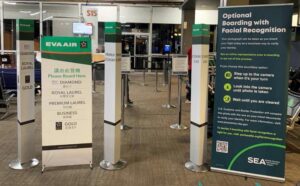 In 2019, there was a fairly large kerfuffle at the Port Commission over facial recognition. At the time, personal privacy was considered a high priority. The Commission ordered a study and after 18 months came back with this report, and a lot of press, including this article…
… and then a very firm sounding blog post from the Port titled Port Permanently Bans Facial Recognition, Other Biometrics for Law Enforcement and Mass Surveillance
But as of today, if one goes to the Port of Seattle web page on biometrics, the story is quite different. And if you click on that same link touting that same accomplishment, you now get this:

Oops.
That is why STNI archives information. More and more in the digital age, information, even from four years ago, has a way of disappearing.
But regardless of why that information is no longer available, biometrics, ie. facial recognition, have been inevitable – and not just for ‘security’. Airlines have been desperate for it for many years because security is one of the biggest customer service complaints they get.
Convenience always wins
And fortunately for them, since the advent of the iPhone and social media, customers have demonstrated time and again an increasingly willingness to sacrifice all their personal information in exchange for a smoother customer experience.
So regardless of the Commission’s good intent (or virtue signalling), the FAA and the Dept. of Homeland Security have made it clear for years that due to ‘immigration’ and ‘terrorism’, biometrics are on the table.
And once the scanners are in place, expanding usage into customer convenience will not be stopped. Since COVID, implementation at all major airports, and for all use cases, has risen dramatically.
Why we track facial recognition
Facial recognition directly impacts the number of flights over your head every day. Security is now one of the biggest choke points at the terminal. Unlike other processes such as baggage handling and parking, it has been hard to predict and even harder to automate. Facial recognition solves for that. For extreme peak periods it may increase capacity by as much as a gate turn.
 Airports are factories. They also have a lot in common with restaurants. Restaurants think in terms of services (breakfast, lunch, dinner) as much as individual customers. They plan for a certain number of turns at each service. For example, if they had sixty customers for 30 customers at one dinner service that means two turns. Covering costs depends on two turns every night. But three is even better.
Airports have gates, not tables. They needs to get the customers to each gate on time, make sure the aircraft is ready, get it off the ground, and clear the gate for the next flight. That’s the airport version of what restaurants do, and in fact they refer to these as gate turns.
Like any successful restaurant, a major goal of airports are to maximize gate turns. The more efficiently the airport can do that, the more routes they can serve, and the more revenue they (and the airlines) generate.
TSA delays are like a restaurant which can’t get customers with reservations to their tables.
Airport growth may or may not be inevitable. But dramatically increased capacity is possible. Techniques like biometrics are now the tools to make it happen; as much as gates or runways. Whether your hope is to slow that growth or achieve proper compensation (or both), neither can happen unless we truly understand this. Just because there will be no new physical fourth runway, just as much capacity can be added.
Returning to the restaurant metaphor, there is no free lunch. There are real consequences for all of us in handing over so much of our lives to the Internet and now facial recognition. But those consequences are shared by all of us. Airports are different. Being constantly scanned à la Minority Report is becoming a reality now because airlines (and now passengers) will support anything that makes for fewer delays. But they will not have to deal with any of the negative impacts caused by increased in operations. People living under the flight should never have to foot the bill for someone else’s lunch.
Convenience = Capacity