So many lemons. Maybe some lemonade?
Environmental Science Associates (ESA) held a webinar today to provide an overview and meaning to the truly astounding number of policy changes affecting NEPA over the past two years. Although an ‘overview’, the NEPA process is so technical the video may be of interest only to specialists. However, we encourage people to watch, or at least skim the slides for the following reasons.
Consultants
ESA is a highly regarded national firm which typically represents industry and 1developers on environmental reviews. They currently have multiple specialists working with the Port of Seattle with the SAMP on both NEPA (federal) and SEPA (state) as well as the Part 150 process.
The information they provide is completely accurate. Their analyses are extremely thorough and especially helpful for specialists.
But people new to these issues see ‘environmental’ and sometimes assume that large firms like ESA will be on ‘our side’, or at least, unbiased. This is not the case. Their work, including this webinar, is tailored to their paying customers. They strive, of course, to be as even-handed as possible. But every consultant frames their work in terms of the policy goals of their clients, and this webinar was no exception.
In short, their analyses are fine. But they are not designed to find opportunities helpful to us.
The Lemons
With all that said, the news for airport communities hoping for relief at the federal level is as bad as they say and has been for decades. But the practical effect of these change for us is actually small.
One large aspect of the National Environmental Policy Act concerns permitting large projects – like the SAMP. Originally, much of the law’s regulatory ‘teeth’ came from the EPA and if this were 1975, when the Sea-Tac Communities Plan was implemented, we would be in much better shape.
However, shortly after that, certain federal agencies, including the FAA, were slowly but surely given control over projects under their authority – such as airport improvements. And then, the FAA was given regularity authority of specific harms — such as noise.
Adding to the regulatory maze, there is also a Presidential Council on Environmental Quality, which plays an important role in determining what gets studied in any NEPA review.
 The focus of this webinar was the past two years. There have been rulings at the Supreme Court that have redefined both what is considered ‘harm’ and what can be mitigated. The Trump administration has furthered weighed in with a long series of Executive Orders directing the FAA and the CEQ to eliminate ‘DEI’ and ‘Environmental Justice’, speed permitting, severely limit mitigation and shorten the statute of limitations on appeal. According to the presenter the One Big Beautiful Bill Act seems to offer a method by which permit applicants can obtain an expedited decision.
As we previously reported, the current SAMP Draft EA decision has been delayed until October 31st while the FAA makes certain the results align with current policy.
Lemonade From Lemons
We want to make sure we do not sound ungrateful to ESA. On the contrary, these webinars are invaluable resources. Further, we do not see the picture as all bad for airport communities. The major lesson we take from the entire Third Runway fight is that environmental law has been used as a cynical part of the Casino for many decades. For far too long both NEPA (and SEPA) has held out a theoretical hope of justice for airport communities. But in practice it only encourages people to waste millions of dollars on law suits. The system has been designed not to pay off.
These new policies simply take off the mask. They remove the distractions and allow us to refocus our attention where it should have been for a long time:
-
- The Port of Seattle’s commitment to be ‘the greenest port in America’
- Their extremely strong financial position, which has capitalized on their ability to avoid providing equitable compensation to our communities
- Their constant finger-pointing at the FAA rather than acknowledging the reality of the situation and doing more of what they always could do under state and local law.
Transcript
machine-generatedIntroduction
Leslie Molton Post (President and CEO, Environmental Science Associates): Good afternoon. Thank you very much for coming today and participating with us on what is now our second federal policy update. We did our first in April, so welcome back if you were able to join us at that time, and if you’re new, happy to have you here.
There’s quite a bit going on and we realized that we wanted to help our community of practice stay on top of the continuing changes coming out of the federal administration on policy and regulation. I’m Leslie Molton Post, president and CEO of Environmental Science Associates. We work with many of you, but if you don’t know us, ESA is a national 100% employee-owned environmental consulting firm. As we like to say, science is our middle name and we have applied science at our core.
We do a range of environmental services: planning, resource management, big environmental compliance programs and strategy, permitting, mitigation, monitoring, and nature-based solutions for coastal resilience, shoreline and flood plain management, and technology services both in-house and for client organizations to support all of that.
Housekeeping Notes
If you would like to invite others to this webinar, we’re delighted to have them, but they need a unique link. You can’t share the link you got, so please ask them to register. The registration link is in the chat. They can register throughout the webinar, so it’s fine for you to tell someone to jump on, but they need their own link to get in. We will be recording this and we send that out afterwards to all the participants who registered with a follow-up email.
ESA’s Federal Strategy Services
At the beginning of the year, we realized we wanted to strengthen our federal services, and I don’t know that we appreciated how much we would need to do that in this year of constant change. We had Eric Badel join us at the beginning of the year – he is the former executive director of the federal permitting council. So he was already laser focused on permit streamlining and helping the federal government expedite and move major projects forward, and of course that continues to be necessary.
We’ve really put a stronger focus on our federal strategy services that Eric directs. We continue to do environmental planning and NEPA, and like many of you, the whole permitting package that comes with that at the state, local and federal level. We do environmental advisory services if your organization is developing or needs to upgrade an environmental permitting program. Policy analysis as you’re here today, tailored trainings and briefings if you need this for your staff or your decision makers, and legislative and regulatory updates.
We also created first for ourselves and now making it free to any and all who would like this: a permitting policy tracker. It’s a user-friendly web-based dashboard where you can search. We are constantly updating the changes to policy, regulation, agencies. So if you’re someone in your organization that is trying to stay on top of this, please take advantage of this free tool. There’s a QR code and a web address that will get you there, and again, check back – we’re constantly updating that and making that available.
Agenda
First, my colleague Meredith is going to lead off with NEPA updates – kind of the continuing storyline of what’s been happening to NEPA. Then we’ll turn to Barbara Colantis. She’s going to be updating us on pending regulatory actions, specific focus on natural resource regulations that have many proposed changes. Eric Badel will then focus on key administration policy updates and finally sort of turn towards the future with a look at what Congress is continuing to do or getting back on board in doing for permit reform in Congress.
You can use the Q&A in the toolbar at any time to preload questions as they occur to you while we’re going. We have a Q&A session at the end and we’ll get to as many of those as we can. If we can’t, we’ll follow up with you by email and try to answer your concerns.
[Poll Results] About 500 participants joining in, lots of consultants and agency representatives at all levels as well as some private industry.
NEPA Updates
Meredith Parkin (ESA’s Environmental Planning Practice Leader): Hi, I’m Meredith Parkin, ESA’s environmental planning practice leader, and I’m going to discuss the latest NEPA developments, what may happen in the future, and hopefully some practical guidance along the way.
There have been a lot of changes in NEPA lately, and there’s so much action, it really seems like it could justify a summer blockbuster movie. We used to have one unified universe of NEPA implementation for all agencies and maybe it’s more like the NEPA multiverse, but we are certainly sharing the latest action with you today.
As Leslie mentioned, we provided a NEPA update back in April and we’re going to revisit some of those changes and then provide an update on the most recent NEPA changes.
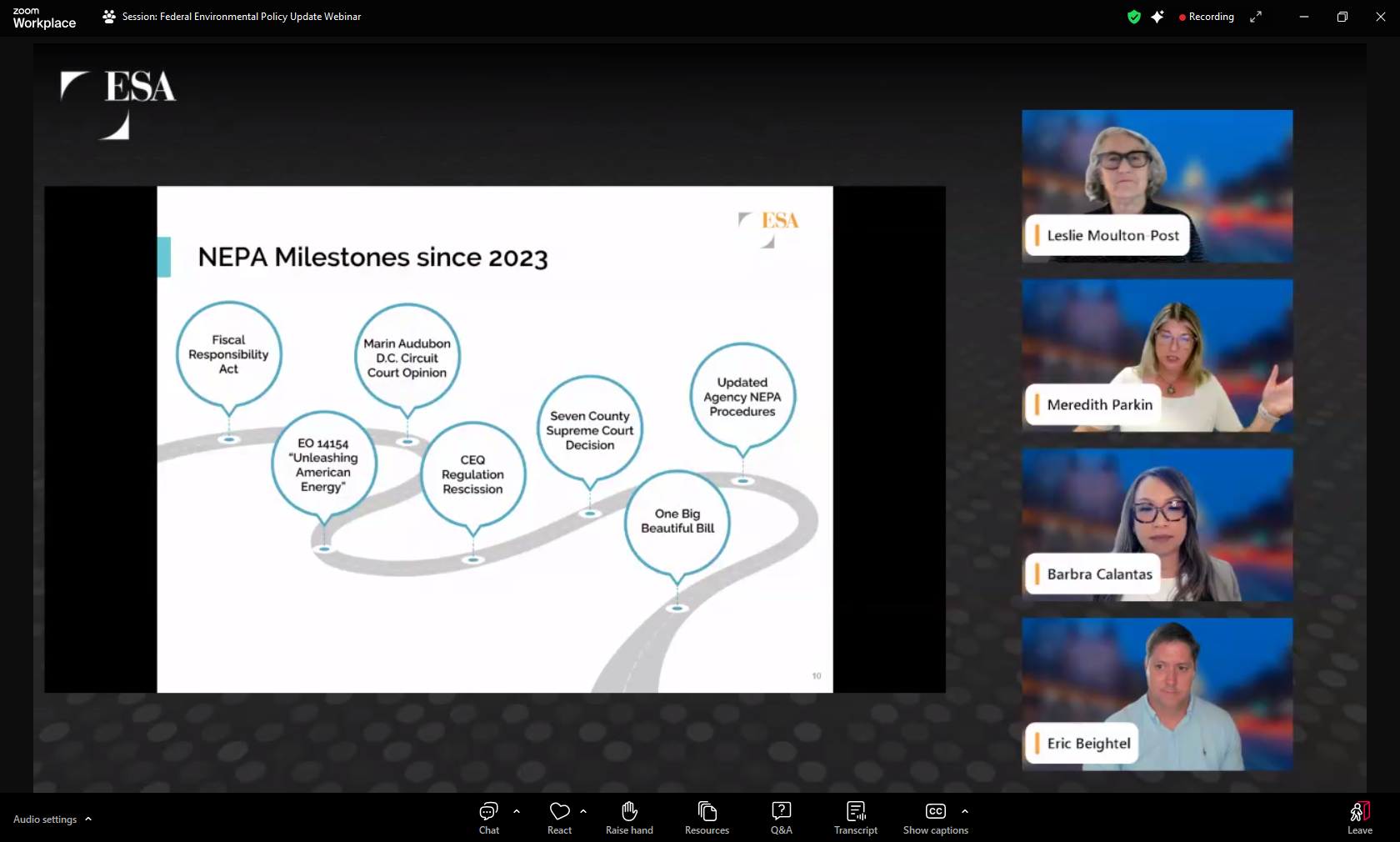
Recent NEPA Timeline
- Fiscal Responsibility Act of 2023 – Important foundation
- DC Circuit Court Opinion – Weighed heavily on Trump administration implementation
- Executive Order on Unleashing American Energy – Direct impact on CEQ’s implementation
- CEQ Rescinded NEPA Implementing Regulations
- Supreme Court Decision – Further informed agency thinking about NEPA implementation
- Agency Updates – Many agencies updated their agency-specific NEPA procedures well before their 2026 deadline
- Budget Reconciliation – Signed by President Trump on July 4th with NEPA implications
Fiscal Responsibility Act of 2023
This was the first amendment to NEPA statute that we had seen in over four decades. The fiscal responsibility act was fairly modest in the way it changed NEPA:
- Statutory caps on page and time limits: One year for 75 pages for an environmental assessment (EA) and two years and 150 pages for an environmental impact statement (EIS), with some flexibility in those limits to get bipartisan support
- Narrowed scope and applicability: Limited major federal actions that are “subject to substantial federal control and responsibility.” For example, agencies’ decisions involving minimal funding, influence, or control are excluded from NEPA’s coverage
Marin Audubon Society v. FAA Case
Late last year, we had a DC circuit court opinion on Marin Audubon Society versus the Federal Aviation Administration. A group of organizations and a resident challenged an air tour management plan by the FAA and the National Park Service regulating tourist flights over four national parks near San Francisco.
The agencies decided to use the existing number of flights under an interim operating authority as the baseline for their environmental analysis, concluding that the plan would have no significant environmental impacts. The court held that the agencies acted arbitrarily by using existing flights under the interim operating authority as the baseline.
Most important part of the ruling: In a 2-to-1 ruling, the DC circuit court stated that NEPA regulations developed by the CEQ lacked congressional or statutory authority. The court said that the presidential executive order issued by Jimmy Carter in 1977 (EO 11991), which directed the CEQ to issue NEPA regulations and for agencies to comply with those regulations, lacked congressional or statutory authority.
As a reminder, executive orders don’t require congressional approval. They’re issued unilaterally by the president and take effect immediately upon issuance. An EO can also be revoked by another president.
Executive Order 14154: Unleashing American Energy
On January 20th, the first day of President Trump’s presidency, he issued Executive Order 14154, which did several things:
- Revoked Executive Order 11991 issued by President Jimmy Carter
- Directed CEQ to rescind the CEQ’s NEPA implementing regulations that were established as part of that 1977 executive order
- Required CEQ to provide guidance to agencies on implementing NEPA
Important distinction: Regulations have effectively the force of law and can be cited as justification for decisions. Guidance is much more flexible – it’s a suggestion, not a must.
CEQ Guidance Released Early 2025
The CEQ guidance released early this year was fairly brief (about 20 pages) and covered:
- Promotion and use of project-sponsored environmental documents, not just from the agency
- Effects analysis should be those that are reasonably foreseeable
- Environmental justice, cumulative impacts, and climate change were out
- Must comply with time and page limits
- Additional clarity on major federal action
- Agencies should update their agency-specific NEPA procedures by 2026 (most large federal agencies have beat that timeline)
Seven County Infrastructure Coalition v. Eagle County, Colorado
Just two months ago, we had a huge Supreme Court unanimous decision. This involved the Surface Transportation Board granting permission to the Seven County Infrastructure Coalition to build an 80-mile railway in Utah’s Uinta Basin to transport crude oil.
Key rulings:
- Agencies are not required to evaluate environmental effects of projects separate in time and place from the proposed action. The board was not required to evaluate increased oil drilling upstream of the basin and increased oil refining downstream along the Gulf Coast as these were separate projects from the railway itself.
- The board need not evaluate environmental effects if they have no legal authority to prevent or mitigate. The board does not regulate oil drilling, oil wells, oil and gas leases, or oil refineries – only railroad lines.
- Clear line with Loper Bright case that overruled Chevron deference. Per Seven County, agencies are the experts and have deference for fact-finding and technical analysis or the scope of analysis for NEPA. Per Loper Bright, courts have deference when interpreting a statute or law.
Important quotes from the court:
- NEPA is purely procedural and has been used as “a blunt and haphazard tool to stop or at least slow down infrastructure projects”
- “Fewer projects make it to the finish line. Indeed, fewer projects make it to the starting line”
- The court felt these procedural hurdles stifle development and economic growth
Agency Updates – June 30th
June 30th was a big day for NEPA procedures. Several agencies such as the Department of Defense, Department of Interior, Department of Energy released NEPA guidance on June 30th with interim and final rules or procedures effective July 30th and comments due August 4th. Other agencies released final rules effective later in August or updated procedures with comments due in late July.
[Poll Results] Department of Interior is taking the lead with Department of Transportation falling close behind in terms of which agencies participants engage with most.
Common Themes in Updated Procedures
- Reinforce NEPA is purely procedural – consistent with Seven County Supreme Court case
- Clarifying definition of major federal action – consistent with NEPA statute
- NEPA does not apply to actions with minimal or no federal funding – Note: lack of federal funding doesn’t automatically exclude NEPA from your project. There could be other NEPA triggers such as a federal permit like an Army Corps Section 404 individual permit. Other federal procedural obligations like Section 106 of the National Historic Preservation Act would still be required.
- Reaffirmed page and time limits
- Analysis of only reasonably foreseeable effects of the proposed activity, not context and intensity as the latest rescinded NEPA implementing regulations
- Emergency response procedures and categorical exclusions – Many agencies had relied on the rescinded CEQ implementing regulations, so many have stated they have retained and/or updated items from those previous regulations
Budget Reconciliation: Pay-to-Play Provision
The budget reconciliation has a provision to allow project sponsors to pay extra for faster NEPA review timelines – what many are calling “pay-to-play” for environmental assessments or environmental impact statements.
How it works:
- Project sponsors may pay 125% of the estimated cost in preparing the EA and EIS to expedite review
- EA reviews must be completed within 180 days of fee payment (normally one year)
- EIS reviews must be completed within one year from publication of notice of intent (normally two years)
Concerns with this system:
- Regulated timelines are associated with final EA and EIS, but doesn’t specifically state the Finding of No Significant Impact (FONSI) or Record of Decision (ROD)
- No provisions that the 125% fee is more or less expensive
- CEQ only has a handful of staff members – unclear how they’ll process all possible requests
- Could prioritize expedited projects only for those who can afford to pay
- Could undermine transparency in the NEPA process
Pending Regulatory Actions
Barbara Colantis (ESA’s Biological Resources and Land Management Practice Leader): Shifting over to pending actions that have occurred in recent months, these are relative to some of the key issue areas we analyze typically during NEPA environmental review.
Endangered Species Act
On April 17th, proposed rulemaking came out from the services (US Fish and Wildlife and National Marine Fisheries) which rescinds the definition of harm, focusing largely on targeting significant habitat modification or degradation, stating that it contradicts the best meaning of “take” in that a proposed action that alters habitat is not the same as an act that directly injures or kills fish or wildlife.
There were over 330,000 comments received during the 30-day comment period, clearly indicating a lot of public interest. As of now, there is still no timeline for final rule.
Recent update: At the end of June, the services submitted a new package that would continue to rewrite key rules of the Endangered Species Act. Specific details are still under wraps, but we’ve learned that these essentially cover the designation of critical habitat, the listing of protected species, and other core elements of the law. This package is now under review of the Office of Information and Regulatory Affairs (division of OMB), and it’s clear that there will be a formal proposal in the near future.
What this means:
- We’ve heard at least one instance of a client considering reinitiating consultation to reduce compensatory mitigation requirements as a result of the proposed rulemaking
- Continued reliance on state protections for driving mitigation requirements for species listed at both federal and state levels
- With so much in motion, it may be prudent to continue sticking to the established norm of how we consider harm, but also consider strategies for what this new approach might mean in terms of impact on mitigation requirements
Clean Water Act – Waters of the US
The definition of Waters of the US (WOTUS) has been a political football in the last few years. As a reminder, in 2023 the Supreme Court Sackett v. EPA decision concluded that WOTUS encompasses only relatively permanent waters and wetlands with a continuous surface connection.
Earlier this spring, the Army Corps and EPA issued joint guidance on how to implement this continuous surface connection requirement. On April 29th, about a month and a half later, the agencies held training and published slides with numerous scenarios which are really helpful in providing clear examples of how to interpret this new guidance. This training rescinded previous trainings in conflict with the requirements.
New Nationwide Permits
The current nationwide permits established in 2021 are expiring. On June 18th, the new proposed nationwide permits were published in the Federal Register. It’s expected that they will be largely updated as they are, but there could be some changes due to public comment or direction from the president when they are finalized in March 2026.
Key findings:
- 56 out of 57 nationwide permits are largely being renewed
- One new nationwide permit is being proposed to cover activities to improve the passage of fish and other aquatic organisms, including nature-based solutions
Notable changes:
- Nationwide Permit 27 (aquatic ecosystem restoration, enhancement and establishment) – changes intended to make permitting restoration activities more efficient
- Nationwide Permit 13 (bank stabilization) – authorizing nature-based solutions associated with stabilization activities
There’s quite a bit happening in Congress driving these changes that will also impact the nationwide permit program, including key bills known as the PERMIT Act and the Nationwide Permitting Improvement Act, which will shift the overall duration of nationwide permits as well as increase the threshold of impact.
Clean Air Act – Endangerment Finding
On June 29th, the EPA formally proposed to revoke its endangerment finding regarding greenhouse gas emissions. We might recall back in 2007 the Massachusetts v. EPA Supreme Court case which determined that GHGs are pollutants under the Clean Air Act, and an endangerment finding that determined that GHGs endanger public health and that EPA is therefore required to regulate them.
The new proposed rule:
- Rescinds that endangerment finding with EPA essentially nullifying its own earlier conclusion
- Means EPA cannot regulate GHGs because they are now claiming GHGs are not a public health threat
- Worth noting that GHGs do remain considered pollutants under the Clean Air Act unless Massachusetts v. EPA is overturned
Key arguments supporting this repeal:
- Section 202 of the Clean Air Act, which governs motor vehicle pollution, was never intended to cover global climate change
- Regulations based on it were a misapplication of the law
- EPA asserts that the science underlying this finding was flawed or has become too uncertain
- New developments warrant a different conclusion today
What this means:
- EPA would lose its authority to regulate greenhouse gases under the Clean Air Act
- Current climate change regulations would lack legal grounding and face potential repeal
- Any future regulation of greenhouse gases under the Clean Air Act would necessitate direct authorization from Congress
- Expected to face many legal challenges if finalized
[Poll Results] Lots of interest in Waters of the US followed by the endangerment finding.
Key Administration Policy Updates
Eric Badel (Federal Strategy Director, ESA): Thanks everybody for sticking with us. I have the unenviable task of trying to wrap this up covering some of the key recent administration policies. There’s no shortage of administration changes that have been coming out, and you’ll see in the content that we’ve selected to cover on this webinar that these are just very recent changes. There’s a whole lot more that we’ve tried to cover in our blogs and other updates.
I’m Eric Badel, the federal strategy director at ESA. I’ve been here for almost eight months. It’s my job to track the changes in administration policy from the agencies and the White House, but also to track legislation and report back on how court cases may be influencing the way that we’re doing project development. It is my responsibility to try to stay on top of all of the various changes, which can be dizzying.
America’s AI Action Plan: Winning the Race
The president issued this AI action plan as well as three companion executive orders really focused on implementing the three pillars of this AI action plan:
- Accelerate AI Innovation – Seeking ways to deregulate or minimize the regulatory burden that AI innovation may face. Provides recommendations for agencies with discretionary funding that can invest in AI to target those investments in states that have a more forgiving regulatory structure to encourage innovation and speed of innovation.
- Build American AI Infrastructure – Really focused on permitting, which is our sweet spot.
- Lead in International AI Diplomacy and Security – Talking about how to promote American AI innovation and share that with our friends but also protect our AI investments from adversaries to ensure that our systems are secure and we’re not exposing ourselves to undue risk from foreign actors.
Build American AI Infrastructure Pillar
The AI action plan is a set of policy recommendations that doesn’t have any effect on its own, but it does lay out a blueprint for where this administration is going and the emphasis they are placing on really pushing the envelope on AI innovation and all the supporting infrastructure necessary to develop AI and data centers.
First action: Create streamlined permitting for data centers, semiconductor manufacturing facilities and energy infrastructure while guaranteeing security. This includes:
- Developing new categorical exclusions to support efficient development of data centers
- Expanding use of FAST-41 (program administered by the Federal Permitting Improvement Steering Council) to ensure projects get inter-agency coordination needed to move through the process more efficiently
- Expanding use of nationwide permits under the Clean Water Act
- Making federal lands available for data centers (Department of Energy recently released a list of sites found to be compatible with data center development)
- Expanding AI to accelerate permitting and environmental reviews – hearkens back to CEQ’s recent permitting technology action plan released in May/June, trying to raise consistency of data standards among federal agencies so systems can operate more effectively together and lean into AI use for routine actions like comment review and resolution on environmental documents, intake of permit applications, sorting of permit mitigation measures
Executive Order 14318: Accelerating Federal Permitting of Data Center Infrastructure
This takes the policy recommendations and puts action behind them, requiring agencies to take certain steps to implement those recommendations.
Defines qualifying project: Projects that meet minimum standard to qualify for coverage:
- At least $500 million of private capital investment
- Electric load generation or need greater than 100 megawatts (equivalent of about 100,000 houses)
- These are large data center campuses or hyperscaler facilities, not small one-offs
- Carveout language for protecting national security or otherwise designated by Secretary of Interior, Secretary of Energy, or Secretary of Defense
If it is a qualifying project:
- CEQ works with agencies to identify new categorical exclusions to support delivery of these infrastructure projects
- Establishes that federal financial assistance that supports less than 50% of total project cost is not a major federal action
- For example: $1 billion project with $500 million private capital and $499 million federal funds – that $499 million would not be sufficient to trigger NEPA
- Does not exclude requirements of Section 106 compliance – would still be a federal undertaking for Section 106 purposes
- You would still have consultation potentially for endangered species, but if you didn’t have the funding agency as lead agency, you may be exempt from Section 7 and may be required to do Section 10 consultation
Additional provisions:
- All qualifying projects posted to permitting dashboard as transparency projects (schedule but not necessarily held to those timetables until they become covered projects under FAST-41)
- Executive director encouraged to work with project sponsors to volunteer to come into FAST-41 coverage
- Directs EPA to identify brownfield or superfund sites where data centers can be located
- Directs Department of Interior to develop programmatic Section 7 consultation for types of construction activities typical for data centers and species that may be affected (available for next 10 years, doubling typical 5-year shelf life)
- Directs Secretary of Army to establish new nationwide permits under Clean Water Act and Rivers and Harbors Act
Energy considerations: The executive order is very clear on types of energy it considers eligible for accelerated coverage: nuclear, natural gas, geothermal, coal – but is noticeably silent on wind and solar renewable energy, consistent with the administration’s posture on those types of renewable energy.
Secretary of Interior Actions on Wind and Solar
Secretary of Interior issued a mandate in July: All departmental actions (any action whether it’s initiation of consultation under Section 7, right-of-way authorization, or anything else – notice to proceed, notice of intent, anything that the department has to take an action on) for a wind or solar project (on or off federal lands, not limited to just federal lands) has heightened scrutiny and must go through headquarters first at the Office of Executive Secretariat for Regulatory Affairs, then through the Deputy Secretary’s office, then finally Secretary Burgum will need to sign off on even the most ministerial actions that would have previously been delegated down to the regions.
This is creating a significant obstacle to timely completion of these actions. Things that could have been handled at the regional level through a phone call are now being run up the flag pole all the way to DC, which creates a lot of schedule uncertainty and schedule risk.
Secretarial Order 3437
Secretary Burgum issued Secretarial Order 3437, companion to a prior executive order from President Trump about eliminating preferential treatment for unreliable foreign-controlled energy sources (essentially code for foreign manufactured components that go into wind and solar projects).
Key provisions:
- Directed departmental bureaus (Bureau of Land Management, Bureau of Ocean Energy Management, and others) to review existing policies to ensure they did not provide undue preference to wind and solar projects
- Removed from the outer continental shelf lease areas that might have been available for offshore wind
- Initiated review of Migratory Bird Treaty Act and bird strikes
- Increased and improved public outreach for offshore wind with community involvement and fisheries as well as tribal engagement (though they’re not going to have any more offshore wind leases in the near term)
Secretarial Order 3438: Managing Federal Energy Resources and Protecting the Environment
This introduces the concept of energy capacity density and requires that any federal lands being contemplated for use for energy development (regardless of what kind) consider energy density that is at least equal to what is considered, and those that may be more dense.
Example: If you have 100 acres for terrestrial wind and you’re going to produce 100 megawatts through those 100 acres, you could have a 10-acre facility that produces 100 megawatts from a nuclear facility or natural gas plant. Under this policy, the requirement is that you consider and evaluate and determine whether or not this larger land use is compatible with the Federal Land Protection and Management Act, the mixed or shared use doctrine of our federal lands.
This is a break from NEPA in many ways – a renewable energy company that wants to develop solar on federal lands is not going to consider developing a nuclear reactor, which goes against their goals and objectives, which is what the NEPA statute’s recent amendments are directing us towards.
This is symptomatic of a broader posture this administration is taking against wind and solar. We anticipate that the commercial decisions that have gone into developing these projects and the utilities who are relying on this energy production that was supposed to come online at some point in the not too distant future – that energy is not going to be there, and that’s going to have real downstream consequences.
While this is clearly a posture they want to take because they are in opposition to these sorts of energy generation sources, the industry and the public are going to suffer at some point as a result of the lack of that energy, and we’re going to see some pushback.
Congressional Permitting Reform
Eric Badel (continued): It’s an uncertain time with Congress and the lack of bipartisanship and polarization among the parties, but there is a lot of energy around permitting reform. We saw in the last Congress the Manchin-Barrasso bill that almost got over the finish line but couldn’t quite get enough support. That has kind of died and we’ve seen a lot more aggressive language come out of the House more recently, but the Senate side is also working on draft documents and discussion drafts.
If you do just a quick snapshot of what has been introduced (whether it’s just introduced by a member or made it out of committee), we have:
- At least 13 bills dealing with Clean Water Act
- Almost 100 on Clean Air Act
- Over 100 for National Environmental Policy Act and Endangered Species Act
Clearly the appetite is there.
SPEED Act (Chair Westerman’s Bill)
This was one that he had introduced in the last Congress as a discussion draft. It has now been introduced in House Natural Resources and voted out of committee. The SPEED Act is targeting modernizing NEPA, shortened permitting timelines, and simplifying NEPA analysis and clarifying the definition of major federal action.
Key provisions:
- Narrows the ability of the agency to evaluate effects that are separate/removed – would codify the language from the Seven County decision
- Limits requirements of agencies to consider new scientific information (would preclude agencies from actually considering new information that comes up during analysis)
- Would double the shelf life of programmatic documents from 5 to 10 years
- Reduces statute of limitations under NEPA from six years under Administrative Procedures Act to 150 days (consistent with transportation agencies)
- Would add grants to the list of funding vehicles that would not trigger NEPA (would remove that trigger and introduce complexities as to how you identify a lead agency if the funding agency isn’t the primary one)
PERMIT Act
Really focused on Clean Water Act revisions:
- Doubling the term of National Pollution Discharge Elimination System permits from 5 to 10 years
- Codifies WOTUS exemptions
- Creates new nationwide permits
- Raises the threshold for nationwide permits up to 3 acres of disturbance (significant increase)
- Would limit judicial review
REIGNS Act
The Regulations from the Executive in Need of Scrutiny. This was part of the reconciliation package. When it made it out of the House, the Senate parliamentarian decided that it did not have strict budgetary impacts (was more policy focused) and so they jettisoned it from that package, but it has been resurrected.
This would require that any major rule/significant rule that comes out of the agencies would have to be put to a vote in front of Congress and pass both chambers. Right now we have the Congressional Review Act which allows Congress to look back at rules that had been issued from a prior administration to determine whether that is consistent with the outcome of the most recent election. This would actually prevent rules from even being implemented until Congress took an affirmative action to approve them, which would obviously have significant slowdown in the ability of agencies to implement regulations.
Appropriations
Both chambers have been working very hard to pass through normal order their individual committee funding bills. A number of them have gone out of committee but have not gone to the full floor. The House and Senate are on separate tracks and are not well aligned, and neither chamber is well aligned with the president’s budget request.
We will have to get a 60-vote majority in the Senate – it will have to be filibuster-proof, which means they’re going to have to have some Democrats come on to whatever budget proposal it is. This means we’re going to more than likely have a continuing resolution to keep us funded through the next few months.
This is the sort of must-pass legislation that permitting reform sometimes finds its way into, so it will be interesting to watch this as funding becomes more clear.
Q&A Session
Leslie Molton Post: Thank you to our panelists for working through some pretty beefy information and updates. Let me get right into some excellent questions.
NEPA Pay-to-Play Questions
Question: Who are the funds paid to? Do they get paid to the lead agency? What is the 125% fee based on?
Meredith Parkin: Those are all great questions because as practitioners, those are the things that we’re asking. The portion of the bill that this is in is less than a page. It essentially says if a project sponsor wants to participate, they have to give the CEQ the description of the project and if they plan on doing an EA or EIS, then the CEQ has 15 days to tell them how much that will be. That’s all that’s said.
You would think that would be what the agency is going to have to go through in the processing for NEPA, but there’s just not much there. Once they come up with that 125%, once they’re given a go, they pay, and then comes the issue of what if it goes over 125%? How is that handled? There are some things that really need to be worked out and guidance needs to be given.
Eric Badel: The biggest question is where’s that money go. CEQ doesn’t do NEPA. Presumably you’d have to redirect those dollars that came in to the agencies, but that’s not required in the statute. I think we’ll need to see CEQ provide some additional guidance on how this program is going to be administered. We also haven’t seen any rumblings of any project sponsors chomping at the bit to take advantage of it.
Leslie: It does seem to just go to the question of the role of CEQ that used to really be in the center of gating NEPA and really now is somewhat sidelined. So here they are getting tasked with this expediting, but they’re not really in position for that. It’s a curious dynamic for sure.
Wind and Solar Transmission Questions
Question: Will the Department of Interior Secretary review wind and solar related actions apply to transmission?
Eric Badel: The order is clear that it is wind and solar projects. An argument could be made that a transmission line connecting to wind and solar, if you’re not reviewing the wind and solar component, the transmission line may be exempt from this heightened scrutiny. We have talked with clients about how do you reframe your project in a way that maybe drops the mention of the solar part and we focus on the transmission part just to lower the temperature around the discussion.
There’s ultimately going to be some discretion at the field level as to is this a thing that is covered by this policy? Do I need to run it up the flag pole or do I have the autonomy to decide that it is not?
There’s going to be a tension between what is actually available for data centers to tie into to support the energy needs and what they can look at for developing coal or natural gas fired or whatever it might be. The intent and the posture is clear, but I think the reality of it is going to force them to modify or at least adapt because the need is so great.
Endangered Species Act Strategy
Question: Strategy of staying the course with current definition versus maybe jumping ahead to the potential change in definition of harm?
Barbara Colantis: I think there’s still a lot of movement happening around Endangered Species Act and the recent package that was submitted further addressing critical habitat and species protection. It’s still yet to be seen what that could look like, so staying the course covers what the current standard is, but would recommend also applying that lens of what would it mean if we’re not accounting for harm.
We’re still accounting for habitat loss that’s not targeted specifically – it’s habitat modification and degradation. The recommendation would be to work closely with whoever you’re working with at the agencies to understand their preference as agency guidance may soon be developed. We’re currently relying on an ESA consultation handbook that hasn’t been updated in decades, and we could see that coming out maybe with some of these proposed rules becoming final.
We could alternatively provide an assessment of how impacts and mitigation could be impacted with harm, but we should still consider including that this is still in draft form.
Closing
Leslie Molton Post: Thank you so much for joining us. We didn’t get to all the questions, but they’re excellent. What we do is we will follow up with an email that will give you a link to the recording and we will continue to answer those questions. We’ll be as direct as we can and may refer you to a blog to get some more depth.
Excellent questions about how this applies to the California Central Valley Water Project, some more on wind and solar. Thank you and again invite you to look at our permitting policy tracker. We’ll keep that up to date as a place where you can check.
I think this will probably become a series because we can expect more change, and we appreciate being in a community of practice with all of you where we are looking to digest the change, give our clients good advice on how to move forward, and be a positive voice for permit reform that continues to come. Thank you again for joining us and have a great rest of your Tuesday.
They also represented the buyers of the Des Moines Masonic Home in their recent EIS for a demolition permit.
1This is a machine-generated transcript generated on the fly by Google/Youtube/AI. Accuracy totally not guaranteed. Provided only as a convenience and to help people with disabilities. Caveat lector!