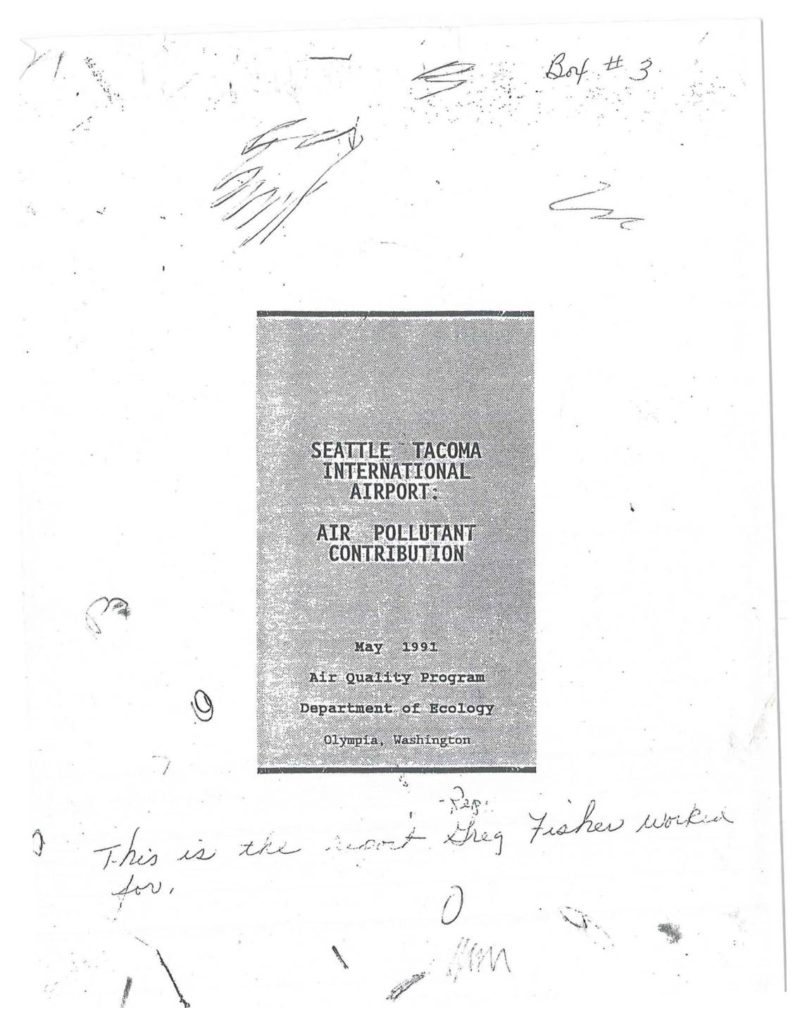
The study - done at the re- quest of 33rd District state Rep. Greg Fisher (D-Des Moines) - indicates that the airport accounts for approxi- mately 8 percent of the carbon monoxide ·and 5 percent of the nitrogen oxide in King Coun- ty. Both substances are suspected carcinogens, which means they may cause cancer. "Those who live around the airport live in an air-pollution ~------------v_o_t_~ __ N_o_._12_7 ____ ~IIL ___________________________ A __ 3~ NORTH HILL SOUTH SEATAC NORMANDY PARK ~s a major polluter · hotspot," said Fisher. "It could have significant impacts on their health." POLLUTION GENER· ATED by the airport may be transported by the wind, transformed in the atmosphere and then deposited in sur- rounding areas, the report said. Taken in the aggregate, au- tomobiles still produce far more pollution than any other source, including the airport, said Jim Nolan of the Puget Sound Air Pollution Control Agency in Seattle. "But you're going to find that the airport is a great pollution producer, partly because so many vehicles travel there," Nolan said. "But in a lot of respects, au- tomobile traffic is much worse than air traffic." The Boeing plant in Renton, for example, generates 11 tons of carbon monoxide and 45 tons of nitrogen oxide each year, Nolan said. The · airport gel'lerates 3,628 tons of carbon monoxide and 1,897 tons of nitrogen oxide annually, according to the report. Automobiles in King County generate 322,037 tons of carbon monoxide annually, according to statistics from the air-pollution control…Open full document
Notes
Purpose: the evaluation of ground level impacts on the ambient air of the Seattle-Tacoma International Airport (Sea-Tac)