I understand that you will never share my information with anyone, you will only use it to keep me updated on relevant events and that I may unsubscribe at any time.
This Thursday, the Des Moines City Council will vote to continue forward with an amended version of their SAMP Interlocal Agreement (ILA) — a joint legal/consulting framework for NEPA/SEPA review of the Port of Seattle’s Sustainable Airport Master Plan (SAMP). The arrangement began in 2018 with four cities: Burien, Des Moines, Normandy Park, and SeaTac.
On Monday November 3rd, the Burien City Council voted to approve the same basic agreement. However, on Friday November 7, the Des Moines meeting agenda was released which indicated that Normandy Park has withdrawn from the agreement.
We support coordinated action on SAMP — but not under the current structure for two reasons, one small, one very large.
First, the agreement assigns costs based on population, not financial health. This may seem ‘equitable’ (as Burien’s City Manager described it). However, the difference in financial strength between the three cities matters far more than population. SeaTac is the only participant not struggling to keep its head above water–and that is, in large part, due to its current benefits package from the airport.
Second, that benefits package, including their Port–SeaTac ILA (2018) creates financial and procedural conflicts that undercut independent advocacy. The agreement calls for a shared response on both NEPA and SEPA, with SeaTac taking the lead. It’s their attorneys.
The goal is independence (and why we keep missing it)
Burien and Des Moines have long sought an independent impacts study (an update to the 1997 HOK study) because credible data is the only path to durable mitigation and compensation. In 2019, the cities pursued the Stantec Study. The City of SeaTac covered 50% of that local cost share (not on a population basis), but advocated for the study to be administered via the Department of Commerce — not under local control. This led to a report whose major conclusions were that more studies are needed.
The SAMP is here now and we still do not have the information we need to address the community impacts of one third more operations over the next decade.
We must have studies conducted as they were done in 1997 — managed by cities outside SeaTac’s Port relationship. That is the only way to obtain tangible results that will endure.
Why SeaTac’s role is conflicted
Under the Port–SeaTac ILA (2018), SeaTac receives two distinct revenue streams from the Port:
$1.4M/year “Community Relief Contribution The City of SeaTac receives this money annually from the Port’s property tax levy. SeaTac agrees not to seek additional Port funding for those same matters, and the payment may be treated as SEPA mitigation. If SeaTac initiates litigation on covered matters without first using the ILA’s dispute process, the Port may suspend payment until the case is resolved (although SEPA appeals may be exempt?)
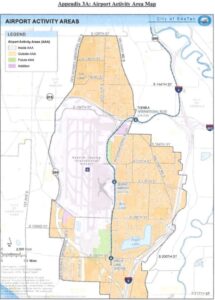
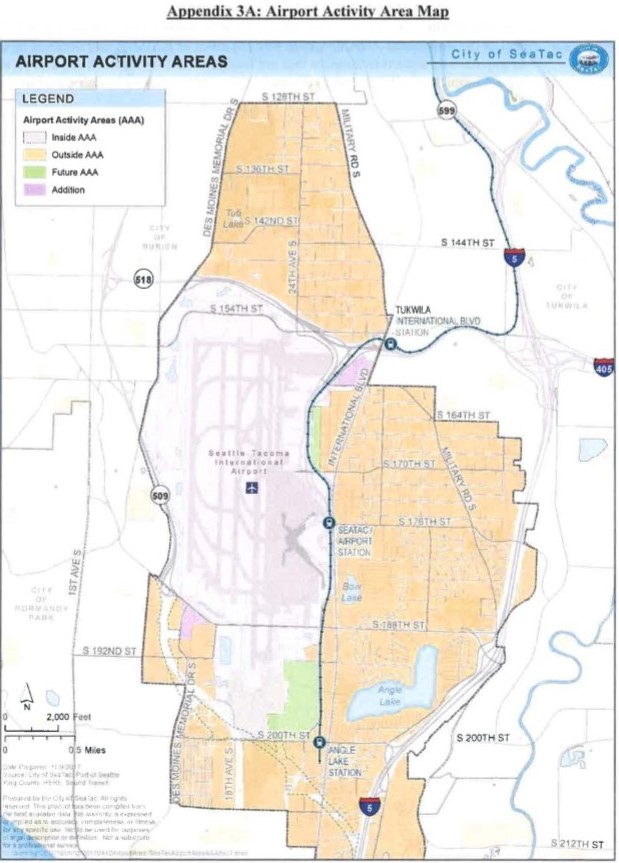
Green area denotes expansion of building projects to 200th Street!Permit/QA payments For the purposes of the SAMP this is even more important. The Port is essentially self-permitting on airport property known as the AAA (the area under consideration in the SAMP!) In exchange, the City of SeaTac receives a minimum $226,600/year (CPI-adjusted)plus additional quarterly payments when total construction valuation exceeds $300M. In effect, more/larger Port projects yield more money for SeaTac!
Combined with the ILA’s “good faith/no surprises” and step-wise dispute-resolution requirements, SeaTac is structurally discouraged from public opposition or independent legal action against Port projects — perhaps not legally barred under all circumstances, but certainly financially and procedurally disincentivized.
What that means for a SAMP ILA right now
The draft 2025 SAMP ILA (among Burien, Des Moines, SeaTac) adds legal services and envisions a single, coordinated comment letter and joint legal steps/appeals. It also assigns contract and fiscal administration to SeaTac and sets decision rules for joint appeals (unanimity to file; majority to continue).
If SeaTac — whose general fund and QA revenues rise with Port activity and whose payments are conditioned on collaborative dispute handling — also controls the SAMP ILA’s purse and contracting, that undermines the core goal: independence. Burien and Des Moines, who bear disproportionate flight-path harms, need a structure free of these conflicts to run consultants, comment strategy, and any litigation.
The constructive fix
Keep SeaTac at the table — but not as fiscal/contract administrator. Place administration with Burien or Des Moines (or a neutral fiscal agent), and spell out safeguards that ensure independent consultant scope, joint comment control, and clear withdrawal/appeal options. That preserves regional coordination without importing the Port–SeaTac conflict into the SAMP effort.
We use cookies to store and/or access device information. Consenting to these technologies will allow us to process data such as browsing behavior or unique IDs on this site. Not consenting or withdrawing consent, may adversely affect certain features and functions.
Functional
Always active
The technical storage or access is strictly necessary for the legitimate purpose of enabling the use of a specific service explicitly requested by the subscriber or user, or for the sole purpose of carrying out the transmission of a communication over an electronic communications network.
Preferences
The technical storage or access is necessary for the legitimate purpose of storing preferences that are not requested by the subscriber or user.
Statistics
The technical storage or access that is used exclusively for statistical purposes.The technical storage or access that is used exclusively for anonymous statistical purposes. Without a subpoena, voluntary compliance on the part of your Internet Service Provider, or additional records from a third party, information stored or retrieved for this purpose alone cannot usually be used to identify you.
Marketing
The technical storage or access is required to create user profiles to send advertising, or to track the user on a website or across several websites for similar marketing purposes.