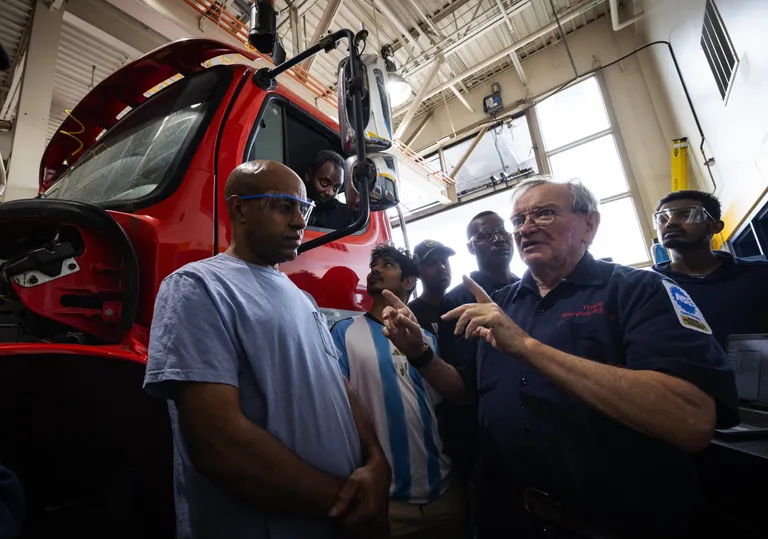
Diesel Transportation and Heavy Equipment Technology instructor Mark Murphy, right, teaches a class on electrical theory and how it relates to diesel engines at South Seattle College in July. (Ken Lambert / The Seattle Times)
By Ryan Nguyen
Seattle Times news producer
Education Lab is a Seattle Times project that spotlights promising approaches to persistent challenges in public education. The Seattle Foundation serves as the fiscal sponsor for Education Lab, which is supported by grants from the Bill & Melinda Gates Foundation and Ballmer Group. Learn more about Ed Lab. 
The next time you’re waiting for your plane to depart from Seattle-Tacoma International Airport, take a look out your window.
If you’re lucky enough to have a view, you’ll see a small army of specialized machinery: Trucks with conveyor belts load your baggage onto the plane, tankers refill the aircraft with jet fuel, and other vehicles cart gear between the runway and hangers.
A new program offered by South Seattle College certifies students in maintaining and repairing these machines used on airport tarmacs to help service aircraft, also known as ground support equipment.
Technicians who can repair all of this machinery “below the wing” are in high demand locally, including at Sea-Tac, said Ferdinand Orbino, dean of skilled trades at SSC. The new certificate intends to help fill these labor and skill gaps while funneling students into in-demand careers.
“I love win-win scenarios,” Orbino said.
The certificate is “the first publicly offered training program of its kind in the United States,” according to the college. The program’s first cohort, nine students, are expected to graduate after completing their final term at the end of the fall quarter.
What students learn
“Crank it!” SSC instructor Mark Murphy orders.
Inside a garage at SSC, a student sitting inside a diesel semitruck revs the engine. The truck roars to life, a sound amplified by the fact that the vehicle’s hood is completely open.
Standing right next to the vehicle are Murphy and half a dozen students in his advanced electrical theory class. As the engine whirs, Murphy points to a computer screen that displays real-time diagnostic data. Numbers related to “fuel rail pressure” and “fan control command” change rapidly.
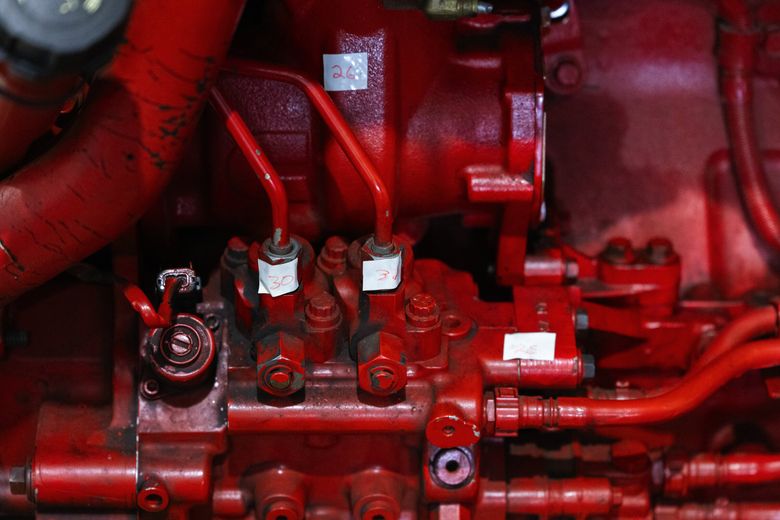
A donated Paccar MX-11 diesel engine has been opened up, exposing the wires for the electronically managed fuel injection and engine brakes, at South Seattle College in July. (Ken Lambert / The Seattle Times)
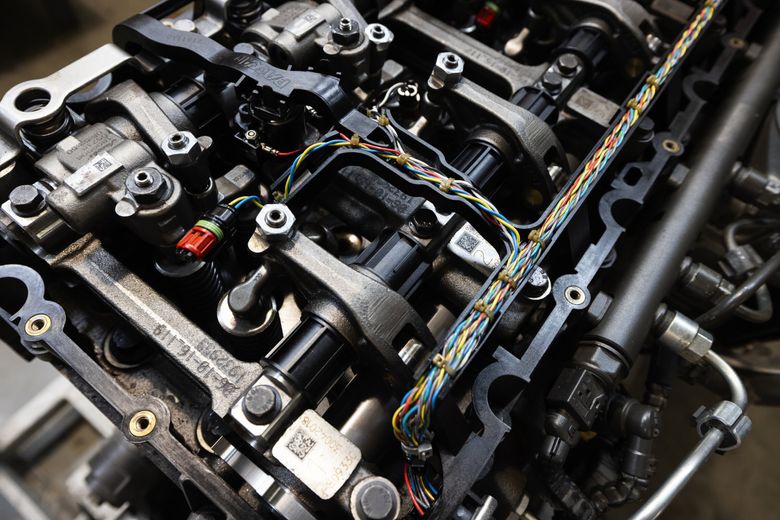
A donated Paccar MX-11 diesel engine has been opened up, exposing the wires for the electronically managed fuel injection and engine brakes, at South Seattle College in July. (Ken Lambert / The Seattle Times)
A student at South Seattle College attends a class in July studying a fuse plan of a truck’s electrical system during a class on electrical theory and how it relates to diesel engines (Ken Lambert / The Seattle Times)
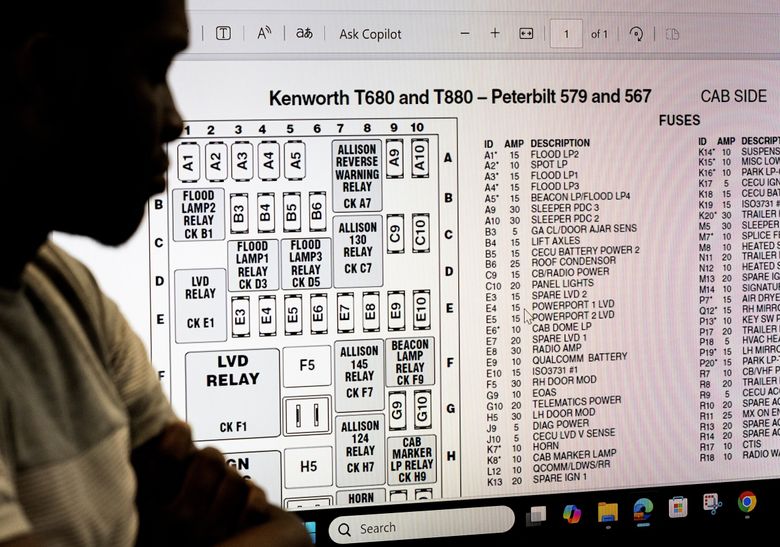
A student at South Seattle College attends a class in July studying a fuse plan of a truck’s electrical system during a class on electrical theory and how it relates to diesel engines (Ken Lambert / The Seattle Times)
Murphy shouts to be heard over the truck’s roaring engine. (Murphy, for his part, turns down his hearing aids.) His students, standing closely, appear unfazed. The student inside the truck leans out of the open window to hear Murphy’s lecture.
As part of the ground support equipment certificate, Murphy’s students learn to disassemble and reassemble diesel engines, use hand and power tools safely, and diagnose problems with complex electrical systems. On this day, Murphy’s class is learning how to test relays, the switches that control electrical circuits in many devices.
One challenge that comes with the course is the amount of specialized vocabulary. Many of the students in the program speak English as a second language, and Murphy said translating what he calls “technical gobbledygook” can be difficult.
For that reason, Murphy teaches the class alongside another instructor, Anthony Clarke, a former high school principal who helps break down technical language into something more easily grasped.
Several of Murphy’s students come from a job program based out of Port Jobs, a nonprofit at Sea-Tac that helps people find and apply for jobs at the airport. Nearly all of the students in that class were born outside the U.S., said E.J. Bravo, Port Jobs’ career development supervisor. Some of their first languages include Spanish, Arabic, Amharic, Marshallese and Fijian.
Industry partnerships
The college created the ground support equipment certificate for two main reasons, Orbino said: the high demand for skilled technicians, and interest from Sea-Tac employees who want to move into technical careers.
SSC partnered with the Port of Seattle to create the program, in addition to Port Jobs, Sea-Tac and Alaska Airlines, among others.
Sign up for Education Lab
An easy way to stay connected to education. Delivered to your inbox Thursdays.
“They identified their need. We are the experts in the training,” Orbino said. “Just working hand in hand to address the gaps that were seen is how we got to where we are now.”
A relay test kit is used during a class on electrical theory and how it relates to diesel engines at South Seattle College. (Ken Lambert / The Seattle Times)
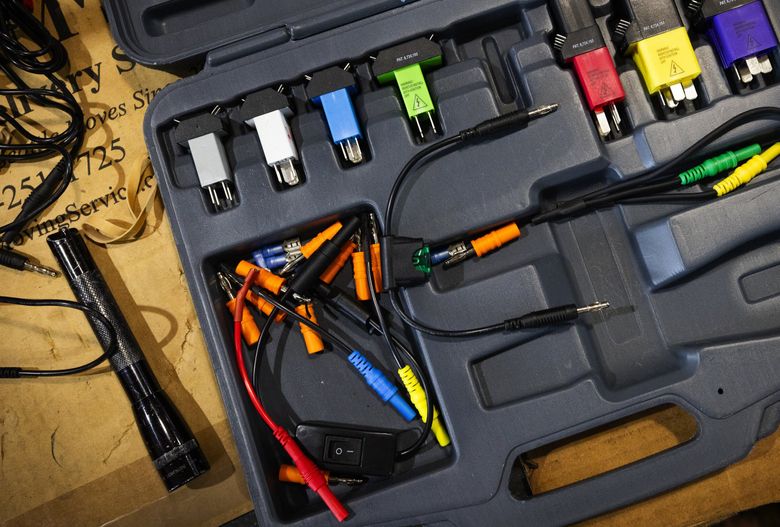
1 of 2 | A relay test kit is used during a class on electrical theory and how it relates to diesel engines at South Seattle College. (Ken Lambert / The Seattle Times)
The partner organizations loan diesel engines and other equipment to the college, he said. Some offer students tours of their facilities.
“To learn something on a book or a PowerPoint is one thing,” Orbino said, “but to learn it and then be able to put your hands on it — that’s where the real magic happens.”
Arun Biswakarma, a student pursuing the certificate, once brought his Nissan Sentra to the college to have the class figure out why the vehicle made a strange noise when he drove.
First, the class listened to the sounds of the car. It sounded like a bee, Biswakarma said, potentially indicating an issue with the vehicle’s brake pads or rotors. The class popped the hood and removed the car’s tires to examine the car. About 15 minutes later, they figured out the issue: The brake pads were “almost gone,” he said.
Biswakarma, 28, contrasted the speedy process to another time, when he brought a different car to a dealership that charged him $200 to diagnose the issue.
“Everyone learned,” Biswakarma said. “That is the reason we are doing it.”
Once students earn the certificate, Orbino said, they could go straight into the workforce at airports, where they could pursue entry-level technician jobs. Ground support equipment mechanics can earn a starting wage of about $30 per hour, according to the Port of Seattle.
But, with some on-the-job training, they could also work with specialized machinery and diesel engines in the automotive or electrical industries. As one example, Murphy and Orbino referenced King County Metro, which has had a shortage of qualified bus mechanics for years, resulting in delays for bus repairs that cause even longer waits for transit passengers.
Afenigus Workalemahu, an SSC student who also drives buses for King County Metro, could be one of those future mechanics.
He’s worked for the agency for almost six years and became interested in SSC’s certificate program after repeatedly seeing job openings for mechanics at his workplace. A higher-paying job would help him support his family members in Ethiopia, where he emigrated from in 2016, he said.
“It’s not only the money satisfaction,” he said. “I’m interested to solve something.”
Instead of finding a job immediately after earning the certificate, students can also pursue more advanced or specialized education, such as an associate degree at SSC or a bachelor’s degree at a four-year university.
Workalemahu could either work as a mechanic for the transit agency or pursue a four-year engineering degree, he said, perhaps at the University of Washington. Either way, he plans to get an associate degree at SSC.
“If you decide to navigate to a different section of your career, whether it’s management or something else, you can still have that door open in the future,” Orbino said. “It just opens up the door for so many more possibilities.”
Diesel Transportation and Heavy Equipment Technology instructor Mark Murphy, right, teaches a class in July on electrical theory and how it relates to diesel engines at South Seattle College. (Ken Lambert / The Seattle Times)
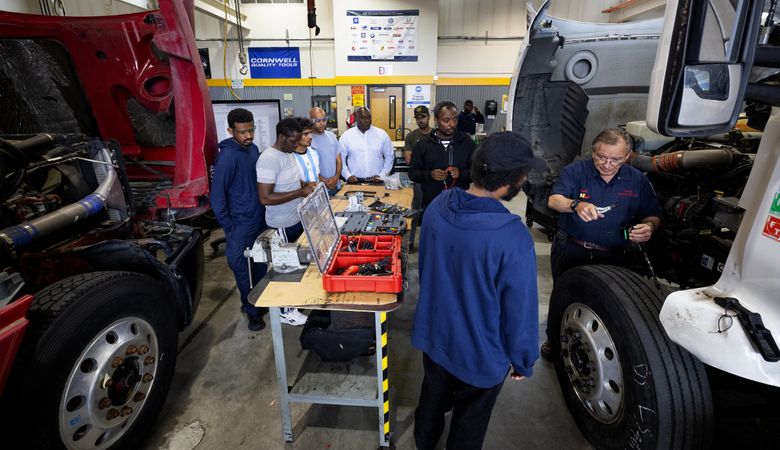
Diesel Transportation and Heavy Equipment Technology instructor Mark Murphy, right, teaches a class in July on electrical theory and how it relates to diesel engines at South Seattle College. (Ken Lambert / The Seattle Times)
To complete the certificate, students need to take 48 credits’ worth of classes, or about three full-time academic quarters.
The program also aims to recruit people already working at Sea-Tac — specifically, those who want to transition into technical roles and potentially secure higher pay.
Sea-Tac employees can enroll in an introductory “bridge” class at the airport to sample classes without the need to enroll at SSC immediately, Bravo said. One track focuses on airport ground support equipment, while another centers on aviation maintenance.
Port Jobs offers these bridge classes through one of its educational programs, Airport University.
“They can take the class for free at the airport and then decide whether or not it’s for them,” Bravo said.
The 2.5-hour classes, taught by SSC instructors, take place twice a week and involve hands-on activities and guest speakers from related industries, Bravo said.
Like in SSC’s GSE program, two instructors teach each class. One instructor focuses on the actual technical skills related to airport ground support equipment, while the other focuses on teaching technical jargon, basic math skills and study techniques. Having a second instructor who focuses on those skills can be helpful for students who haven’t taken a math class in decades or who don’t speak English as a first language, Bravo said.
Related
At Sea-Tac Airport, refugee workers fear the traveling world they connect
Upon finishing the class, students get a $1,000 scholarship from Airport University and Alaska Airlines that can pay for tuition, textbooks or other academic expenses for the SSC program.
Pitshou Mwemena, 38, enrolled in a bridge class for the first cohort of the airport ground support equipment program. He had worked at Sea-Tac as a driver for the trucks that remove and dispose of wastewater from airplane restrooms, another kind of ground support equipment. He aims to return to Sea-Tac as a mechanic.
Improving gender diversity
One difficulty the program faces is recruiting more women, Orbino said, adding that the hardest part of improving gender diversity is facing stereotypes over how skilled trades are only for men.
“This is the first quarter, but we’re not where we want to be yet,” Orbino said of the first cohort of ground support equipment students, which is all men.
Clarke, the co-instructor, said the program also needs to create awareness that the heavy diesel industry even exists, especially as technicians continue to remain in high demand.
Students who are interested in the certificate can register for classes in mid-February, as part of the program’s second cohort. No experience is required to join.
Murphy is bullish on the likelihood that his students will find employment after completing the certificate.
“You have any idea, with the technician shortage, how fast they’re going to get jobs?” Murphy said.
Ryan Nguyen: rnguyen@seattletimes.com. Ryan Nguyen is a news producer at The Seattle Times.