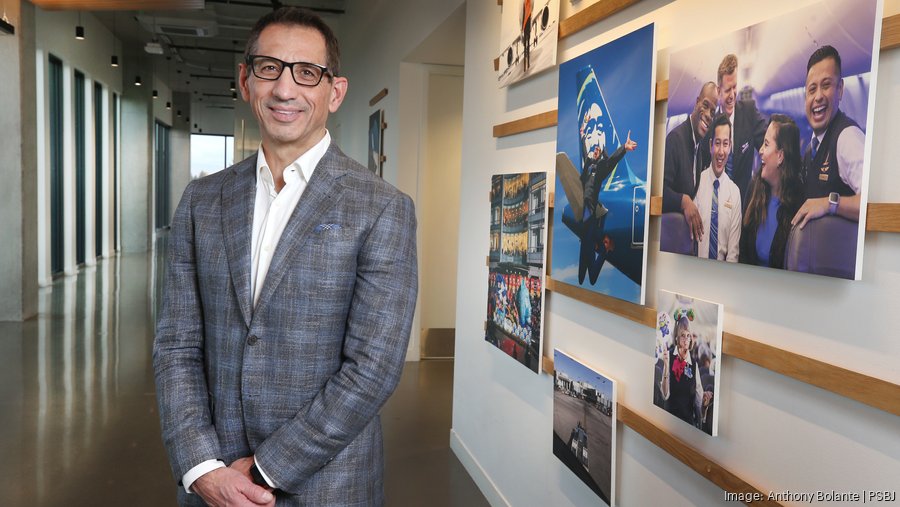
Alaska Air CEO Ben Minicucci named Executive Of The Year

By Nick Pasion – Reporter, Puget Sound Business Journal
Dec 11, 2025
Story Highlights
What’s This?
- Alaska Airlines CEO Ben Minicucci completed the $1.9 billion Hawaiian Airlines acquisition in September 2024.
- The merger enables Alaska to compete globally with international routes.
- Minicucci also played a central role in the 2016 Virgin America acquisition that made Alaska the U.S.’s fifth-largest carrier.
More than a hundred people were stuffed between two gates in the N Concourse at Seattle-Tacoma International Airport on May 12. The excitement was palpable as Ben Minicucci walked onto the stage, framed by blue flowers and cherry blossoms.
Since becoming the CEO of Alaska Air Group in 2021, Minicucci’s tenure has been a lesson in crisis management. Alaska, alongside the rest of the industry, lost millions during the pandemic, and Minicucci inherited a carrier on the rebound. In January 2024, a fuselage panel on a Boeing 737 Max blew out midair during an Alaska flight from Portland, throwing the airline’s operations into distress.
On that warm spring day, however, Minicucci had his sights set on a new horizon. It was a day of celebration. Alaska, the fifth largest domestic carrier in the U.S., was shedding its reputation as a predominantly regional carrier. It was venturing into something new, something bigger. Under Minicucci, Alaska was asserting itself on the global stage.
During his nearly 22-year career with Alaska, Minicucci has twice been a central figure in acquisitions that set the airline’s growth on new trajectories. The second of those landmark deals — the $1.9 billion purchase of Hawaiian Airlines — set the stage for May’s inauguration.
That day, Minicucci presided over the launch of its nonstop service to Japan, using a plane gained through the Hawaiian Airlines acquisition. That deal had equipped Alaska with a larger fleet, access to new airports and the tools to challenge the country’s four largest airlines, starting with international flights.
The SeaTac-based carrier had entered a new era of travel.
“We’re going to be a more formidable competitor against the biggest four airlines in the world — little old Alaska,” Minicucci told the Business Journal in November.
‘Every bolt, every component’
Minicucci didn’t grow up thinking a lot about planes. After World War II, his parents immigrated from Italy to Canada on a boat. The couple was poor; his father’s English was limited.
“He had chicken for how many days (on the voyage) because that’s the only thing he knew how to say,” Minicucci says of his father.
They settled in Montreal, where Minicucci spent his early life. The youngest of four, Minicucci has said that it felt like he grew up in Italy, even though the family lived in Canada — they spoke Italian at the dinner table, cured their own meats and made their own wines at the house.
Minicucci often reminisces about his father, Giovanni. He would get up at 4:30 a.m. to smoke in the bathroom, and Minicucci would wake to the smell of his Player Cigarettes wafting through the house. He worked in construction in difficult, often cold conditions, but he didn’t complain. He looked after the family.
Through his father, Minicucci found a passion for fixing things. He said his family was too poor to buy new, so his dad taught him how to work with his hands, a practice that led him to engineering.
“If anything was broken, like a fence or anything on the patio, or even the plumbing and stuff, we would work on it,” Minicucci says.
Now, Minicucci takes apart his dishwasher, dryer and other appliances, just to see how they work. How-to tutorials on YouTube have become his go-to instructor. Those tutorials have become particularly helpful when tinkering with his favorite hobby: bicycling.
Minicucci spends his weekends biking. He has a dedicated group of friends who loop around Lake Sammamish and Lake Washington. If he goes on vacation or travels, cyclng is on the itinerary.
At his home in Issaquah, he spends his free time disassembling and reassembling his six bikes at his work station. He’ll put on YouTube videos and spend hours at the task.
“When I ride my bikes, I know that every bolt, every component of that bike I have touched,” Minicucci says. “And so when I’m screaming down a hill at 50 miles an hour, I just know that it’s good.”
In 1993, Minicucci enrolled at the Royal Military College of Canada, where he studied mechanical engineering. The experience gave Minicucci his first in-depth look at airplanes.
“I was in charge of maintenance,” Minicucci says. “I’d be working with the mechanics, changing props, changing tires and brakes. Just getting into the guts of airplanes was amazing.”
 expand
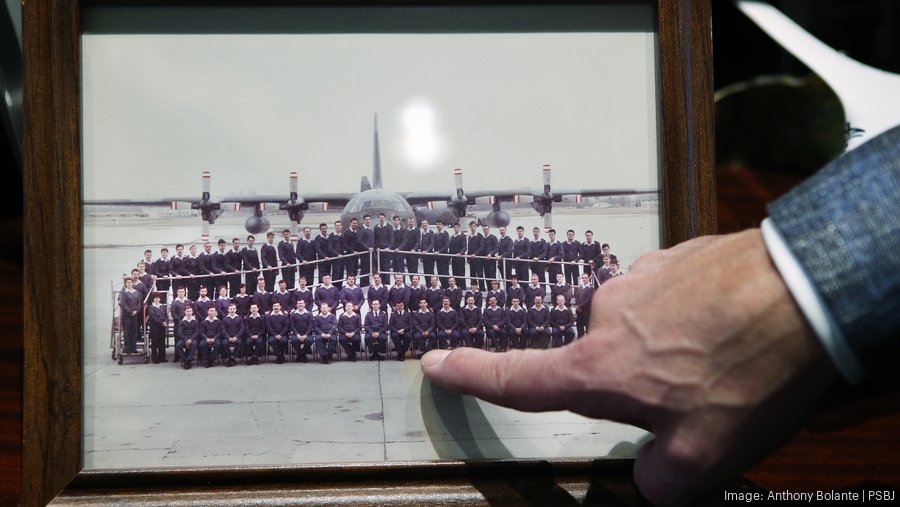
Alaska Airlines CEO Ben Minicucci points himself out in a photo of his time as a captain in the Royal Canadian Air Force where he led a maintenance squadron.
Anthony Bolante | PSBJ
He spent the next 14 years in the military, working on jets. After being deployed in the Persian Gulf War, Minicucci reenrolled in the Royal Military College of Canada, where he received a master’s degree in mechanical engineering.
When he left the military, it was against his father’s wishes. If he had stayed an extra six years, he would have qualified for the pension, and his dad begged him not to leave. But Air Canada had recruited him for its maintenance division, an opportunity Minicucci didn’t want to pass up.
“I said, ‘Dad — it’s an instinct, I think I could have a great career,’” he recalls.
‘Ben has proven himself’
Walking around Alaska Airlines’ campus in SeaTac, Minicucci greets employees like they’re old friends, including those he’s never met before. He will often approach them with a wave, flash a smile and stop to ask about what they do, how long they’ve been at Alaska and how they’re enjoying it.
If he feels like a central figure in Seattle, that’s because he’s been at the core of the growing airline for nearly a decade — even as it contended with one of its biggest crises of the 21st century.
In 2012, Delta Air Lines began to challenge Alaska’s dominance over Seattle customers. The airline was the largest in the country, and it wanted to use Seattle’s geographic proximity to Asia to add new international routes.
“I do think Alaska was caught flatfooted,” said Roger Nyhus, a consultant who advised Alaska at the time. “They had been the dominant carrier for many years, and I think they would admit that they took that status for granted. Delta started spending millions of dollars in the community.”
Related coverage
- Alaska hints at plans for new lounge at Sea-Tac Airport
- The airport lounge ‘arms race’ is just getting started
- Alaska Air backs $150 million investment in Gates-led green energy fund
- Alaska Airlines underway on ‘single largest construction project’ in its history
At the time, Alaska was the sixth-largest carrier in the country. It had built loyalty among Seattle customers but was known for its customer service, not a variety of offerings. The four major U.S. airlines were also exiting a rocky period of consolidation and looking to assert their strength.
And it wasn’t just Delta. Since 2012, monthly passenger totals at Sea-Tac Airport have nearly doubled, and the airport’s carriers have grown from 36 to 46. Airlines were trying to capitalize on the deep pockets of Seattle travelers.
Alaska responded by emphasizing its ties to the Pacific Northwest, Nyhus said. The carrier launched a campaign to tell the region Seattle was its home, a mantra Minicucci now emphasizes. Then, in 2016, Alaska acquired Virgin America, an airline with an extensive network in California.
Industry analysts said at the time that the deal transformed Alaska from a potential acquisition target to a national player, growing it to be the fifth-largest U.S. carrier and cementing its position on the West Coast.
 expand
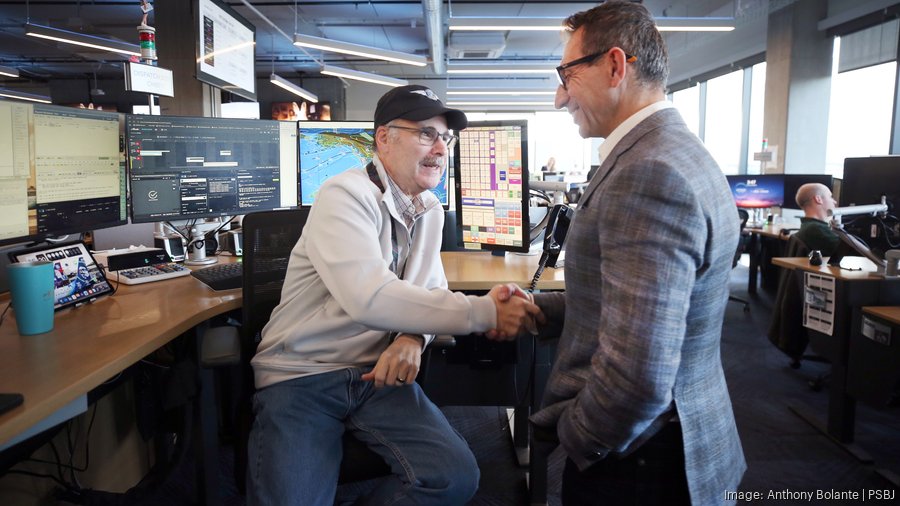
Chief dispatcher on duty Rick Jabusch, left, shakes hands with Alaska Airlines CEO Ben Minicucci in the bridge, or operations center, where dispatchers work to determine the safest and most efficient routes for aircraft to fly.
Anthony Bolante | PSBJ
Minicucci was appointed CEO of Virgin America during that transition. Part of his role at the time was to bring in about 3,500 employees from Virgin America, about 150 people at a time, to talk about the airline’s strength and how it meshed with Alaska.
Tilden, then CEO of Alaska, says he went to a few meetings. Minicucci went to all of them. By 2020, Alaska was operating smoothly, with the leadership of Minicucci. It had largely held its ground in Seattle after the push inward by Delta, though the Atlanta airline has added seven gates at Sea-Tac since 2014.
“Now is the time to position Alaska for future growth, and now is the time to move forward with this long-planned transition,” Tilden said in the announcement of Minicucci as his successor. “Ben has proven himself over a long career.”
Tilden says by 2019, company executives had already begun to think of Minicucci as his successor. But when the pandemic hit, operations froze. Revenue cratered by 97% over the span of a few months. Alaska executives said at the time they were in a better financial place than most airlines, confident they could withstand the crisis.
By November 2020, when its outlook began to stabilize, Alaska announced that Minicucci would succeed Tilden.
‘A new adventure’
After leaving the military, Minicucci had spent seven years at Air Canada, where he traded fighter jets for passenger planes. Beginning in 1997, he held various jobs in technical operations and worked his way up to vice president of aircraft maintenance.
And in 2000, Air Canada won a bidding war to acquire Canadian Airlines, positioning Minicucci’s new employer as the singular major air carrier for the Great White North and giving him a front-row seat to his first airline merger.
Airline mergers and acquisitions are often a tricky proposition, experts say. In recent years, regulatory approval has become harder to come by since less competition can often mean higher prices for consumers. There are efficiency and safety concerns that come with combining software and processes, not to mention the regulatory hurdles airlines have to clear to operate under one call sign.
If done successfully, acquisitions can fast-track airlines for growth, giving them quick access to new gates and airplanes. But if done incorrectly, any hiccups along the way can derail service and potentially send revenue tumbling, a concern for Wall Street in the hyper-competitive airline industry.
The Air Canada acquisition was no exception. The financials for Canadian Airlines were flubbed, so Air Canada had to declare some assets under bankruptcy. Integrating the overlapping workforces of the airlines also led to mass layoffs. Service was impacted, and it took Air Canada years to recover.
As the acquisition unfolded, Minicucci was living in Vancouver, British Columbia, having been put in charge of maintenance at the airline’s hubs in Vancouver, Winnipeg and Calgary. He had fallen in love with the West Coast and even run his first Iron Man in Vancouver a few years prior. But with the acquisition, Air Canada wanted to bring him back east.
His wife at the time wanted to stay out west. Their kids hadn’t started school yet. And then, Alaska Airlines called.
“A new adventure,” Minicucci recalls with a smile. “That was 22 years ago. I never looked back.”
 expand
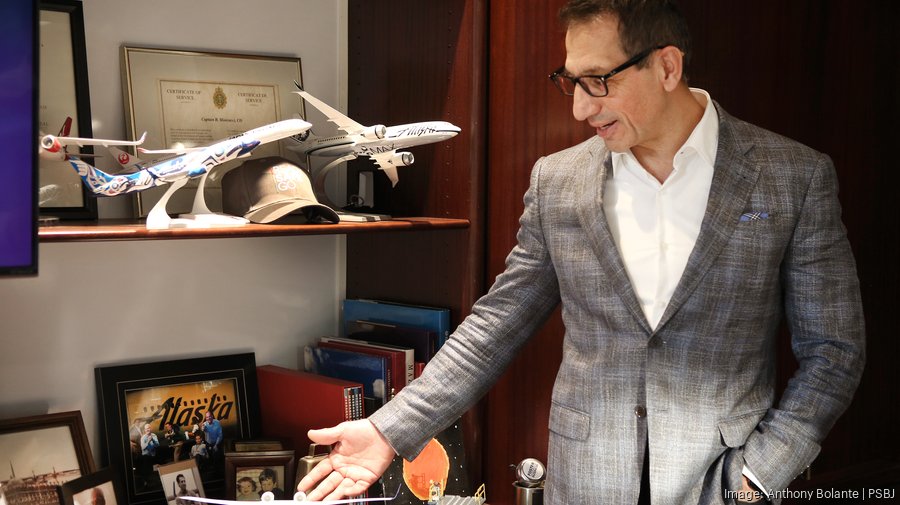
Minicucci points at a scale model of a futuristic delta-wing commercial aircraft with Alaska Airlines branding as he talks about the future of commercial air travel.
Anthony Bolante | PSBJ
Minicucci joined Alaska Airlines as the staff vice president of maintenance in 2004. That year, Alaska’s fleet was only 109 jets, the airline flew 16.3 million passengers and it had just five flights between Seattle and the East Coast.
Minicucci worked out of Seattle, where he quickly caught the attention of company executives for his focus on process, a practice that would come to define his career at Alaska.
“I think people pretty quickly — counting my predecessor, Bill Ayer — they saw that process focus, process orientation would really benefit us outside of maintenance,” former Alaska CEO Brad Tilden told the Business Journal. “So he took on a project to really clean up our Seattle operation.”
In the company mythos, Ayer was frustrated with slow operations at Sea-Tac Airport, Alaska’s primary hub. So, at a company retreat, Ayer asked who could smooth out the process. Minicucci raised his hand.
He started by breaking down its operations. How do you set the flight plan? How do you make sure the aircraft is fully fueled? After you land, how do you get the airplane to the gate? How do you get the door to open in 60 seconds? What needs to happen to get the bag to the carousel in 20 minutes?
Then he began to grade employees on scorecards to measure how well they were meeting that process. Lots of people got C’s, D’s and F’s, Tilden says. A few received A’s and B’s, but it took time to get everyone on the same page.
“There was always a twinkle in Ben’s eyes as he was doing this,” Tilden says.
Alaska became one of the fastest carriers in the country shortly after, according to reports by FlightStats, a title it has largely maintained in the years since. The effort burnished Minicucci’s reputation among Alaska’s executives, and at 43 years old, he was promoted to chief operating officer and executive vice president.
“I feel like a disciple from Ben,” says Jason Berry, who now serves as Alaska’s chief operating officer and executive vice president. “He taught me rigor and how to push and challenge and ask good questions to make sure we’re not missing a thing.”
About Alaska Air Group
- Headquarters: SeaTac
- Average daily flights: 1,500
- Routes: 37 U.S. states and 30 international cities in 12 countries
- Headcount: More than 30,000
- Fleet size: 407 aircraft
‘It’s about endurance’
When Minicucci took over Alaska in March 2021, one of his first priorities was extending the company’s investments in technology. Alaska has long had a focus on tech — it was the first airline to offer ticket purchasing online — and Minicucci extended that trend.
During his tenure, Alaska created an investment fund, named Alaska Star Ventures, to back startups providing technology aiding its operations. Since taking over, Alaska has invested in startups focused on green fuel, artificial intelligence and jet design.
“Under his leadership, our partnership has strengthened and become more innovative,” says Port of Seattle CEO Steve Metruck. “Together, we are working on ensuring that SEA is a world-class airport that expands regional economic opportunity.”
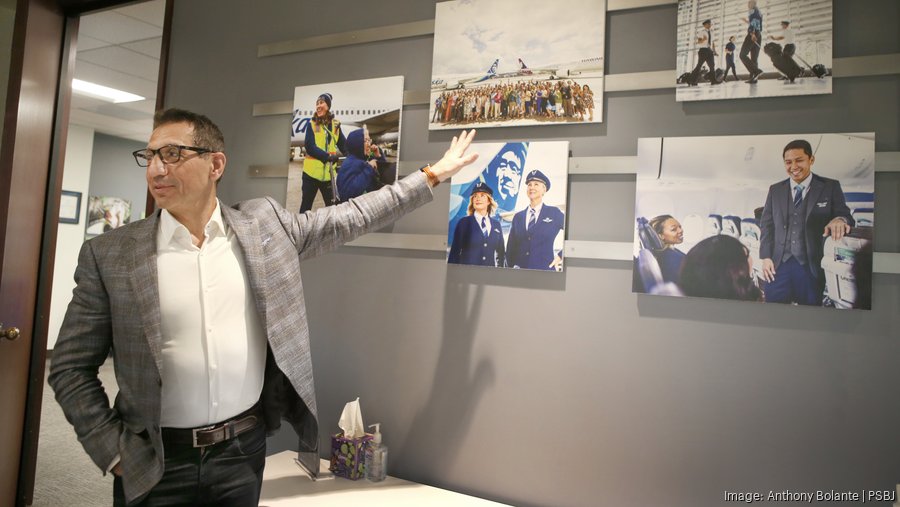 expand
Minicucci talks about photos in his office of Alaska Air staff at work at airports around the world.
Anthony Bolante | PSBJ
On Minicucci’s office shelf is a model plane from JetZero, a company designing planes with flat wings that use less fuel. Alaska participated in a $26 million Series A round for the company in 2024.
“We’re a technology company that flies people from A to B,” Minicucci says. “The technology piece we have to do extremely, extremely well, and that, for me, is going to be a huge area of focus.”
One of the largest technology challenges for Minicucci came this year, when two IT outages in July and October forced Alaska to ground its fleet. In doing so, Alaska lost more than $117 million. Minicucci announced he would bring in outside help to address the issue and hired Dublin-based professional services giant Accenture to look through its systems.
But those obstacles and investments are part of the normal day-to-day of an airline executive. In fact, many of Minicucci’s competitors are investing in similar tech. Minicucci wanted to make a splash. He wanted the airline to grow.
 expand
Alaska Airlines Chief Operating Officer Jason Berry, left, explains measures the airline took to mitigate an aviation fuel shortage stemming from a November leak in the 400-mile-long Olympic Pipeline that cut off the flow of fuel to Seattle-Tacoma International Airport shortly before Thanksgiving.
Anthony Bolante | PSBJ
Minicucci says he was in Hawaii when he closed the deal to buy Hawaiian Airlines, a $1.9 billion transaction that would change the future of the airline.
“We had looked at it before, and I always found reasons to not do it,” Tilden says. “So, it took me a few weeks to get my head around it, but I do really believe in it now.”
But many industry analysts raised their eyebrows at the acquisition. A few months earlier, the federal government had blocked JetBlue’s attempted acquisition of Spirit Airlines, upending the budget airline’s long-term strategy.
But Minicucci was confident. He had been through this before. And Alaska was emerging from the pandemic with a story to tell.
“There was very little overlap between us and Hawaiian,” Minicucci says. “The networks were very complementary, so it was good for customers. Customers in Hawaii now can connect with the massive Alaska network.”
It also created more competition in the market, Minicucci says, allowing Alaska to use Hawaiian’s gates and widebody planes to compete on long-haul routes with the country’s largest airlines.
In a presentation to investors in December 2024, Minicucci unveiled a three-year plan nicknamed “Alaska Accelerate” to expand cargo, add a new credit card, build new lounges in its West Coast hubs and add $800 million in revenue over the next three years.
If the previous decade was about defending the airline’s home turf, Minicucci appears ready to venture into new territory.
Still, he knows global competition won’t be easy. Shortly after Alaska announced it would add nonstop flights from Seattle to Rome in 2026, Delta unveiled its own nonstop routes to Rome and Barcelona, also set to begin in May.
“I tell my team, it’s about winning the series,” Minicucci says. “It’s about endurance, about being good for a long time, and we’re not going to win every game. The important thing is that we’re moving upward.”