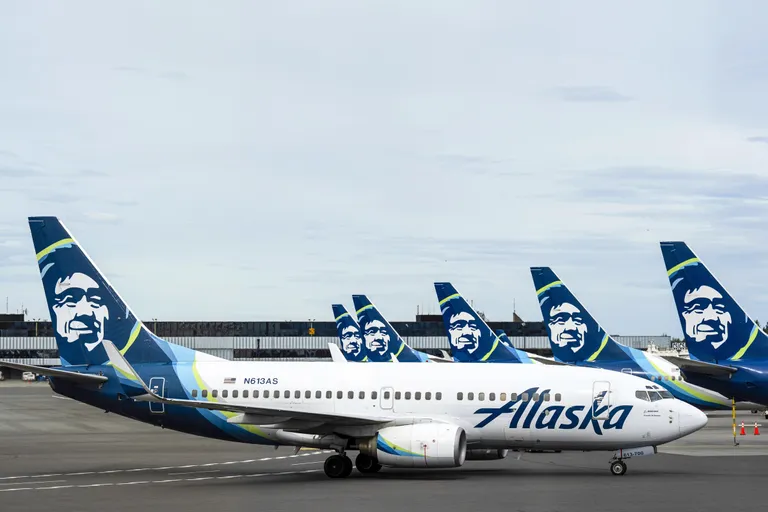
Alaska Airlines planes at the Ted Stevens Anchorage International Airport last summer in Anchorage. (Jae C. Hong / AP)
Seattle Times business reporter
After disappointing 2025 financial results, Alaska Air Group pointed to macroeconomic factors that were out of their control, pinning most of the blame on weakening consumer demand for travel.
Alaska’s competitors faced some of the same headwinds and saw their profits climb year over year. Alaska, though still profitable in 2025, saw its profits drop 70% compared with the year before. Despite the rocky results, Alaska executives are still optimistic about the carrier’s expansion plans, sticking to long-term vision to boost revenue, reach new customers and turn its hometown Seattle hub into a global gateway by 2030.
On a Friday call with investors, Alaska executives said an industrywide drop in demand contributed to their decreased earnings, while acknowledging Alaska-specific issues such as “friction” in integrating the newly acquired Hawaiian Airlines and high real estate costs as the carrier expands.
“Last year was a year of transformation where we laid the groundwork for the next chapter of Alaska Air Group,” CEO Ben Minicucci told investors Friday. “It did not come without growing pains.”
Alaska Air Group — which includes Alaska and Hawaiian Airlines, as well as regional carrier Horizon Air and ground support company McGee Air Services — saw profits drop 74% in 2025 compared with the year prior, from $395 million to $100 million.
For the fourth quarter, which ended in December, profits dropped 70% year over year, from $71 million to $21 million.
Delta, meanwhile, saw a 44% jump in profit from 2024 to 2025, while United saw a nearly 7% increase.
All three carriers saw revenue growth, with Alaska increasing full-year operating revenue 21% compared with 2024, while United reported 3.5% growth and Delta 2.8%.
How does Alaska compare to its competitors?
Alaska, Delta and United, all saw revenue growth in 2025. But Alaska’s profits dropped while Delta and United grew.
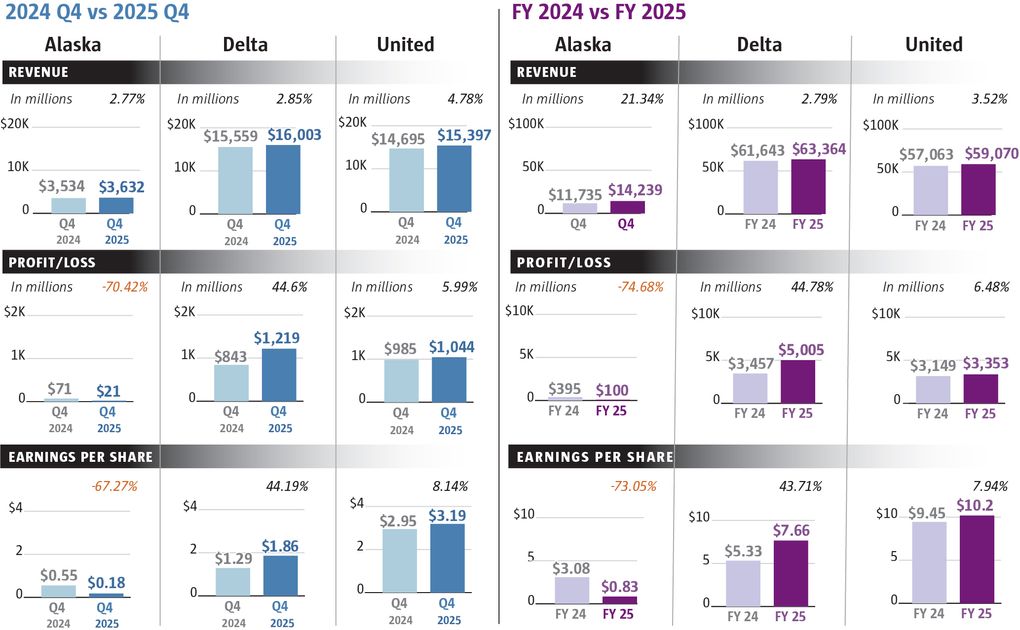
Sources: Alaska Air Group, Delta Air Lines, United Airlines (Reporting by Lauren Rosenblatt, graphic by Mark Nowlin / The Seattle Times)
In an interview ahead of the earnings release Thursday, Alaska’s head of investor relations Ryan St. John said the biggest factor in Alaska’s 2025 results was a slump in demand that started in February and continued into the summer travel season.
Demand picked up again in the second half of the year, with a temporary slowdown in the fall during the government shutdown and resulting mandate to cut flights. Since then, St. John said, demand has continued to rebound this year, with Alaska recording some of its highest booking days in its history this month.
On Friday, Alaska executives again attributed much of the year’s performance to economic factors out of their control. On top of the change in demand, company leaders focused on volatile fuel prices on the West Coast, where there are few refineries available to provide the jet fuel carriers need. Seattle-Tacoma International Airport felt that firsthand in November, when a leak in the Olympic Pipeline forced airlines to turn to contingency plans to make sure flights kept operating smoothly.
For Alaska, a 10-cent change in fuel prices can result in a 75-cent change for the carrier’s earnings per share, Chief Financial Officer Shane Tackett said.
“We really need the West Coast refineries to stabilize. They just are not up and operating consistently enough,” Tackett said.
The airline is planning to work with communities and federal agencies to “smooth out” the issues with existing refineries and find new ways to bring more fuel to the West Coast, Tackett continued. But it would take a few years to get that initiative in place.
Alaska’s full year financial results included about $100 million of “transient ” costs that won’t occur in future quarters, Tackett told investors. He pointed to market labor agreements and increased real estate costs incurred as Alaska expands.
“Real estate costs continue to be the highest costs,” Tackett said. “All the investments that were necessary but being made in the core hubs, there is a cost reality that comes with that.”
All of the Alaska executives who spoke with The Seattle Times and with investors this week said the company has successfully integrated Hawaiian Airlines into its operations this year, checking several major milestones off its to-do list after completing its acquisition in September 2024.
But Chief Commercial Officer Andrew Harrison acknowledged Friday that the acquisition introduced some challenges that affected the company’s 2025 results.
“2025’s progress was slowed by macroeconomic challenges, and integration friction,” he said.
Most of the heavy lifting is now complete, Alaska said, including launching a joint loyalty program and receiving a single operating certificate from the Federal Aviation Administration. Alaska is still in the midst of transitioning to a single booking platform, but has already started using the new system to book future flights. In April, it will finalize the transition.
This year, Alaska also faced two significant IT outages caused by failures in the company’s data centers. In October, after the second disruptive outage, it hired consulting firm Accenture to evaluate its IT infrastructure.
On Friday, Minicucci and Tackett said the airline is investing in more resiliency and redundancy to its systems to prevent another breakdown.
“We’re making headway,” Tackett said. “We’ve got a lot of detailed plans ready to execute in the first quarter. We spent a good amount of time in the fourth quarter understanding what we need to do.”
The company has included those IT investments in its projections for 2026, Tackett said.
Alaska issued a wide range of guidance for next year — expecting earnings per share for the full year somewhere between $3.50 and $6.50. That’s a steep jump from 2025, which saw 18 cents earnings per share.
Facing several questions from analysts about that expansive range, Alaska leaders said they’ve baked in room for another year of economic pressures.
The best-case scenario assumes Alaska continues to reap rewards of its merger with Hawaiian and eliminates the one-time costs it faced this year. The worst-case scenario factors in another “deceleration” of demand and high fuel prices.
“Change can occur quickly in either direction,” Tackett said.
Analysts from JPMorgan Chase agree the airline faced external pressure in 2025 and is prepared to turn it around this year, they wrote in a note to investors Friday.
“There’s little doubt 2026 is starting off on the right foot,” the analysts wrote. “In Alaska’s case, their conservatism appears to be driven more by, well, conservatism … likely shaped by the tumultuous year the industry just experienced.”
Lauren Rosenblatt: 206-464-2927 or lrosenblatt@seattletimes.com. Lauren Rosenblatt is a Seattle Times business reporter covering Boeing and the aerospace industry.