TagStART(267)
-
KLane BU Presentation on Aviation Emisions 8 25 2021
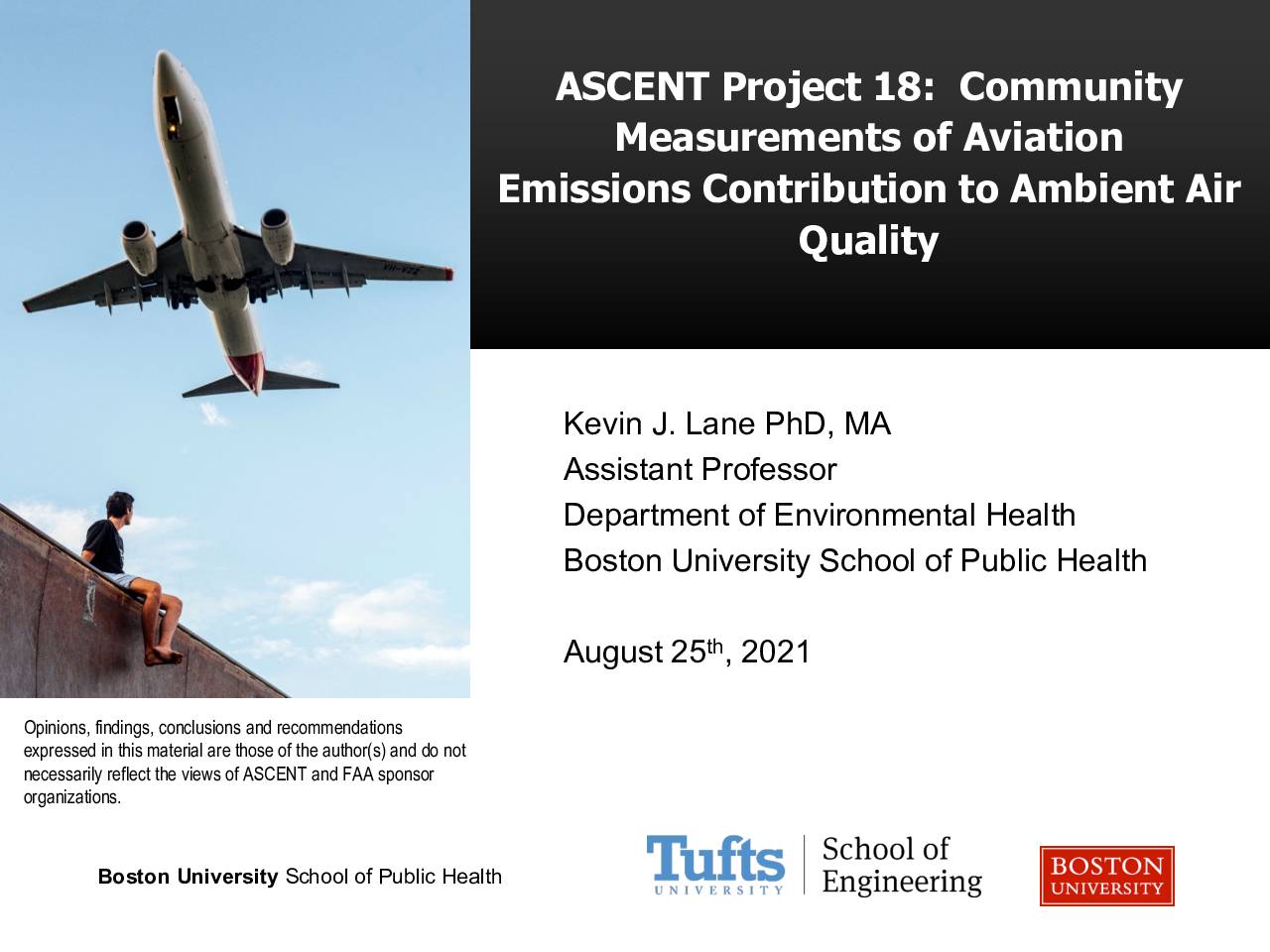
expressed in this material are those of the author(s) and do not necessarily reflect the views of ASCENT and FAA sponsor organizations. Kevin J. Lane PhD, MA Assistant Professor Department of Environmental Health Boston University School of Public Health August 25th, 2021 Boston University Slideshow Title Goes Here Boston University School of Public Health Aviation Activities Activities involving flying aircraft A number of social and economic benefits Fastest growing transportation mode Environmental and public health concerns Boston University Slideshow Title Goes Here Boston University School of Public Health Background Ultrafine particulate matter: Particles < 100 nm in aerodynamic diameter Typically combustion products Large reactive surface area Limited removal in lung Potential to translocate effects beyond respiratory system Epidemiological evidence fairly limited 10 years ago, growing rapidly Ohlwein 2019: 85 studies 2011-2017, including long-term studies Boston University Slideshow Title Goes Here Boston University School of Public Health Particle Matter Pollution Measured as Particle Number Concentration (PNC – particles/cm3) Boston University Slideshow Title Goes Here Boston University School of Public Health UFP Health Effects: Cardiovascular • Increases in biomarkers of inflammation related to cardiovascular disease (Lane et al. 2016; Devlin et al. 2014) • Changes in heart rhythm and vasomotor function (Vora et al. 2014) • Decreased microvascular function (Karottki et al. 2014) • Recurrent myocardial infarction (Wolf et al. 2015) • Systolic blood pressure and hypertension (Corlin et al. 2018), though with mixed evidence (Magalhaes et al. 2018) •… -
DRAFT Runway Use LOA
Seattle Terminal Radar Approach Control (S46), Seattle Air Traffic Control Tower (SEA) and Port of Seattle (POS) DRAFT LETTER OF AGREEMENT EFFECTIVE: (___, 2019) SUBJECT: Informal Runway Use Program 1. PURPOSE: To establish the Noise Abatement Informal Runway Use Program for the Seattle- Tacoma International Airport (KSEA). This program has been established by the Port of Seattle (POS) and is administered by the Federal Aviation Administration (FAA) at Seattle Terminal Radar Approach Control (S46) and Seattle Air Traffic Control Tower (SEA). The goal of this informal runway use program is to establish a clear understanding of the preferred way in which all of the runways will be used in various operating conditions. However, it is not intended that the program described herein would restrict operations or adversely discriminate against any user. Deviations from specified runway use may be necessary because of emergencies, weather, traffic volume, airport construction, or maintenance work. Under these circumstances, runway selection will be in accordance with FAA Orders 7110.65 and 8400.9. 2. SCOPE: The policy outlined herein provides for the preferential arrival and departure usage of each runway at KSEA. This voluntary program applies to all turbojet aircraft weighing 12,500 pounds or more. The program that is described herein shall be utilized to the maximum extent possible whenever wind, weather, traffic density, controller workload, equipment, operations and field conditions and other considerations permit. 3. RESPONSIBILITIES: POS, S46 and SEA must ensure that all appropriate personnel are briefed on this voluntary program. The FAA reserves the right… -
Air Traffic Briefing Presentation 180821
– SEA is slotted to receive Wake Turbulence Recategorization in October 2018. • Minimal foreseen impact to AAR/ADR due to fleet mix. – Glide Slope angle on 34R of 2.75 degrees was the industry standard when created • Still within current standards of 2.5 – 3 degrees Federal Aviation Administration Four Post System Federal Aviation Administration Four Post System Federal Aviation Administration Four Post System Federal Aviation Administration Fleet Mix Changes In 2005, turboprops accounted for 33% of the aircraft operating at SEA. In 2017, the percentage of turboprop aircraft was 17%. The percentage of aircraft classified as “heavy” have also increased during this timeframe. Federal Aviation Administration SEA Traffic Counts • 1998 – 407,597 • 1999 – 433,660 • 2000 – 445,677 (steady drop 2001 to 2012) • 2012 – 309,597 • 2016 – 412,170 • 2017 – 416,136 (10% increase year over year 2013-2016) • 2018 – projected – 435,000, about 1999 numbers Federal Aviation Administration Thank you. -
Airlines4America Heimlich StART 28Apr2021
John P. Heimlich, Vice President & Chief Economist Presentation to SEA Stakeholder Advisory Round Table April 28, 2021 The Long Climb Out Is Underway Airlines for America (A4A) Members and Mission Founded in 1936 A4A advocates on behalf of its members to shape crucial policies and measures that promote safety, security and a healthy U.S. airline industry. We work collaboratively with airlines, labor, Congress, the Administration and other groups to improve aviation for the traveling and shipping public. » Airlines and airports have taken unprecedented steps to ensure the safety of our employees and customers. » Domestic and short-haul-international leisure / visiting-friends-and-relatives activity are leading the recovery. » Air cargo continues to build on records set in 2020 and has proven a critical source of income. » Bookings for future air travel remain depressed, particular to those traveling for business purposes. » Large losses in 2021 will compound the record losses incurred in 2020, resulting in massive amounts of debt. » Sea-Tac is closer than most of its peers to restoring pre-pandemic levels of scheduled air service. » 2019 systemwide passenger totals won’t return until 2023-2024—but will arrive much sooner at some airports. » Most airlines are now operating smaller fleets, with one-third fewer twin-aisle aircraft. » Despite a nearly five-fold increase in passengers, commercial aviation reduced its U.S. noise footprint 94% from 1975-2019 and accounts for just 2% of U.S. GHG emissions—and is committed to further improvements. » Historically, every U.S. airline job helps support an estimated nine U.S.… -
201210 Fed Policy Work Grp Meeting summary
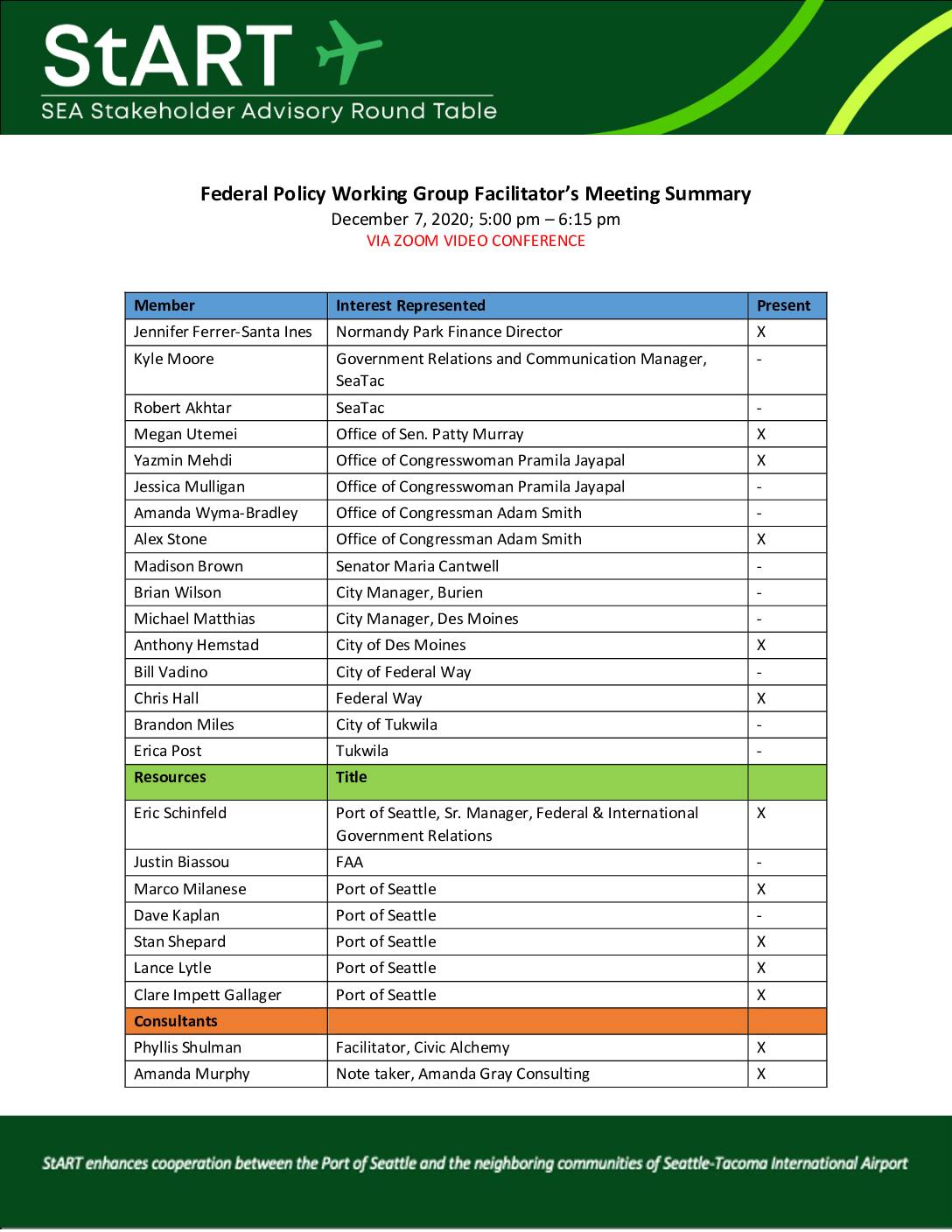
Federal Policy Working Group Facilitator’s Meeting Summary December 7, 2020; 5:00 pm – 6:15 pm VIA ZOOM VIDEO CONFERENCE Member Interest Represented Present Jennifer Ferrer-Santa Ines Normandy Park Finance Director X Kyle Moore Government Relations and Communication Manager, SeaTac - Robert Akhtar SeaTac - Megan Utemei Office of Sen. Patty Murray X Yazmin Mehdi Office of Congresswoman Pramila Jayapal X Jessica Mulligan Office of Congresswoman Pramila Jayapal - Amanda Wyma-Bradley Office of Congressman Adam Smith - Alex Stone Office of Congressman Adam Smith X Madison Brown Senator Maria Cantwell - Brian Wilson City Manager, Burien - Michael Matthias City Manager, Des Moines - Anthony Hemstad City of Des Moines X Bill Vadino City of Federal Way - Chris Hall Federal Way X Brandon Miles City of Tukwila - Erica Post Tukwila - Resources Title Eric Schinfeld Port of Seattle, Sr. Manager, Federal & International Government Relations X Justin Biassou FAA - Marco Milanese Port of Seattle X Dave Kaplan Port of Seattle - Stan Shepard Port of Seattle X Lance Lytle Port of Seattle X Clare Impett Gallager Port of Seattle X Consultants Phyllis Shulman Facilitator, Civic Alchemy X Amanda Murphy Note taker, Amanda Gray Consulting X -
201209 StART Meeting Recap
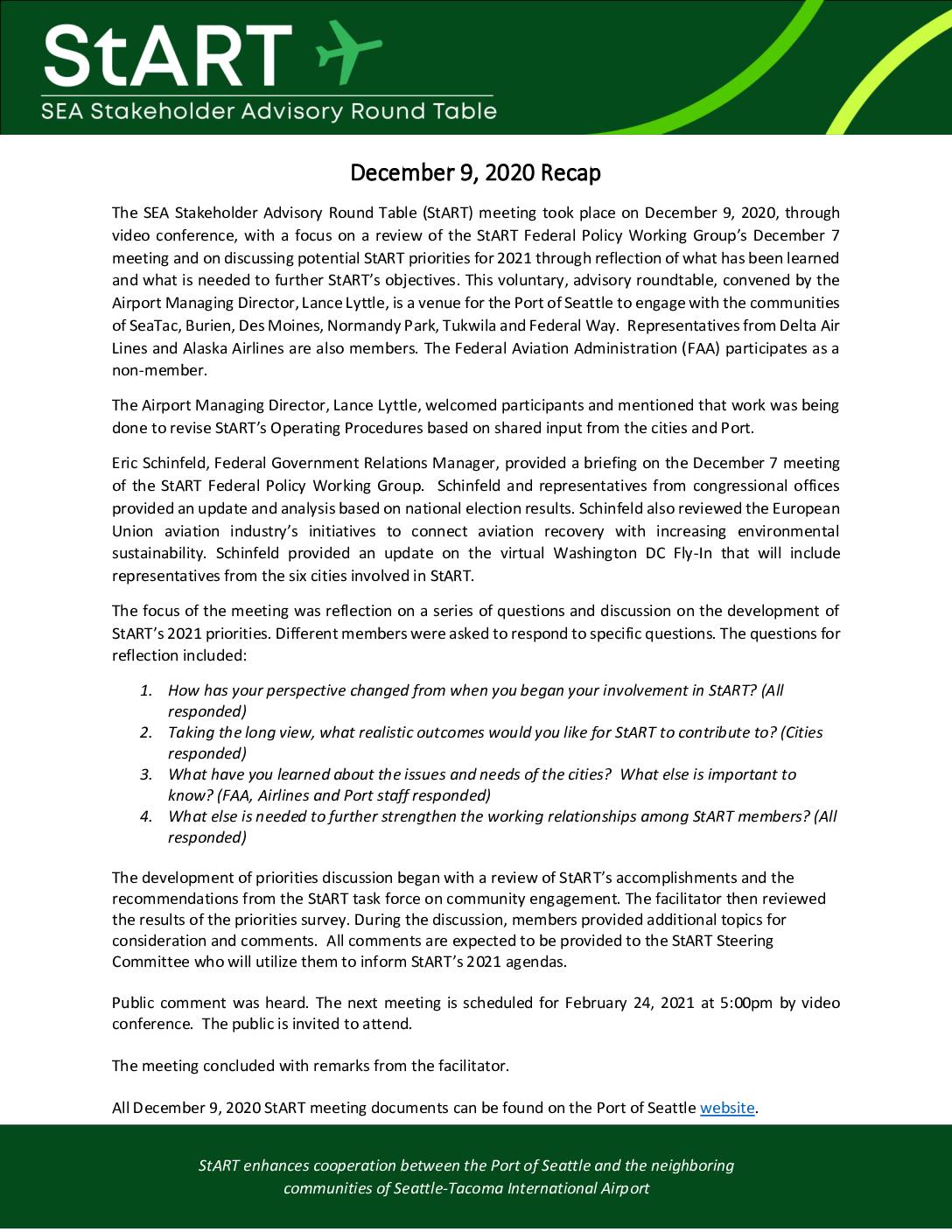
StART enhances cooperation between the Port of Seattle and the neighboring communities of Seattle-Tacoma International Airport December 9, 2020 Recap The SEA Stakeholder Advisory Round Table (StART) meeting took place on December 9, 2020, through video conference, with a focus on a review of the StART Federal Policy Working Group’s December 7 meeting and on discussing potential StART priorities for 2021 through reflection of what has been learned and what is needed to further StART’s objectives. This voluntary, advisory roundtable, convened by the Airport Managing Director, Lance Lyttle, is a venue for the Port of Seattle to engage with the communities of SeaTac, Burien, Des Moines, Normandy Park, Tukwila and Federal Way. Representatives from Delta Air Lines and Alaska Airlines are also members. The Federal Aviation Administration (FAA) participates as a non-member. The Airport Managing Director, Lance Lyttle, welcomed participants and mentioned that work was being done to revise StART’s Operating Procedures based on shared input from the cities and Port. Eric Schinfeld, Federal Government Relations Manager, provided a briefing on the December 7 meeting of the StART Federal Policy Working Group. Schinfeld and representatives from congressional offices provided an update and analysis based on national election results. Schinfeld also reviewed the European Union aviation industry’s initiatives to connect aviation recovery with increasing environmental sustainability. Schinfeld provided an update on the virtual Washington DC Fly-In that will include representatives from the six cities involved in StART. The focus of the meeting was reflection on a series of questions and discussion… -
201028 StART Meeting Recap
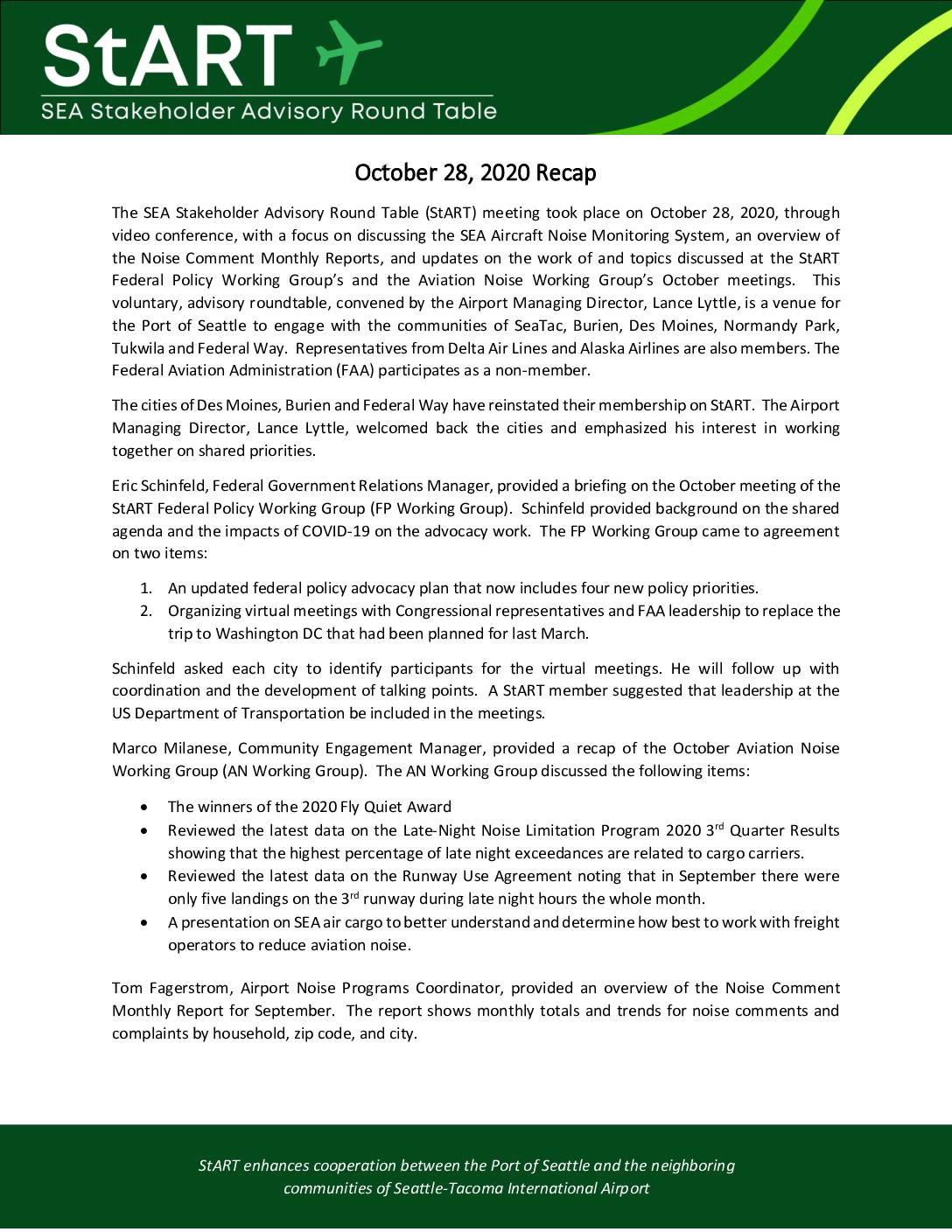
StART enhances cooperation between the Port of Seattle and the neighboring communities of Seattle-Tacoma International Airport October 28, 2020 Recap The SEA Stakeholder Advisory Round Table (StART) meeting took place on October 28, 2020, through video conference, with a focus on discussing the SEA Aircraft Noise Monitoring System, an overview of the Noise Comment Monthly Reports, and updates on the work of and topics discussed at the StART Federal Policy Working Group’s and the Aviation Noise Working Group’s October meetings. This voluntary, advisory roundtable, convened by the Airport Managing Director, Lance Lyttle, is a venue for the Port of Seattle to engage with the communities of SeaTac, Burien, Des Moines, Normandy Park, Tukwila and Federal Way. Representatives from Delta Air Lines and Alaska Airlines are also members. The Federal Aviation Administration (FAA) participates as a non-member. The cities of Des Moines, Burien and Federal Way have reinstated their membership on StART. The Airport Managing Director, Lance Lyttle, welcomed back the cities and emphasized his interest in working together on shared priorities. Eric Schinfeld, Federal Government Relations Manager, provided a briefing on the October meeting of the StART Federal Policy Working Group (FP Working Group). Schinfeld provided background on the shared agenda and the impacts of COVID-19 on the advocacy work. The FP Working Group came to agreement on two items: 1. An updated federal policy advocacy plan that now includes four new policy priorities. 2. Organizing virtual meetings with Congressional representatives and FAA leadership to replace the trip to Washington… -
201012 StART Av Noise Working Group Agenda
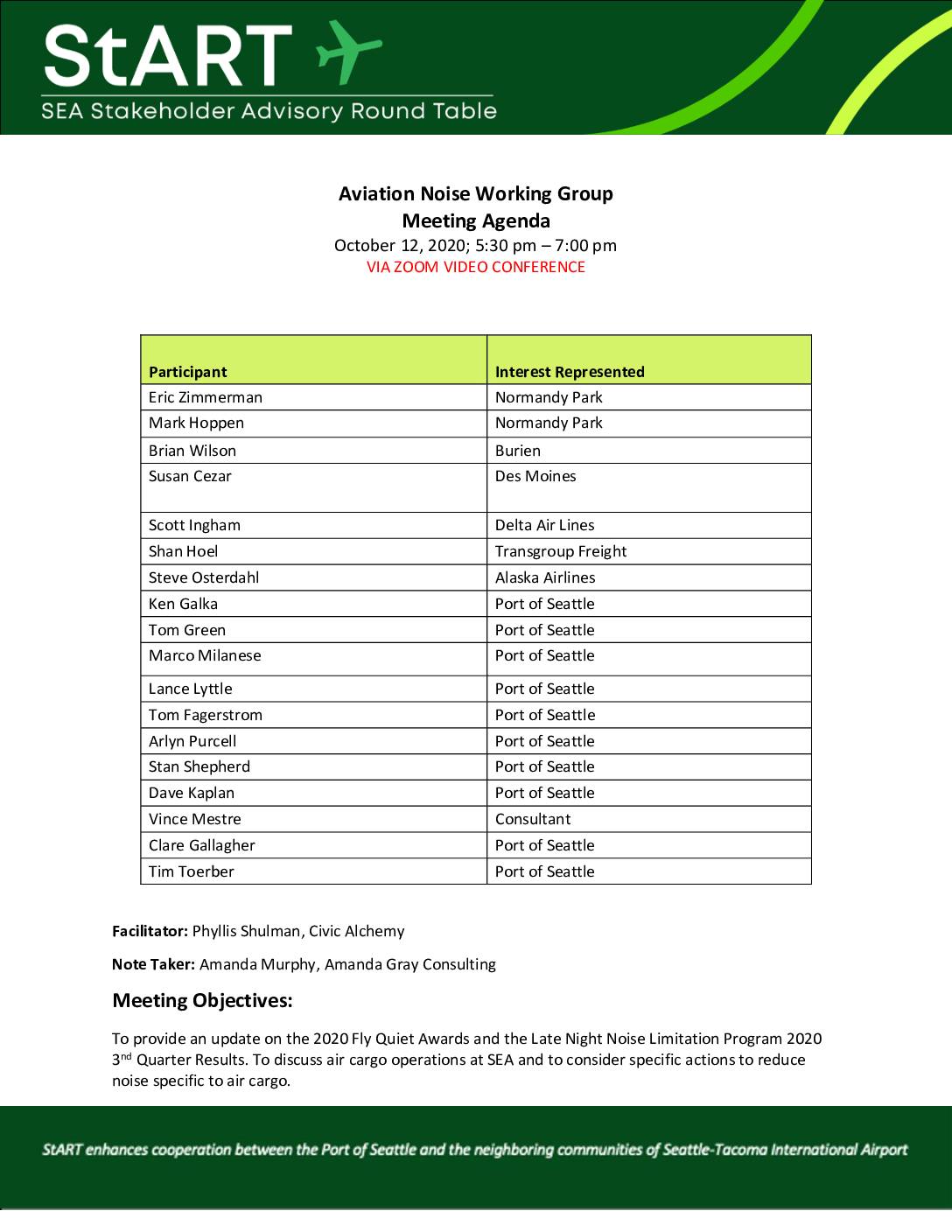
Note Taker: Amanda Murphy, Amanda Gray Consulting Meeting Objectives: To provide an update on the 2020 Fly Quiet Awards and the Late Night Noise Limitation Program 2020 3nd Quarter Results. To discuss air cargo operations at SEA and to consider specific actions to reduce noise specific to air cargo. StART Facilitator’s Meeting Summary October 12, 2020 Meeting Summary Noise Monitoring Stan Shepherd, Port of Seattle Shepherd commented that there has been community interest in understanding the reliability of the airport’s noise monitoring system. To respond to this interest, Port staff are developing a report that provides a variety of information regarding noise monitoring. He asked for feedback about the value of this type of report. Participants stated that they wanted to ensure the monitors are calibrated accurately and are operating correctly, which was one of the reasons stated to provide this report. It was stated that it would be helpful to have the report posted on the Port’s website. 2020 Fly Quiet Awards Tom Fagerstrom, Port of Seattle Fagerstrom explained how every year the Port presents three awards – judged using three criteria: • Noise levels of take offs and landings using four monitors • Adherence levels to the Noise Abatement flight procedures • Adherence to the ground maintenance engine run up regulations • And beginning in 2021, a forth category connected to the number of late-night noise exceedances Winning airlines are publicly acknowledged by the Port Commission and with a press release, advertisements, banners in the main terminal, and… -
201005 StART Meeting Presentation 02 0
View menu > Slide Master. When master slide view opens, select the image, then choose Change Picture in the Picture Format menu. Navigate to the image you wish to use and click Insert. You may need to use Send to Back if the image inserts in front of the text/artwork. Photos should be at least 15”h x 26.67”w. To adjust size and placement of the image, select the Crop tool in the Picture Format menu. The round handles are used to adjust the image inside the solid black lines of the box. Hold down the Shift key as you resize to keep the image undistorted. Permanent Monitoring System SEA Noise Monitoring System • 24 permanent monitors located in close-in communities surrounding SEA, or in locations generally north and south of the runways near a departure or arrival flight path. • System was upgraded in 2015 • Larson Davis 831 • Close-in monitors are sited north and south to capture noise events to and from each of the 3 runways. • Aircraft noise event data is gathered and shared on a monthly basis via the Port’s Noise Programs website. Monitor Locations Flight Tracking System – EnvironmentalVue • Record of all flights that occurred at SEA • Same radar data feed the FAA uses • Historic record of flight details • Altitude • Aircraft Type • Location • Speed • Airline • Flight tracks are correlated with likely noise events • Non-correlated noise is identified as community Noise Monitoring Data The purpose… -
200819 SAMP NTP EnvrReview Schedule for StART
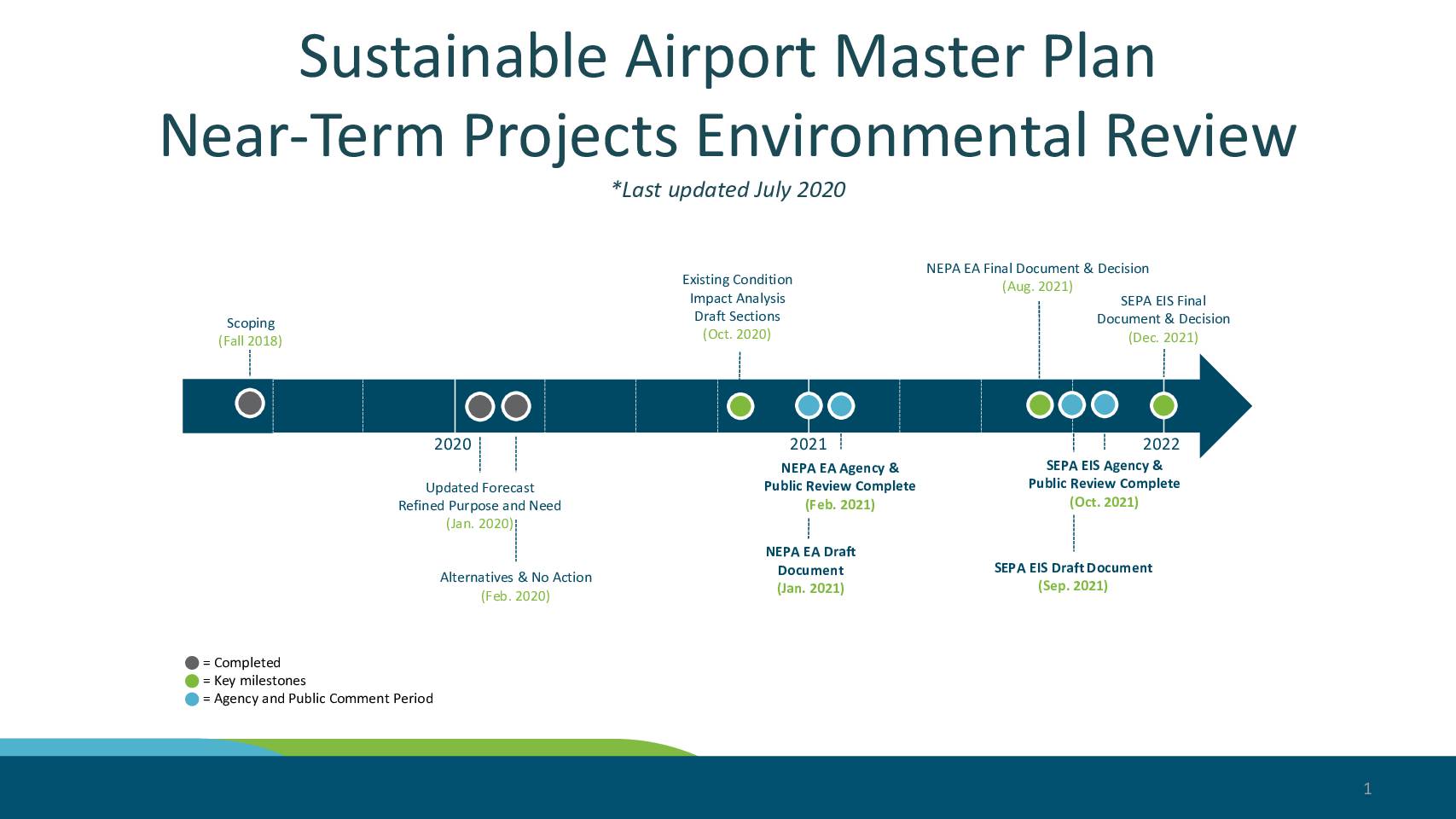
Sustainable Airport Master Plan�Near-Term Projects Environmental Review �*Last updated July 2020