TagRCAA(175)
-
-
ACC Statement On Port
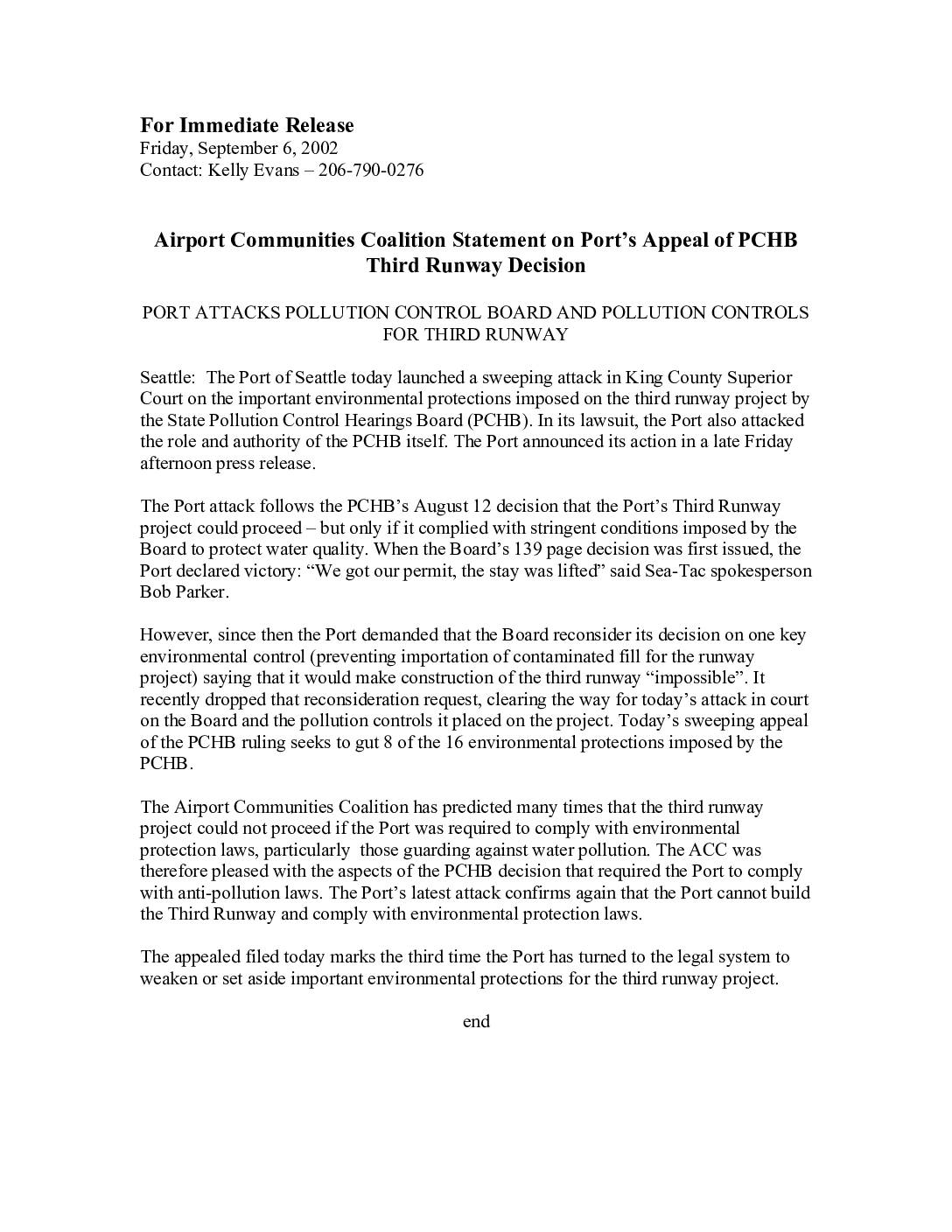
Airport Communities Coalition Statement on Port’s Appeal of PCHB Third Runway Decision PORT ATTACKS POLLUTION CONTROL BOARD AND POLLUTION CONTROLS -
PCHB Decision 8 2002
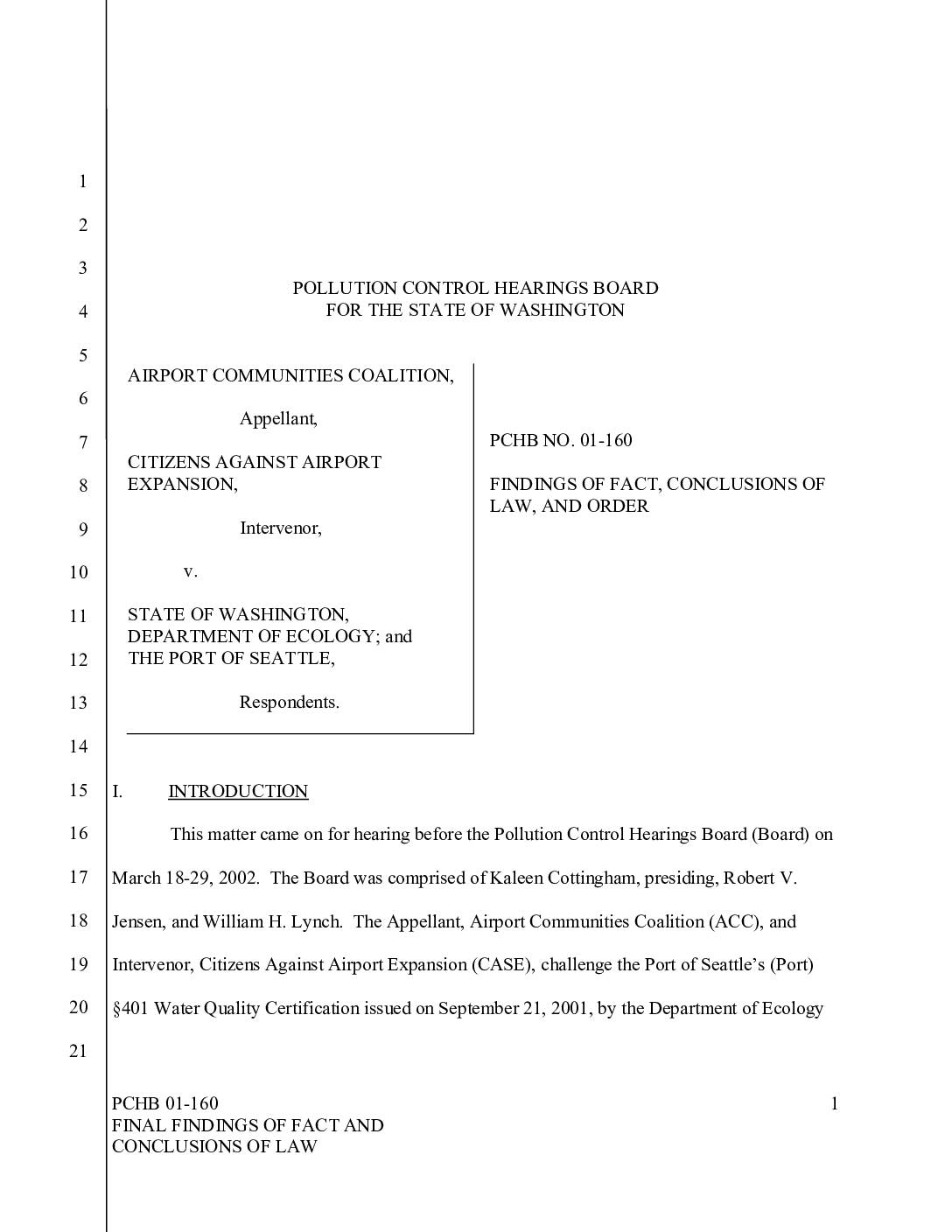
March 18-29, 2002. The Board was comprised of Kaleen Cottingham, presiding, Robert V. Jensen, and William H. Lynch. The Appellant, Airport Communities Coalition (ACC), and Intervenor, Citizens Against Airport Expansion (CASE), challenge the Port of Seattle’s (Port) -
Sea-Tac NPDES Draft Permit – 2005
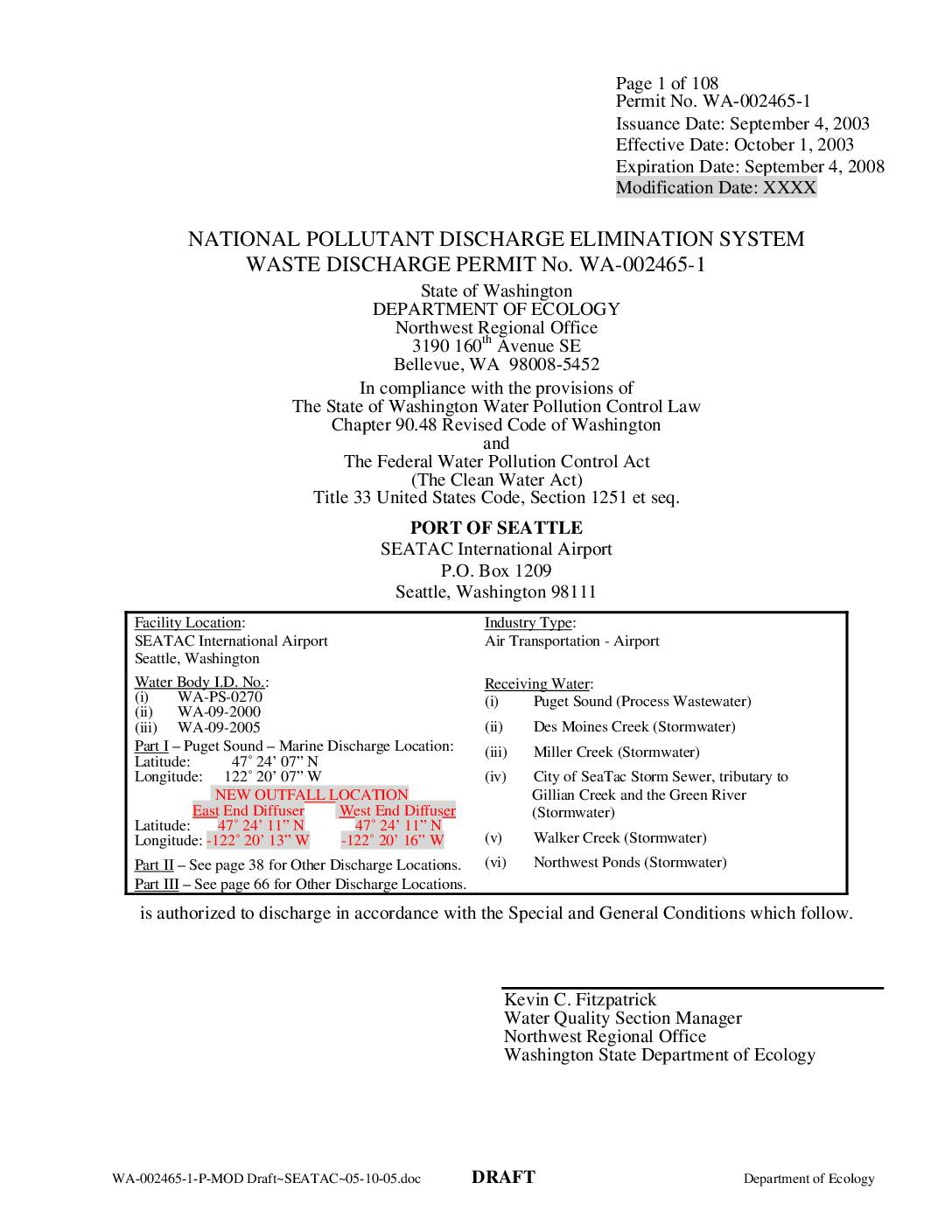
Title 33 United States Code, Section 1251 et seq. PORT OF SEATTLE SEATAC International Airport P.O. Box 1209 Seattle, Washington 98111 Facility Location: SEATAC International Airport Seattle, Washington Industry Type: Air Transportation - Airport Water Body I.D. No.: (i) WA-PS-0270 (ii) WA-09-2000 (iii) WA-09-2005 Part I – Puget Sound – Marine Discharge Location: Latitude: 47˚ 24’ 07” N Longitude: 122˚ 20’ 07” W NEW OUTFALL LOCATION East End Diffuser West End Diffuser Latitude: 47˚ 24’ 11” N 47˚ 24’ 11” N Longitude: -122˚ 20’ 13” W -122˚ 20’ 16” W Part II – See page 38 for Other Discharge Locations. Part III – See page 66 for Other Discharge Locations. Receiving Water: (i) Puget Sound (Process Wastewater) (ii) Des Moines Creek (Stormwater) (iii) Miller Creek (Stormwater) (iv) City of SeaTac Storm Sewer, tributary to Gillian Creek and the Green River (Stormwater) (v) Walker Creek (Stormwater) (vi) Northwest Ponds (Stormwater) is authorized to discharge in accordance with the Special and General Conditions which follow. -
Sea-Tac NPDES Fact Sheet Addendum – 2005
of Seattle (Port) on September 4, 2003. The permit was appealed and, following a hearing, the Pollution Control Hearings Board (PCHB or Board) issued its Findings of Fact, Conclusions of Law and Order (Order) on October 18, 2004. In the Order, the PCHB remanded the permit and required the Department to address several shortcomings in the permit. This Fact Sheet Addendum contains the basis for the changes proposed to be made in the permit as a result of the PCHB’s Order. REQUIREMENTS SET FORTH BY POLLUTION CONTROL HEARINGS BOARD The Board required the Department to address the following aspects of the permit on remand: • Department must include AKART requirements in permit and incorporate interim limitations on wastewater from Industrial Wastewater System: The PCHB directed the Department to evaluate two alternatives for compliance with the AKART requirement set forth under state law for contaminated wastewater collected in the Port’s Industrial Wastewater System (IWS): o Discharge of all of deicing contaminated wastewater to King County’s Publicly Owned Treatment Works (POTW), and o Separation of high strength glycol streams, combined lagoon aeration. The PCHB stated that the AKART analysis should also incorporate consideration of whether the permit should contain a limit on total pounds of BOD discharged into Puget Sound. The PCHB’s Order requires the Department to require the Port to implement AKART as soon as possible, and to include interim limits for BOD in the permit, as well as any other nonconstruction measures to achieve water quality criteria. • Department must… -
2006 Tia Feb
Truth In Aviation, Newsletter of the Regional Commission on Airport Affairs--Feb, 2006 Feb 14, 2006 Vol. 14, No. 1 Dept. of Ecology Reports Eight Violations of Water Quality Rules At Sea-Tac in Two-Month Period According to the Department of Ecology, Port of Seattle contractors violated the water-quality rules for Sea-Tac Airport on eight different occasions between 13 October & December. The results were discharges of muddy or contaminated water into Lake Reba, Miller Creek, Walker Creek, & the wetlands of Walker Creek. Most of the violations happened at the third-runway site. ...more RCAA Calls for Co-operative Efforts To Prevent Water-Quality Violations At Third-Runway Construction Site The Regional Commission on Airport Affairs has called for fast action by Sea-Tac Airport and the Department of Ecology to prevent additional environmental damage to local streams & wetlands from side effects of Airport construction. ...more Are Fines Enough? Ecology Calls For More Action by Port of Seattle Fines totaling $101,000 have been assessed against the Port of Seattle for the water-quality violations that are detailed in other places in this newsletter. But is the fear of fines a sufficient incentive to prevent future violations? The Department of Ecology apparently thinks not. ...more Port of Seattle Not Happy With Construction Problems Port of Seattle officials have sent mixed messages about the recent series of water-quality violations at Sea-Tac. Deputy Airport director Michael Feldman was quoted by the Seattle Times as saying “When we have these kind of incidents, I think they [the communities] have every… -
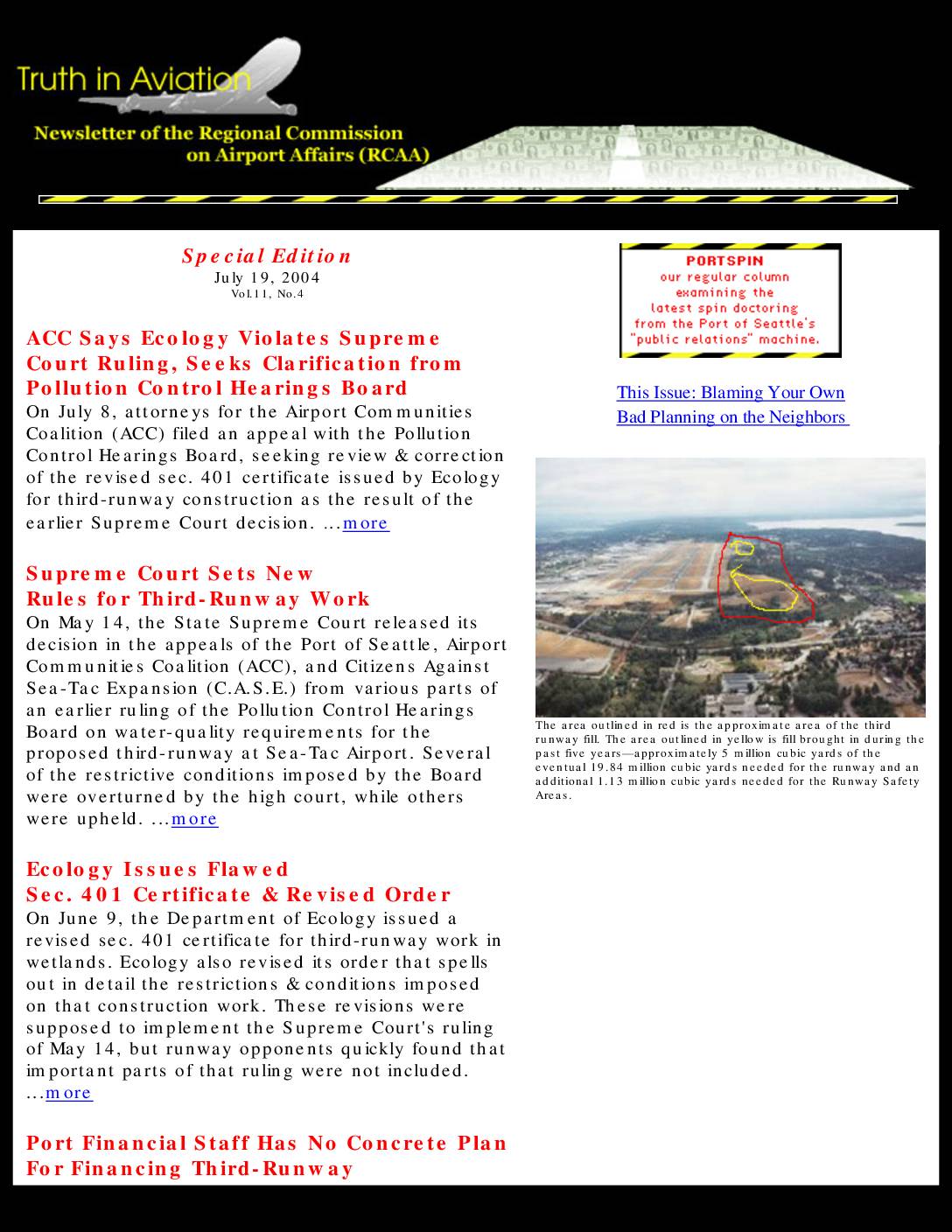
2004 Tia July 19
On July 8, attorneys for the Airport Communities Coalition (ACC) filed an appeal with the Pollution Control Hearings Board, seeking review & correction of the revised sec. 401 certificate issued by Ecology for third-runway construction as the result of the earlier Supreme Court decision. ...more Supreme Court Sets New Rules for Third-Runway Work On May 14, the State Supreme Court released its decision in the appeals of the Port of Seattle, Airport Communities Coalition (ACC), and Citizens Against Sea-Tac Expansion (C.A.S.E.) from various parts of an earlier ruling of the Pollution Control Hearings Board on water-quality requirements for the proposed third-runway at Sea-Tac Airport. Several of the restrictive conditions imposed by the Board were overturned by the high court, while others were upheld. ...more Ecology Issues Flawed Sec. 401 Certificate & Revised Order On June 9, the Department of Ecology issued a revised sec. 401 certificate for third-runway work in wetlands. Ecology also revised its order that spells out in detail the restrictions & conditions imposed on that construction work. These revisions were supposed to implement the Supreme Court's ruling of May 14, but runway opponents quickly found that important parts of that ruling were not included. ...more Port Financial Staff Has No Concrete Plan For Financing Third-Runway This Issue: Blaming Your Own Bad Planning on the Neighbors The area outlined in red is the approximate area of the third runway fill. The area outlined in yellow is fill brought in during the past five years—approximately 5 million cubic yards… -
RCAA Truth in Aviation – Fall 2001
The Newsletter of the Regional Commission on Airport Affairs Vol. 7, No. 2 Fall 2001 IN BRIEF On August 10 the state Department of Ecology (DOE) issued a Section 401 water quality certifi- cation for the third runway project. This is the third attempt by the Port to get its 401 approval. This process has been watched with concern by people in the airport communities ever since DOE reassigned the lead analyst, Tom Luster, to “more pressing projects”, hired Port consultants as “inde- pendent” technical reviewers, and “negotiated” the certificate in meetings chaired by a mediator paid for by the Port. (See TIA Summer 2001, p.5.) The Airport Communities Coalition (ACC) has ap- pealed the decision and asked for a stay. The hear- ing on the stay is scheduled for mid-October 2001, but no schedule for the main appeal has been set. The 401 decision is a one-time opportunity for the State to determine whether the third runway meets applicable state aquatic resource regulations. These regulations cover areas such as fill, stormwater discharges, decreased streamflow, groundwater, water quality in the streams, and wetland health. By law, the Port must demonstrate that there is “reasonable assurance” that construc- tion and the third runway itself will not violate State water quality standards. Affidavits from experts in support of ACC’s ap- peal point out that the Port did not even provide the information necessary to decide if applicable water quality standards could be met, much less reasonable assurance that they would be met.… -
NL Fall 00v 2
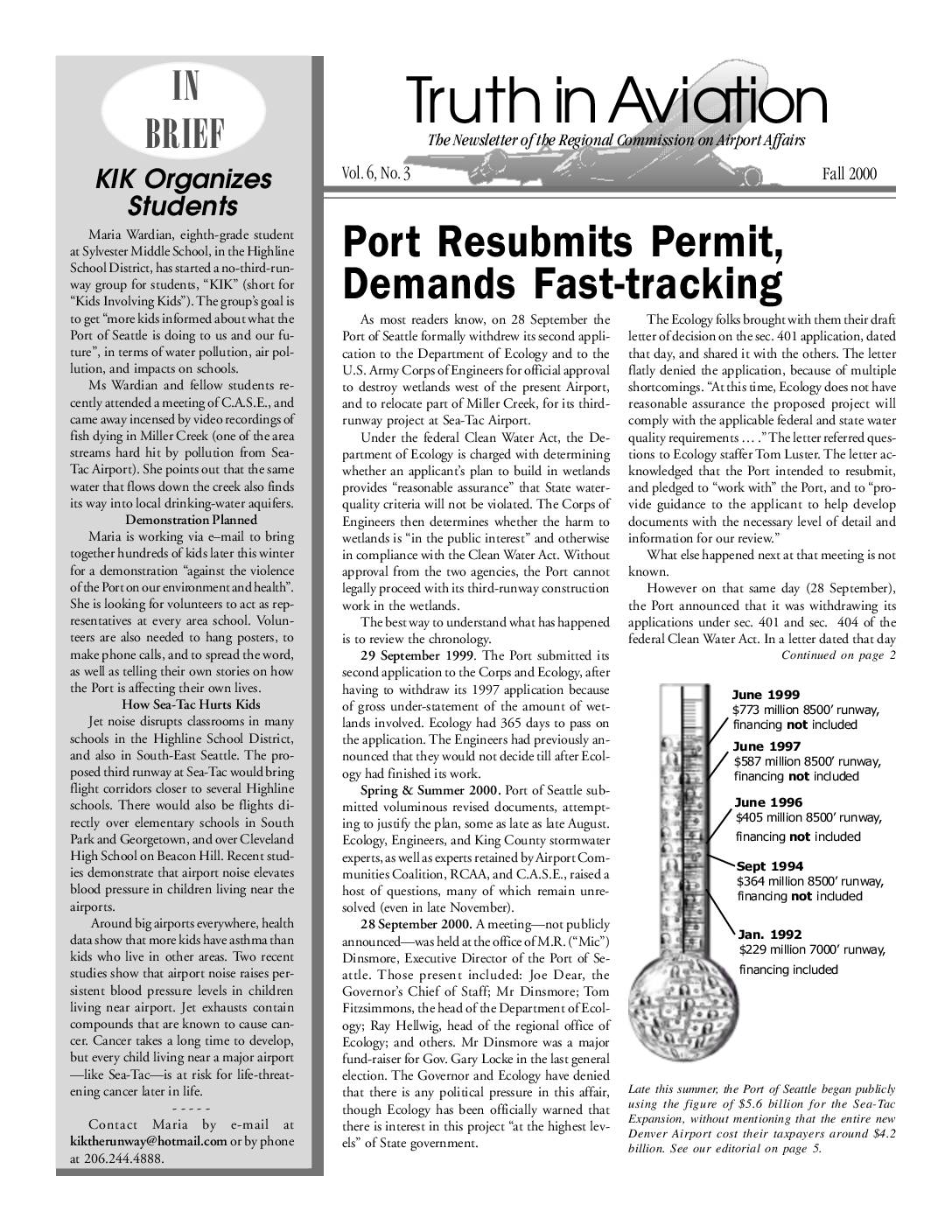
The Newsletter of the Regional Commission on Airport Affairs Vol. 6, No. 3 Fall 2000 ����� ��� ����� ������ �������� ������������� As most readers know, on 28 September the Port of Seattle formally withdrew its second appli- cation to the Department of Ecology and to the U.S. Army Corps of Engineers for official approval to destroy wetlands west of the present Airport, and to relocate part of Miller Creek, for its third- runway project at Sea-Tac Airport. Under the federal Clean Water Act, the De- partment of Ecology is charged with determining whether an applicant’s plan to build in wetlands provides “reasonable assurance” that State water- quality criteria will not be violated. The Corps of Engineers then determines whether the harm to wetlands is “in the public interest” and otherwise in compliance with the Clean Water Act. Without approval from the two agencies, the Port cannot legally proceed with its third-runway construction work in the wetlands. The best way to understand what has happened is to review the chronology. September 1999. The Port submitted its second application to the Corps and Ecology, after having to withdraw its 1997 application because of gross under-statement of the amount of wet- lands involved. Ecology had 365 days to pass on the application. The Engineers had previously an- nounced that they would not decide till after Ecol- ogy had finished its work. Spring & Summer 2000. Port of Seattle sub- mitted voluminous revised documents, attempt- ing to justify the plan, some as late as… -
ACC – NPDES Case Trial Brief, 2004
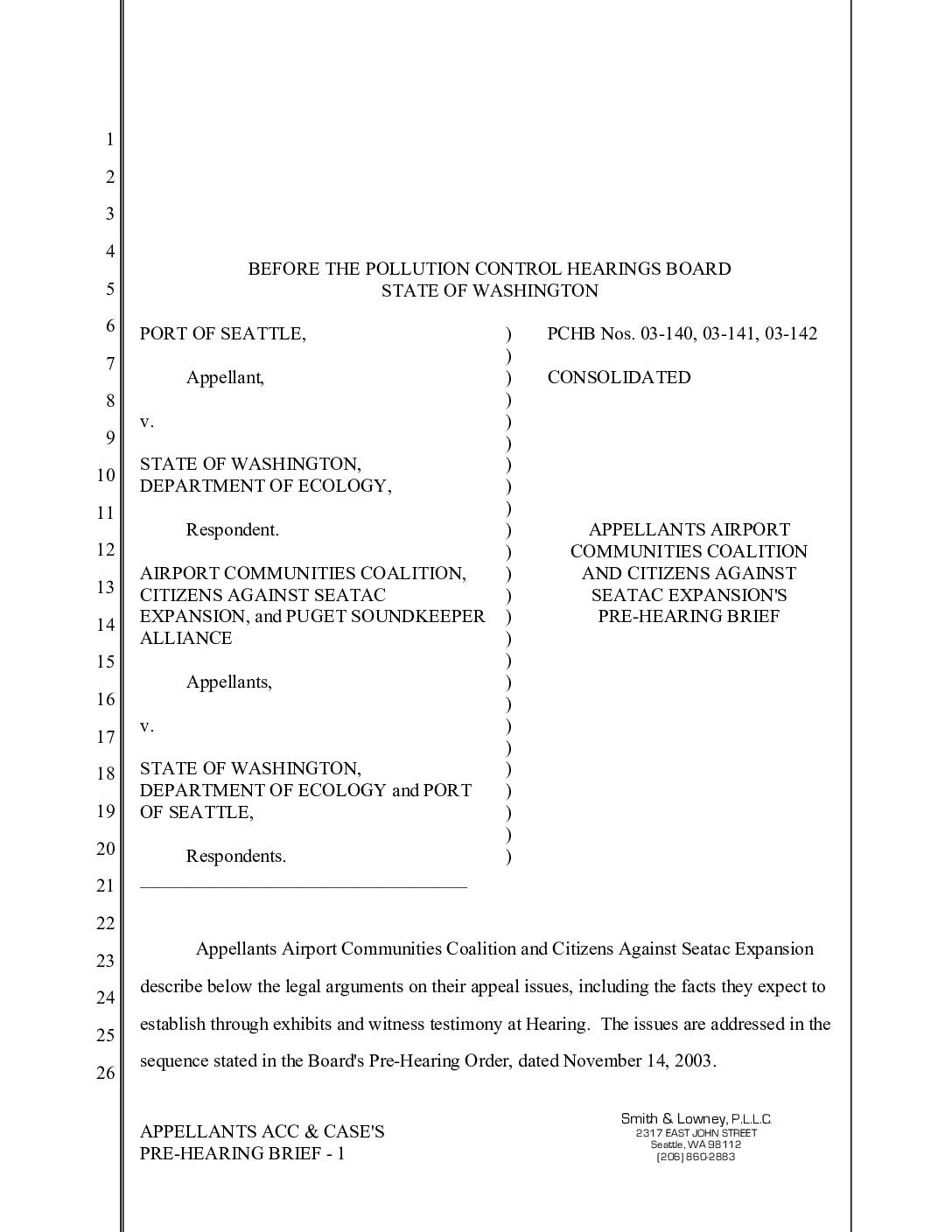
describe below the legal arguments on their appeal issues, including the facts they expect to establish through exhibits and witness testimony at Hearing. The issues are addressed in the sequence stated in the Board's Pre-Hearing Order, dated November 14, 2003.