TagPort Of Seattle Commission(369)
-
2018-11-27 RM 8c
ACTION ITEM Date of Meeting November 27, 2018 DATE: November 5, 2018 TO: Stephen P. Metruck, Executive Director FROM: Dan Thomas, Chief Financial Officer Michael Tong, Asst. Finance Director - Budget SUBJECT: Adoption of Resolution No. 3751, adopting the final budget of the Port of Seattle for the Year 2019, as amended ACTION REQUESTED Request Commission authorization for the adoption of Resolution No. 3751: A resolution of the Port Commission of the Port of Seattle adopting the final budget of the Port of Seattle for the year 2019; making, determining, and deciding the amount of taxes to be levied upon the current assessment roll; providing payment of bond redemptions and interest, cost of future capital improvements and acquisitions, and for such general purposes allowed by law which the Port deems necessary; and directing the King County Council as to the specific sums to be levied on all of the assessed property of the Port of Seattle District in the Year 2019. EXECUTIVE SUMMARY The 2019 business and budget planning process began in April. In the past few months, staff conducted budget work session, provided briefings/memo to the Commission on budget process, key budget assumptions, division business plans and budget development overview, preliminary operating budget, and preliminary capital budget. The preliminary budget document was provided to the Commission on October 23, 2018, and made available to the public on October 25, 2018. Staff recommends the following final budget process: November 27, 2018 – Second Reading and Final Passage of Resolution… -
2018-04-10 SM 9a Supp Airport Drives Traffic Enhancement
• Roadway system designed 1968 – 50 years ago – 5 million annual passengers • Major realignment for Light Rail 2008 – Right of way/Relocation of northbound lanes – Prior condition - gridlock within inboard roadway loops typical – Removed return to terminal loop ramps – Removed 40% of recirculating vehicles 1968-2018 Landside Access Critical to SEA Managing a Complex Balance Requires Comprehensive Long-Term Strategic Policy Intelligent Traffic System (ITS) • Sensors attached to gantries on Airport Expressway and Air Cargo Road capture vehicle count and speed • Data can determine a general level of service on roadways Powerful Data Available for Improvement Initiatives Traffic Mitigation Plan • Instituted for 2012 holiday season • Implemented as needed during peak periods 9PM-1AM • Revised and enhanced Thanksgiving 2017 • Automated alerts to Airport Duty Managers – Coordinate resources and communication to stakeholders • POS Police • GT Operators • City of SeaTac Operational Mitigations Have Limited Effectiveness Traffic Mitigation Plan (Cell Phone Lot) • All cell phone patrons utilize Right turn only onto 170th Street to International Boulevard • Right turn on International Boulevard to South Airport Entrance at 182nd Street • Right turn to 182nd Street and onto Airport Expressway system to terminal Traffic Mitigation Plan Level 1 Traffic Mitigation Plan (Commercial Traffic) • Coordinated closure of on-ramp from Air Cargo Road to Southbound Expressway • Traffic rerouted on 170th Street to International Boulevard to 182nd Street entrance • Allows greater distance for taxis and TNCs to merge into left… -
2018-04-10 SM 9a
BRIEFING ITEM Date of Meeting April 10, 2018 DATE: April 2, 2018 TO: Executive Director Stephen P. Metruck FROM: Michael Ehl, Director Aviation Operations Jeffrey Hoevet, Senior Manager Airport Operations SUBJECT: Airport Drives Traffic Enhancement Briefing EXECUTIVE SUMMARY Sea-Tac’s roadway system was designed in the late 1960s when the Airport facilitated the movement of 5 million annual guests. Replacement of the original return-to-terminal loops, immediately adjacent the parking garage, with the South 160th Street recirculation loop in 2008 assisted in removing some 40% of recirculating traffic from the inner drives, and effectively expanding the projected practical capacity of the system beyond its saturation at 40 million annual guests which was forecast in 2016-2017. Given Sea-Tac’s record 40 percent growth in passengers between 2012 and 2017, the roadway system is again strained in peak operating periods, regularly resulting in stop and go conditions on the inbound/southbound lanes of the Northern Airport Expressway. While these conditions historically affected Arrivals/Lower Drive traffic and were limited to nighttime holiday peak periods, 2017 saw the emergence of impacts spread more broadly across the operating day, to include daytime impacts to the Departures/Upper drives. Equally dynamic in nature has been the changing mode split for ground transportation options available to Airport patrons. In particular, the introduction of Transportation Network Companies (TNCs) to Sea-Tac in 2016 drastically altered the volume of vehicles using the roadway system as necessitated by the transit from remote holding lots to the customer pick- up area on the third floor of the… -
2018-04-10 SM 8b Supp Tourism Presentation
• 45 applicants -- $393,500 in funding requested • Review committee selected a total of recipients – 10 Previous Recipients, 16 New Awardee Projects – 22 Culture/Eco/Nature projects – Recipient match funds $148,008 -
2018-04-10 SM 8b Tourism Grants
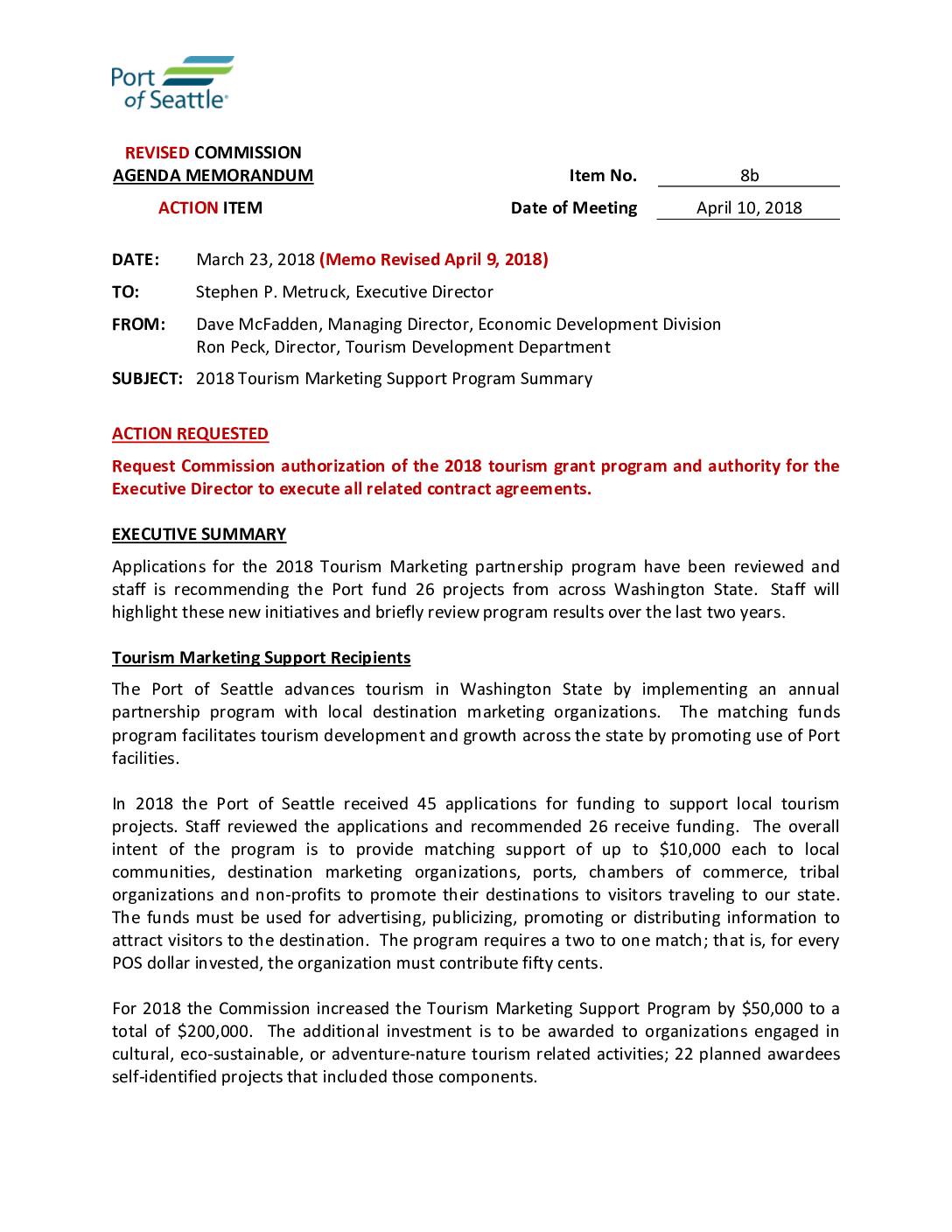
ACTION ITEM Date of Meeting April 10, 2018 DATE: March 23, 2018 (Memo Revised April 9, 2018) TO: Stephen P. Metruck, Executive Director FROM: Dave McFadden, Managing Director, Economic Development Division Ron Peck, Director, Tourism Development Department SUBJECT: 2018 Tourism Marketing Support Program Summary ACTION REQUESTED Request Commission authorization of the 2018 tourism grant program and authority for the Executive Director to execute all related contract agreements. EXECUTIVE SUMMARY Applications for the 2018 Tourism Marketing partnership program have been reviewed and staff is recommending the Port fund 26 projects from across Washington State. Staff will highlight these new initiatives and briefly review program results over the last two years. Tourism Marketing Support Recipients The Port of Seattle advances tourism in Washington State by implementing an annual partnership program with local destination marketing organizations. The matching funds program facilitates tourism development and growth across the state by promoting use of Port facilities. In 2018 the Port of Seattle received 45 applications for funding to support local tourism projects. Staff reviewed the applications and recommended 26 receive funding. The overall intent of the program is to provide matching support of up to $10,000 each to local communities, destination marketing organizations, ports, chambers of commerce, tribal organizations and non-profits to promote their destinations to visitors traveling to our state. The funds must be used for advertising, publicizing, promoting or distributing information to attract visitors to the destination. The program requires a two to one match; that is, for every POS dollar invested, the… -
2018-04-10 SM 7a
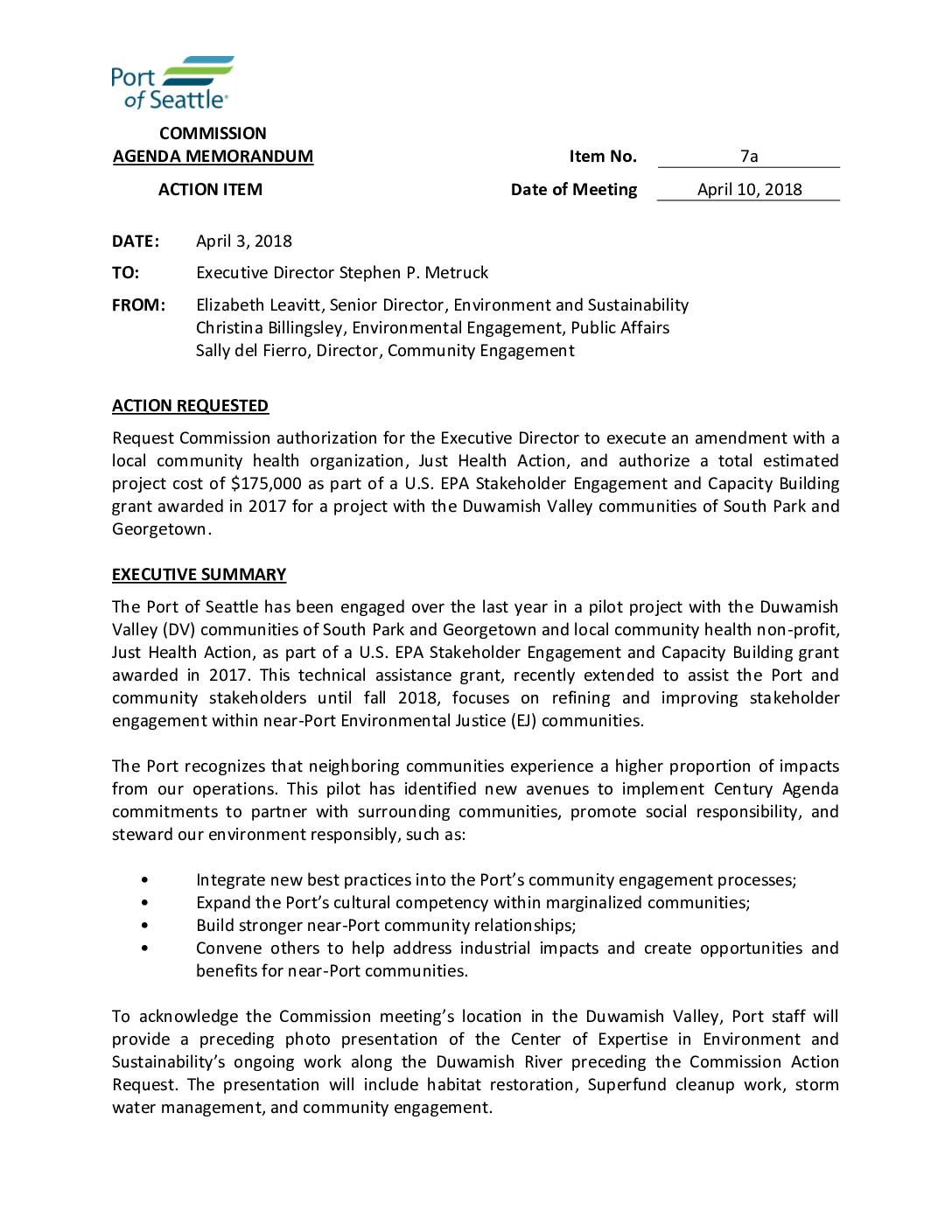
ACTION ITEM Date of Meeting April 10, 2018 DATE: April 3, 2018 TO: Executive Director Stephen P. Metruck FROM: Elizabeth Leavitt, Senior Director, Environment and Sustainability Christina Billingsley, Environmental Engagement, Public Affairs Sally del Fierro, Director, Community Engagement ACTION REQUESTED Request Commission authorization for the Executive Director to execute an amendment with a local community health organization, Just Health Action, and authorize a total estimated project cost of $175,000 as part of a U.S. EPA Stakeholder Engagement and Capacity Building grant awarded in 2017 for a project with the Duwamish Valley communities of South Park and Georgetown. EXECUTIVE SUMMARY The Port of Seattle has been engaged over the last year in a pilot project with the Duwamish Valley (DV) communities of South Park and Georgetown and local community health non-profit, Just Health Action, as part of a U.S. EPA Stakeholder Engagement and Capacity Building grant awarded in 2017. This technical assistance grant, recently extended to assist the Port and community stakeholders until fall 2018, focuses on refining and improving stakeholder engagement within near-Port Environmental Justice (EJ) communities. The Port recognizes that neighboring communities experience a higher proportion of impacts from our operations. This pilot has identified new avenues to implement Century Agenda commitments to partner with surrounding communities, promote social responsibility, and steward our environment responsibly, such as: • Integrate new best practices into the Port’s community engagement processes; • Expand the Port’s cultural competency within marginalized communities; • Build stronger near-Port community relationships; • Convene others to help address… -
2018-02-13 SM 9b Supp SAMP Update Presentation
Unconstrained forecast of 66 million annual passengers by 2034 Long-term vision – planning update Airside modeling • Conducted initial round of modeling • Recalibrated model to 2016 conditions • Modeled long-term future improvements • Findings – Airfield/airspace constraints result in major congestion (aircraft delays) as activity nears million passengers (2029) – Phased approach required to advance SAMP • Identify projects to accommodate near-term demand within existing constraints – Near-term projects • Conduct environmental review of Near-term projects • Recommend follow-on planning study to address airfield/airspace constraints Phased approach required to meet future demand meet demand Long-term vision - phased approach Near-term projects - 56 million annual passengers by 2027 Long-term vision – Additional planning required for demand beyond 2027 Near-term projects– Major improvements Westside Maint. Campus Hardstand - north North Gates Hardstand - central Second Terminal Roadway Improvements Busway & Stations Fuel Farm Expansion Taxiway A/B Extension ARFF Relocation Highspeed Exit Taxiway D Extension Near-term projects – planning update Airside modeling • Modeled 2027 conditions – NorthSTAR (pre-SAMP) – IAF (pre-SAMP) – New North Gates – New Hardstand Parking positions • Findings – Near-term projects can accommodate 2027 forecast demand – Approximates 56 million annual passengers – South Aviation Support Area (SASA) not needed to accommodate near-term demand and so not included in Near-term projects Near-term projects can accommodate 2027 forecast demand Next steps • Complete planning for Near-term projects • Work with FAA to finalize SAMP documentation • Planning work to support environmental review • Community open houses Q1/Q2… -
2018-02-13 SM 9b SAMP Update Memo
BRIEFING ITEM Date of Meeting February 13, 2018 DATE: February 4, 2018 TO: Stephen P. Metruck, Executive Director FROM: Jeffrey Brown, Director of Aviation Facilities and Capital Programs Thomas Hooper, Manager Aviation Planning Program SUBJECT: Sustainable Airport Master Plan (SAMP) Planning Update EXECUTIVE SUMMARY This briefing provides an update on the status of SAMP planning. The Port initiated the Sustainable Airport Master Plan (SAMP) in 2013 and the planning work is nearing completion, with public scoping for environmental review anticipated to begin in Q2 or Q3 of 2018. The primary purpose of the SAMP is to identify facility improvements required to satisfy demand over the 20-year planning horizon and to balance capacity in all key functional areas to the fixed capacity of the airfield. To that end, the SAMP started with an unconstrained, 20-year forecast of cargo and passenger activity which was used to determine peak hour facility requirements based on demand derived from the movement of aircraft, passengers, bags, vehicles and freight. Alternatives for facilities development to satisfy demand were then developed and assessed, resulting in a phased capital program to deliver needed capacity through the 20-year planning horizon. For planning purposes, the SAMP assumes the airport’s current three-runway system and close- in airspace configuration will remain in place. With the airport’s small footprint and significant physical constraints, redevelopment at Sea-Tac requires expensive relocation of existing facilities and limited options for expansion. Work to evaluate alternatives for project phasing and to assess airside capacity has included extensive airside modeling… -
2018-02-13 SM 9a
BRIEFING ITEM Date of Meeting February 13, 2018 DATE: February 5, 2018 TO: Stephen P. Metruck, Executive Director FROM: Pearse Edwards, Government Relations Director Lindsay Pasternak Wolpa, Regional Government Relations Manager Katie Kuciemba Halse, Local Government Relations Manager SUBJECT: 2018 Local and Regional Government Relations Priorities EXECUTIVE SUMMARY Port of Seattle government relations staff worked with Commissioners, executive team members, internal subject matter experts, and external stakeholders to develop local and regional policy priorities to guide Port advocacy efforts. While many of the 2017 agenda items remain as part of the proposed 2018 agenda, a number of items have been reprioritized in reaction to local, state and federal activity. 2018 Local and Regional Government Relations Priorities Top Priorities Port-wide • Workforce Development and Priority Hire: Support proposals to enhance local and regional investments in workforce development and career connected learning through direct program coordination with other public agencies and school boards, while collaborating with industry partners and private sector outreach. Work with other jurisdictions to implement regional priority hire policies through a Memorandum of Understanding between the Regional Public Owner participants and an Interlocal Agreement between the Port, the City of Seattle and King County. • Economic Opportunity: Support the jurisdictions and residents in King County to promote economic diversity and healthy, livable communities. • Equity and Inclusion: Support an inclusive economy where opportunity and prosperity are widely shared regardless of race, gender, ethnicity or socio-economic status. Be a leading regional voice on immigration policies that ensure the Port, our… -