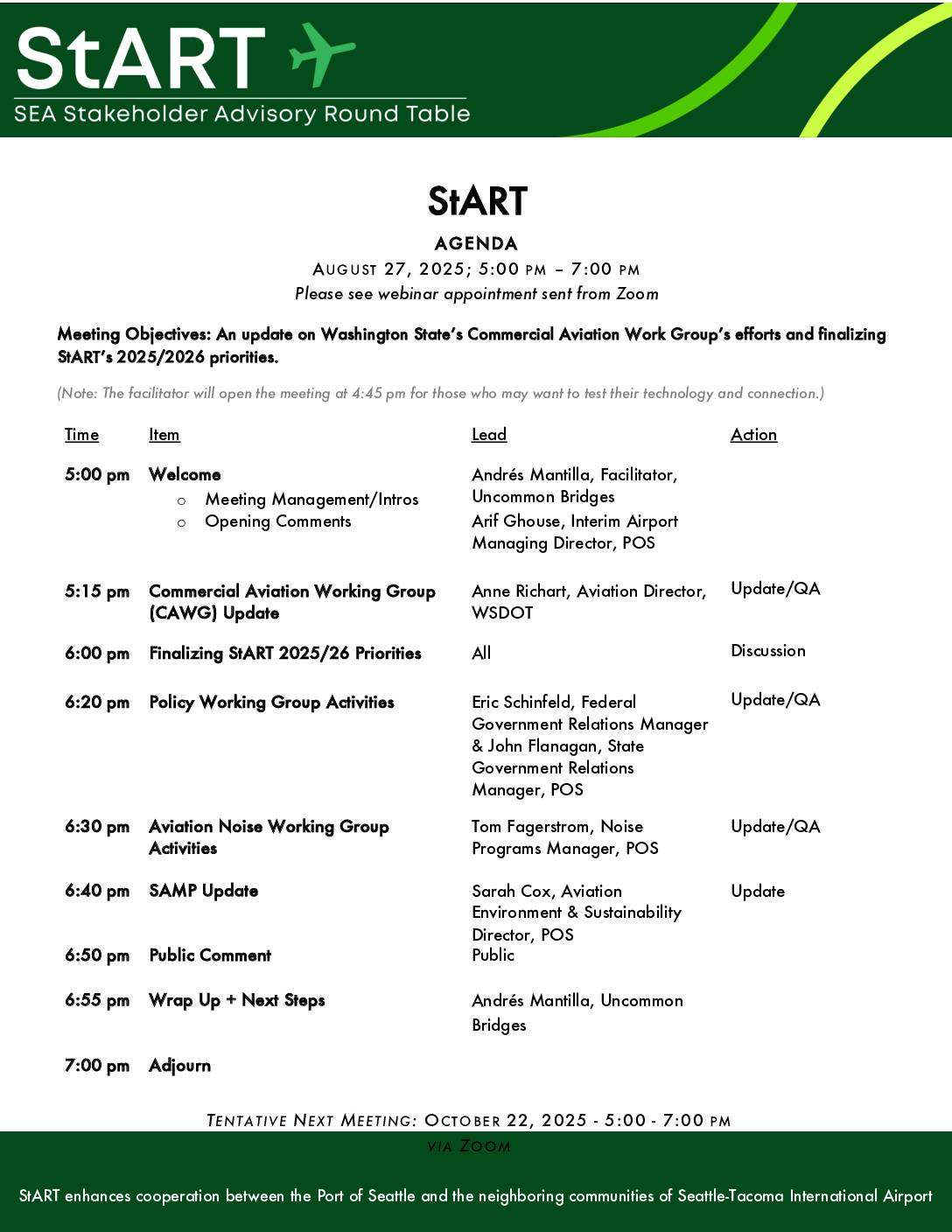
Meaningful progress hindered by a lack of time and good information
StART meetings are still not recorded by presenters. We provide unofficial follow-up transcripts usually a day after the meetings.
In the most energetic meeting in years, the usually sleepy group covered several important topics. But with important announcements on a Record of Decision on the SAMP, and a clear outline of the upcoming Part 150, it is time to be direct as to the group’s need for better information. Much of this article will be fact checking.
Commercial Aviation Working Group
 There was a lengthy presentation on the progress of the state second airport committee known as the CAWG. For those few who watch CAWG meetings, what they lack in effectiveness, they more than make up for in length.
So, we were surprised by the vitriol and disappointment some members expressed over a lack of progress. We’ve become increasingly concerned as to why – what do members expect to get from the CAWG? The Port, the FAA and the PSRC have made it clear for over a decade that even if it were open today, a second airport would never reduce operations at Sea-Tac! This ongoing refusal to accept such basic facts strikes us now as willful. We call upon the Port and the StART to permanently remove these discussions from their meetings. Encouraging this misinformation only serves to distract the group from meaningful work.
Another member suggested that the Port was compelled by the FAA to continuously maximize capacity — or risk losing necessary funding. This is a gross over-simplification of the FAA grant system and if the StART is meant for information-sharing the Port should also stop encouraging such convenient misunderstandings.
The airlines, business, Greater Seattle, and our own legislature push the Port to do so because they all prefer Sea-Tac.
Residents have put the cart before the horse for decades. There were always options to move at least some capacity to PDX, Paine Field and Boeing Field.
Before even choosing a site, the State must express a clear desire that Sea-Tac is no longer the go-to. Without that signal, Sea-Tac will always find a way to expand.
The reason other communities are so resistant to hosting an airport is that they can see how poorly the Port of Seattle is constantly encouraged to treat us.
If the Port and State are sincere about siting another airport? They should make a real effort to fulfill their 1976 promise to Sea-Tac communities:
“As we do better, you’ll do better.”
Air Quality Monitoring
There seemed to be concern as to the lack of air quality monitoring. Quoting from the STNI 2026 Legislative Agenda
When 2025 began there was one aviation air quality monitoring station in Puget Sound. By end of year there may be three. It is to their great credit that the University of Washington and Puget Sound Clean Air Agency (PSCAA) have largely standardized on both equipment and procedures. But we can’t stop there.
We encourage StART member to follow STNI. This goal is already within sight.
Expanding Fly Quiet Program
The discussion was deferred to a future meeting. We would remind the Port that these are already in place at other airports. We look forward to the Port’s support.
SIRRP/Part 150
The Port has doubled down on the SIRRPP program, which continues to insist on acoustic testing, limits to pre-1993 systems, and within the current DNL65. Shameful.
Eligible Homes
There have always been a certain number of homes that did not receive sound insulation because they chose not to. People move on and sometimes the new owner would not become aware of eligibility for a while. In recent years, the Port has been much better at following new owners and the number is now about sixty.
The proposed (2032) noise map looks like it would double eligibility — but only for first-time sound insulation. Shameful.
State funding
The state originally funded $1,000,000 for SB5955. That was lost in last year’s final state budget. Senator Murray promised $3.5M but that too was lost when Republicans took over. The Port committed $6.5M, which it says is still on the table, although it has done nothing thus far.
ASIP
Where the Port did fall down was on multi-family (apartments, condos, houses of worship) which were left behind for decades. The Port Commission finally approved an Accelerated Sound Insulation Program in 2020, but that will still not be completed until 2026. That meeting was also the first public acknowledgment that any systems might have problems.
Port of Seattle Shared Agenda
One of the most common critiques we receive is ‘the law of averages’. Since the Port has so many proposals, at least some of them must be good, right?
Sadly, no. There is nothing for us in either their current State or Federal agenda. Every item will set us back and must be rejected. Most, like funding for sound insulation at both the state and federal levels, are attempts by the Port to avoid spending when they are doing better than ever.
It is critical that we are kind but firm: no more distractions, no more ‘splitting the difference’, no more substitutions.
SB5652?
One member seemed to advocate for bringing back last year’s airport legislation. We must strenuously disagree.
What the community needs most from Olympia now is a fresh, independent expert assessment modeled on the 1997 HOK study. Last year’s legislation would not have achieved that. With the upcoming SAMP ROD, we must get this right — and right now.
SAMP Update
The Port reiterated that the Draft EA Record of Decision (ROD) is expected anywhere between September 22nd and October 31st.
The Port Commission will be briefed at their first meeting after it drops, either September 23, October 14 or October 28.
There has been confusion (or perhaps complacency) that the ROD would arrive on October 31. There is a sixty day appeal window. But since none of the communities are prepared, it is difficult to know what grounds they might even find.
Low information
There have been no lessons learned from the Third Runway. With no continuity among activists or cities (other than SeaTac) how could there be?
This meeting struck the most constructive tone in years. If this level of engagement had carried forward past 2018, we would be in a far better place. So much more could be done, with this group of participants. But it is difficult to make even minimal progress unless members develop fluency on even basic issues. That always means not relying on the Port as a single source of truth.