Too much technical. Not enough human
The last Stakeholder Advisory Roundtable (StART) meeting focused on ‘establishing a priority framework for 2025’ and included updates from various working groups. Arif Ghouse, SEA’s interim aviation managing director, introduced himself as the new chair, taking over from Lance Lyttle who departed in April.
The challenge at all these meetings is that, frankly, everyone is in over their heads. There is a blizzard of information, most of it useless for our concerns. Still, there are always a few useful things if one knows what to listen for. That’s extremely awkward to say, but how can cities advocate for themselves without even a 101-level understanding of the issues?
That’s not a catty metaphor. Until the pandemic, the Port used to conduct Noise 101 Seminars for both the public and electeds – using the same firm that is consulting on the current Part 150 Study. Without even that background, these meetings are one big 301 level lecture after another. It’s not a lack of information, it’s the wrong kind.
So, rather than cover that blizzard, we want to focus on one item you can advocate for, now.
First, we want to acknowledge the community reps who did ask for something specific – particularly the request to expand the Fly Quiet program (currently midnight to 5am), to 11pm to 6am. Well done! As we keep saying, the 10pm to 7am is the nine hour period considered essential to public health by the FAA. That’s why it is specified as the penalty period under DNL! And for what it’s worth, other airports are trying to do this (eg. La Guardia). It is not tilting at windmills.
Part 150 Study Update
There was an update on the Part 150 Study which determines who gets sound insulation. Unfortunately to get to your action item, there is no way to avoid some introductory gobbledygook.
A Part 150 Study is voluntary and supposedly an independent process an airport can do anytime to benefit communities. It has its own committees and reports. But in practice a Part 150 is always conducted in concert with airport expansion plans – like the SAMP. So, as in the past, the airport and FAA have created a linked process.
This Part 150 has been going on since last year through something called a Technical Review Committee (TRC) but the Part 150 and the SAMP will share the same analyses and schedules. And the outcome of the Part 150 will drive all the noise mitigation for the SAMP. The airport will say this saves money, eliminates duplicative effort, and gets to a decision quicker, all of which benefit the airport. The participants are essentially identical to the participants in SAMP planning and roundtable (StART) city land use planners. In other words, many committees, same people, same practical outcomes — good, bad or indifferent.
This Part 150 Technical Review Committee (TRC) is led by an independent environmental consultant – the same firm that did the Noise 101 seminars, Environmental Science Associates. They provide the 1expertise because just learning the software used in establishing Noise Exposure Maps (NEM) will make anyone’s brain hurt. But there are zero community representatives, the group meets in private and (sorry) city representatives are not noise experts. Their role is often just to provide data inputs for the software — not advocate for you.
We have a ‘tone’ because this TRC has no genuine community representation, and it should because all that technical gobbleydegook has very real-world consequences for people. Remember: the outcome determines what homes the FAA will pay to provide sound insulation – either first time or updates in the future. Anything that increases that boundary, even by small amounts, can mean better health for dozens or even hundreds of families.
The SAMP may conclude as early as this year. The Part 150 Study could be published in 2026 or 2027. So for now the current DNL65 is the same as it was in 2018 – the one that reduced the number of eligible homes by two-thirds.
The Thick Blue Boundary
The TRC is not done, but enough that they recently published a tantalizing possible NEM for 2032. But their diagrams are far too coarse to determine eligibility.
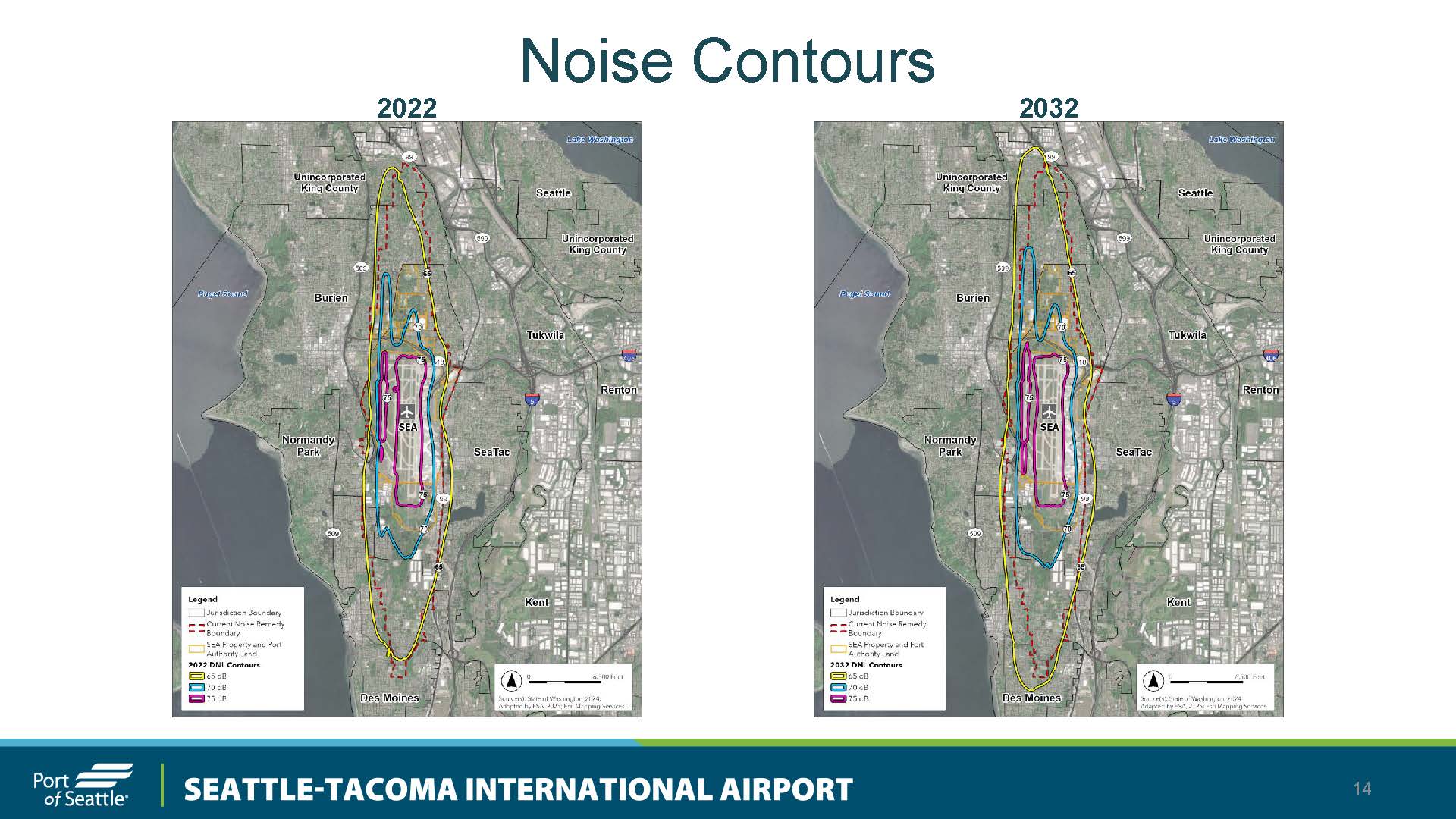
They have also said they may stick with the current (2018) map for determining eligibility until then.
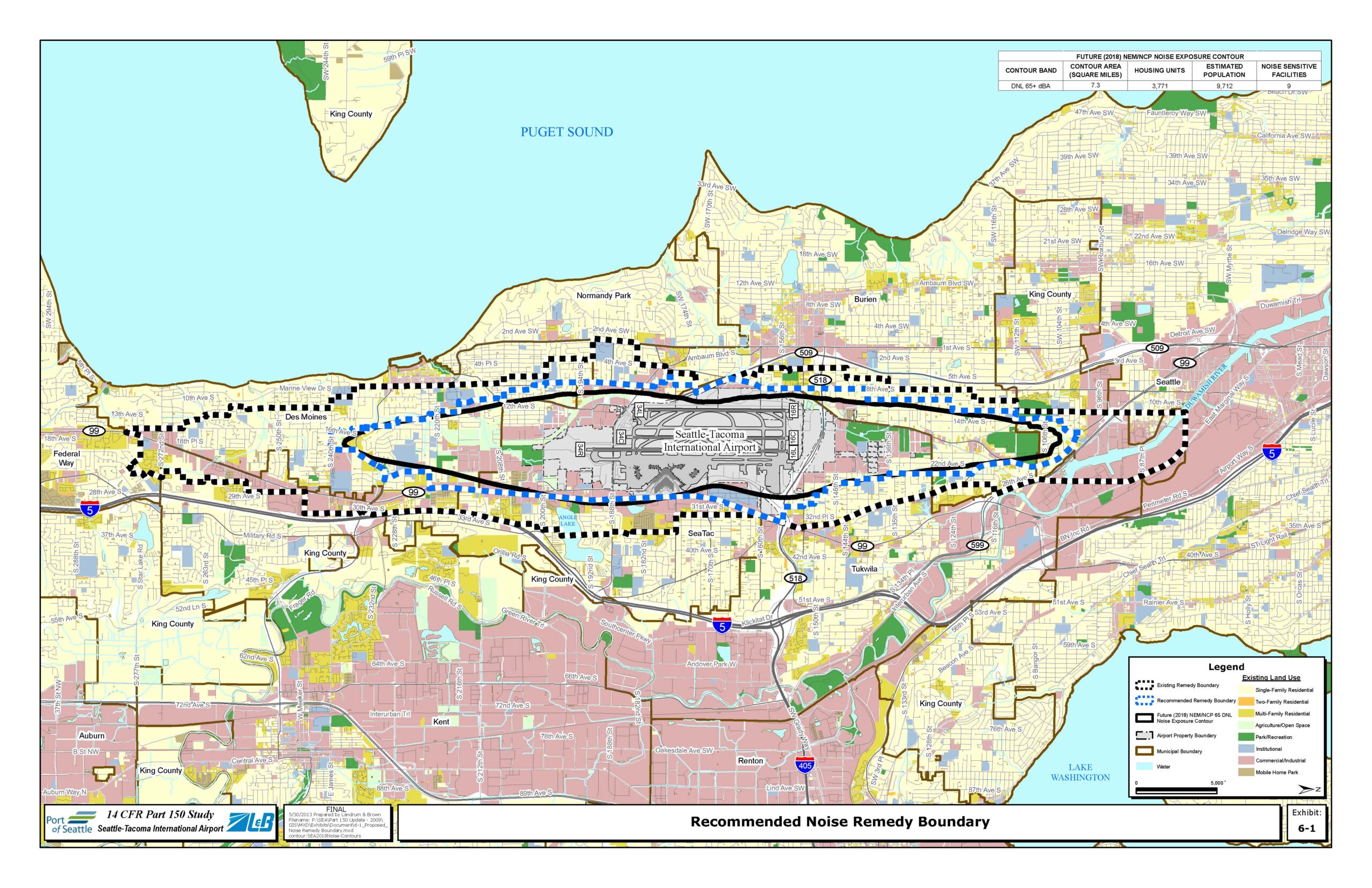
That matters. Every home that has to wait until 2032 is a home that may not be eligible for sound insulation, either new or updates. They will have to deal with years of unnecessary noise and health impacts.
And there is this. Zoom in on that dashed blue boundary. That too is vague. We’ve overlaid the homes using the same GIS software all government agencies use to establish land use. The blue boxes go over the middle of hundreds of homes. The possible interpretation on the left only includes homes in the current boundary. Another, more generous interpretation on the right, could add many, many more.
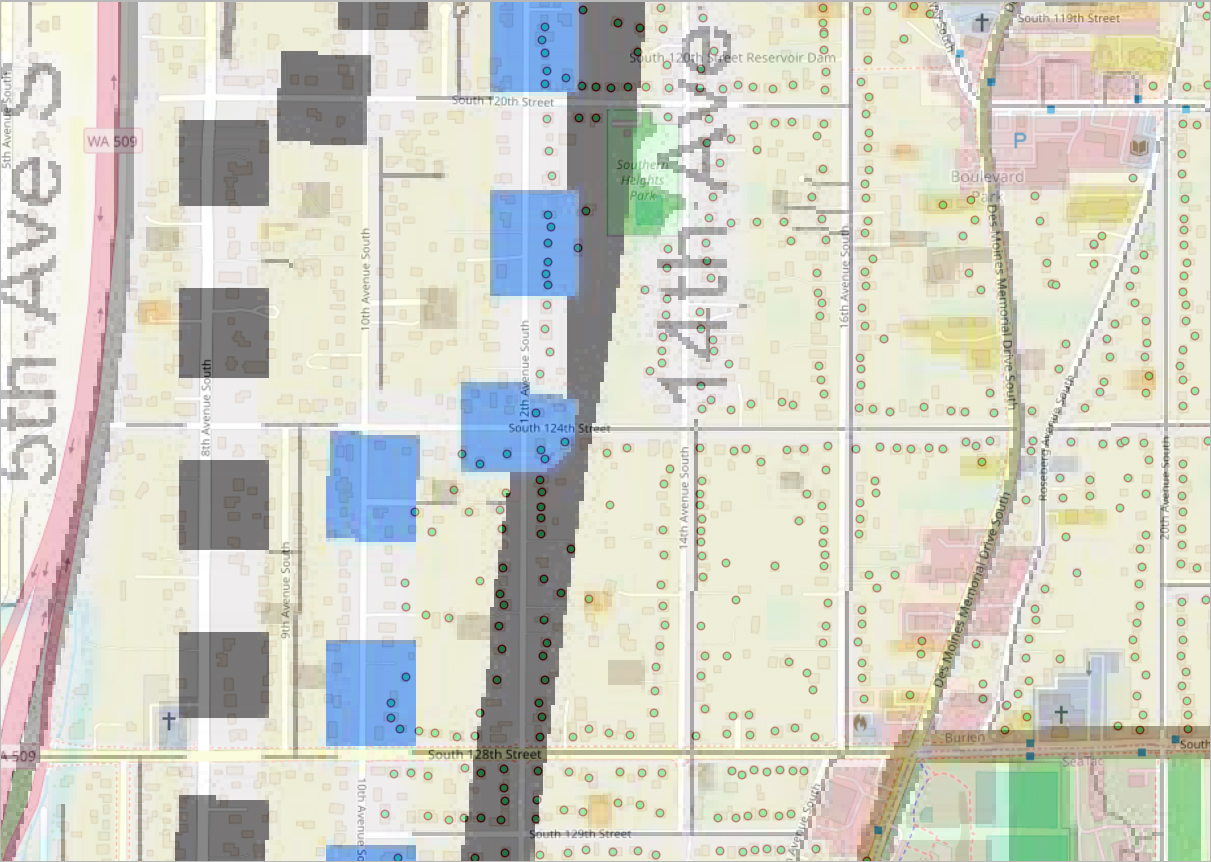
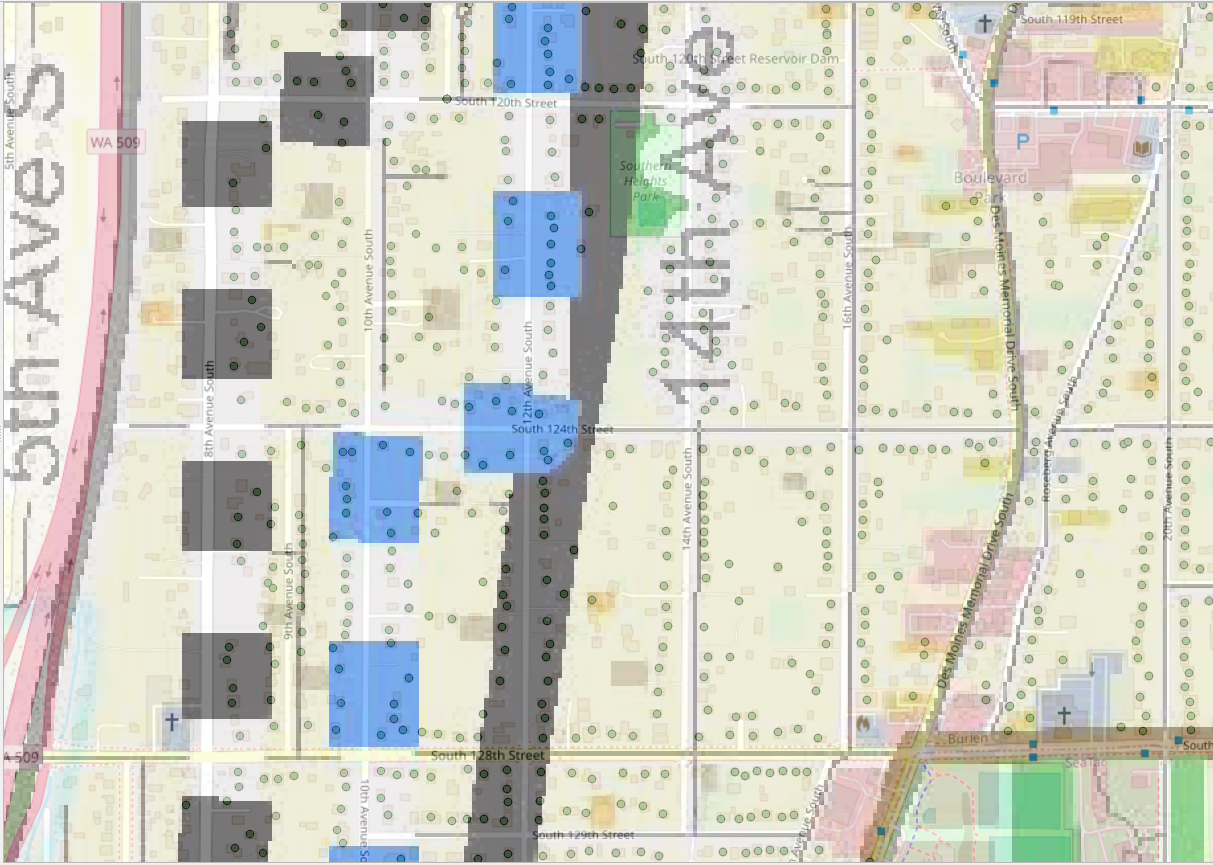
This is a very real issue for people in those neighborhoods – areas where one home has a Port Package while the one right next door does not. How that line is finally interpreted will not be a technical matter for people on the wrong half of the blue.
There are public workshops planned for the fall – of course after the boundary map is established. This creates the illusion of public engagement. Traditionally, these workshops serve mainly to explain to laypeople how the decisions were made – not change the result to one that is more equitable. Once a boundary is established by ‘the experts’ working behind closed doors, good luck. We need to act now.
Call to action
Contact your City and Port electeds immediately, before the TRC concludes work on the next boundary map.
- Insist that they publish the proposed map – and make it accurate enough to clearly indicate which homes will be eligible. Now. Before their work is complete.
- Insist that the proposed map provide the most generous possible coverage for homes – remember, this is not about eligibility for first time sound insulation; this will also determine federal funding for possible second chance (update) programs.
- Insist that a more generous 2032 boundary be adopted along with the SAMP so that more homes are eligible for any possible federal funding as soon as possible.
- Or, just insist that TRC meetings be open to groups like STNI that can provide the independent expertise necessary to advocate for you. There is no one else at the moment.
1The system is guided by a paid software known as AEDT. A single license is $1,200, it really does require a pro to operate. The output is inscrutable and almost never shared with the public. The Quick Start Guide alone is 44 pages.