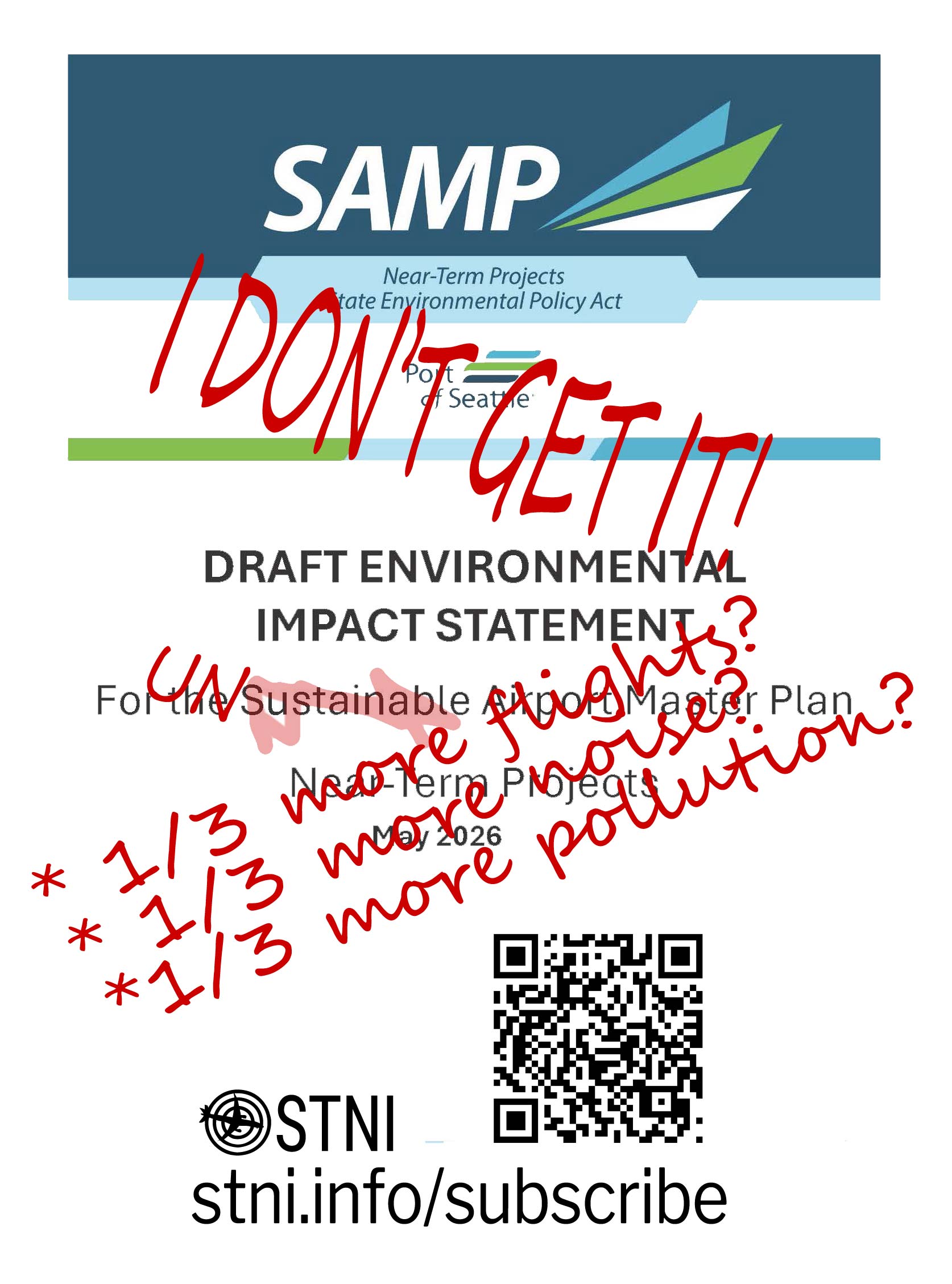
What you need to know
The Sustainable Airport Master Plan Near-Term Projects SEPA Draft Environmental Impact Statement (SEPA/DEIS) is now available. Public comment is open for sixty days, until July 21, 2026. There will be four Port-sponsored open houses and two webinars. Several cities will also receive briefings at their city councils. We will provide calendar reminders for all our subscribers.
SAMP/SEPA Draft EIS Documents
We are studying the documents right now. We know you are busy. We know it feels overwhelming. If you can attend a public meeting, please do. But we believe that the best use of your time will be to be patient, and follow a trusted source that is prepared to act on your behalf. That is STNI.
As of Sep25,2026, it appears that at least one of the documents is damaged. We have alerted the Port of Seattle.
Before you comment
The Port has done an admirable job in making public comment easy. Perhaps a bit too easy. Every email or quick comment is considered an official public comment. Their interest is in having as large a number of comments as possible, even if all are negative. The FAA considers a large number of comments, not as a tool to improve service, but in scoring which airports should receive various grants. That is why we ask you to consider the following approach:
- Use our template. We will provide a well-researched set of comments you can add your name to, or use as a starting point for your own.
- Ask us first. If you want to do your own research, use our site. Our site is the most complete public resource on the SAMP. People often ask the Port, FAA, WSDOT, or their city for data during these periods. Those requests take a long time and usually return only a piece of what you were looking for. Just ask STNI.
- Write your city and its advisory committees. Tell them to do the same. City staff and residents are almost always new to airport processes. Unlike the Port of Seattle, they do not have decades of experience. That is the problem: they only know what they know. Insist that everyone has access to complete information — not only what the Port or FAA have on the table. Just ask STNI.
Background
The SAMP began in 2012. It has had dozens of moving parts, but the projects being submitted for approval now were more or less finalized over a decade ago. None of our cities have handled it well, because people always treat these ad hoc. The Port of Seattle has been clear from the start: this will never end.
About “public comment”
That term is unfortunate. We do not blame anyone who has trouble digesting the documents, or who cannot understand how a process this large would not include any community mitigation or compensation.
Practically speaking, “public comment” is designed for specialists to provide notes that improve or challenge specific findings. The documents are complicated, but not for people who are prepared. A tax attorney can fly through a lengthy IRS ruling. A surgeon can follow the most complex procedure.
The person who reads these comments evaluates each one against specific regulatory requirements. If a thousand people comment and 999 of them only say “This stinks,” that does not stick it to the man, it makes extra work for a clerk. We deserve and can obtain relief. We won’t get there by venting.
What our cities are doing instead
We are concerned that our cities may continue making the same tired arguments to avoid doing all they should — even using FIFA as an excuse for needing more time to prepare. They will issue many statements encouraging the public to make your voice heard. We agree. But it could also be used as one more distraction from the fact that they have not studied for a test they knew was coming fourteen years ago.
The next sixty days
We need to provide useful comments — ones that lead to a better SAMP this year, and to legislation that addresses the broader impacts on airport communities next year. But our cities will always be our primary advocates. We must also send them a clear message: Stop making excuses. Start developing a continuous, long-term strategy to help airport communities.
I don’t appreciate the Port of Seattle increasing more flights at Sea/Tac Airport. You pushed the 3rd runway on us which you said would not be used only in emergency scenarios. Our home is on the same level as the runway so the sound travels west our direction. Then there is the traffic issue off the airport onto 518/405/I-5 which has not been addressed. It’s a bottle neck 2-6 and getting worse with multiple accidents. Why in the world you think everyone in the Northwest needs to be funneled to Sea/Tac is beyond me. Please expand airports north, east and south and help preserve our sanity and environment. It’s not fair to us and our property values and health.
Thank you
Traffic has become increasingly dangerous on the 518. People from all over the county come here and freak out on the road that they have to share space in a more urban area. We need improvements and expansion in the other regional airports to take care of their own residents.
I also lose Internet regularly whenever a large flight comes in. It might be for only a few seconds, sometimes it takes up to a minute to get back online. When a therapy session or online medical appointment is being conducted, it becomes increasingly frustrating and dangerous to bother client and professional. With an increase in flights with equipment that regularly disrupt business, it only hurts the area.
Thank you for making that important point. Airport operations are often disruptive to many forms of local electronic communication. The issues have been trivialized as either imagined or as being inconsequential next to “passenger safety.” As wireless communication becomes mission-critical for people living and working under the flight path, this must be addressed.
When bought our house, we were told the 3rd runway was for emergency only. Had we known you would change that, we probably would have found another home.
You want ⅓ more noise, ⅓ more flights, ⅓ more pollution and less green to counterbalance your carbon footprint? NOW you want to expand more? Tear down our natural forests? Add more warehouses that only reflect heat, deter rainfall and add to our impending environment catastrophe? Add more big trucks on our already outdated roads and highways.
– We don’t get a quiet day – ever – constant air traffic noise starts at 4am and doesn’t stop until ??
– We stopped growing our own vegetables bc of pollution that rains down on us. (We left a magnet outside by accident – it was VERY telling. )
– We have to shut the windows to watch TV bc the noise of the planes.
– The traffic around south Seattle is a nightmare and is now jammed every day.
– We now have hand signals that all our neighbors understand – to wait for the plane to pass to finish the sentence.
– We can’t take any phone calls outside – too noisy.
– We can’t shoot any video or record anything for our online businesses – just too noisy.
You’re expanding the airport but not the infrastructure around it. You’re forcing every single passenger in the PNW to fight through the Seattle traffic mess to get to your airport – adding hours on to their commute or trip.
It’s just not a sustainable plan and you know it. This has to stop being all about the money.