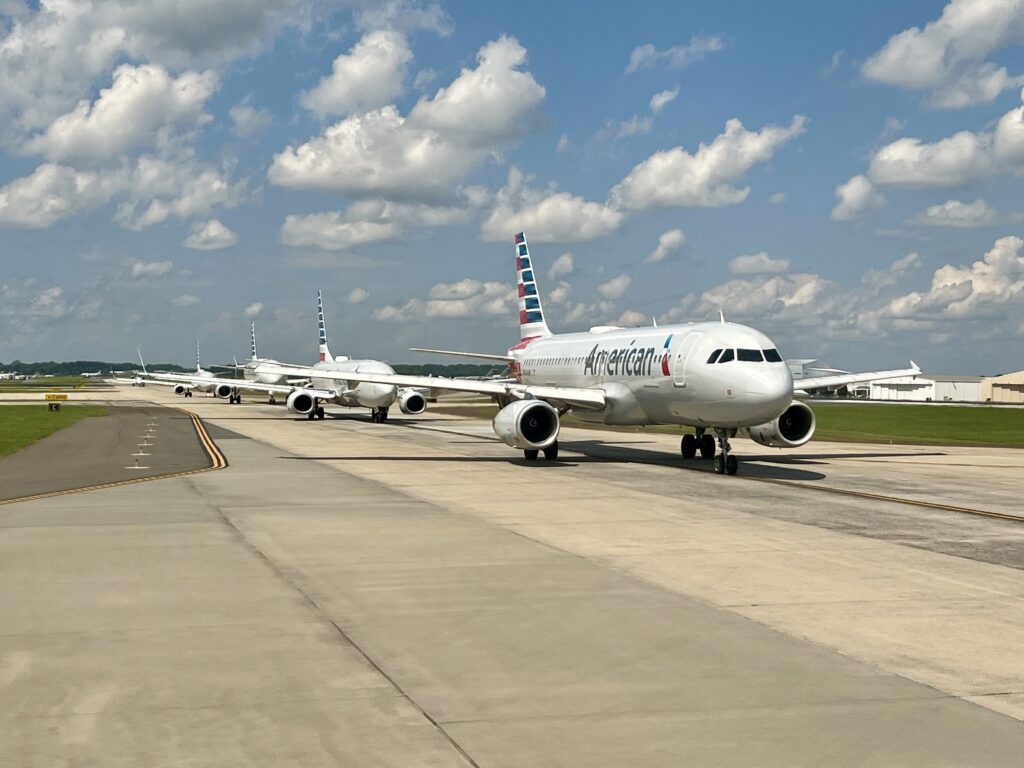
An update on commercial aviation in this year of the SAMP
The first quarter of 2025 continued to show mixed financial results for major U.S. airlines. Despite some post-pandemic recovery in travel demand, economic uncertainty, higher operational costs, and softening domestic travel led to significant challenges across the industry. Here’s how the top carriers performed:
- American Airlines (AAL): Revenue of $12.6 billion, with a GAAP net loss of $473 million. Adjusted net loss was $386 million.
- Delta Air Lines (DAL): Revenue of $14.0 billion. Operating income of $569 million and earnings per share of $0.37. Delta withdrew full-year guidance due to economic uncertainty.
- United Airlines (UAL): Revenue of $13.2 billion. Adjusted net income of $302 million ($0.91 per share), reporting its best Q1 performance in five years, but caution remains for the rest of the year.
- Southwest Airlines (LUV): Revenue of $6.4 billion (a record), but a net loss of $149 million and an adjusted loss of $77 million.
- Alaska Air Group (ALK): Revenue grew 9% year-over-year, but the airline still posted a GAAP net loss of $166 million. The early stages of its Hawaiian Airlines integration showed modest gains.
In summary, while airlines like Delta and United showed stronger performance due to premium travel and international markets, most carriers are still struggling with domestic demand softness and economic headwinds.
We also note that ongoing tariff concerns likely mask what would have been problematic regardless.
Why is Airline profitability so difficult?
Historically, the airline industry has been a tough business. Even before COVID-19, profit margins were razor-thin. Although airlines saw record profits between 2015 and 2019, these were largely exceptional years fueled by cost-cutting, low fuel prices, and loyalty program revenues—not from ticket sales alone.
Airlines face high fixed costs (aircraft, labor, fuel) and are highly sensitive to external shocks like oil prices, recessions, and even tariffs. Ticket prices are heavily competitive, limiting their ability to raise fares without losing customers.
Importantly, many airlines increasingly rely on:
- Frequent Flyer Programs: Loyalty programs are often sold to banks to support credit card partnerships, providing billions in stable, upfront revenue.
- Ancillary Revenue: Fees for baggage, seat assignments, and in-flight services now account for a significant share of profitability.
- Federal Support: During economic downturns, airlines often require substantial government bailouts—as seen during the 2001 attacks, the 2008 financial crisis, and COVID-19.
- Tourism programs: The Port of Seattle operates the single largest promotions in the State of Washington.
In effect, the business of flying passengers alone is often not profitable. It is the surrounding ecosystem—credit cards, government support, and corporate partnerships—that keeps airlines financially viable.
Why we track this?
STNI tracks airline financial health because it undercuts one of the Port of Seattle’s main arguments for the major airport expansion known as the Sustainable Airport Master Plan (SAMP). Namely, that they are simply “responding to organic demand” from airlines.
In reality, airlines and airports like Sea-Tac constantly work to create demand, not just meet it. Airlines push promotions, loyalty programs, and partnerships precisely because organic demand—especially for domestic leisure travel—is never enough to sustain growth. The Port, in turn, seeks to maximize non-aeronautical revenue (such as concessions, parking, and tourism promotion) that depends on ever-increasing passenger volumes.
Expansion is not just a neutral reaction to public demand—it is a business strategy aimed at ensuring financial survival and boosting revenues, very little of which returns to any local community besides the City of SeaTac. despite so many negative impacts to health and quality of life. Understanding the true financial picture helps communities push back against misleading narratives about the necessity of endless growth at Sea-Tac Airport.