Diversity in Contracting shows genuine progress. StART is just more stonewalling and propaganda
At its May 27, 2025 meeting, the Port of Seattle Commission reviewed two major annual reports that ostensibly reflect two major commitments: the 2024 SEA Stakeholder Advisory Round Table (StART) Annual Report and the Diversity in Contracting Annual Report. The content and tone of each revealed two fundamentally different trajectories. One program was transparent about its challenges and earnestly committed to achieving its goals. The other was StART.
StART: “Community” process without the community
StART was created in 2018 to bring together the Port, SEA Airport, nearby cities, airline representatives, and community voices to address the growing impacts of airport operations – a hybrid of the Highline Forum and the FAA ‘Roundtable’ format. The 2024 Annual Report described technical work on glide slope changes, ground noise modeling, and late-night noise abatement procedures. But what it did not clearly disclose—is that the core decisions about which initiatives advance and even meeting rules are made not in the public StART meetings, but behind closed doors by a Steering Committee composed exclusively of Port staff, city administrators, and airline representatives.
StART Annual Report from 2025 05 27 Meeting
This Steering Committee operates by consensus—meaning any one member can veto changes—and, crucially, includes no community members. As revealed in an April 2024 briefing to the Des Moines City Council, even cities that participate in good faith are constrained in what they can propose or support. During the May 27 Commission meeting, Commissioner Felleman pointed out that it had been spearheaded by now-departed airport director Lance Lyttle. But more than one Commissioner seemed unaware of the governance structure. Their reactions included concern and surprise that community voices are systematically excluded from the body that controls StART’s priorities and scope. Commissioner Felleman asked why the group had not been expanded to other impacted areas – such as Beacon Hill and Vashon Island and also seemed surprised to learn that the steering committee had opposed that idea.
Compounding concerns over transparency and influence was a disclosure that the Port’s state lobbyist met with the Washington State Department of Commerce during the last budget cycle. Shortly afterward, the Department dropped a $1 million allocation that would have supported the state’s first funding for updates to residential sound insulation. This money was championed by communities and originally included in the governor’s proposed budget. The Port’s lobbyist discussed with the DOC that the Port “was not ready to act”—a claim that may have directly influenced the funding’s removal.
Commissioner Mohamed asked if that funding request would be renewed – when the Port was ready to do something (as yet undefined) on Port Package updates. The answer was yes. That sounds good, but the better question would have been – since the funding needed for Port Packages is so massive, why not leave that existing $1M in place and ask for another $1M in the next session?
These disclosures cut against the Port’s public messaging. In 2024, the Port formally launched its Sound Insulation Repair Replacement Pilot Program (SIRRPP), but no construction is expected until 2026.
In the meantime, near-airport neighborhoods continue to deteriorate under unrelenting noise exposure and vibration. The excuse offered is that the Port cannot act without guaranteed FAA reimbursement. But this narrative is not merely misleading it is factually inaccurate. Nothing prevents the Port from investing its own record-setting revenues into this program and seeking reimbursement later–as airports like San Francisco International (SFO) have already been doing for five years. If the Port really wants to create a federal standard, it should work collaboratively with SFO to get FAA regulations on sound insulation update reimbursement.
Commissioner Felleman asked about having more data – specifically concerning late night noise improvements. We agree. However, we also note the lack of transparency concerning the SIRRPP. To date there has been no information on how the Port has spent $6.5M, plus $3M supposedly earmarked by Senator Patty Murray. Where has this money gone? After almost 18 months of the SIRRPP, the Port has not identified a single home as ‘eligible’ besides the handful of pre-1993 systems that were already eligible for reimbursement under FAA guidelines. Again – it is getting someone else to pay, not actual need that is driving the entire discussion.
This strategic delay—what many now see as “slow walking”—has real human costs. Families continue to live in homes with outdated or non-existent insulation, their health impacted by poor air quality, interrupted sleep, and chronic noise stress. That the Port lobbied against a modest $1M state allocation only reinforces the perception that it is more concerned with institutional control than public accountability.
Contrast: Diversity in contracting faces challenges with sincerity
If the StART report represented equity in form without substance, the Diversity in Contracting program showed the opposite: a willingness to confront challenges with transparency and humility. The 2024 report disclosed that while Women and Minority Business Enterprises (WMBEs) received a record 21.7% of total Port spending—translating to over $116 million in prime contracts and $100 million in subcontracts—not all goals were met. Some sectors, particularly in public works and large consulting, lagged behind.
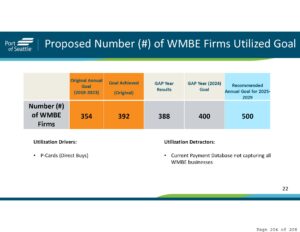
Yet the report was delivered with clarity and without defensiveness. The Office of Equity, Diversity, and Inclusion (OEDI) acknowledged where progress had slowed, identified bottlenecks, and outlined new strategies for improvement. Under Resolution No. 3836, the Port is now implementing structural changes such as mandatory Equity in Contracting Plans for large procurements, centralized tracking dashboards, and post-award compliance monitoring. These reforms go beyond symbolism. They embed accountability into systems of decision-making, procurement, and performance measurement.
Commissioners praised the OEDI team for its honesty, and emphasized that sincerity—not perfection—is what builds public trust. It was noted during discussion that genuine progress requires acknowledging where goals are missed and adapting accordingly. The Commission also reinforced its support for protecting these equity programs against legal or political attacks, particularly as national challenges to race- and gender-conscious contracting continue.
Two stories, one agency: which vision wins?
The contrast between these two programs reveals a troubling asymmetry. The Diversity in Contracting team, despite many challenges, has moved the Port meaningfully toward greater inclusion. It is clear that the Port Commission cares about the issue and that is what makes the discussion productive.
The StART program, meanwhile, has achieved only things its most powerful stakeholders—airlines and the Port itself will allow. There has been no meaningful give and take. Community members participate in working groups, but have no voting authority. Members can publicly propose, but the Steering Committee can quietly say no — which makes the public wonder what any members of that Steering Committee (including our own city administrators) truly believe.
Every community ‘win’, late night noise reductions, glide slope, were first proposed decades ago. The four out of seven ‘wins’ at the federal levels were trivial at best. The addition of a state legislative agenda was not the Port’s idea – it came after the Port noted that StART had never been engaged in state legislation to provide meaningful relief.
StART members, both community and city, are so unaware of the basics of airport funding they don’t even bother countering the Port’s (false) narratives, eg. that it cannot act on sound insulation without external funding — despite examples of other airports doing exactly that! Even when state funding is set aside, it is lost—apparently with the Port’s tacit or active encouragement.
And yet, no one seems to notice. How can we obtain the things we deserve when we aren’t even aware of what to ask for?
What we can say with certainty: when the Port Commission truly cares about an issue, it is willing to spend money and obtain results. When the results are not there, suspect a lack of genuine concern, or worse straight up propaganda and virtue signaling. Is the Port of Seattle prepared to act decisively to protect the health and well-being of the communities it impacts? Or continue to tell al story of “study” and “partnership,” while real relief for residents is always just a few years away?