
Why Fly Quiet programs are not great. And the magic of DNL
Sleep disruption, specifically from aircraft, is very unhealthy, creating both acute and chronic illnesses. The FAA recognizes this and takes night time flights into account when establishing the noise boundary (DNL) determining which homes get sound insulation. But there is a lot more to it than that.
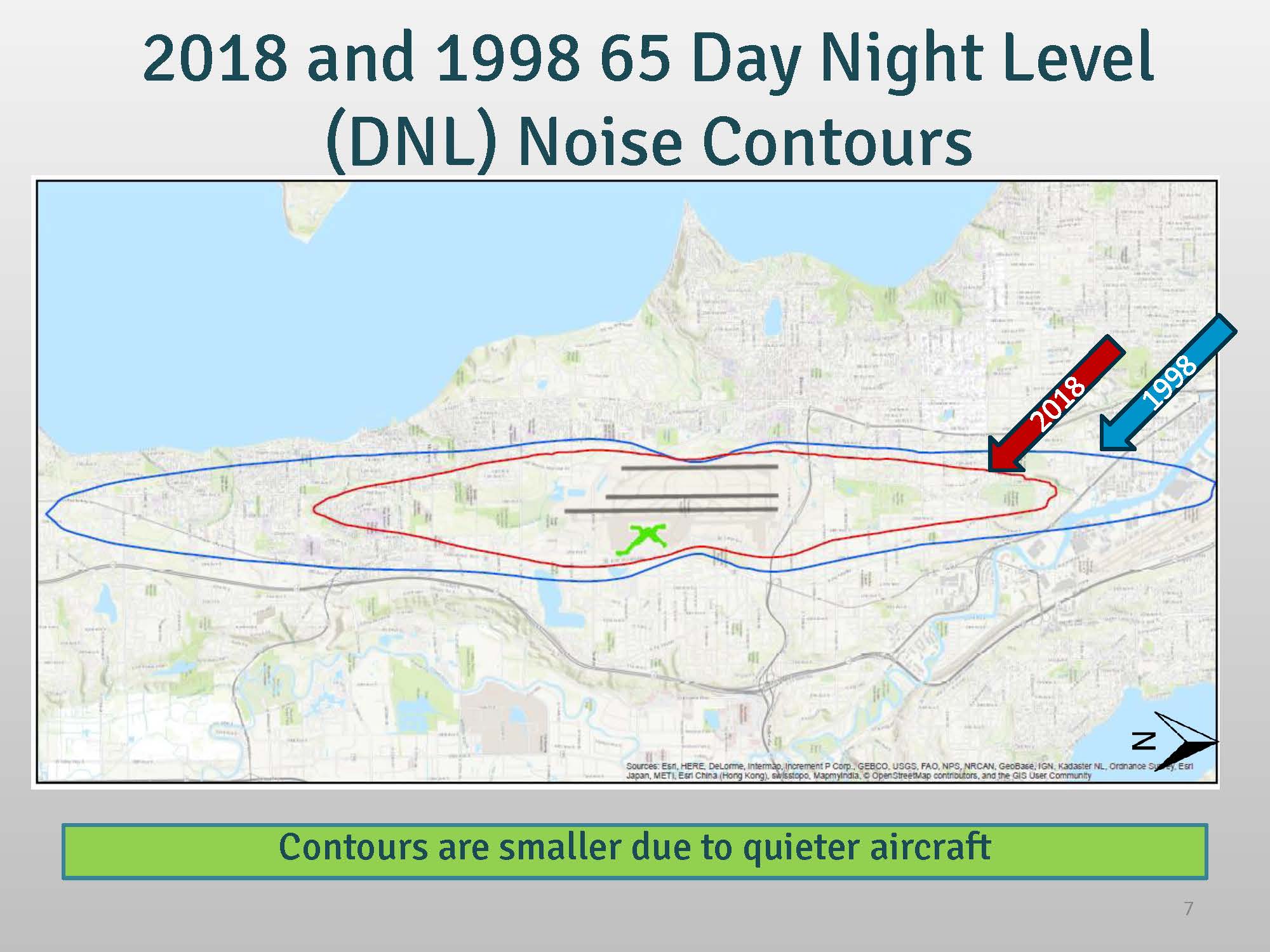 For years, we have referred to that noise boundary- the geographic area where homes are eligible for sound insulation – as the DNL65. We’ve done that (and will continue to do that) as a shorthand for much longer, boring terms like ‘1998 65 Day Night Level Noise Contour’. In this article, we’ll use the term ‘DNL’ more as it is meant to be used: a weighted system to compare noise levels.
Sleepy Time
The FAA says that homes where the ‘average’ outdoor sound level is 65dB are eligible for grants to the airport operator (the Port of Seattle) to provide sound insulation. But, recognizing that noise at night is particularly bad, it also says that noise events during the 9 hours from 10PM – 7AM should be more heavily weighted. To do that, in the 1970’s they adopted a measuring system which is sort of like a ‘decibel’ but not really called Day Night Level (DNL). DNL is essentially, decibels – but with a Sleepy Time Penalty of 10dB.
An example might explain this better than a definition.
- If a flight goes over your home at 1PM @ 64dB, it is (duh) 64dB. It is also 64dB under the DNL system.
- But if the same flight goes over your home at 1AM @ 64dB, it is still 64dB in the real world, but it is 74dB under the DNL system. That’s the Sleepy Time Penalty. 10dB.
That may not sound like much of a penalty. But to put this into some context:
Most human beings perceive a ten decibel increase as twice as ‘loud’.
So, essentially, the FAA is scoring events during that nine hour period as twice as loud by virtue of occurring while you’re trying to sleep.
The magic of DNL
But what does that mean in practical terms? Well, the FAA says that the average noise level over your home has to be at least 65dB for you to be eligible for federal sound insulation money. So, another example:
Let’s say that on a given day, there were 300 flights over your home. Every one of them was exactly 64dB, but 50 of them occurred from 10PM – 7AM.
- If the FAA simply took the average of all those 300 events, the average noise level would be 64dB. So, you would not be eligible for federal sound insulation money.
- Now let’s switch to the DNL system with the 10dB Sleepy Time Penalty. That same day consists of 250 flights @ 64dB and then 50 flights @ 74dB. Under the DNL system that works out to about 68dB. Congratulations, you are eligible for sound insulation.
That’s the magic of DNL. Without the Sleepy Time Penalty Period, thousands of homes that got Port Package would not. Every dB is worth millions of dollars.
No curfew for you!
Federal law explicitly forbids any restrictions on takeoffs or landings at any time of day (or night) without a lengthy and onerous appeal procedure – so lengthy and onerous that no major airport has received such a restriction in decades. In other words: no curfew for you.
Fly Quiet programs
 But that doesn’t mean that nothing can be done. Like many airports, over the decades Sea-Tac Airport has created a Fly Quiet program – an attempt to obtain voluntary concessions from the airlines. It encourages them to not fly between midnight and 5:00am, to use quieter aircraft, and to use quieter procedures. And though not technically a requirement of the FAA, having a Fly Quiet program is considered favorably when evaluating other airport-related grants. In other words, it’s a nice thing to do for the community and the benefits can be real. But airport owners like the Port of Seattle also get something out of it besides a warm glow.
Five Hours
Note that the Sea-Tac Fly Quiet window is five hours. But human beings cannot sleep properly with only five hours of quiet. That is why the Sleepy Time Penalty is from 10PM – 7AM – nine hours.
It’s also important to note the number of flights between 10PM and midnight and then from 5AM to 7AM.
To give readers a sense of this, on a typical day:
| Time Period | Hours | Percentage | Type | Color | Border | Pattern |
|---|---|---|---|---|---|---|
| 7AM – 10PM | 15 | 62 | Daily Operations | #28a745 | #28a745 | solid |
| 10PM – 12AM | 2 | 7.5 | DNL penalty, no restrictions | #fd7e14 | #dc3545 | diagonal |
| 12AM – 5AM | 5 | 21 | Fly Quiet (DNL penalty, voluntary restrictions) | #ffc107 | #dc3545 | diagonal |
| 5AM – 7AM | 2 | 7.5 | DNL penalty, no restrictions | #fd7e14 | #dc3545 | diagonal |
But, there is another way to look at this…
| Time Period | Hours | Percentage | Type | Color | Border | Pattern |
|---|---|---|---|---|---|---|
| 7AM – 10PM | 15 | 84 | Daily Operations | #28a745 | #28a745 | solid |
| 10PM – 12AM | 2 | 7 | DNL penalty, no restrictions | #fd7e14 | #dc3545 | diagonal |
| 12AM – 5AM | 5 | 2 | Fly Quiet | #ffc107 | #dc3545 | diagonal |
| 5AM – 7AM | 2 | 7 | DNL penalty, no restrictions | #fd7e14 | #dc3545 | diagonal |
Although 2% of flights occur during the five Fly Quiet hours, 16% occur in the nine hour Sleepy Time Penalty period. The two hours from 10PM – midnight, then the two hours from 5AM – 7AM are among the busiest of the day.
All hours are not created equally
Best case with the current Fly Quiet program: Your body is starting to sleep at some of the noisiest activity, obtaining an insufficient period of quiet , then ending with another peak period.
According to researchers, these two portions of the sleep cycle perform different functions, but both are especially critical to public health.. It really doesn’t matter how quiet it is during those five hours, if the other four recognized by the FAA are completely unrestricted.
Why five is not nine
 You may wonder why the Port did not simply make the Fly Quiet program match the nine hour Sleepy Time Penalty Period in the first place. To answer that, just look at the recently completed International Arrivals Facility. The IAF is called the IAF because one major goal of the Port of Seattle is to be the gateway to Asia. And due to the time differences, international flights need to be scheduled during our night. As the airport expands, expect those late night and early morning schedules to become even heavier.
The Port will respond that they are doing everything possible to change federal law on these issues. But change at the federal level may take decades – if ever. And besides, would they really have spent over $1,000,000,000 building the IAF if they did not want a bajillion more flights during the Sleepy Time Penalty Period?
Call to action
Given Sea-Tac Airport’s ongoing strategy to expand flight operations during the DNL penalty hours, and regardless of the current state of federal regulations, the Port of Seattle can act unilaterally to implement at least three important policy improvements which will improve the public health of people living under the flight path:
- Expand the Fly Quiet program to encompass the nine hour period recognized by the FAA as important for human health. Since it is a voluntary program, they will obviously receive push back from the airlines. But regardless, ongoing negotiations to reduce flights and noise during Sleepy Time must be on the table. Forever.
- As a part of the SAMP, commit funding for airfield improvements to reduce noise during takeoff and maintenance which have been promised for decades.
- Commit a significant amount of Port dollars annually to provide the most effective sound insulation to the largest possible number of residents under the flight path – both new and updated systems.
The FAA recognizes the importance of nine hours of un-disrupted sleep to our health. But whether or not their own regulations will provide us with the protections we deserve, there is nothing stopping the Port of Seattle from doing more on its own.
The timing of this article hitting my inbox is crazy. I literally was viewing my sleep patterns on my smartwatch 5 minutes before checking my email, and was seeing that I am spending like 1% of my sleeps in deep sleep. And thinking about how the flights continue over my house through 3am, and begin again at 5am. I have lived in my house for 8 years now. No wonder I am COMPLETELY burnt out, and experiencing waves of death exhaustion on the daily
The residence area in which assistance from the airport in providing sound suppressing improvements to ones home was established prior to the addition of the third runway. My home is located about two miles east of the airport and noise has never been an issue until after the addition of the third runway. I request that the residence area be reevaluated and expanded to account for the 3rd runway.