Slimmed down version loses Overburdened Community provision
In a vote mostly along party lines the committee passed HB1303-1st Substitute bill.
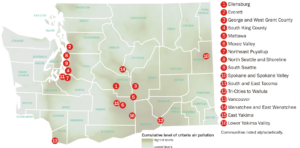 The key change was removal of the original requirement that pollution overburdened communities, those ranked highest on a standardized Environmental Justice scale, would automatically be subject to a new layer of environmental review specifically targeted to cumulative impacts from large polluters. That provision would have automatically included airport communities affected by the Sustainable Airport Master Plan (SAMP).
Despite that loss, sponsor Sharlett Mena (29th D), spoke in support of the bill, saying it retains the key concept: environmental review from a justice lens, irrespective of economic benefits. She called it a first step towards the ultimate goal of making an EJ lens and cumulative impacts a prerequisite for harm reduction and community mitigations. We strongly agree.
A few Democrats peeled off from the original bill citing concerns about ‘over-regulation’ for developers. And in a passionate speech against, Mary Dye (9th R) put forward an amendment, which she claimed ‘would protect farmers from damage by wind farms’. That amendment failed along party lines.
The bill now heads to the Appropriations Committee.
Full coverage of all legislation we’re supporting is here.
Our Take
It is always interesting to us how many electeds feel a need to include economic benefits in any discussion of environmentalism. For us this is sad, revisionist history, and usually disingenuous. When environmental laws were originally developed in the 1960’s and 1970’s it was a given that any environmental policy must provide firm advocacy on one side of the table to balance the always greater interests of business and economics on the other. We notice that supporters of unlimited growth at Sea-Tac Airport have no such qualms. They understand what they are advocating for and never give ground on their core values without some form of compulsion, or at least hard negotiation.
And these are negotiations. There should be strong opening positions which then lead to a final compromise solution. But when we give ground even before the other team takes the field, how can we hope to achieve a just solution?
We applaud Representative Mena and FrontandCentered.Org for working hard to move the conversation away from the constant greenwashing of the past four decades and closer to where it always needed to be.