The Airport Communities Podcast
Last week told the crazy story of Tagamet to describe something economists call perverse incentives–how people can waste so much money addressing a problem in the wrong way, you can’t even get research money to figure out how to address it in the right way.
In another episode, we described No Data, No Problem. How industries slow walk research for decades by saying we can’t fix it until we get better research.
We’ve received some comments telling us these ideas are too abstract. So, this week we’re talking about something everyone can relate to: the noise! Or rather, how that noise is measured for airport communities.
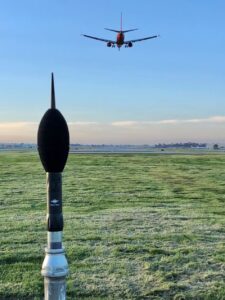 In the 1990’s, at the behest of the Puget Sound Regional Council, the Port began installing noise monitoring equipment. To date it has spent over $15,000,000 on three versions of noise monitoring equipment. You can track each noise event at our SEL Monitoring pages. If you look at the Noise Exposure Maps for the Part 150 Study, those ‘rings’ seem to indicate that the noise levels, even near the runways are often ’85’. And yet, in real life, your neighbor mowing his lawn next door is also 85 decibels. How can this be? How can that sound be an ’85’ and the sound registered next to the airfield also be ’85’? It’s because all ‘decibels’ are not created equal.
What is a decibel? It’s certainly not the number in those DNL rings. But what about the numbers registered by the noise monitors?
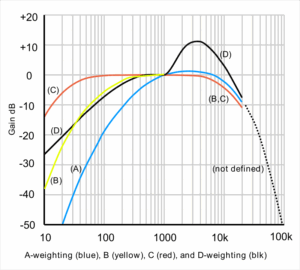 The decibels used by almost all government measurements are referred to as ‘A-weighted’, which means ‘adjusted for human hearing’. And, as you can see by looking at the blue curve, that is done by severely reducing the value of low frequencies (bass), which we call ‘turning down the bass on your stereo.’
When you measure aircraft noise with A-weighting, the readings tend to be much lower than expected because much of the energy you feel, which is that low end, is filtered out of the reported number.
Why is this important? Because, as anyone who lives under the flight path knows, low frequencies are a huge component of commercial aircraft noise. The rumble that shakes your house should be a very unusual experience. We almost never experience it in the natural world except in case of danger. And whether you notice it or not, your body reacts to it in very specific ways. Ways that make a trip to the movie theater exhilarating. Once in a while.
Unfortunately, our bodies were not designed to have this experience hundreds of times a day. Your physiology considers every flight a ‘danger’ and responds accordingly. Constant triggers tend to lead to a variety of chronic illnesses.
Why would the Port spend so much money for a state-of-the-art system and continue to undercut the real noise reporting value?
We close the episode by suggesting that State and Federal lawmakers might not understand the intensity of the noise problem if the number on a report says that a guy mowing his lawn next door is the same as the number registered by the noise monitors when a 747 flies directly over head!
It’s time to turn off that tone-control and publish the unfiltered noise data. It’s time to end A-weighting.
AirNoise.io phone app
SEL Noise Reports & Graphs
Latest Noise Monitor Contract
A-Weighting (Wikipedia)
Low frequency noise and annoyance
Annoyance caused by the low-frequency sound…
To learn the rest of the story on each of these programs: stni.info/subscribe
- Subscribe to our video feed
- Find us on all the best podcasts, including Apple and Spotify, or subscribe via SSAppleSpotifyYoutube
My neighbors are rarely mowing their lawn when I’m trying to sleep.
You guys had a boundary around areas affected by airplane noise and you helped provide sound suppressing assistance to people inside that area. Then the third runway was added, but you didn’t revise that boundary area. You really should.