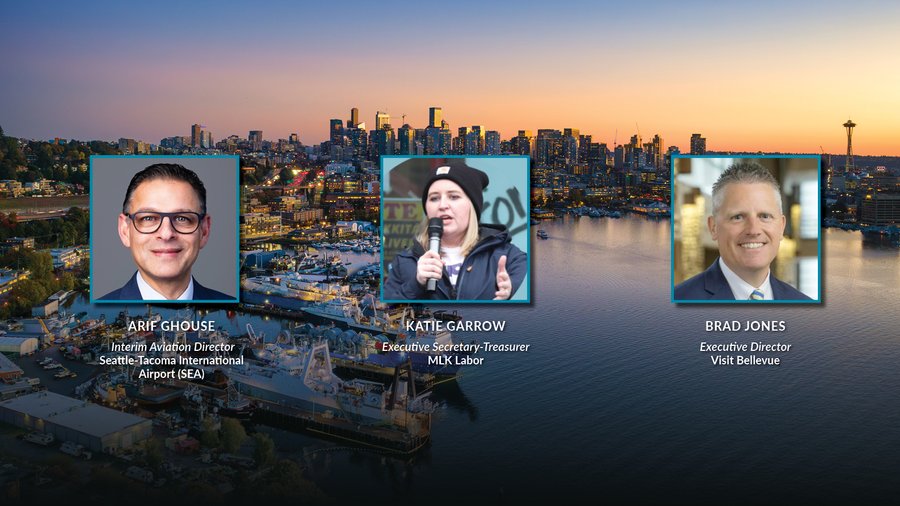
As the Puget Sound region continues to attract new residents, record visitor demand, and expanding global business ties, its infrastructure and workforce face unprecedented pressure—and opportunity. Leaders from Seattle-Tacoma International Airport, MLK Labor, and Visit Bellevue share how they’re adapting to rapid growth, strengthening global access, and preparing the region for the next decade of economic expansion. Their insights reveal a shared commitment to ensuring that the benefits of this boom are broadly felt, strategically supported, and built for long-term success.
The thought leaders participating in the discussion:
- Arif Ghouse, Interim Aviation Director, Seattle-Tacoma International Airport (SEA)
- Katie Garrow, Executive Secretary-Treasurer, MLK Labor
- Brad Jones, Executive Director, Visit Bellevue
- Moderated by Don Baker, Publisher and Market President, Puget Sound Business Journal
Trends over the last several years show how popular our region is both for visitation and population growth. What do these trends mean to each of your organizations and how you serve your audiences?
ARIF: We’ve been monitoring growth in the region very closely for some time now. The airport serves as the front door to visitors who want to come here and experience this beautiful place we call home. But it also serves as a gateway for residents to visit or conduct business around the world. The more our population grows, the more people pass through the airport. On top of that, we’re home to several of the largest global companies, which means a lot of business travel is facilitated through SEA. All of this to say, we’ve been watching and planning for more growth that continues to come – whether that’s through upgrades to our existing facilities or preparing a Master Plan for the future that is currently going through the environmental review process at the state level.
BRAD: Our region is one of the most exceptional destination regions in the world. From unparalleled natural beauty and diverse landscapes to a thriving business ecosystem, dynamic urban centers, and vibrant cultural experiences, the Pacific Northwest continues to stand out on the global stage. For Visit Bellevue, these trends reinforce the importance of how we present and deliver our destination. As demand grows, the way we package our experiences, tell our story, and drive awareness becomes increasingly critical. Our work is centered on elevating Bellevue’s identity within this broader region and ensuring we attract the right visitors, provide compelling reasons to choose Bellevue, and deliver an outstanding, seamless experience once they arrive. Growing popularity heightens expectations, and our role is to ensure Bellevue exceeds them.
KATIE: As the Seattle region grows as a tourist destination, it’s vital to provide safe infrastructure, world-class hospitality, and vibrant cultural experiences. Unions have responded to this growth by providing a highly trained workforce and fighting to ensure this wealth is shared fairly. As the cost of living rises, union contracts with strong wages and benefits are more critical than ever.
What are you currently doing to prepare for more growth in the future?
ARIF: We’re nearing completion on several major airport upgrades to improve service right now which is very exciting for passengers who’ve been seeing construction the past several years. These projects are a part of our Upgrade SEA program and were far overdue considering how many passengers we see annually. Now, we’re looking to the future and working through an extensive process on our airport Master Plan. The Master Plan proposes over 30 projects that address future demand through design and redevelopment of Port facilities. We won’t expand our footprint outward, so we’re looking at how to improve efficiency, safety, and access to the airport within our current boundaries, infrastructure, and operations. The projects range from realigning airport roadways to building a second terminal – all with an eye on future scenarios and overall Port goals.
BRAD: Bellevue, and Visit Bellevue has been in purposeful growth mode for years. We recently worked on updating our Destination Development Plan, strengthening our destination brand strategy, and worked closely with industry partners to sustainably grow our tourism marketing, sales and development budget through new assessments and strategic resource investments. We have also worked to implement meaningful destination stewardship programs that facilitate strong accessibility, sustainability, workforce development and economic diversity. As a result, we’ve been able to more than double our programming and return on investment.
KATIE: As we prepare for additional growth and once-in-a-lifetime events like the World Cup, unions are fighting to make sure prosperity reaches every worker. Whether this is strong union contracts or cutting-edge labor standards laws, the labor community is fighting to ensure no one is left behind. It’s equally important to help unorganized workers form unions and win the wages, benefits, and protections they deserve. The Labor Community is also building the infrastructure that expands beyond the airport itself. Thousands of highly-skilled workers are building our rapidly expanding light rail network to connect the SEA airport to cities across our region. With Sound Transit encountering funding hurdles, we must find ways to keep these critical projects on their current timelines.
For any top tier destination, access plays an important role. How is your organization positioning itself to maintain and promote global access, and why does that matter to your work and the broader community?
KATIE: Seattle’s diverse, highly skilled workforce has made our region a global destination. Because so many workers themselves are immigrants, maintaining a welcoming and inclusive community is key to maintaining our unparalleled workforce.
ARIF: Airline partners have really started taking note of SEA’s position globally in recent years. We sit halfway between Europe and Asia, so our international nonstop services have grown. We currently reach 36 destinations nonstop, with more coming online next year. This drives inbound and outbound tourism, links us to diverse markets around the world, and fosters the trade of ideas and business. As interest grows, we continue to share what our region has to offer with partners so that we maintain those connections for our community. Yes, the airport serves travelers, but it means so much more to our economy. A recent report found that SEA supported 175,000 jobs regionally and had a business output of $33.3 billion in 2023. We take that role very seriously in how we think about future planning.
BRAD: We believe that access is a critical driver for any top-tier destination. We are proactively positioning Bellevue to maintain and grow global access by:
- Developing new partnerships to launch Bellevue airport shuttle service and transportation to and from SEA Airport, in 2026 we are working to launch a cruise ship shuttle from Bellevue.
- Preparing for the full two-line light rail connection directly linking the airport and our urban core
- Launching and growing BellHop, our free, all-electric, on-demand micro transit service offering point-to-point mobility within downtown Bellevue
- Supporting business growth by anchoring a well-connected, clean, safe, and highly experiential destination anchored by world-class hotels, meeting venues, shopping, and a multicultural culinary scene
With more than 15% of our visitors coming from overseas, Bellevue is already a global destination. Visit Bellevue launched its first international marketing campaign in Japan in 2023 and will expand into South Korea in 2026 efforts that strategically position us for continued global demand.
The airport acts as that first impression and gateway for so many who visit or have decided to call this place home. It recently celebrated 75 years of service, and a lot has changed since that opening date, but that role to welcome people here and people home remains the same. What would you like to see out of a modern international airport?
BRAD: SEA Airport is one of the region’s most important tourism assets. Expanded global nonstop service strengthens our competitive position and enhances our ability to welcome visitors from around the world. The airport has made significant strides in modernization and user-experience improvements, but travelers still expect a more seamless, efficient, and digitally enabled journey.
- A modern international airport should deliver:
- Expedited, technology-driven processing and security screening
- More efficient ground transportation operations, with the goal of 10-minute drop-off and pick-up
- Improved digital integration, enabling more intuitive wayfinding and communication
- Expansion of terminal and gate capacity to meet long-term demand
Growth at SEA is essential and unavoidable. While it may be challenging, accelerating these improvements is crucial for maintaining our global competitiveness.
ARIF: We’ve spent a lot of time talking with partners like Visit Bellevue and MLK Labor asking just that. Given our space constraints, every project we’re proposing in the Master Plan considers efficiency and aligning with the Port’s sustainability goals. First, access to the airport will be critical, which is why there is a component of realigning roadways and improving transit connections to get here. We’re also proposing a second terminal and parking structure just north of the current terminal to house 19 new gates. This allows airlines to schedule aircraft more efficiently and meet expectations for the continued regional demand. The plan also considers airfield safety updates, new cargo facilities, and several other proposals that will set us up for future demand. This demand is coming regardless of whether these projects happen or not simply because of the population growth and travel patterns. The Master Plan captures that innovative spirit we’re all so familiar with in this region and ensures the experience people have here represents the best of the Northwest.
KATIE: This is a wonderful question. The most important way to leave a lasting impression on travelers is through the hundreds of workers who interact with each visitor. From the flight attendants to the airport food vendors, to the person providing a ride to their final destination, it is the people who truly make a difference. The best way to ensure a premier experience for travelers is to treat all workers with the respect they deserve.
Describe for our readers why this gateway in particular matters to your work and the region as a whole?
KATIE: SEA airport is more than a gateway to our beautiful region — it’s an economic engine supporting tens of thousands of good jobs and billions of dollars in economic activity. Unions know how essential it is to have a world-class airport to support tourism and are prepared to do our part to meet the need.
ARIF: We connect people throughout Western Washington to the rest of the world, and we welcome many who seek out the Pacific Northwest in return – whether that’s for business or tourism. We also carry important cargo from across the state to other parts of the globe. To facilitate all of that, we are an economic engine in our own right, directly providing over 25,000 jobs at SEA. It is our duty to provide the very best experience for those using the facilities. By creating a positive lasting impression, we reaffirm our commitment to being a welcoming Port city and we continue to promote economic opportunities for our local communities.
Big picture: Are we ready as a region to meet the growth we’re seeing? What else needs to happen?
ARIF: I think there is a lot of smart action right now to help us get there. At the Port, we’re doing everything we can to responsibly plan for airport and seaport operations. We’re forecasting demand, accounting for different scenarios, and taking steps through our master planning process to bring our facilities up to the standard they should be at.
KATIE: Our region is fortunate to have elected leaders who see unions as partners. But too many workers are still struggling with inadequate healthcare and housing costs that are out of reach. Unions will continue fighting to ensure every worker gets respect, strong representation, and a voice at the bargaining table.
BRAD: SEA is the primary entry point for most of our visitors. It is fundamental to our regional identity, our economic vitality, and our global connectivity.
A high-performing airport:
- Seamlessly connects visitors to our region
- Shapes first impressions of our destination
- Drives tourism spending and supports hospitality jobs
- Enhances our visibility in the global marketplace
The Port of Seattle plays a critical role in expanding airline partnerships, introducing new routes, and elevating destination awareness, work that directly supports the tourism sector. Washington State currently and has lacked a competitive statewide tourism marketing budget (we continue to be in the last five states in the US), the Port has stepped forward to help fill that gap. Their continued partnership and the need for the state legislature to step up is essential to our ability to attract visitors and maintain our global standing.
We are ready, but readiness requires continuous action. To meet future demand, our region must: Expand infrastructure, particularly at SEA Airport, Pursue additional nonstop domestic and international routes, Invest in competitive statewide destination marketing, where we are currently losing market share and work to develop new attractions and experiences that give travelers fresh, compelling reasons to visit while continuing to strengthen visitor experience programming to enhance satisfaction, mobility, safety, and overall engagement. Travelers are always looking for what’s new. If we don’t keep evolving, other destinations will outpace us. Our region has enormous potential, we simply need sustained investment, thoughtful collaboration, broader awareness, and a shared commitment to competitiveness to fully realize it.