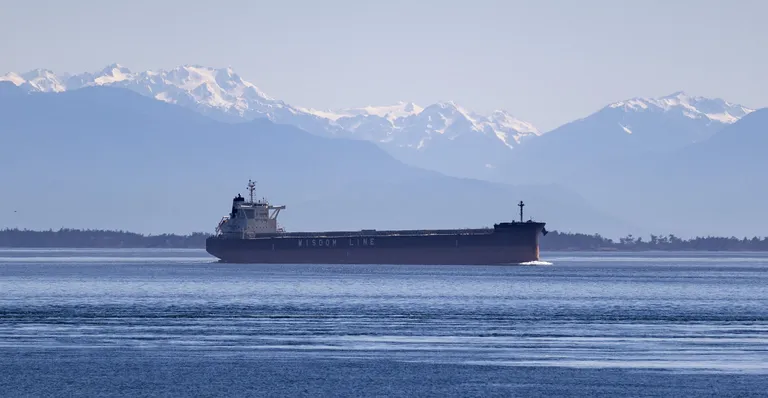
From his getaway cabin on San Juan Island, Fred Felleman has a clear view of the international shipping lanes of Haro Strait. The wide variety of big ships passing by are not just a photogenic curiosity for Felleman. They’re a personal and professional preoccupation.
“I’m an avid ship-spotter,” said Felleman, a longtime marine protection advocate and elected Seattle Port commissioner.
Felleman subscribes to ship-tracking apps on his smartphone to call up speed, course and destination info on vessels of interest. “This is my video game,” he said.
Lately, he is also paying particular attention to the ship smokestacks.
“I’m looking if there’s black smoke or white smoke,” Felleman explained. “If it’s trailing a black cloud, they’re using heavy fuel oil and not scrubbing” the exhaust.
Felleman was dismayed earlier this fall when a United Nations-led push to decarbonize the marine shipping industry went aground under threat of punitive trade sanctions from the Trump administration. Nevertheless, Pacific Northwest seaports are voyaging ahead with plans to coax their customers toward using cleaner fuels.
Clean air plans
This month, Seattle’s and Tacoma’s port commissioners gave preliminary approval to a joint clean air strategy for the next five years. The Vancouver Fraser Port Authority has a similar climate action plan and coordinates with its neighbors.
The Northwest Clean Ports emissions inventory shows that big cargo vessels are the largest source of air pollution related to the seaports. If the global shipping industry were its own country, it would rank as the world’s seventh-largest greenhouse gas emitter, according to the ClimateWorks Foundation.
Felleman, having donned his policymaker hat in place of his ship-spotter glasses, joined his fellow port commissioners in voting unanimously for the 2026-2030 Clean Air Implementation Plan. The numerous steps outlined in the plan include building out more shore power so that visiting cargo ships can plug in instead of idling at their berths.
Another section calls for electrification of trucks and cargo handling equipment on the docks. But then Felleman and the other commissioners had to navigate through the tricky shoals of how to transition oceangoing vessels to cleaner fuels. It may take years for the region to reach safe harbor on that priority.
Collision course over natural gas fuel
Before this month’s vote on the air pollution strategy, the port commission offices in Seattle and Tacoma were flooded with more than 100 public comments urging rejection of the marine industry’s current favorite alternative fuel, liquefied natural gas.
“LNG has no place in a clean air plan. It’s fracked gas,” organizer Stacy Oaks, of the climate group 350 Tacoma, testified to the Port of Tacoma Commission in October. “To include it means you’re only looking at a pinpoint when you’re looking at the problem.”
“It’s cleaner at the point of burning. So, you know, this will be a fix,” Oaks said of the argument she wanted to counter. “But that ignores … all of the life cycle emissions, where it’s leaking during the fracking, during the transport, during the storage.”
Uncombusted natural gas, or methane, is a very potent greenhouse gas when it reaches the upper atmosphere. Activists contend it takes only a modest amount of leakage to negate the climate benefits of switching ships to LNG from dirtier conventional fuels.
The Port of Tacoma staff has removed all references to LNG from the local version of their clean air blueprint. But the version applicable to the oceangoing cargo ship terminals in Tacoma and Seattle — which fall under the Northwest Seaport Alliance’s purview — keeps LNG on the table as an option to improve air quality.
“While we are not promoting the use of LNG, it would be inappropriate to remove all mention of it,” the Port of Seattle Commission wrote in a letter emailed to air plan critics earlier this month. “The reality is that the number of LNG ships in operation worldwide doubled between 2021 and 2024 and is expected to double again before the end of the decade.”
The letter also noted that port authorities do not control the fuel choices made by ship operators that call on Northwest harbors.
According to the maritime analytic firm DNV, 641 LNG-fueled ships were in operation globally by the end of last year. Shipping lines have placed orders with shipyards for over a thousand more alternative fuel container ships, tankers, car carriers and cruise ships.
DNV found that LNG-capable propulsion dominated the alternative fuel ship orders placed in 2025 with a 67% market share worldwide. Methanol-fueled engines captured most of the rest at 20%. Ammonia and hydrogen fueling bring up the rear.
The popularity of LNG as a transition fuel for shipping lines can be explained by the fact that natural gas is cost-competitive and available now at scale. The new vessels actually have dual-fuel engines as a rule. That’s so they can run on a traditional marine fuel — heavy fuel oil or diesel — when a cleaner fuel is unavailable.
LNG-fueled ships in the Salish Sea
In Puget Sound, shipping line TOTE Maritime claimed first mover bragging rights in 2023 by completing the conversion of two large cargo ships assigned to the Tacoma-Anchorage circuit to LNG propulsion using dual-fuel engines. The ships refuel at a terminal opened by Puget Sound Energy in 2022 at TOTE’s Tacoma berth. The neighboring liquefaction and gas storage facility continues to attract considerable controversy from climate campaigners opposed to new fossil fuel infrastructure.
In reply to emailed questions about whether Puget Sound Energy was prepared to sell LNG to other shipping lines, a PSE spokesperson would only say that the natural gas utility was “committed to serving our customers’ cleaner marine fuel needs.”
The British Columbia-based maritime conglomerate Seaspan also has ambitions to expand in the Salish Sea in the alternative marine fuels realm. Earlier this year, Seaspan launched ship-to-ship LNG refueling in Vancouver and Nanaimo using newly acquired LNG bunker vessels, which are akin to operating a mobile floating gas station.
“We’ll continue to desire to expand to ports in places like the Puget Sound, which includes Seattle, Tacoma, Port Angeles and the Oakland area, which includes San Francisco,” Seaspan’s energy division head Harley Penner told The Vancouver Sun recently.
Seaspan and TOTE Maritime give similar numbers for air pollution reductions from switching to LNG compared to traditional bunker fuel: 20%-27% less planet-warming carbon dioxide and dramatically less soot and smog.
Separately, ports and shipping lines in Seattle, Tacoma, Vancouver, Southeast Alaska and South Korea have arranged multiport demonstration projects dubbed “green corridors” to reduce air emissions. The Alaska cruise corridor and Northwest U.S.-Korea alliances identified green methanol as their preferred alternative to assess.
Green methanol is a synthetic fuel with the zero-emissions potential. Its drawbacks include high price, low availability, lower energy density than fossil fuel and the fact that it requires gobs of renewable electricity to produce.
Felleman wants to also promote another low-carbon fuel given that LNG is dogged by controversy and that other alternative marine fuels like methanol, hydrogen or ammonia will likely take a decade to catch on. He proposes to thread the narrows between industry preferences and climate concerns with renewable natural gas, or RNG.
Renewable natural gas — aka bio-LNG — is most commonly derived from the breakdown of landfill waste, municipal sewage or feedlot cow manure. It carries a higher price than conventional natural gas. In October, Seaspan said it partnered with renewable energy broker Anew Climate to make bio-LNG available for ship refueling.
“There needs to be significant incentives to increase the production and decrease the price of RNG because it’s the most direct way to reduce the climate impacts associated with the number of LNG-powered ships coming on line,” Felleman said.
RNG can be certified as carbon neutral, and it has the qualities of natural gas of producing less harmful particulates, nitrogen oxides and sulfur oxides than traditional bunker fuel. But as with other forms of natural gas, methane leakage can offset the benefits to the climate and port neighbors.