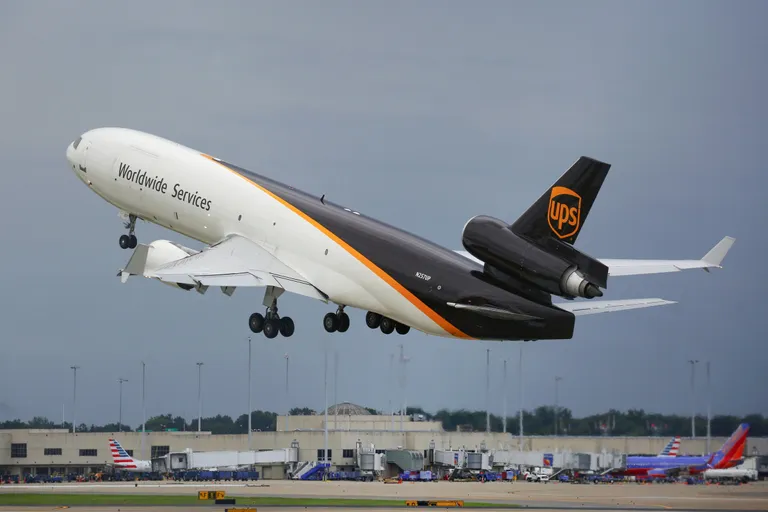
A UPS cargo jet takes off in Louisville, Ky., on July 27, 2020. (Luke Sharrett / Bloomberg)
Seattle Times business reporter
WASHINGTON, D.C. — Boeing and the Federal Aviation Administration failed to understand the safety risk related to several reports of a part fracturing on the MD-11 cargo plane over the last two decades.
That was the message delivered Tuesday as federal investigators from the National Transportation Safety Board examined events leading up to a November MD-11 crash that killed 15 people.
On 10 occasions between 2002 and 2022, Boeing received reports from MD-11 operators that the same part had fractured. That part, known as a spherical bearing race, plays a crucial role in the pylon structure, which holds the plane’s engine to its wing. In November 2025, that same part broke apart catastrophically aboard an UPS MD-11, which crashed on takeoff outside a Louisville, Ky., airport.
Boeing had determined that the previous reports of that same part failing did not indicate a safety risk and the manufacturer did not mandate any action. The FAA, which oversees Boeing and approves decisions related to potential safety concerns, does not have any record of disagreeing with Boeing on that determination.
Documents shared by the National Transportation Safety Board and testimony from Boeing and the FAA during the NTSB’s investigative hearing into the UPS MD-11 crash show gaps in the process Boeing and its regulator used to make that safety determination.
Boeing was aware of a bearing race failure in 2002 but, in internal documents responding to another failure five years later, Boeing wrote that it was the first reported incident of this type, according to the NTSB’s records. Boeing included that incorrect information in its decision to determine the 2007 failure did not pose a safety risk.
In that same document, though, Boeing said that “if left undetected” a broken bearing race could damage surrounding lugs. That’s what happened nearly 20 years later, when the UPS plane crashed in Louisville, according to the NTSB’s investigation so far.
In another 2007 instance, an MD-11 operator told Boeing that the lugs housing the spherical bearing cracked. But that information never made it into the system Boeing and the FAA use to evaluate if a broken part or unusual conditions presents a safety risk.
“Had that information come to light at the time, the determination might have been different,” said Melanie Violette, a continued operational safety technical adviser with the FAA.
Looking back on the past analysis Boeing and the FAA made regarding the spherical bearing race, Violette admitted: “The actual way things played out was not the way it was understood.”
Scott Hirsch, senior director of Boeing Commercial Airplanes’ fleet operation, said Boeing had found “a detail in the design” of the bearing race “that could lead to cracking,” following a metallurgic analysis after a reported failure of the part.
“We expected there would be bearings that were going to break,” Hirsch said. But they didn’t expect it would affect the plane’s ability to fly safely.
“We have work to do,” Hirsch said Tuesday.
The NTSB’s hearing brought together those involved in the aircraft’s manufacture, operation, inspection and maintenance to help determine where something went wrong. The NTSB will continue its investigation after the hearing before determining a likely cause and issuing recommendations.
During testimony, Hirsch and Violette said Boeing and the FAA would make different decisions if presented with all the information they had today. Both organizations said they have strengthened their processes for identifying recurring issues.
But NTSB Chair Jennifer Homendy seemed alarmed by the testimony shared Tuesday.
Sign up for Evening Brief
Delivered weeknights, this email newsletter gives you the day’s top stories and need-to-know news, as well as intriguing topics to spark conversation as you wind down from your day.
She wondered aloud if Boeing and the FAA should review thousands of previous decisions to rule a potential concern was not a safety issue.
Boeing brings about 4,000 continued operational safety reports to the FAA every year, according to Violette, from the agency. Of those, about half are considered potential safety issues, and only 50 to 100 result in mandated changes related to Boeing products.
Boeing and the FAA are aligned about 90% of their decisions related to safety risks, Violette said.
That’s little comfort to Homendy.
“What we’re all wondering is how many other components are out there that were determined to be not a safety issue that are actually a safety issue, because assumptions were made from analysis years ago,” Homendy said Tuesday. “Maybe you should take a look at those again.”
In the documents released Tuesday, the NTSB revealed that concerns with Boeing’s MD-11 were more widespread and started earlier than previously known.
The NTSB said in January that Boeing had issued a service letter to MD-11 operators in 2011 after receiving reports of four instances of the spherical bearing race failing.
On Tuesday, the board said there had been 10 reports of the same part failing, dating back to 2002, and that Boeing had issued a service letter to operators regarding the part in 2008.
In that letter, Boeing said it had updated its maintenance manual with inspection instructions related to the spherical bearing race, but did not require operators to take any action.
However, in a handwritten letter that same year to vendor ST Engineering San Antonio Aerospace, which performs some MD-11 work on behalf of UPS, Boeing advised that because of a fracture in the bearing race, the piece “must be removed and replaced prior to further flight.”
In response to questions about the discrepancy between those two directives, Boeing and the FAA said they did not have insight into the decision-making process then or were not familiar with the language of the letter to ST Engineering.
In 2011, Boeing revised its service letter related to the MD-11 to include a redesigned spherical bearing but still did not require any action.
UPS, which had faced NTSB’s questions about its own inspection processes earlier in the day, said it reviewed Boeing’s service letters and did not take any further action.
David Springer, USP’s senior director of engineering, said at the start of the day he believed UPS’s maintenance program was adequate because it was following the information it had received from Boeing. By the end of the day, he said didn’t have confidence that another accident wouldn’t occur.
“We rely on the FAA and Boeing’s determination of what safety level, hence the level of risk, rolls into the service documents,” Springer said. Boeing’s determination “drives our priorities.”
Boeing said Tuesday it is reviewing its spherical bearing and, though Hirsch couldn’t speculate on what the company’s analysis might find, he expects more recommendations are coming.
The NTSB will continue its investigative hearing Wednesday with a discuss on the design of the MD-11’s pylon, the overall structure that connects the plane’s engine to its wing.
Lauren Rosenblatt: 206-464-2927 or lrosenblatt@seattletimes.com. Lauren Rosenblatt is a Seattle Times business reporter covering Boeing and the aerospace industry.