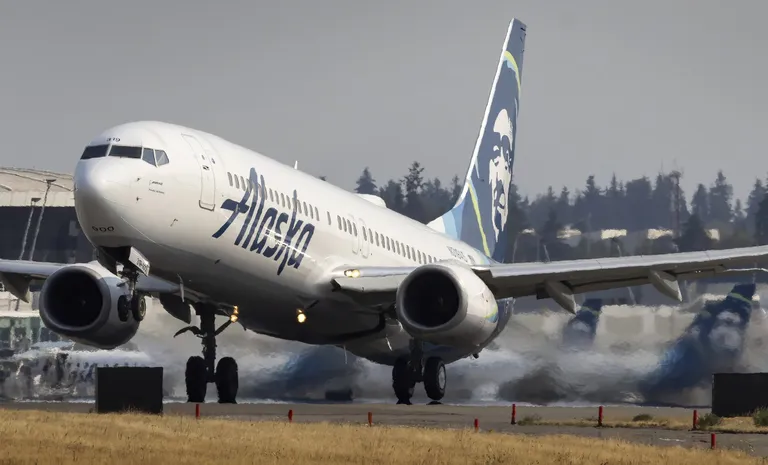
A Boeing 737 takes off at Seattle-Tacoma International Airport. On Thursday, Washington leaders launched a nonprofit committed to sustainable aviation fuel, which promises to reduce aviation carbon emissions by 80%… (Ellen M. Banner / The Seattle Times, 2024)More
Seattle Times business reporter
MUKILTEO — Washington hopes to be a leader in producing planet-friendly jet fuel — and the state’s companies, universities and elected officials say they are moving closer to that goal.
On Thursday, Washington leaders launched a nonprofit committed to sustainable aviation fuel, which promises to reduce aviation carbon emissions by 80% compared to traditional jet fuel.
The nonprofit, called the Cascadia Sustainable Aviation Accelerator, secured $20 million from state funding and a private donation to “de-risk” the production of sustainable aviation fuel, making it easier for companies, universities and institutions to study, develop and, eventually, produce the alternative fuel source.
Sustainable aviation fuel has been in the works for nearly two decades, but the industry has not taken off. SAF is slow and costly to produce and, though the technology is mature, there are few facilities producing the alternative fuel.
SAF accounted for less than 1% of annual jet fuel consumption last year, according to a December report from the International Air Transport Association.
On Thursday, Washington’s elected officials and aviation leaders gathered at Boeing’s Future of Flight museum in Mukilteo to celebrate the new initiative. Leaders from Boeing, Alaska, Amazon, Washington State University and the state Department of Commerce pledged again and again that Washington would be at the forefront of sustainable aviation, carrying on a legacy of aviation firsts in the state.
“We have all the pieces in place to ensure this once-in-a-generation economic opportunity is realized, and this accelerator will make that happen,” Gov. Bob Ferguson said.
“You have a partner in the state of Washington,” he told the aviation industry. “For this truly historic opportunity, we have to move our state forward.”
SAF is an alternative to petroleum that makes fuel from so-called “feedstocks.” There are several ways to make it, but all capture gases from renewable sources, like used cooking oils or animal waste. After a complicated process, SAF is eventually mixed with traditional jet fuel to lower carbon emissions during flight.
Related
- Runway wall caused all the deaths in 2024 South Korean plane crash, report says
- WA commits $20M to sustainable aviation
- Alaska Airlines unveils a new look, coming soon to Seattle skies
The accelerator introduced Thursday is meant to speed up both research and production, which will enable the state to produce SAF on a large scale. It will put Washington at the forefront of what the state expects will be the next economic boom in the aviation industry, the nonprofit’s leaders said.
Washington already passed legislation to accelerate permitting and environmental review for construction of clean energy plants and introduced a tax credit that provides subsidies for SAF.
At the celebratory event Thursday, Boeing announced that, starting this year, all its flights for operations and deliveries from Renton, Everett and Paine Field will fly on up to 30% SAF.
And SkyNRG, a Dutch company building a sustainable fuel production facility in Walla Walla, said Thursday it had completed state and county environmental reviews that will allow it to move forward with construction.
A ‘catalyst’ for the industry
The aviation industry has been chasing SAF for decades. Boeing conducted the world’s first test flight powered by biofuels with Virgin Atlantic in 2008.
Yet SAF production accounted for just 0.6% of annual jet fuel consumption last year, according to the December report from the International Air Transport Association.
SAF production doubled from 2024 to 2025, IATA found, totaling about 634 million gallons last year. For comparison, Seattle-Tacoma International Airport alone uses about 600 million gallons of jet fuel annually, according to the Port of Seattle.
The alternative fuel is also still pricey, IATA found. In 2025, the extra costs associated with SAF added $3.6 billion in fuel costs for the aviation industry.
On Thursday, Washington’s aviation industry nonetheless projected optimism. The accelerator it introduced is meant to tackle those problems, its supporters repeated over the course of the event.
Washington State University President Elizabeth Cantwell told the group “it’s probably late to the game to begin solving it at this scale, but it’s not too little. It’s exactly what’s needed.”
The accelerator’s list of partners is extensive: Alaska Airlines, Amazon, Boeing, the Port of Seattle, Snohomish County, the state Department of Commerce and Washington State University.
The group received $10 million in state appropriations last year and another $10 million from a philanthropic gift, said Sen. Marko Liias, a Democrat representing Edmonds. “We are now sitting on $20 million to catalyze this industry,” he said.
It’s not clear how far that funding will go, though.
SkyNRG, the Dutch company, originally estimated it would need $600 million to $800 million to get its facility up and running.
SkyNRG plant moves forward
John Plaza, the CEO of SkyNRG Americas, acknowledged at Thursday’s event that the industry has more demand for SAF than supply, but urged attendees to consider how far the initiative has come in the last 20 years.
“Lots of people like to say ‘there’s not enough SAF, we haven’t made enough progress,’” Plaza said. “Today, we’re past the theory. We’re into the implementation.”
SkyNRG set out to develop its Washington site in 2023, calling it Project Wigeon. The facility will sit on a 165-acre site at Wallula Gap and, once up and running, will produce 50 million gallons of SAF a year.
SkyNRG said Thursday the company secured approval from the state Department of Ecology and Walla Walla County to begin construction.
The company will start construction in 2028 and begin producing SAF in 2030.
Plaza declined to share how much private funding the company has for the Walla Walla facility. In 2025, the state Department of Commerce awarded a $1.5 million grant to the Port of Walla Walla to support SkyNRG’s construction of the facility.
Andy Billig, a former Washington state senator and now senior adviser for SkyNRG, said passing those environmental reviews was the hardest part of the process. The technology SkyNRG will use to make SAF is already in use elsewhere, Billig said, so he isn’t worried about putting it into practice.
“Now it feels like not easy sailing, but easier sailing,” he said.
Correction: Andy Billig’s name was misspelled in an earlier version of this story.
Lauren Rosenblatt: 206-464-2927 or lrosenblatt@seattletimes.com. Lauren Rosenblatt is a Seattle Times business reporter covering Boeing and the aerospace industry.