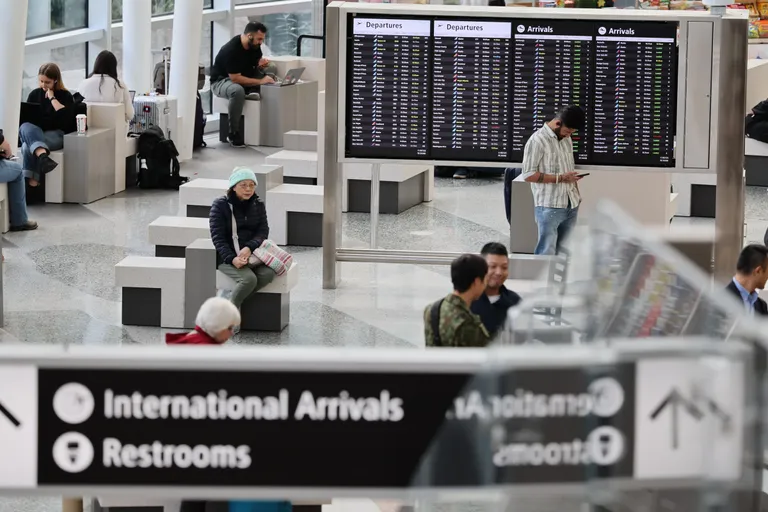
A view of the international terminal at Seattle-Tacoma International Airport last week. (Kevin Clark / The Seattle Times)
Seattle Times business reporter
As the federal government reopens, lawmakers are publicly questioning the decision-making behind the Trump administration’s mandate restricting air travel.
On Friday, U.S. Rep. Rick Larsen, D-Everett, urged the Department of Transportation and the Federal Aviation Administration to share more data behind the decision to mandate a 10% reduction in flight operations at 40 major airports. He and other Democratic lawmakers initially expressed concern that the mandate put in place last week was less about sincere safety concerns than a political negotiating ploy.
Larsen, the ranking Democratic member on the House Committee on Transportation and Infrastructure, led a group of 26 representatives in sending a letter to the DOT and FAA, seeking answers to 12 questions by mid-November.
Among those questions, lawmakers acknowledged that the FAA had “identified adverse safety trends” but asked for “specific patterns and risks” at each of the airports required to reduce operations.
The lawmakers also requested more information on how the government agencies coordinated with the aviation industry, including airlines and the unions representing pilots and flight attendants, and how it will decide when to return to normal operations.
“We understand the urgent need to address any mounting aviation safety risks. … However it appears that the administration made this decision without adequate coordination with key aviation stakeholders,” the letter read. “The unprecedented nature of the administration’s decision to suddenly and drastically limit air traffic demands congressional review.”
Larsen and other members of the Democratic Party similarly called for more transparency from the FAA immediately after it announced its plans to reduce air travel earlier this month. Chuck Schumer, the minority leader of the Senate, accused the regulator of using air travel as a political tool, limiting flights to put pressure on the Democrats to vote to reopen the government.
Sen. Patty Murray, D-Wash., last week called on the FAA to “share the actual safety data with the American public to justify these cuts.” She accused Republicans of prolonging the shutdown by refusing to talk to Democrats about rising health care costs.
“Republicans need to get their heads out of the sand,” Murray said last Friday, days before a group of Democratic senators broke ranks on Sunday and voted to reopen the government. Washington’s two Democratic senators, Sens. Murray and Maria Cantwell, voted against the bill Monday.
More about the flight cancellations
- FAA takes first steps to restore flights after shutdown strain, but some limits remain
- Airlines optimistic about quick recovery once FAA ends flight cuts
- Cancellations continue at Sea-Tac (Thursday, Nov. 13)
- What to do if your flight is delayed or canceled
- Has your flight been canceled due to the shutdown? Let us know
President Donald Trump signed a bill to reopen the government Wednesday, less than a week into the FAA’s directive to reduce flights. The FAA’s original plan required airlines to gradually reduce operations, reaching a 10% cut by this Friday, but the agency paused its directive Wednesday as the government was poised to reopen.
On Friday, the FAA again lowered its threshold for how many flights airlines must cut. Airlines are now required to reduce flights by 3% at major hubs, including Seattle-Tacoma International Airport, while the FAA assesses how to return operations to normal.
Transportation Secretary Sean Duffy has emphatically denied that the decision to reduce flights was a political maneuver. In an interview on CNN on Sunday, Duffy said the FAA’s safety team came to him with the recommendation after reviewing safety data.
Pilots had complained that air traffic controllers were not as responsive as usual and were not using the correct language, Duffy said. There were reports of planes in the wrong place on runways and aircraft getting too close to one another in the air, he continued.
“I look at that data that came from the safety team, and the trend line is going in the wrong direction, so I need to take action,” Duffy said on Sunday. “This is not political. This is strictly safety.”
Sign up for Evening Brief
Delivered weeknights, this email newsletter gives you a quick recap of the day’s top stories and need-to-know news, as well as intriguing photos and topics to spark conversation as you wind down from your day.
Jennifer Homendy, chair of the National Transportation Safety Board, praised the government’s decision last week.
“Conducting safety risk assessment and then using data to mitigate that risk is exactly what (the Transportation Department and FAA) should be doing to proactively ensure safety for the traveling public,” Homendy wrote on X.
Rep. Rick Larsen, D-Everett, is the ranking Democratic member on the House Committee on Transportation and Infrastructure. (Rod Lamkey / The Associated Press, 2021)
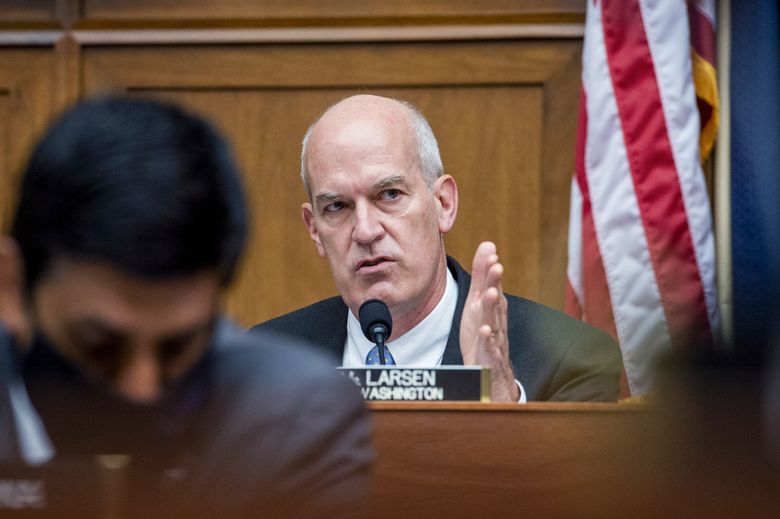
Rep. Rick Larsen, D-Everett, is the ranking Democratic member on the House Committee on Transportation and Infrastructure. (Rod Lamkey / The Associated Press, 2021)
Larsen and Democratic members of the House transportation committee asked for a briefing from the FAA and DOT to “gain further clarity into the administration’s recent decisions and next steps.”
“We all share the goal of ensuring aviation safety,” the letter concluded. “However, any actions must be data-driven, transparent and collaborative to prevent unintended consequences.”
Lauren Rosenblatt: 206-464-2927 or lrosenblatt@seattletimes.com. Lauren Rosenblatt is a Seattle Times business reporter covering Boeing and the aerospace industry.