The Airport Communities Podcast
Last week we answered a series of questions from the previous week. (We get many of the same questions every week.)
We had intended to talk about the Port of Seattle’s recent SAMP Webinar, but host JC came across the book Particles of Truth at a recent UWDEOHS seminar on community air quality projects. Researchers were enthusiastic about it and after reading it, we can understand why.
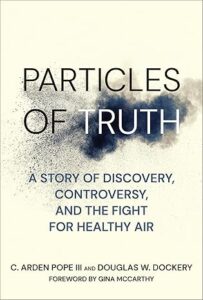 Particles of Truth provides a history of resarch on PM2.5 particles — the last addition to the list of criteria pollutants in 1997. The book discusses the challenges faced in getting funding, getting listened to, and ultimately, what it takes to obtain regulations that lead to better public health.
One of the most disappointing and confusing aspects of the Sustainable Airport Master Plan (SAMP) is not just the lack of mitigation, it’s that everyone seems to be ‘in compliance’.
How can there be so much obvious air pollution from 450,000 annual operations, and yet the results of a federally regulated study says the airport is not only currently in compliance, but even after adding almost 90,000 more operations will still likely continue to be in 2032!
We provide a thumbnail of how air pollution regulation began in the early 1970’s. How so much initial progress was made in just a few years. How it was meant to be built on. And then how industry developed techniques to push back and slow both research and further improvements to a dead stop.
This is the Casino.
It’s tough to get on the list
Before the EPA, industry would frequently rely on bogus studies to say that dangerous products, such as leaded fuels, were ‘safe’.
Another approach, still popular today, is to perform ‘economic benefit studies’ and substitute false equivalencies that terrorize the public (job killer! can’t be done!)
With the advent of NEPA, environmental regulation became a two-edged sword. Once a pollutant gets on ‘the list’, the government has tremendous authority in regulating emissions. So naturally, the requirements for getting on that list are rigorous. However, getting on the list has become increasingly harder and harder.
On a related note, industry likes to say that the regulations are not only impossible but cost prohibitive. In fact, every regulatory hurdle placed before industry has been overcome with a minimum of fuss. The results have been spectacular but because their solutions were such non-events, no one notices how much better life is without environmental lead and a proper ozone layer!
No data. No problem
But the more sophisticated approach to blocking regulation today is to support research in public, but work behind the scenes to limit funding. Since most independent research is done by universities that live off of state and federal budgets, that is a fairly simple matter.
If you don’t have data that rises to the proper level of rigor, you can never regulate. As it should be. But if you cannot regulate, agencies are also not required to measure. If you’re not required to measure, you can never get the data. Round and round we go.
That is how Sea-Tac Airport can generate so many aviation emissions and be free of compliance or mitigation requirements. Aviation-specific emissions are not on ‘the list’ of regulated emissions and not enough money is ever available to fund the work necessary to get there.
No money? No data.
No data? No problem.
Good enough
It’s as if, environmental regulation became ‘good enough’. After the most obvious catastrophes were averted, it became tougher and tougher to get public enthusiasm for more. ‘Regulation’ stopped being a word one could say in polite company and even with so many chronic health problems, funding for more work has become tougher.
Faced with so many challenges, after a while, researchers begin to self-censor; asking for only a fraction of the funds they need to make the same rapid progress they were able to achieve in the 1970’s.
It will happen
It can be slow and frustrating. And there is never the ‘community demand!’ we would hope for. Public health tends to rank high on what people say they are concerned about; low on what they choose to spend on.
Still, Particles of Truth shows that positive results still happen. Despite being unknown during the rollout of the EPA, today they are heavily regulated and by so doing have saved countless lives. These things go in cycles. As with lead, PM2.5s and so many other hazards to public health, the same will happen with aviation emissions.
2019 UW DEOHS MOV-UP Study
2020 SAMP for Dummies
2022 Where’s My Clair Patterson?
2024 Ultrafine particles linked to over 1,000 deaths per year in Canada’s two largest cities
2025 PSCAA Activates AQM
To learn the rest of the story on each of these programs: stni.info/subscribe
- Subscribe to our video feed
- Find us on all the best podcasts, including Apple and Spotify, or subscribe via SSAppleSpotifyYoutube