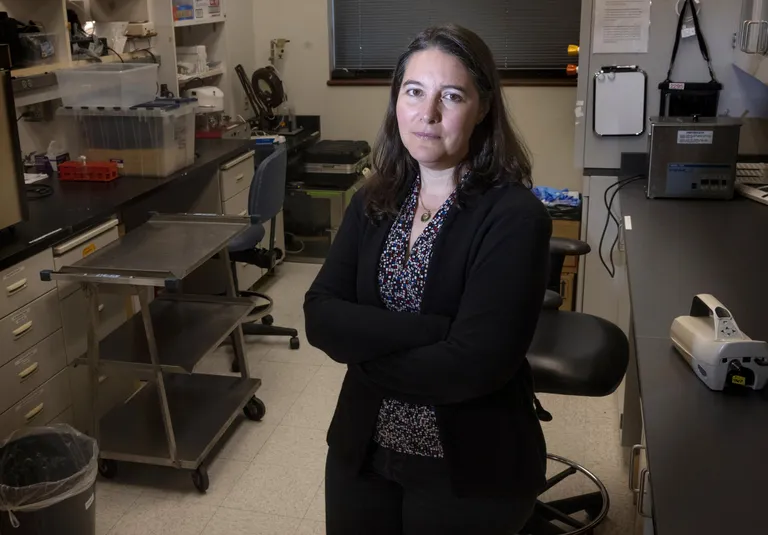
As a scientist who depends on research grants, Elena Austin of the University of Washington can’t bear to look at the DOGE grant-slashing website.
“I’ve been trying to avoid it,” she told me.
It did not, however, avoid her.
DOGE, the Elon Musk-headed Department of Government Efficiency, recently posted that a grant to Austin, an environmental health scientist in Seattle, had been tagged for elimination. Hers is one of more than 11,000 grant nullifications DOGE now displays on its “Wall of Receipts,” where it purports to tally money saved by canceling leases, contracts and grants.
With Austin’s grant, what stands out is the advertised size of the savings.
In a budget of trillions, the cost-cutting needs to be in the millions or billions to make a dent. But terminating Austin’s grant saved just $866, according to DOGE’s own accounting.
Not $866,000. Eight hundred and sixty-six bucks.
“It’s a little hard to believe, but it’s true,” she told me. “There’s three years of work behind it, and they canceled it to save $866.”
Most of the grants listed as blocked by DOGE have some link to diversity, equity or social justice work, or are for research on topics the Trump administration doesn’t believe in, like climate change.
Austin, though, studies air quality in the UW’s Department of Environmental & Occupational Health Sciences. She looks at how particulates or chemicals in the air affect people, from school kids to agricultural workers.
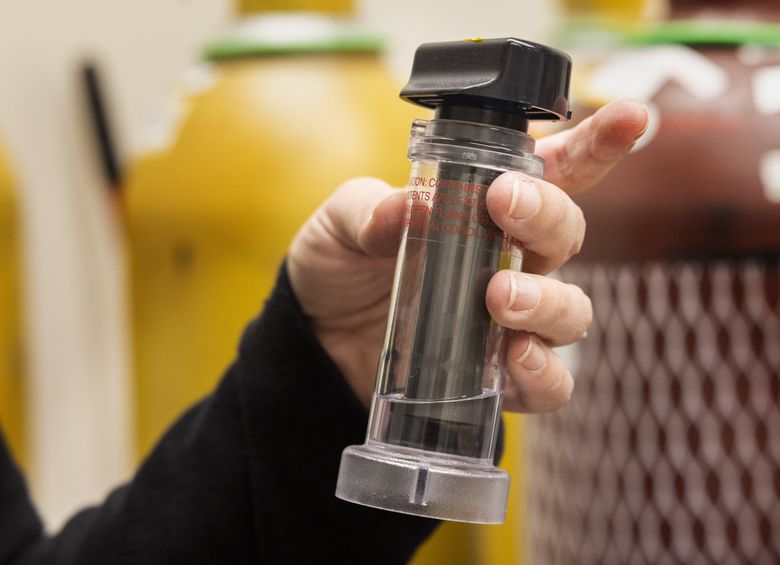
Elena Austin, a professor of environmental health at UW, holds an air quality instrument, part of a condensation particle counter, in her air quality lab Friday. (Ellen M. Banner / The Seattle Times)
Shortly after DOGE listed her grant on its trophy wall, she got a termination email. It said her grant had been zeroed out “effective immediately, on the grounds that the award no longer effectuates the program’s goals or agency priorities.”
Except the work funded by the award is largely done. The Environmental Protection Agency had given her team $548,537 in 2021 for a multiyear study on whether portable filtering systems have a material impact on the indoor air that school kids breathe.
All but $866, or 99.8% of the total, has been spent.
But now it isn’t clear whether the government even wants the results. Austin was working on writing up the findings, to present at a meeting with the EPA May 28. But with the cancellation of her grant, now that meeting has also been canceled.
“That meeting was to share our results,” she says. “But now, if it no longer fits their priorities, it seems like maybe they’re not interested in knowing the results?”
Why was the grant canceled? Other than the boilerplate listed above, Austin hasn’t been told. I asked EPA and its press office coughed up more boilerplate: “The agency determined that the grant application no longer supports Administration priorities and the award has been canceled.”
What those priorities are they didn’t say. Why cancel something that’s already done, and then cancel the meeting where you were going to receive the results you already paid for?
All in the name of efficiency.
Austin was looking at the effects of wildfire smoke and other particulates on 16 schools in Washington state. The team that included three other UW faculty assessed whether bad outdoor air was a significant factor inside classrooms, and if relatively cheap filtering machines could help.
“Given that people spend 85% to 90% of their time indoors, the quality of indoor air is likely to have a significant impact on health, even though it is outdoor air that is regulated,” explained one paper from her team.
Austin said “there’s nothing in this work having to do with equity or diversity. There isn’t an explanation I can think of for canceling it.”
In the description of her research on the DOGE site, it notes that some of the air monitoring was to be done with the Yakama Nation. The Yakama were partners, for “developing culturally-aware educational material that is in-line with requirements and regulations applicable on Yakama Nation Tribal land, and (to) help ensure that the research team does not inadvertently violate tribal sovereignty,” the grant preamble says.
Is it possible that DOGE canceled this air quality grant because it was triggered by the phrase “culturally-aware?” That’s not as bad as the Pentagon purging photos of the atomic bomb plane Enola Gay due to the word “gay.” But it would be in the same ideology run amok ballpark.
Other scientific grants have been swept up into DOGE’s net because their descriptions contained flagged words such as “underrepresented” or “misinformation.”
Austin simply doesn’t know. It’s also been reported that the EPA is canceling all grants from some funding programs, including the one Austin is in, Science to Achieve Results, or STAR. But the EPA has denied it is doing across-the-board cancellations. The agency didn’t respond to my questions about the STAR program.
Absurd as it is to void a grant to save $866, Austin now is facing far costlier problems. Nearly all the staff was laid off last week at the National Institute for Occupational Safety and Health, or NIOSH, as part of the Trump effort gutting that agency. NIOSH funds a research unit that Austin co-leads for safety studies in Northwest farming and forestry.
That research unit was set to receive $1.6 million for its work this next year, including for a study on pesticide-breathing hazards to workers who do farm spraying. Now that research is also on the chopping block.
Last week, 19 states, led by Washington and New York, sued to try to block these cuts, arguing it’s illegal for the administration to unilaterally shut down research programs that were approved by Congress.
Austin said she intends to write a report, for the schools if nothing else, as well as try to publish the work from the canceled grant in a scientific journal, so it won’t be in vain.
But from her vantage, the role of the U.S. government in scientific research, which has long led the globe, suddenly seems up in the air.
“We’re in a really hard spot right now in the research world,” Austin said.
When I was in her lab, another faculty member wandered by to talk about his own research getting the ax.
The news business is about finding answers, but this time I’ve got nothing but questions.
Is this being done out of anti-higher-ed spite? A too-hasty attempt at budget scrubbing? An ideological crusade sent off-kilter by an overly broad AI search? Incompetence?
They canceled a grant to save $866. I don’t know what else to conclude except that the answer to these questions is “yes.”
Danny Westneat: dwestneat@seattletimes.com. Danny Westneat takes an opinionated look at the Puget Sound region’s news, people and politics.
Discussion
UWDEOHS has been behind every emission study and air quality improvement program near Sea-Tac since the Sustainable Airport Master Plan was announced in 2016. Dr. Austin's particular focus has been on asthma and indoor air quality improvements for school children, including a current https://deohs.washington.edu/aaa-study and the first fixed site air quality monitoring system south of the airport coming soon.Canceling this grant is not merely a loss for research and public health. The pettiness of the decision cannot help but be discouraging for researchers in this field who struggle every year to obtain funding that should be, if anything, much larger and completely automatic.
We hope you will join us in showing your support for Dr. Austin's work, and all the work UWDEOHS is doing to improve public health.