You can think of any major airport as the most extravagant short-term parking lot imaginable, with an equally extravagant quickie-mart. Both are connected to a 1super-highway. But instead of one on and off ramp, there are many known as Standard Instrument Departures (SIDs) and Standard Terminal Arrival Routes (STARs). SIDs are the flight procedures that guide aircraft from takeoff out to the wider world (called en route), while STARs connect that wide world to the airport. It is the job of the TRACON–air traffic control–to act as traffic cop. They provide one of those procedures and sequence who goes first.
Procedures
Although it looks like a spray paint of flights, there are only a dozen or so commonly used SIDs and STARs–especially for an airport like Sea-Tac which is highly standardized. You will hear airport officials grouse about its small footprint, but it is over 97% commercial jet traffic, and has only east-west facing runways.
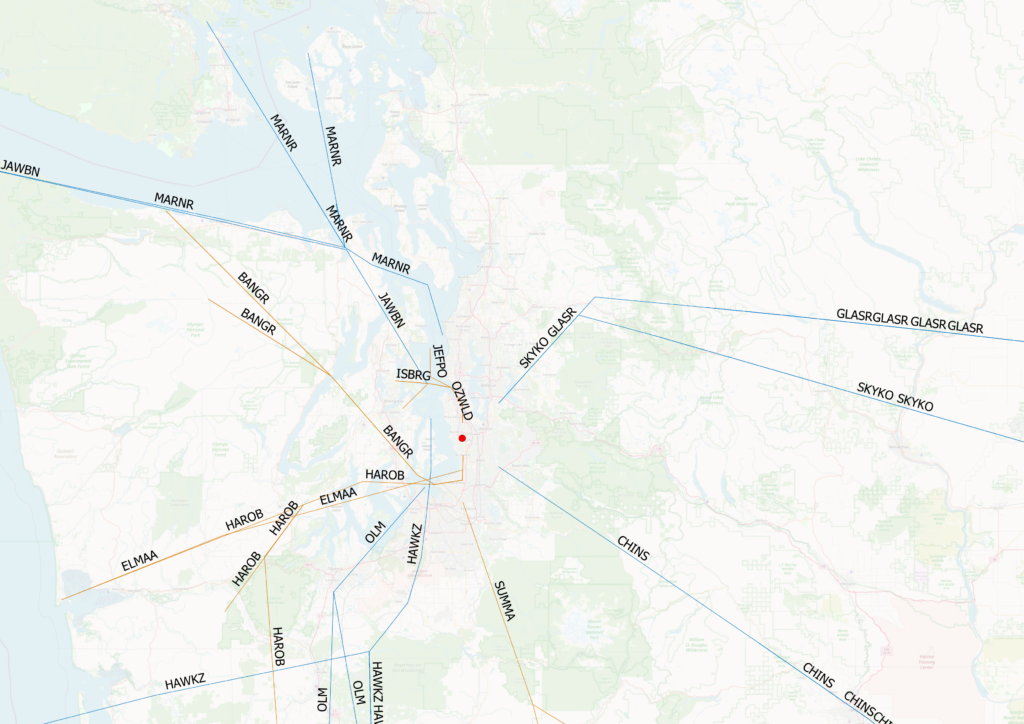
Main Flight Procedures: SIDs & STARs
| Procedure | South Flow | North Flow | ||||||
|---|---|---|---|---|---|---|---|---|
| 16L | 16C | 16R | 34L | 34C | 34R | |||
| BANGR NINE | SID | RNAV | 1 | 1 | 1 | 1 | 1 | 1 |
| ELMAA FIVE | SID | 1 | 1 | 1 | ||||
| HAROB SIX | SID | RNAV | 1 | 1 | 1 | 1 | ||
| ISBRG ONE | SID | RNAV | ||||||
| JEFPO ONE | SID | RNAV | ||||||
| MOUNTAIN TWO | SID | |||||||
| OZWLD ONE | SID | RNAV | 1 | 1 | ||||
| SEATTLE ONE | SID | |||||||
| SUMMA TWO | SID | |||||||
| CHINS FIVE | STAR | |||||||
| GLASR THREE | STAR | |||||||
| HAWKZ EIGHT | STAR | RNAV | ||||||
| JAWBN SEVEN | STAR | |||||||
| MARNR EIGHT | STAR | RNAV | ||||||
| OLYMPIA TWO | STAR | |||||||
| SKYKO ONE | STAR | |||||||
Each of those procedures has an ideal centerline, and an acceptable corridor the aircraft stays within. The procedures marked as RNAV utilize electronic navigation which makes their path (the corridor) incredibly consistent.
Loading map…
Flow
Because Sea-Tac runways are east-west, they have two flow states: north and south.
North flow: 133 days (36%) | South flow: 232 days (64%)
256 flow direction changes in 2025
NextGen
PBN (Performance-Based Navigation), a modern standard that uses RNAV (Area Navigation) has replaced the old, imprecise radio beacons with pinpoint GPS coordinates.
Concentration
The flight concentration you feel is not only because of more flights, it is because the aircraft are limited to these on/off ramps, and, every year, those ramps are, in effect, becoming more consistent, often within a few hundred feet both vertically and horizontally. Because RNAV allows pilots to fly with surgical accuracy, flight paths have become incredibly narrow and consistent. This precision is used strategically to concentrate noise over the smallest possible geographic footprint, essentially “funneling” sound over specific corridors rather than scattering it across Puget Sound. This modern choreography makes the airspace more efficient and predictable for controllers, but it also makes the neighborhoods directly under these satellite-guided tracks experience a heavy, repetitive concentration of overhead traffic.
https://seatacnoise.info/?page_id=36887&preview=true
Altitude
Every procedure also comes with a descent profile which is often referred to as a ‘glide slope’. That is a misnomer. The aircraft use power to provide a controlled and smooth descent. The glide slope is a radar beacon generated by antennas at the ends of the runways to provide the proper angle of descent–three degrees.
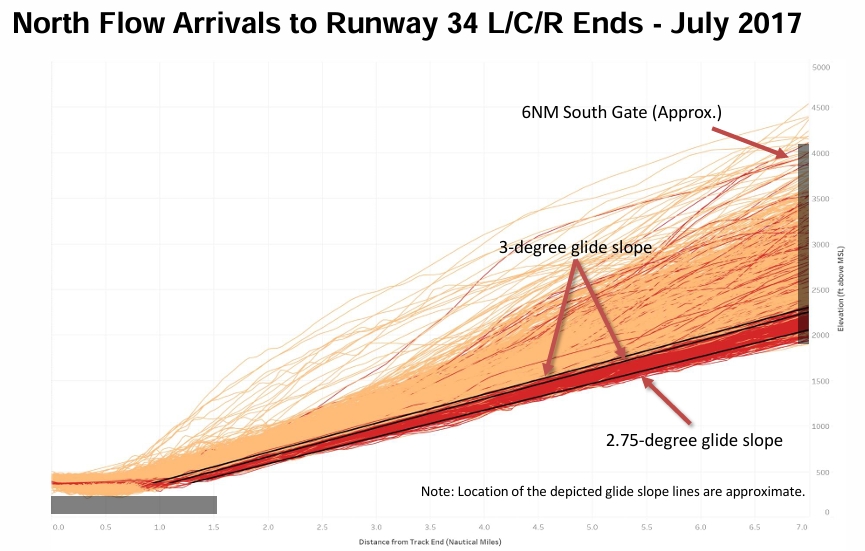 As with x and y axes, the glide slope is remarkably consistent. However, there will be some outliers and there are no hard requirements.
Residents often insist that flights are coming in lower and lower over time. According to both the Port’s analysis, and our analysis of 12 months of flight tracks, that is not the case. Most of this perception comes with the increase in flights and with the fact that the pilot has control over descent.
1Two sets of superhighways. Every major airport is also tightly integrated with one or more roadway systems. An airport is never really a destination. Its success depends on how efficiently it moves people and cargo in and out.