TagRv(3131)
Excerpt generated from Relevanssi PDF content
-
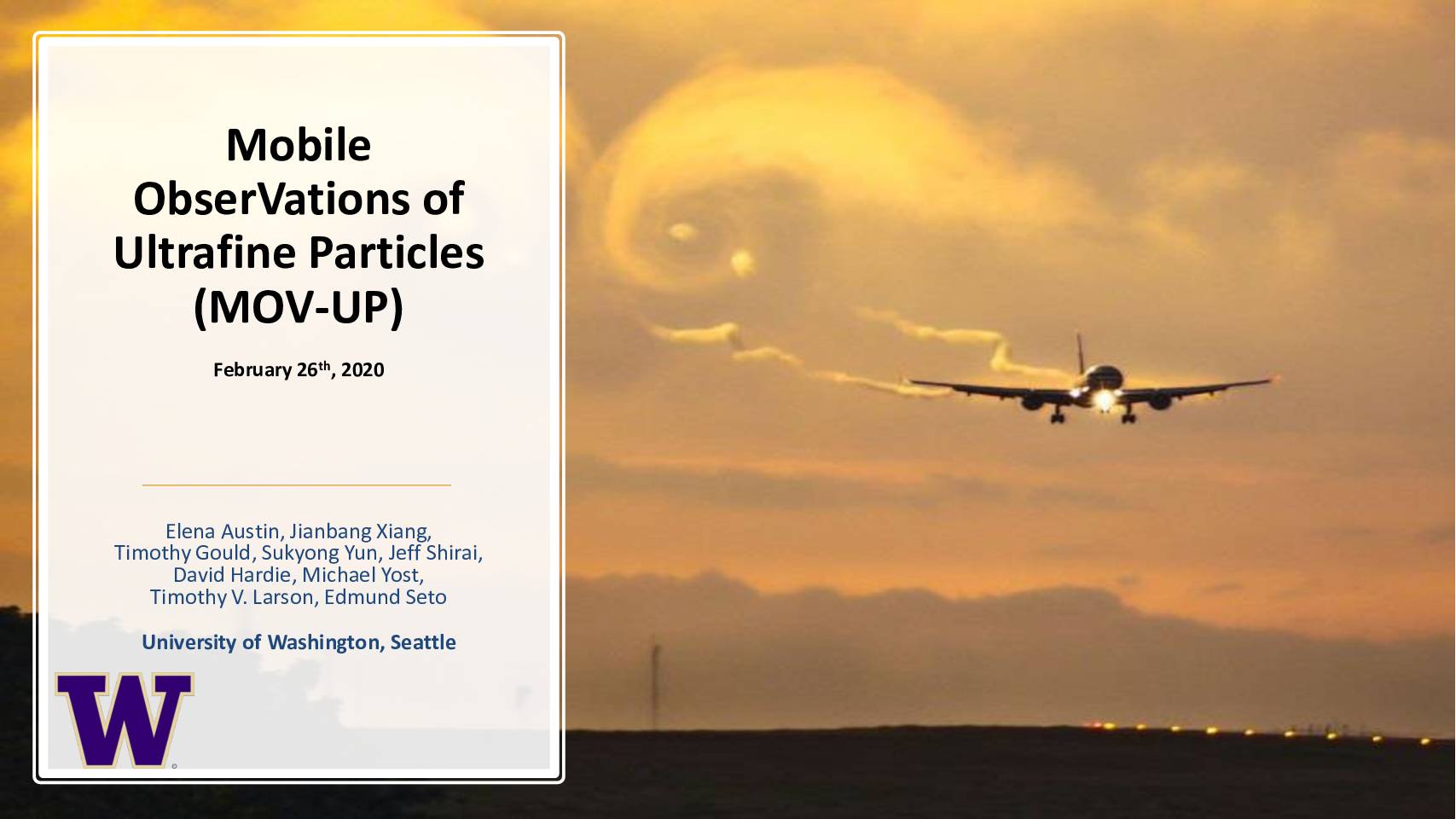
StART Feb 26 2020 Presentation 2 UW MOV UP Study
• Study the implications of air traffic at Sea-Tac • Assess the concentrations of ultrafine particulate matter (UFP) in areas surrounding and directly impacted by air traffic • Distinguish between and compare concentrations of aircraft- related and other sources of UFP • Coordinate with local governments, and share results and solicit feedback from community Community Engagement Funding for the MOV-UP study was provided to the University of Washington by a proviso in the state budget. Study Advisory Group *3 meetings to date Ongoing communication with community *6 meetings to date e.g., Highline Forum, Federal Way City Council, Seattle/King Board of Health, Airport Impacts Meeting Media Coverage Important characteristic of Ultrafine Particles • They have a large amount of surface area, relative to their size. • They are small enough to enter the bloodstream, cross the placenta, and cross the blood-brain barrier. • Because they are small, they have very little mass. • Typically, they are measured differently than PM2.5, which includes larger particles, and therefore has appreciable mass that can be weighed. Ultrafine Particles (UFPs) Ultrafine Particles unregulated but potentially important Health Effects more uncertain compared to PM2.5 ,but a growing body of evidence Diesel Engines emit ultrafine particles resulting in elevated levels near major roadways (within 200 meters downwind) Jet aircraft directly emit “ultra” ultrafine particles (< 30 nanometers) Study Region: Mobile Transects and Fixed Monitoring Site Locations Mobile Monitoring Platform Parameter Instrument Mobile and Fixed sampling: Particle number concentration (35 nm – 1 µm) P-Trak 8525, w/ diffusion… -
StART Feb 26 2020 Presentation 1 late night noise
Number of Exceedances Percent of Ops Exceeding EVA Air 130 83 64% FedEx Express 98 46 47% China Airlines Cargo 38 30 79% Air Transport Intl. 207 19 9% Cargolux 18 16 89% Atlas Air 11 7 64% Korean Air Cargo 16 5 31% Alaska Airlines 820 5 1% Delta Air Lines 445 4 1% United Airlines 224 3 1% Omni Air Intl. 14 1 7% Southwest Airlines 196 1 Less than 1% Airlines That Operated With No Noise Exceedances Q4 Airline Total Late Night Operations American Airlines 220 Horizon Air 175 JetBlue 98 Cathay Pacific 65 Spirit Airlines 41 Sun Country Airlines 32 Frontier Airlines 30 Compass Airlines 23 SkyWest Airlines 21 Hawaiian Airlines 14 CargoJet 10 ABX Air 9 Kalitta Air 3 Sky Lease Cargo 1 Condor 1 *These airlines will also be contacted by Port staff Tracking the Data Q3 to Q4 Third Quarter 2019 Fourth Quarter 2019 Total Late Night Operations 3874 2960 Total Ops Exceeding Thresholds 239 143 departures / 96 arrivals 220 139 departures / 81 arrivals Percent of Total Ops Exceeding 6% 7% Percent of Exceeding Ops Cargo/Passenger 62% Cargo – 38% Passenger 56% Cargo – 44% Passenger EVA Air • Operates two Boeing 777 departures to Taipei per night • Very good response and communication after Q3 results • Meaningful dialog has resulted in planned change to the quieter Boeing 787 in May 2020 • Change presents many operational challenges to EVA • Outreach and appreciation • Communication with EVA will continue… -
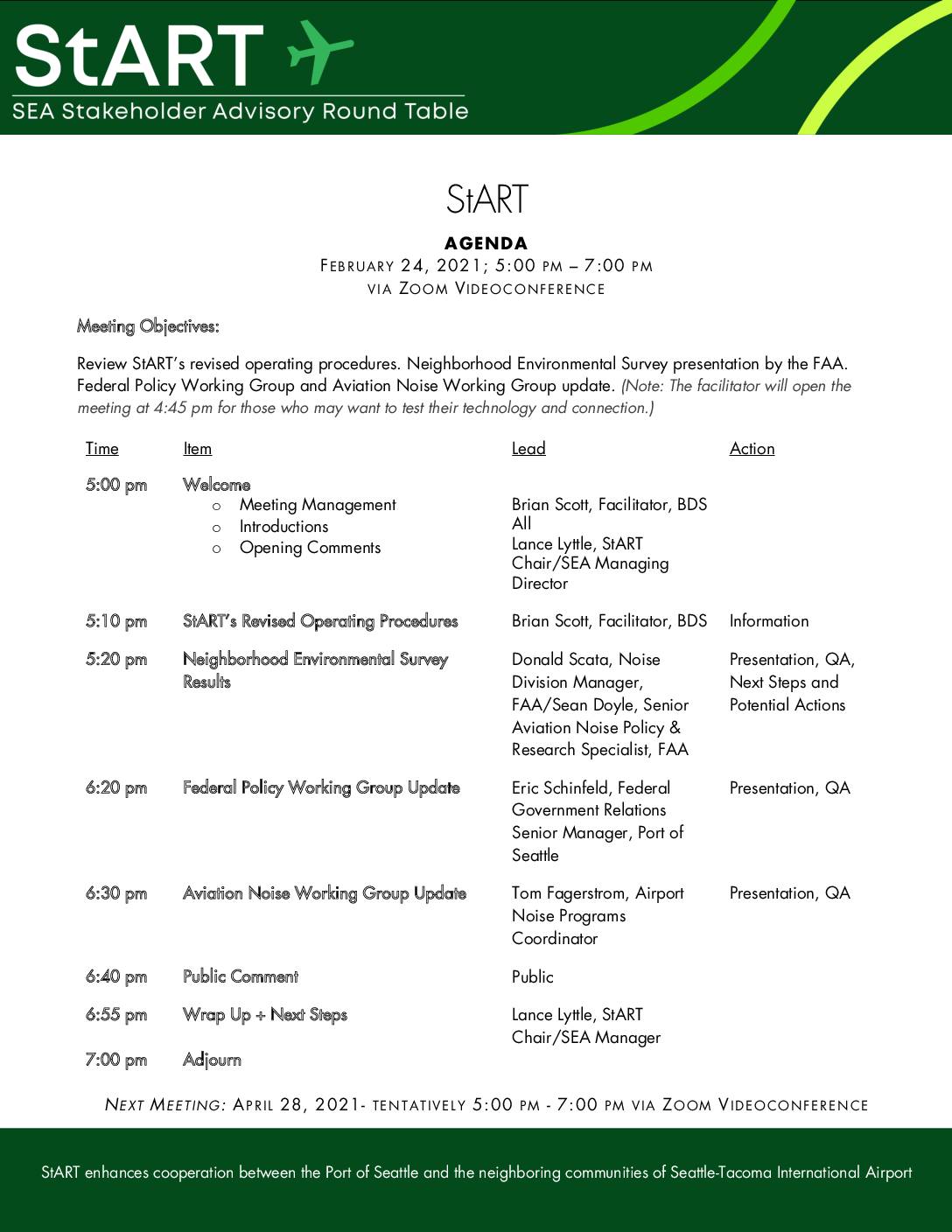
StART Feb 24 2021 agenda
StART enhances cooperation between the Port of Seattle and the neighboring communities of Seattle-Tacoma International Airport StART AGENDA FEBRUARY 24, 2021; 5:00 PM – 7:00 PM VIA ZOOM V IDEOCONFERENCE Meeting Objectives: Review StART’s revised operating procedures. Neighborhood Environmental Survey presentation by the FAA. Federal Policy Working Group and Aviation Noise Working Group update. (Note: The facilitator will open the meeting at 4:45 pm for those who may want to test their technology and connection.) Time Item Lead Action 5:00 pm Welcome o Meeting Management o Introductions o Opening Comments Brian Scott, Facilitator, BDS All Lance Lyttle, StART Chair/SEA Managing Director 5:10 pm StART’s Revised Operating Procedures Brian Scott, Facilitator, BDS Information 5:20 pm Neighborhood Environmental Survey Results Donald Scata, Noise Division Manager, FAA/Sean Doyle, Senior Aviation Noise Policy & Research Specialist, FAA Presentation, QA, Next Steps and Potential Actions 6:20 pm Federal Policy Working Group Update Eric Schinfeld, Federal Government Relations Senior Manager, Port of Seattle Presentation, QA 6:30 pm Aviation Noise Working Group Update Tom Fagerstrom, Airport Noise Programs Coordinator Presentation, QA 6:40 pm Public Comment Public 6:55 pm Wrap Up + Next Steps Lance Lyttle, StART Chair/SEA Manager 7:00 pm Adjourn NEXT MEET ING : APR I L 28, 2021- TENTAT IVELY 5:00 PM - 7:00 PM V IA ZOOM V IDEOCONFERENCE -
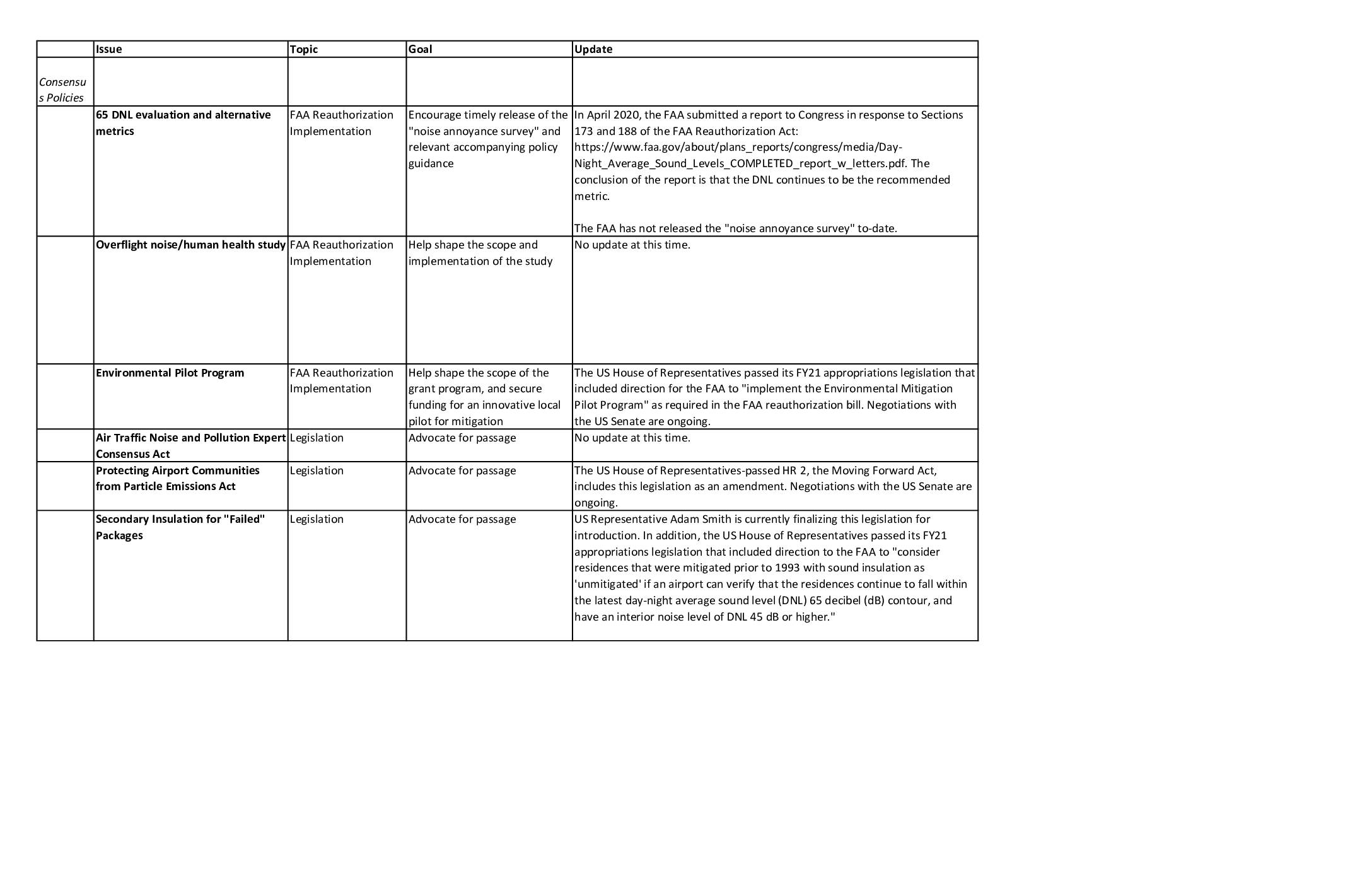
StART DRAFT Fed Advocacy Plan
In April 2020, the FAA submitted a report to Congress in response to Sections 173 and 188 of the FAA Reauthorization Act: https://www.faa.gov/about/plans_reports/congress/media/Day- Night_Average_Sound_Levels_COMPLETED_report_w_letters.pdf. The conclusion of the report is that the DNL continues to be the recommended metric. The FAA has not released the "noise annoyance survey" to-date. Overflight noise/human health study FAA Reauthorization Implementation Help shape the scope and implementation of the study No update at this time. Environmental Pilot Program FAA Reauthorization Implementation Help shape the scope of the grant program, and secure funding for an innovative local pilot for mitigation The US House of Representatives passed its FY21 appropriations legislation that included direction for the FAA to "implement the Environmental Mitigation Pilot Program" as required in the FAA reauthorization bill. Negotiations with the US Senate are ongoing. Air Traffic Noise and Pollution Expert Consensus Act Legislation Advocate for passage No update at this time. Protecting Airport Communities from Particle Emissions Act Legislation Advocate for passage The US House of Representatives-passed HR 2, the Moving Forward Act, includes this legislation as an amendment. Negotiations with the US Senate are ongoing. Secondary Insulation for "Failed" Packages Legislation Advocate for passage US Representative Adam Smith is currently finalizing this legislation for introduction. In addition, the US House of Representatives passed its FY21 appropriations legislation that included direction to the FAA to "consider residences that were mitigated prior to 1993 with sound insulation as 'unmitigated' if an airport can verify that the residences continue to fall within the latest day-night… -
StART Dec 11 2019 presentation two
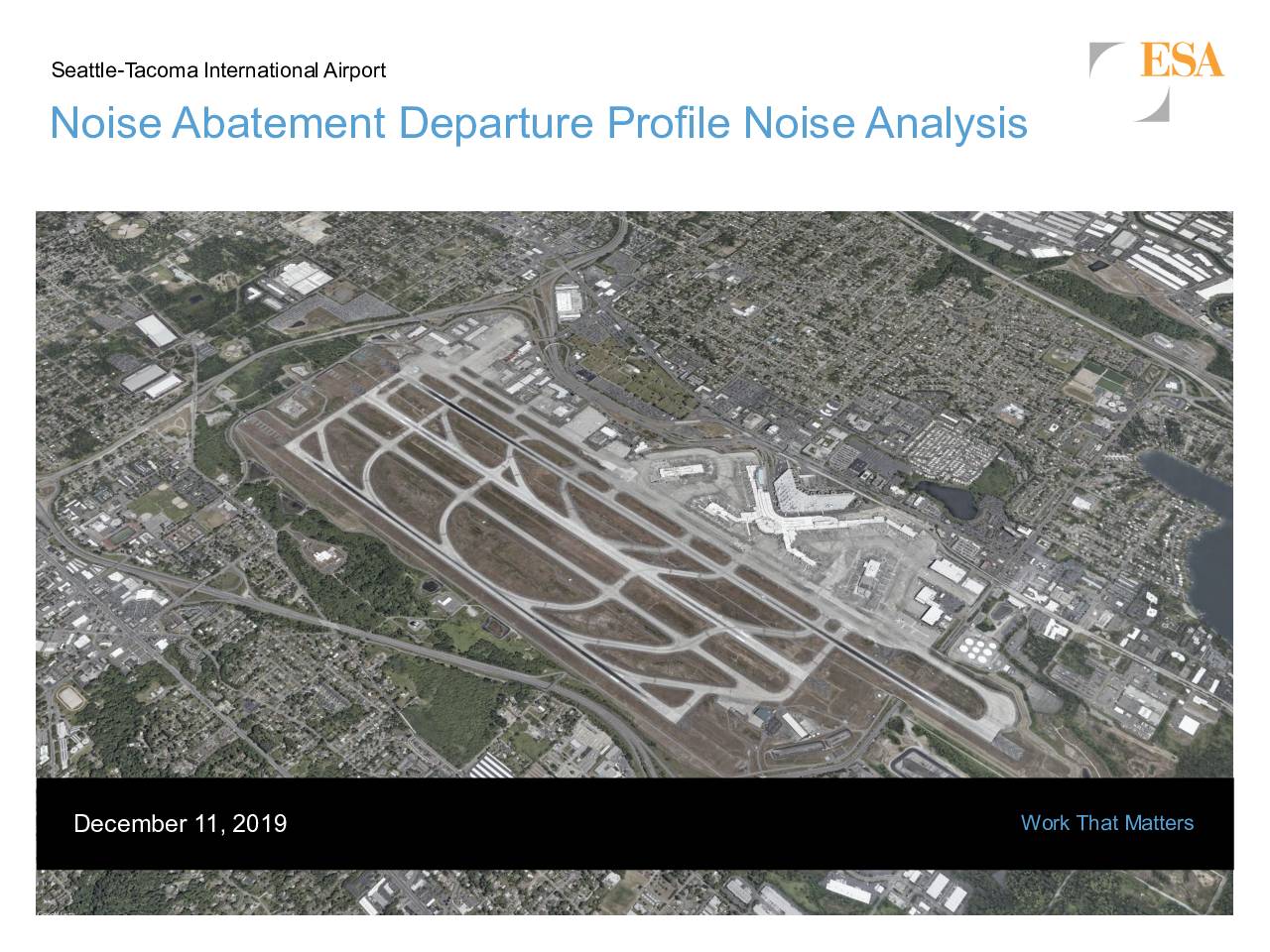
• Two Noise Abatement Departure Profiles (NADPs) are followed domestically and internationally: the Close-in and Distant departure profiles • A Close-in NADP is more beneficial in abating noise in areas closer to the runway end; while a Distant NADP is more beneficial in abating noise in areas farther down the departure corridor • A Distant NADP appears to provide the most benefits to the developed areas in the SEA environs Key Points esassoc.com PORT OF SEATTLE Presentation Overview • Introduction • Background on Abatement Departure Profiles • Review the SEA NADP Noise Analysis Results • Recommendations • Respond to Questions from StART Members esassoc.com PORT OF SEATTLE • To determine the NADPs currently in use at Seattle-Tacoma International Airport (SEA), ESA surveyed five airlines operating Boeing 737-800s at SEA • The existing NADPs were normalized to Stage Length 4 conditions and aircraft noise exposure was modeled using the Aviation Environmental Design Tool (AEDT) • ESA compared the Sound Exposure Level (SEL) Contours and Grid Point values for the Close-In and Distant NADPs for four runway ends: 16L, 16C, 34R, and 34C • The analysis identified a preferred NADP for use at SEA Introduction esassoc.com PORT OF SEATTLE • After the technical work was completed and presented to the StART Working Group on October 14, 2019, Delta Air Lines conducted a internal review of its response to the NADP Survey • As a result of that review, Delta Air Lines determined that its survey response incorrectly reflects the NADP that it… -
Elements of Part 150 and Community Roundtables Info Sheet
Elements of Part 150 Noise Compatibility Programs and Community Roundtables Information Sheet Changes in airport operations, airspace procedures, aviation infrastructure, and technology can have impacts on communities. Part 150 studies and community roundtables are two methods by which airports and the FAA can help communities understand and participate in recommending changes to aviation services in their community.1 There are benefits to each approach, and many airports could be well-served by employing both strategies in a complementary manner. For example, an airport that is preparing to update its Part 150 program may be well-supported if there is already an effective roundtable in place, leading to more effective community participation in the Part 150 process. Similarly, a community roundtable may benefit from the periodic benchmarking and documentation of conclusions in a formal, approved Part 150 Noise Compatibility Program. Since 1983, more than 275 airports nationwide have taken advantage of the voluntary Part 150 Noise Compatibility Program, which provides a structured process for airports to engage with communities, airlines and other user groups as well as the FAA, with the goal of reducing incompatible land uses. A Part 150 study is a discrete undertaking intended to involve all stakeholders in evaluating current and future noise impacts, and identifying measures to mitigate them. It can result in recommendations for strategies to improve noise compatibility of existing and future development around airports such as changes in flight procedures and local zoning, land acquisition, sound insulation, and others. Federal funding for some solutions, such as sound… -
StART Dec 11 2019 presentation one
To be used when use of RWY16C is limited due to weather Utilizes an intersection departure (RWY16L at Echo) Arrivals parking north of Box 77 (center of terminal) will taxi behind aircraft departing, reducing the number of crossings downfield Potential efficiency gain from fewer crossings CURRENT PROCEDURES NEW PROCEDURES WORKGROUP FINDINGS Efficiency gains Largely dependent on A/C not needing 16L for arrival or full-length departure Use of RWY16C for departures not likely Not as efficient as keeping standard procedures and utilizing RWY16C strategically Increased complexity New “focus areas” Taxi-in times will likely increase, even for A/C parking south of Box 77 Determined not to be feasible Seattle Airport�End-Around taxi Procedure�proposal General overview CURRENT PROCEDURES NEW PROCEDURES WORKGROUP FINDINGS -
StART Dec 11 2019 Meeting Recap
StART enhances cooperation between the Port of Seattle and the neighboring communities of Sea-Tac Airport December 11, 2019 Recap The Sea-Tac Stakeholder Advisory Round Table (StART) meeting took place on December 11, 2019 with a focus on discussing the results of the Noise Abatement Departure Profiles Noise Analysis, recapping the Federal Policy Working Group’s and Aviation Noise Working Group’s meetings, and getting an update on the end-around taxi procedure. This voluntary, advisory roundtable, convened by Seattle-Tacoma International Airport Managing Director Lance Lyttle, is a venue for the Port of Seattle to engage with the communities of SeaTac, Burien, Des Moines, Normandy Park, Tukwila and Federal Way. Representatives from Delta Air Lines, Alaska Airlines, and Lynden Transport are also members. The Federal Aviation Administration (FAA) participates as a non-member. The Airport Operations Director, Laurel Dunphy, chaired the meeting in the absence of Lance Lyttle. Dunphy acknowledged and thanked two of the community representatives who will not be returning in 2020 - Trina Cook, Tukwila community representative, and Earnest Thompson, Normandy Park community representative. She also announced that Port representatives will be meeting with representatives from the cities who have temporarily suspended their involvement in StART on December 17. Dunphy reviewed several StART accomplishments in 2019 and shared that Lyttle is committed to continuing the work with the communities. Dunphy reminded cities that StART community representative terms are up at the end of the year and that cities can re-nominate current members or nominate new members to serve on StART. It was… -
StART Dec 4 2019 Airport Cities Federal Policy Letter FAA
We are writing to share our priorities for implementation of the Subtitle D—Airport Noise and Environmental Streamlining section of the Federal Aviation Administration (FAA) Reauthorization Act of 2018. We look forward to your swift and successful completion of these provisions. Seattle-Tacoma International Airport (Sea-Tac) is the 8th busiest airport in the country in terms of passenger volumes and one of the fastest growing – increasing from approximately 31 million travelers served in 2010 to almost 50 million last year. The airport plays a vital role in the region’s ongoing economic vitality, but this growth is straining the capacity of our airport and having significant impacts on our communities. For this reason, the Port of Seattle (which owns and operates Sea-Tac) and the six cities immediately surrounding the airport have identified federal policies, regulations and programs we believe are essential to help address local community concerns. In particular, we have looked at the 2018 FAA Reauthorization Act’s noise provisions as a way to substantively move forward on noise abatement and mitigation. As existing law with definitive deadlines for action, these items provide the most near-term opportunities for progress. While all of the Subtitle D noise provisions are important, we have identified three top priorities – 1) the provisions related to evaluation of the 65 DNL noise standard (sections 173, 187 and 188), 2) the study of the impact of overflight noise on human health (section 189), and 3) the proposed environmental mitigation pilot program (section 190). The timely and effective execution… -
StART Dec 4 2019 Airport Cities Federal Policy Letter Congressional
The Honorable Patty Murray The Honorable Maria Cantwell United States Senate United States Senate The Honorable Adam Smith The Honorable Pramila Jayapal United States House of Representatives United States House of Representatives The Honorable Rick Larsen United States House of Representatives Dear Senator Murray, Senator Cantwell, Representative Smith, Representative Jayapal and Representative Larsen, We are pleased to write to share our collectively developed near-term priorities for addressing airplane noise and emissions through implementation of existing law and passage of relevant legislation. We look forward to working with you and your staff toward swift and successful completion of these provisions. Seattle-Tacoma International Airport (Sea-Tac) is the 8th busiest airport in the country in terms of passenger volumes and one of the fastest growing – increasing from approximately 31 million travelers served in 2010 to almost 50 million last year. The airport plays a vital role in the region’s ongoing economic vitality, but this growth is straining the capacity of our airport and having significant impacts on our communities. For this reason, the Port and the six cities immediately surrounding the airport have identified federal policies, regulations and programs that we believe are essential to help address local community concerns. Specifically, we have looked at two areas of focus: 1) implementation of provisions of the 2018 Federal Aviation Administration (FAA) Reauthorization Act, and 2) passage of legislation that helps address ongoing issues of concern: FAA Reauthorization Provisions While all of the Subtitle D noise provisions are important, we have identified three top…