TagHighline Forum(259)
https://www.portseattle.org/page/highline-forum
The Highline Forum provides Southwest King County municipalities, educational governing bodies, and the Port of Seattle with the opportunity to share information, interact with outside speakers and other governmental organizations, and work in partnership on initiatives that benefit the residents of Southwest King County.
One elected representative and one senior administrator from the following jurisdictions or institutions make up the membership of the Highline Forum:
- City of Burien — Councilmember Alex Andrade and City Manager Adolfo Bailon
- City of Des Moines — Mayor Yoshiko Grace Matsui and City Manager Katherine Caffrey
- City of Federal Way — Mayor Jim Ferrell and Councilmember Lydia Assefa-Dawson
- City of Normandy Park — Councilmember Jack Lamanna and City Manager Amy Arrington
- City of SeaTac — Councilmember Joe Vinson and City Manager Jonathan Young
- City of Tukwila — Councilmember Armen Papyan and Policy Analyst Laurel Humphrey
- Highline College — Vice President for Institutional Advancement Josh Gerstman and External Relations Shakira Ericksen
- Highline School District — School Board Member Angelica Alvarez and Superintendent Dr. Ivan Duran
- Port of Seattle — Commissioner Hamdi Mohamed and Aviation Managing Director Wendy Reiter
An elected representative from the Port of Seattle (Commissioner Hamdi Mohamed) and a jurisdiction or institution co-chair (shared by Tukwila Council President Armen Papyan and SeaTac Councilmember Joe Vinson) moderate the meetings.
Learn more about the Highline Forum and what’s ahead this year.
Sign up to receive Highline Forum updates by email, including meeting agendas and summ
-
2018 01 30 SM 7a supp
Advance this Region as a Leading Tourism Destination – Increase visitors and visitors expenditures throughout Washington state – Expand utilization of the Port’s assets Maximize Value of Tourism Throughout Washington Tourism Marketing Partnership • Supports Port’s goal to grow economic opportunity • Demonstrates partnership with travel organizations • Demonstrates Port’s leadership in visitor industry Promoting Statewide Tourism Source: UNWTO 2017 Program Highlights • Received 32 applications from throughout the state • Over $270,000 in funding requested • Review committee selected a total of 18 recipients – Twelve outside King County • Port invested $150,000 • Matching funds from recipients will exceed $100,000 -
2018-01-30 SM 7a
BRIEFING ITEM Date of Meeting January 30, 2018 DATE: January 12, 2018 TO: Dave Soike, Interim Executive Director FROM: Dave McFadden, Managing Director, Economic Development Division Ron Peck, Director, Tourism Development Department SUBJECT: 2017 Tourism Marketing Support Program Summary EXECUTIVE SUMMARY On April 11, 2017 the Commission received an update on the program and a list of recommended recipients for the 2017 program. The briefing for January 30, 2018 will recap the 2017 program and identify planned changes for the 2018 Tourism marketing support program. Tourism Marketing Support Recipients The Port of Seattle developed a partnership to facilitate tourism development and growth across the state by promoting use of Port facilities. For 2018 the Commission increased the Tourism Marketing Support program by $50,000, taking the Port’s commitment from $150,000 in 2017 to $200,000 in 2018. The additional $50,000 is to be awarded to organizations engaged in cultural, eco, sustainable, or nature tourism travel related activities. The overall intent of the program is to provide matching support of up to $10,000 each to local communities, destination marketing organizations, ports, chambers of commerce, tribal organizations and non-profits to promote their destinations to visitors traveling to our state. The funds must be used for advertising, publicizing, promoting or distributing information to attract visitors to the destination. The program requires a two to one match. In other words, in order to receive two dollars from the POS, the destination marketing organization must demonstrate a one dollar contribution to the effort. COMMISSION AGENDA – Action… -
2017 10 24 RM 7a attach 4
Attachment 4: Transfer of Airport Property to EDD Additional details: If the property is currently generating revenues, these revenues factor into the calculation of revenue sharing (50%) and serve to reduce passenger airline cost per enplaned passenger (CPE). Eliminating this revenue source for the airport would thus increase CPE. Proceeds from the sale would be in the form of a cash transfer to the Airport Development Fund. This will then provide additional cash to fund future capital improvements at the airport. Cash funded assets are amortized and charged to the airline rate base so that the impact is essentially the same as if the asset was debt funded. Thus, CPE would be the same. If the property was noise property funded (in part) with FAA noise grants, then the share of proceeds from the sale equivalent to the original grant funded share of the property when it was acquired, would be treated as grant money for purposes of reinvestment. Among other conditions, this means the capital costs of new assets funded with this money would be excluded from the airline rate base. In this case, there would be a CPE benefit. In summary, while the airport benefits from having more cash to fund capital improvements, the impact on CPE is not as clear. If the property generates income, the net effect is likely an overall increase in CPE due to reduced revenue sharing. This could be offset to some extent if the reinvested money is treated as grant money. Item… -
2017 10 24 RM 6c supp
Pearse Edwards, Director, Government Relations, Port of Seattle Eric ffitch, Manager, State Government Relations, Port of Seattle Trent House, Contract Lobbyist, Port of Seattle Item No. 6c Date: October 24, 2017 Status Check-in • Agenda status: – Presented to Commission on 10/10 – Received written feedback before and after 10/10 presentation – Current version has redline additions to reflect feedback – Seeking Commission adoption in today’s meeting Questions? Priority Agenda Items • Transportation access to Sea-Tac Airport: Support funding for a partnership between the Port of Seattle and the Washington State Department of Transportation to conduct a study of State Route 518 to address current and future corridor needs related to increased regional development that will affect transportation demand on that corridor. – Improvements to this critical regional transportation corridor will reduce congestion and improve safety as the growth of the Seattle-Tacoma International Airport adds increasing pressure to communities surrounding the airport and to an already over- subscribed state transportation asset. Focus on Growing Jobs, Increasing Opportunities • Workforce development: Support proposals to enhance state investments in workforce development in the maritime, manufacturing, and industrial sectors. This may include possible amendments to port statute to clarify the authority of port districts to continue to play a role in workforce development in these sectors. ‒ In this way, the Port can continue on a path of leadership in providing opportunities to the region’s young people while supporting our business partners in their search for skilled workers. Priority Agenda Items – Continued… -
2017-10-24 RM 6c
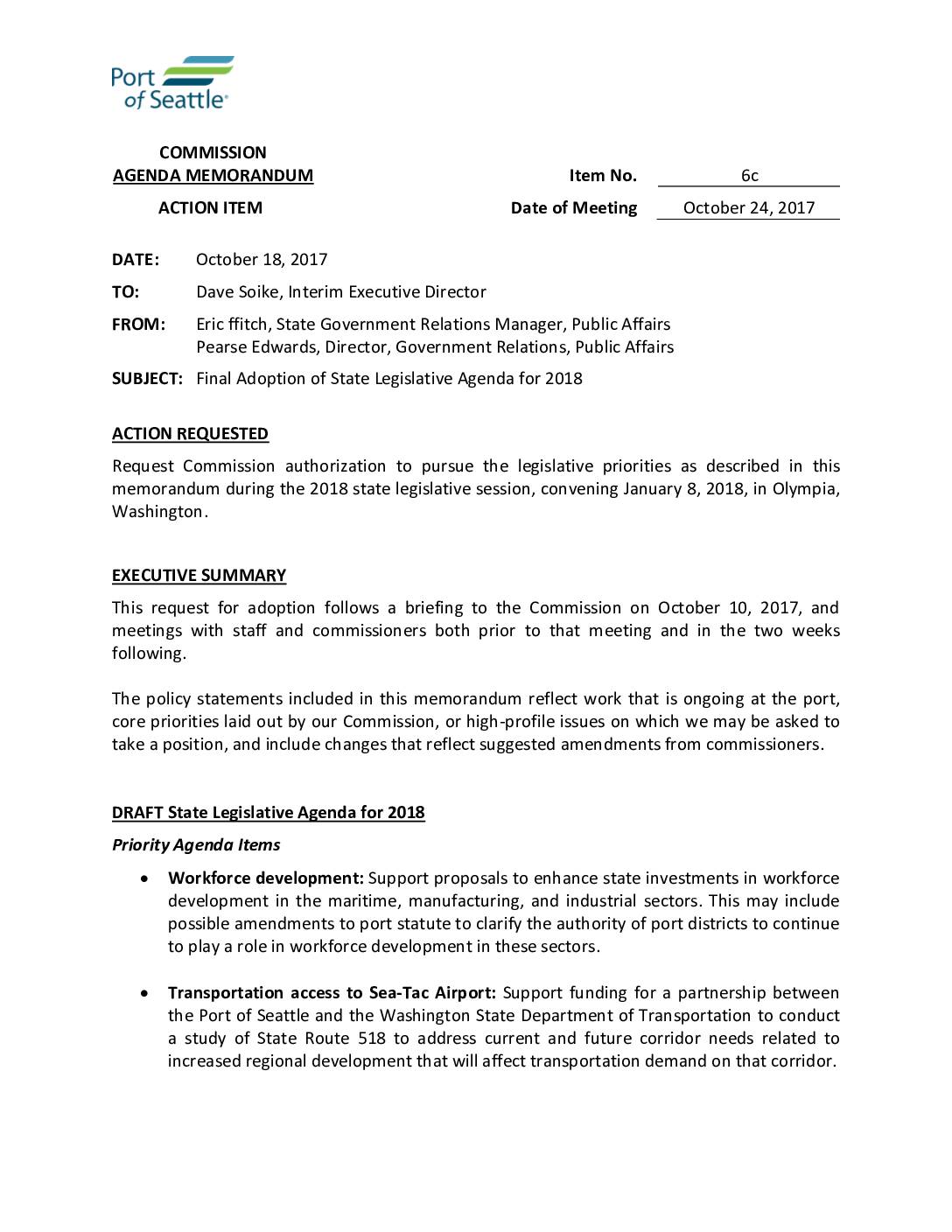
ACTION ITEM Date of Meeting October 24, 2017 DATE: October 18, 2017 TO: Dave Soike, Interim Executive Director FROM: Eric ffitch, State Government Relations Manager, Public Affairs Pearse Edwards, Director, Government Relations, Public Affairs SUBJECT: Final Adoption of State Legislative Agenda for 2018 ACTION REQUESTED Request Commission authorization to pursue the legislative priorities as described in this memorandum during the 2018 state legislative session, convening January 8, 2018, in Olympia, Washington. EXECUTIVE SUMMARY This request for adoption follows a briefing to the Commission on October 10, 2017, and meetings with staff and commissioners both prior to that meeting and in the two weeks following. The policy statements included in this memorandum reflect work that is ongoing at the port, core priorities laid out by our Commission, or high-profile issues on which we may be asked to take a position, and include changes that reflect suggested amendments from commissioners. DRAFT State Legislative Agenda for 2018 Priority Agenda Items • Workforce development: Support proposals to enhance state investments in workforce development in the maritime, manufacturing, and industrial sectors. This may include possible amendments to port statute to clarify the authority of port districts to continue to play a role in workforce development in these sectors. • Transportation access to Sea-Tac Airport: Support funding for a partnership between the Port of Seattle and the Washington State Department of Transportation to conduct a study of State Route 518 to address current and future corridor needs related to increased regional development that will affect transportation… -
2017 10 24 RM 6b motion
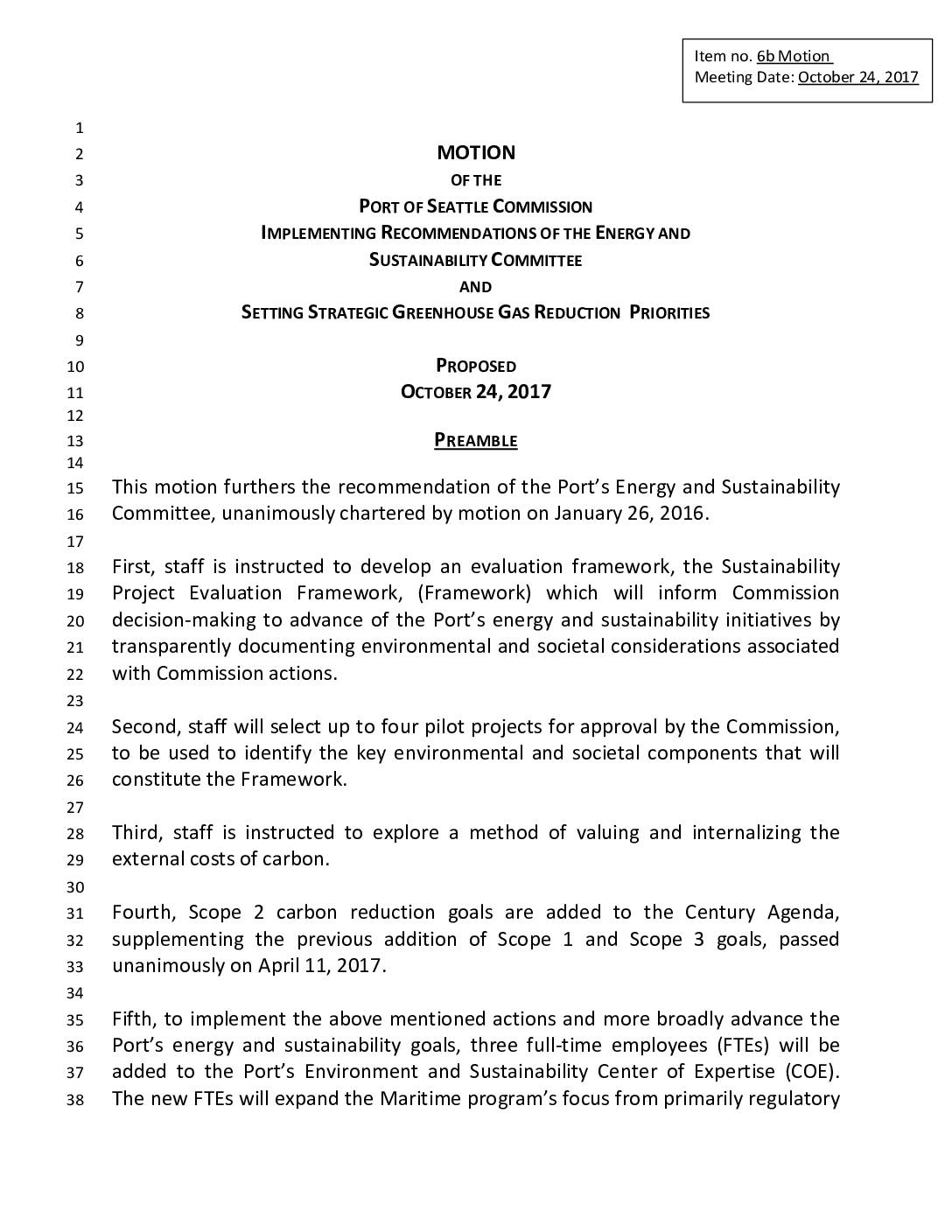
This motion furthers the recommendation of the Port’s Energy and Sustainability 15 Committee, unanimously chartered by motion on January 26, 2016. 16 First, staff is instructed to develop an evaluation framework, the Sustainability 18 Project Evaluation Framework, (Framework) which will inform Commission 19 decision-making to advance of the Port’s energy and sustainability initiatives by 20 transparently documenting environmental and societal considerations associated 21 with Commission actions. 22 Second, staff will select up to four pilot projects for approval by the Commission, 24 to be used to identify the key environmental and societal components that will 25 constitute the Framework. 26 Third, staff is instructed to explore a method of valuing and internalizing the 28 external costs of carbon. 29 Fourth, Scope 2 carbon reduction goals are added to the Century Agenda, 31 supplementing the previous addition of Scope 1 and Scope 3 goals, passed 32 unanimously on April 11, 2017. 33 Fifth, to implement the above mentioned actions and more broadly advance the 35 Port’s energy and sustainability goals, three full-time employees (FTEs) will be 36 added to the Port’s Environment and Sustainability Center of Expertise (COE). 37 The new FTEs will expand the Maritime program’s focus from primarily regulatory 38 COMMISSION AGENDA – Briefing Item No. 7e Page 2 of 5 Meeting Date: October 24, 2017 compliance to include environmental sustainability. It will also increase resources 39 in Aviation Facilities and Infrastructure to meet the new Century Agenda goals. 40 Sixth, Port staff will coordinate with the Northwest Seaport… -
2017 10 24 RM 6b attach 2
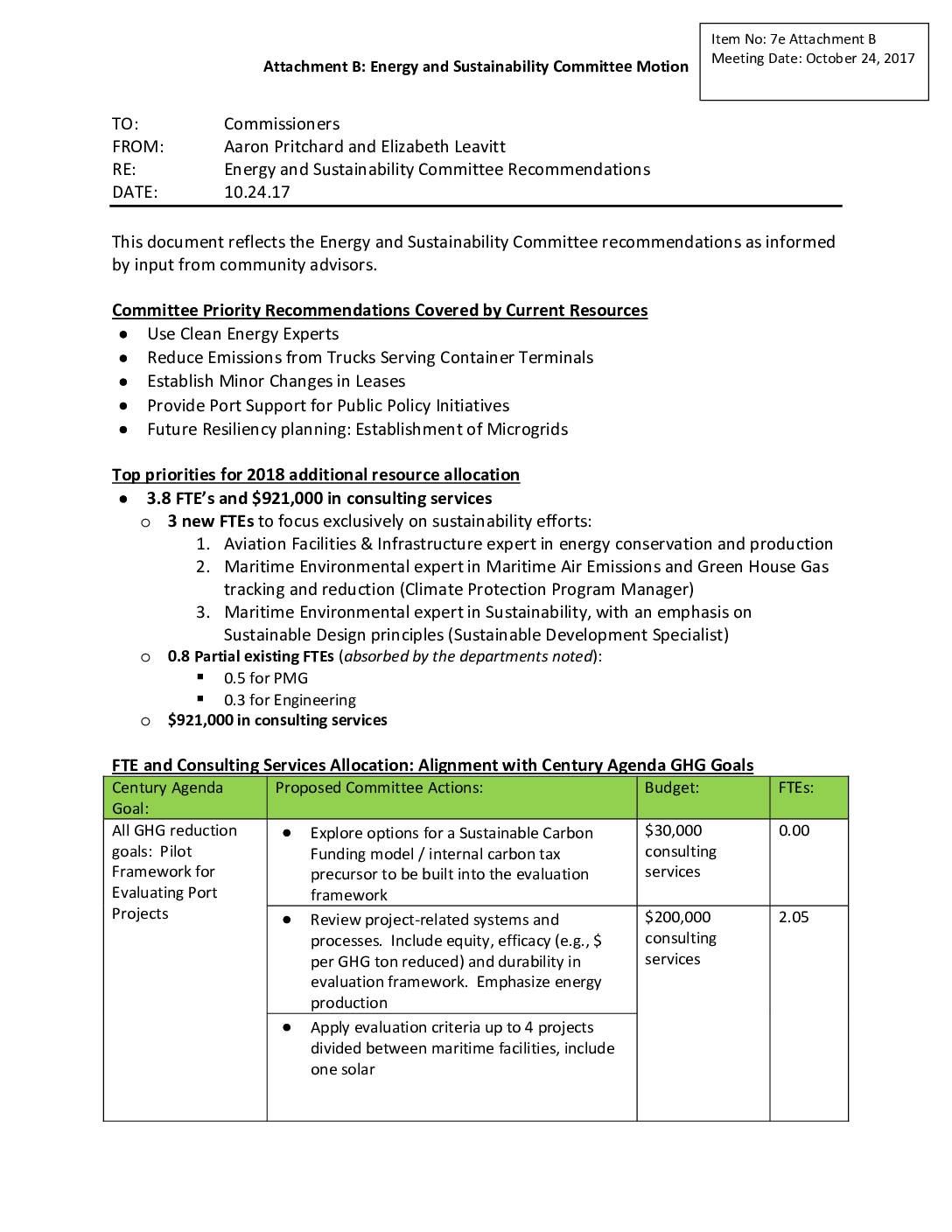
Attachment B: Energy and Sustainability Committee Motion Item No: 7e Attachment B Meeting Date: October 24, 2017 TO: Commissioners FROM: Aaron Pritchard and Elizabeth Leavitt RE: Energy and Sustainability Committee Recommendations DATE: 10.24.17 This document reflects the Energy and Sustainability Committee recommendations as informed by input from community advisors. Committee Priority Recommendations Covered by Current Resources • Use Clean Energy Experts • Reduce Emissions from Trucks Serving Container Terminals • Establish Minor Changes in Leases • Provide Port Support for Public Policy Initiatives • Future Resiliency planning: Establishment of Microgrids Top priorities for 2018 additional resource allocation • 3.8 FTE’s and $921,000 in consulting services o 3 new FTEs to focus exclusively on sustainability efforts: 1. Aviation Facilities & Infrastructure expert in energy conservation and production 2. Maritime Environmental expert in Maritime Air Emissions and Green House Gas tracking and reduction (Climate Protection Program Manager) 3. Maritime Environmental expert in Sustainability, with an emphasis on Sustainable Design principles (Sustainable Development Specialist) o 0.8 Partial existing FTEs (absorbed by the departments noted): 0.5 for PMG 0.3 for Engineering o $921,000 in consulting services FTE and Consulting Services Allocation: Alignment with Century Agenda GHG Goals Century Agenda Goal: Proposed Committee Actions: Budget: FTEs: All GHG reduction goals: Pilot Framework for Evaluating Port Projects • Explore options for a Sustainable Carbon Funding model / internal carbon tax precursor to be built into the evaluation framework $30,000 consulting services 0.00 • Review project-related systems and processes. Include equity, efficacy (e.g., $ per… -
2017 10 24 RM 6b attach 1
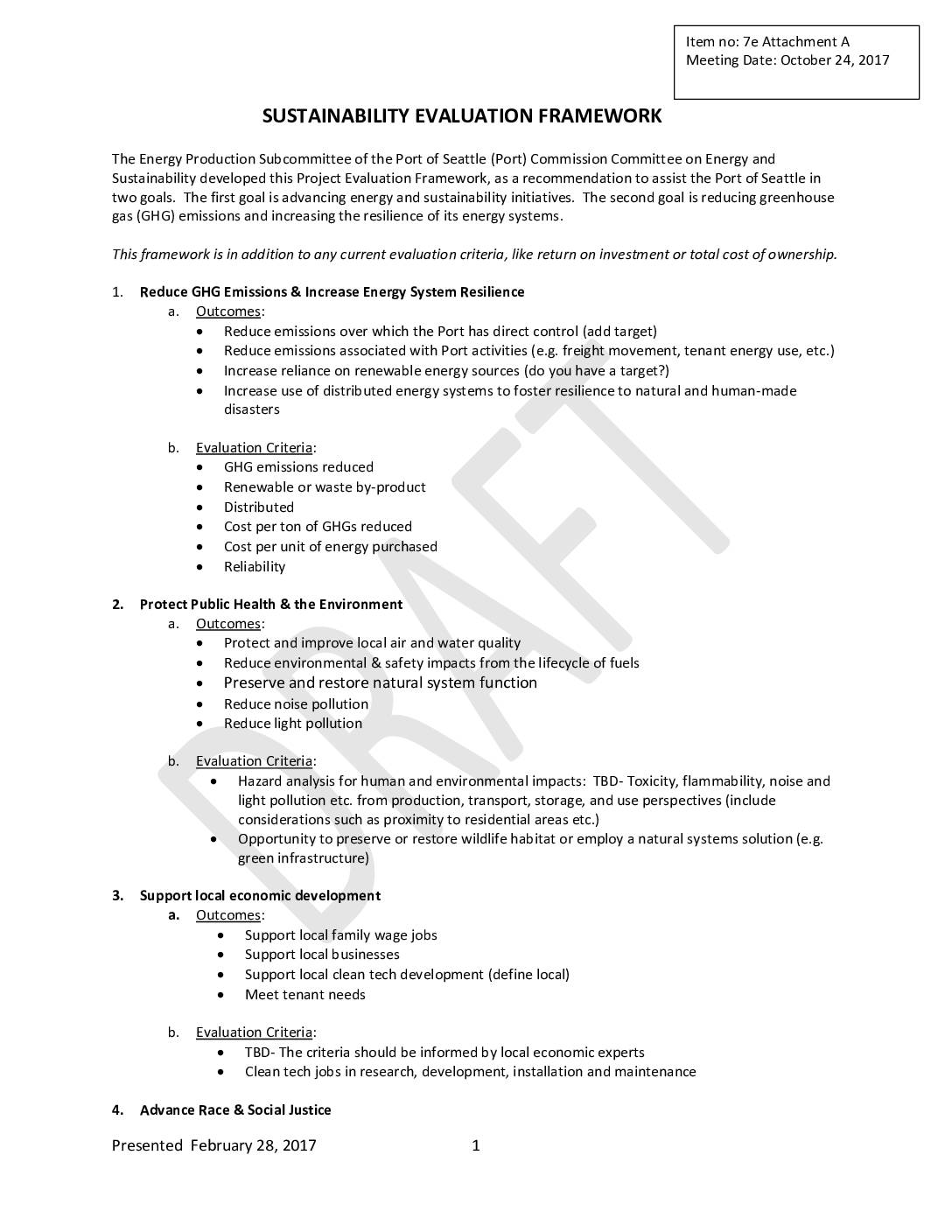
The Energy Production Subcommittee of the Port of Seattle (Port) Commission Committee on Energy and Sustainability developed this Project Evaluation Framework, as a recommendation to assist the Port of Seattle in two goals. The first goal is advancing energy and sustainability initiatives. The second goal is reducing greenhouse gas (GHG) emissions and increasing the resilience of its energy systems. This framework is in addition to any current evaluation criteria, like return on investment or total cost of ownership. 1. Reduce GHG Emissions & Increase Energy System Resilience a. Outcomes: Reduce emissions over which the Port has direct control (add target) Reduce emissions associated with Port activities (e.g. freight movement, tenant energy use, etc.) Increase reliance on renewable energy sources (do you have a target?) Increase use of distributed energy systems to foster resilience to natural and human-made disasters b. Evaluation Criteria: GHG emissions reduced Renewable or waste by-product Distributed Cost per ton of GHGs reduced Cost per unit of energy purchased Reliability 2. Protect Public Health & the Environment a. Outcomes: Protect and improve local air and water quality Reduce environmental & safety impacts from the lifecycle of fuels Preserve and restore natural system function Reduce noise pollution Reduce light pollution b. Evaluation Criteria: Hazard analysis for human and environmental impacts: TBD- Toxicity, flammability, noise and light pollution etc. from production, transport, storage, and use perspectives (include considerations such as proximity to residential areas… -
2017-10-24 RM 4c
ACTION ITEM Date of Meeting October 24, 2017 DATE: October 16, 2017 TO: Dave Soike, Interim Executive Director FROM: Dave Caplan, Senior Director, Strategic Initiatives SUBJECT: Adoption of 2018-2022 Long Range Plan ACTION REQUESTED Request Commission approval of the 2018 – 2022 Long Range Plan. EXECUTIVE SUMMARY This approval request is for adoption and implementation of the 2018-2022 Long Range Plan (LRP). The LRP is an official document that contains the five-year plans to achieve the Century Agenda and High Performance Organization (HPO) strategies. The Century Agenda LRP lists sixteen objectives distributed among four strategies. The High Performance Organization portion of the LRP lists eleven objectives distributed among five strategies. Each objective lists 1 – 4 key priority actions that the Port of Seattle is focused on from 2018 – 2022. Each priority action lists 1 –5 milestones to be achieved in 2018. The Commissioners raised the following points in the Oct. 10th request for approval: Century Agenda Objective 1: GROW SEAPORT ANNUAL CONTAINER VOLUME TO MORE THAN SIX MILLION TWENTY-FOOT EQUIVALENT UNITS (TEUs). It was requested we develop actions to impact the customer container demand of the Northwest Seaport Alliance (NWSA). To this end, the following milestone has been added: “Explore opportunities to expand utilization of Foreign Trade Zone #5 in partnership with NWSA and other public/private stakeholders.” Century Agenda Objective 10: “INCREASE THE PROPORTION OF FUNDS SPENT BY THE PORT WITH QUALIFIED SMALL BUSINESS FIRMS ON CONSTRUCTION, CONSULTING, GOODS AND SERVICES TO 40 PERCENT OF THE… -
Highline Forum Agenda Final 2017-11-15
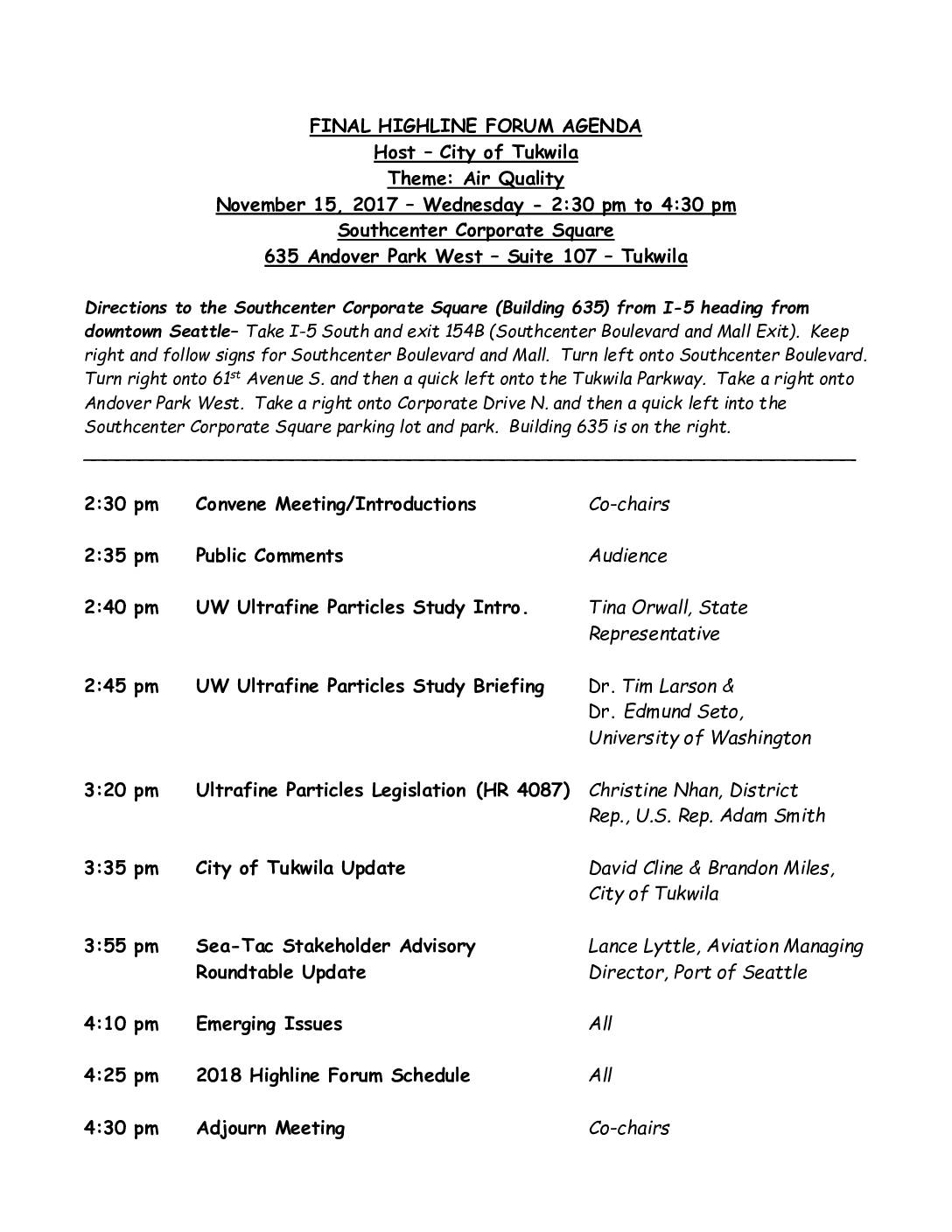
November 15, 2017 – Wednesday - 2:30 pm to 4:30 pm Southcenter Corporate Square 635 Andover Park West – Suite 107 – Tukwila Directions to the Southcenter Corporate Square (Building 635) from I-5 heading from downtown Seattle– Take I-5 South and exit 154B (Southcenter Boulevard and Mall Exit). Keep right and follow signs for Southcenter Boulevard and Mall. Turn left onto Southcenter Boulevard. Turn right onto 61st Avenue S. and then a quick left onto the Tukwila Parkway. Take a right onto Andover Park West. Take a right onto Corporate Drive N. and then a quick left into the Southcenter Corporate Square parking lot and park. Building 635 is on the right. __________________________________________________________________ 2:30 pm Convene Meeting/Introductions Co-chairs 2:35 pm Public Comments Audience 2:40 pm UW Ultrafine Particles Study Intro. Tina Orwall, State Representative 2:45 pm UW Ultrafine Particles Study Briefing Dr. Tim Larson & Dr. Edmund Seto, University of Washington 3:20 pm Ultrafine Particles Legislation (HR 4087) Christine Nhan, District Rep., U.S. Rep. Adam Smith 3:35 pm City of Tukwila Update David Cline & Brandon Miles, City of Tukwila 3:55 pm Sea-Tac Stakeholder Advisory Lance Lyttle, Aviation Managing Roundtable Update Director, Port of Seattle 4:10 pm Emerging Issues All 4:25 pm 2018 Highline Forum Schedule All 4:30 pm Adjourn Meeting Co-chairs