Solve for Sea-Tac. Solve for every airport community
Develop local solutions here at Sea-Tac Airport, based on the Sea-Tac Communities Plan of 1976 (STCP).
The STCP was the first of its type in the nation and still the only comprehensive blueprint for a sustainable airport community vision.
Today, there are many airport groups across the nation advocating for relief via the FAA and Congress. We support their efforts. However, after decades of resistance, we now realize that much of this work could always have been done here!
Due to geography, history and politics, Sea-Tac Airport has always presented one of the most challenging environments for surrounding communities. Finding solutions that work here, work everywhere. Make Sea-Tac Airport the pilot for mitigations and policies that scale. Solve for Sea-Tac. Solve for every airport community.
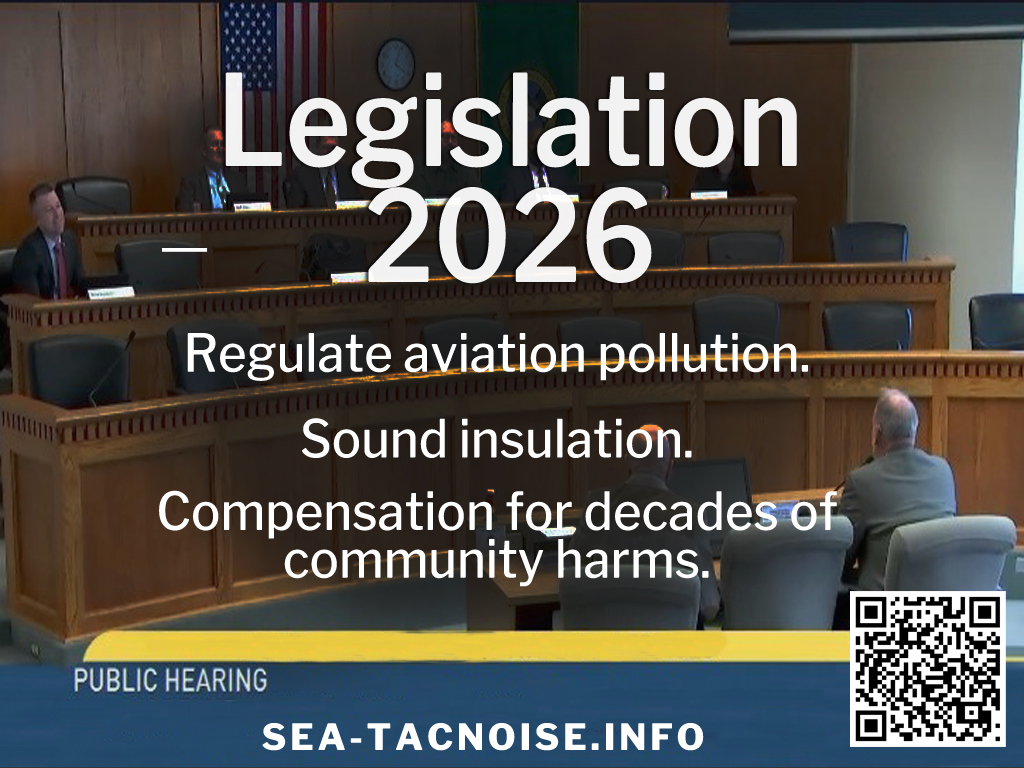
The STNI 2026 Legislative Agenda
Solutions for every level of government
Cities
Airport Community Manager
Every aspect of airport mitigation is technically daunting and requires ongoing, professional engagement. The Port of Seattle maintains full-time on-call expertise on every aspect of airport impacts and planning. Local communities should pool resources and create a permanent, full-time professional manager, to monitor the airport and identify opportunities. The current approach of reacting to each airport expansion in an ad hoc manner has only led to a series of failures and resentments. Discussion.
Fixed Site Air Quality Monitoring Network
The key to obtaining regulatory authority starts here. When 2025 began there was one aviation air quality monitoring station in Puget Sound. By end of year there may be three. It is to their great credit that the University of Washington and Puget Sound Clean Air Agency (PSCAA) have largely standardized on both equipment and procedures. But we can’t stop there.
Cities like Burien, Normandy Park, Federal Way and Seattle (White Center) can follow Des Moines’ lead and establish their own sites, creating the first 360 degree monitoring network in the nation – an important goal from the Sea-Tac Communities Plan!
Challenge: Several well-meaning bills at the federal level constantly talk about doing something nationally. But we are already doing it ourselves. The only help we need is funding.
Port of Seattle
Sound insulation
The Port should provide a simple solution for thousands of bad Port Packages going back to the 1990’s by committing three million dollars a year of their own money to the state fund created by SB5955. Establish a first-come, first serve program based on San Francisco International Airport model. Abandon the (voluntary) DNL65 – a 50 year old standard that never properly addressed the public health impacts of aviation noise and pollution.
Grant Reform
For decades, the Port has provided a series of community grant programs, funded only by the Property Tax Levy, that are highly inefficient, with onerous matchi requirements, small sizes, and very narrow purposes. They have continually argued that all these limitations are legally necessary under the State Constitution. That was never true. It is one thing to choose not to provide relief. It is quite another to mislead the public.
The Port of Seattle Commission should move to end all match requirements and provide a direct grant program to any adjacent city in order to address any recognized airport impacts.
Harmonized Climate Action Plan with King County International Airport
King County has developed a Strategic Climate Action Plan to help achieve significant reductions in aviation-derived pollution and GHG. The Port of Seattle has participated in that process. We share the same airspace. We should commit to adopting the same specific goals.
Land Stewardship Plan
The Port’s Land Stewardship Plan provides an excellent framework for improving tree canopy and limiting the negative impacts from commercial development. However, the current LSP does not apply to properties outside the AAA (airfield) limiting its usefulness significantly. The Port should simply commit to applying LSP standards to all its holdings.
End Unfunded Mandates
The FAA requires city properties near the airport to provide maintenance to insure safe navigation. These features (such as ‘bird deterrents’) can cost more than $100,000 to install and maintain, but provide no benefit to the respective city. As the operator of the airport, all costs and mitigations associated with FAA regulations should be borne by the Port of Seattle.
State
Independent, Comprehensive Community Impacts Study (‘HOK 2026’)
To counter a deeply flawed Third Runway EIS, in 1997, the state provided funding for the landmark HOK Study — a comprehensive, independent, expert-driven assessment of community impacts and recommendations for future mitigation and compensation.
Today’s Sustainable Airport Master Plan (SAMP) is an even larger expansion than the Third Runway, yet the Draft EA provide no community mitigations. Given recent rulings by the Supreme Court and a string of Executive Orders that are harmful to airport community interests, if we are to achieve any form of justice, we need an HOK 2026.
Challenge: Last year, legislation was proposed which would have tasked the University of Washington and Seattle Health to do something that appears similar. It is not. Both agencies do great work. But the University of Washington mission is research, and neither organization is properly equipped to conduct an equivalent study. This kind of work can only be done properly by full-service, multi-disciplinary consultants, ironically the kind the Port of Seattle has on-call in developing the SAMP. We need our own, independent, experts to provide a once in a generation set of analyses and recommendations.
Port District Property Tax Levy
Title 53 governs Port Districts like the Port Of Seattle. Currently, the Port enacts an annual Property Tax Levy which powers airport expansion but has no requirements to address community impacts other than permitting the use of funds for economic development, tourism and noise abatement. The law should be amended in two ways
- Add public health as a permitted use of Port District GO bond funding.
- Require the Port to direct a percentage of eligible revenues towards the State fund addressing Airport Impacts (SB5955).
Port District Avigation Easement Reform
Title 53 governs Port Districts like the Port Of Seattle. Currently, §54.030 (3) demands that home owners provide a perpetual Avigation Easement in order to receive sound mitigation. This also prevents homeowners from receiving compensation of any kind as a result of damage incurred by airport operations. As absurd as it may sound, the prevailing legal thought is that if an airplane fell on your property you would not be able to sue the Port for damages for which they were partially responsible.
Environmental Justice in project review
Last year we supported the CURB Act (HB1303) and we continue to do so. It aims to improve environmental justice and public health by requiring the Department of Ecology to incorporate environmental justice considerations into their environmental review process. Although originally not written for Sea-Tac, its goals are a perfect match for airport communities.
Challenge: Last year there were two competing bills – one being a catch-all of airport issues and not specific enough to be actionable. We need our delegations to coalesce around the CURB Act and provide a solid framework to address not only the SAMP, but all future airport expansions.
Leasehold Tax Reform
The Port of Seattle is able to own, develop and lease property for profit. A significant amount of land was purchased and developed around the airport using FAA grants. This land is exempt from property tax. The Port pays Leasehold Excise Tax, however, the majority of that revenue goes to the State, leaving only a small amount of revenue for cities. 100% of Leasehold Excise Tax paid by the Port on FAA-funded properties should be returned to affected communities as compensation for the ongoing loss of tens of millions of dollars in property tax, home ownership, and trees.
Port of Seattle Commission Districts
Title 29A governs all aspects of elections in the State Of Washington. Currently, §29A.92.040 says that Port Districts with at-large Commission seats ( like the Port Of Seattle) can voluntarily decide to switch to a District-based voting system. However, the mechanism for a voluntary switch is not specified. The only specifics pertain to making sure the public is involved in the districting plan to make sure it is equitable. There is also another section which provides for a court-ordered switch to a district-based Commission, but that would only occur if there was a voting-rights violation of a ‘protected class’. Unfortunately, people living under the flight path do not currently qualify.
Federal
FAA Reform of allowable grant uses
The FAA currently allows airport sponsors to apply for a variety of grants to fund new sound insulation projects with the current DNL65. The Agency should expand that list of permitted uses to include sound insulation updates to all previous recipients.
As part of their master plan update process, the airport should be required to commit a percentage of their annual grant applications towards those use cases.
Passenger Facility Charge (PFC) Reform
Passenger Facility Charges are collected as a fee on every ticket sold. Airports may apply for grants to fund projects which utilize a portion of those receipts – including new sound insulation. The program should be modified to include those expanded use cases.
Airport Improvement Program (AIP) Reform
AIP grants are provided to airport sponsors annually. currently limited to new sound insulation. This should be expanded to second chance programs, like San Francisco International Airport. AIP grants should also be expanded to include other community mitigations directly related to commercial aviation. For
It should be a requirement that at least some percentage of the Port’s annual grant certain percentage of annual grants should be required for mitigation in each annual request.
Return regulatory authority to EPA
Return authority over noise and pollution to the EPA, from where it should never have left. We endorse Rep. Grace Meng’s HR 3001 Quiet Communities Act
No Substitutions or distractions
The issues we do not support are just as important as the ones we do
- Although many of our policies align with climate change, we do not make that our main focus because reducing GHG is so often used to distract airport communities from local concerns.
- We do not support any political party. We don’t care how fantastic any politician is on issue (x), we only care about their position on our issues.
- We are also not interested in any other good works done by any agency, including the Port of Seattle.
- We are unwilling to accept solutions that are twenty five years off in the future.
The false substitution
- Jobs! Economic Development! These are the Port of Seattle’s essential missions. However, they will never be acceptable substitutes for noise, pollution and the many other negative impacts of large airports.
The major distractions
- Sustainable Aviation Fuel: SAF is described as carbon-neutral. Whether or not that can ever be achieved, the current goals, which are not agreed to by all major airlines, is to achieve 10% SAF by 2029. Discussion
- Second Airport: Whether or not such a facility can ever be built, the Port of Seattle, the FAA and the PSRC have all made clear: it will never reduce the number of operations around Sea-Tac Airport. This has been one of the toughest things for people to wrap their heads around. Discussion
- Electrification: All powered devices must be made zero-carbon as quickly as possible. There is no higher priority for the planet. However, aircraft have proven to be the most difficult sector to de-carbonize and useful solutions are many decades away. Also, another tough pill to swallow is that the majority of noise generated by commercial aircraft comes from the air frame, not the engines. For many residents under the flight path, even zero-noise engines will be almost as loud as fossil-fuel powered craft. Why Electric Aircraft are no panacea.
The coming dangers
- Autonomous unmanned vehicles (AUM) You may be more familiar with the term ‘drones’. You will also hear this referred to as ‘advanced mobility options’. We consider AUMs to be not merely a distraction, but a potential threat. It is quite likely that Sea-Tac will become a main hub for this emerging technology due to the existing infrastructure and logistical advantages. Despite being electric powered, they are far from noiseless and the negative potential of (literally) thousands of such operations weekly over our neighborhoods, in addition to all the commercial traffic, should not be allowed to gain altitude. Unlike commercial service, they can go somewhere else. They must go somewhere else.
- Supersonic aircraft. Some ideas are too insane to ever die.